Showing posts with label boat. Show all posts

Just one more ring...

Sunday, August 4, 2019

I’ve really been enjoying moving around on the boat these days. With the engine behaving well, the weather cooperating, and my comfort with the boat at an all-time high, there is every reason in the world to simply tootle around and see what there is to see. Last week this sent me into the wilds of the Far East - to Hackney and beyond. My excuse was a few days of freelance technical drawing work for a designer friend with a studio in the area, which right now is reason enough to spend two days moving the boat. This took me further east than I’ve been before, past Victoria Park and along the entire short length of the Hertford Union Canal, a tiny mile-long cut that connects the Regent’s Canal to the River Lea. Once on the Lea I found a leafy spot at Hackney Marshes and spent a very pleasant week enjoying the hipster neighbourhood and checking out the surprisingly cool environs of Walthamstow, which may feature in a future blog.

When I eventually turned around to leave the River Lea I decided to take a slight detour on my way south for a celebratory lap around the old Olympic Stadium. You may not be aware of it, but the Olympic Stadium sits on an island completely surrounded by the River Lea and City Mill River, with the Bow River not far off. (The Lea is more properly known as the Lea Navigation, and is controlled by locks and weirs. The Bow is semi-tidal and therefore less navigable.) So it seemed natural for me to take a short detour around the island for old time’s sake.
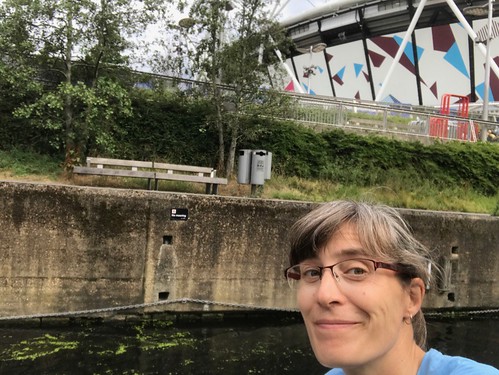
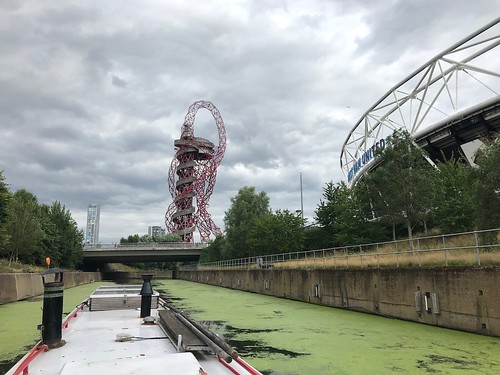
IMG_6199
The stadium is now branded in West Ham colours

IMG_6203
I’m pretty sure this was the site of the infamous Bubble Rehearsal

It was a nice little trip, though the back waters surrounding the stadium are quite weedy, and I had to stop a few times to clear them out of the propellor and rudder. And near around the site of our old workshop (recently torn down, boo!) there are two extremely low bridges.

IMG_6206
And I mean LOW. Of course I took my poor, battered stove chimney down, but the water heater chimney is screwed together so I had to inch forward as slowly as possible until I was confident it would clear. There was about 2-3” of space. The low bridge after this one cleared by even less. If the water level had been higher...

Then it was down the Limehouse Cut, a shortcut created between Limehouse Basin and the River Lea. I used to cycle down the towpath of the Limehouse Cut on my way to work at Three Mills Studios, which I also went past on the boat that Sunday afternoon. It was quite satisfying to see it all again. I’m unofficially calling that trip the Olympic Ring, though annoyingly there is no small bass plaque for that particular navigational achievement (unlike the Thames Ring). Maybe I’ll have to get one made up. If only I was in the business of knowing how to have original one-off items made.

Finally I ended up at Limehouse Basin, which is the other point at which the canal system meets the Thames. Limehouse Basin provides residential moorings for narrowboats but also for yachts and much much larger boats. That far downstream the traffic is often of the more serious ocean-going variety. There are also a few overnight moorings available for visiting canal boats so I tied up alongside a high wall and checked out the area.

IMG_6236
Limehouse used to be a working dock for narrowboats loading cargo for transport along the canals. It’s all gentrified now, as evidenced by the zillion dollar residential towers overlooking the basin.

Limehouse, though, was not the end goal but just the starting point for one more really big adventure for Lucky Nickel this summer. Since I got the boat, I’ve wanted to take it along the Thames through central London. Narrowboats are really not built for tidal waters, but if done at the right tide state it’s possible to get a tiny flat-bottomed boat from Limehouse to Brentford safely. So having completed the Thames Ring, and with that long-standing desire in the back of my head, and with Piran’s insistent nudges urging me on, I decided to look into what would be needed to complete the London Ring - a journey from my marina on the Paddington Arm, along the Regent’s Canal to Limehouse and then out onto the Thames for the trip west to Brentford Lock and back home once again to the marina. (Note that it's also possible to go the other way round - anti-clockwise. But that means entering Limehouse Lock coming from upstream. And all the advice is that if you think the left turn into Brentford is hairy, it's nothing compared to trying to get into Limehouse.)

The Thames tideway is under the control of the Port of London Authority, and naturally there are different rules on the Thames than there are on the canals. One of those rules is that vessels 45' and longer must have a VHF radio on board. Lucky Nickel is exactly 45’ so acquiring a VHF radio was the first hurdle. While it’s simple to order the equipment on Amazon, you also need a licence to operate one, and to get a licence you need to complete a radio operator’s course and then sit an in-person exam, all of which were not impossible but would be tricky to sort out in the short term.

Also, there’s the not-insignificant fact that there's a lot of traffic on the Thames in central London. Commercial tour boats, working tugs, and the infamous Thames Clippers all go up and down the river daily. There are a lot of bridges to pass under, and there's an exclusion zones around the parliament buildings at Westminster. And there are rules about all of that. There are also currents and tides so the water moves around and up and down a lot more than on the canals. All of this was enough to make me pause.

Luckily, as I was passing through Camden Locks the week before I paired up with a nice young man who was very chatty and mentioned that he’d been at Limehouse Basin recently. When I said I’d been thinking about the Thames trip he told me that the harbourmaster at Limehouse often pilots boats up the Thames on that trip. I fired off a quick email to Limehouse and shortly after got a phone call from Adam, who turned out to be lovely and helpful and ex-Navy. Adam said all the right things. Yes, he frequently helps people move their boats from Limehouse to Brentford, narrowboats included. Yes, he could book the lock at Limehouse and call ahead to Brentford. Yes, he could bring a radio and life jackets and a life ring. Yes, he could advise on the best times to leave to hit the tide right. Yes, he could teach me along the way, so I would understand how to pass through safely if I wanted to do the trip again on my own. And he would do all this for what seemed a quite reasonable fee to fulfil a years-long dream.

So I hired Adam to help me take the Lucky Nickel up the Thames on the morning tide on a cloudy Tuesday. And of course Piran came along too, because it was partly his idea, and because he’s more familiar with the boat than anyone else currently on this continent, and because he, like me, is still (f)unemployed and thus available on a random weekday morning.

2019-07-30 08.27.22
Here I am getting ready to head into Limehouse Lock that morning. Note the new life preserver on the roof. We also had to remove or tie down anything that was loose up top.

IMG_6224
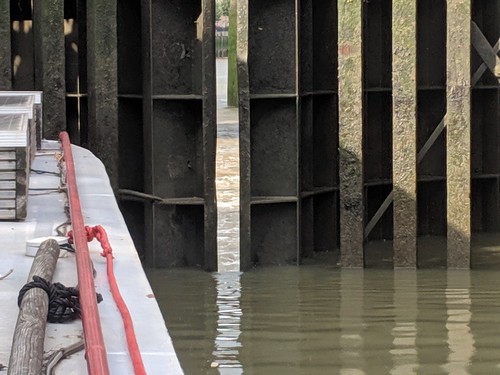
Limehouse lock is big. And the gates are differently shaped to other locks I’ve seen. They're actually quarter-circles, which I think means it’s easier for them to move while the water level is unequal.

2019-07-30 09.05.41
And here’s why I think the shape of the lock doors makes it easier to move them. Because the lock keeper actually cracks the bottom gates open a bit before the water level was equalised to speed things up. It’s hard to tell from this photo, but this is the water pouring out of the lock through the doors, at least a foot above the river water level. It was kind of creepy. Apparently it’s even more alarming when they do it going the other way - opening the doors to raise the water level in the lock, thus exposing you to a wall of water pouring into the lock.

2019-07-30 09.06.44
Here we are about to exit the lock, alongside a second boat that had done the trip many times before.

And then we were on the Thames. Which is freakin' HUGE at that point. And bouncy. For that first bit I had my hand welded to the tiller with the other arm braced to the rail. There were no giant waves, but the movement of the water bounced the boat around sideways and front-to-back in a way that was truly unsettling. Perhaps it would have been less so if we hadn’t been on a boat that contained virtually all of my worldly possessions.

2019-07-30 09.09.10
Here’s me at the tiller, looking nervous, having just exited the lock. And Adam - cool and calm. Just another day at the office for him. Piran has a whole collection of photos of me looking anxious, hunched over, and concentrating intently. For our purposes, this one is enough.

It all happens fast on that part of the river. And the biggest and most exciting landmark comes first.
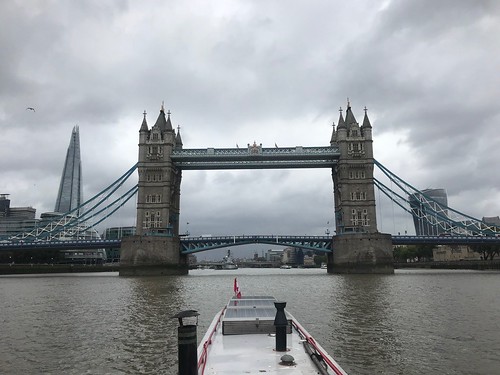
IMG_6245 (2)
This photo speaks for itself.

2019-07-30 09.28.45 (2)
As does this one. This is slightly before or after I looked to the right and then starting jumping up and down shouting “Oh my god it’s the Tower of London!”

We passed HMS Belfast, London Bridge, Southwark Cathedral, the Globe Theatre, and the Tate Modern. I continued driving until just before Waterloo Bridge, and then handed over to Piran.

IMG_6257
Who ably managed past a few more landmarks.

IMG_6262
The London Eye on the left, and Beg Ben - swathed in scaffolding, coming up on the right.

IMG_6273
More scaffolding on the Palace of Westminster, with the buoys marking the exclusion zone just visible in the water.

IMG_6281
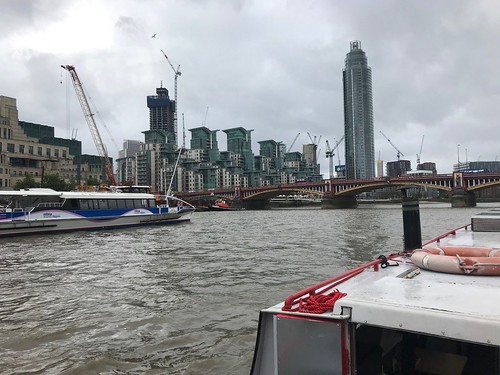
The MI6 building on the left, and Vauxhall Bridge coming up.

The Thames Clippers do put up quite a wake, but mostly we kept well clear of them. (Or possibly they kept well clear of us. I imagine the internal paperwork resulting from an upturned narrowboat under Westminster Bridge is ferocious and best avoided.) Adam coached us along, reminding us to watch out not just in front but also for what might be coming up behind, directing us around the bends in the river, and telling us which arches to pass under at each bridge. We left Limehouse about an hour after low tide, so we were being carried upstream by the rising tide faster and faster the later it got. Since we were traveling with the tide, we had right of way against boats coming downstream against the tide - the reasoning being that a boat has more manoeuvrability when working against the tide than being swept along with it.

The further upstream we got, the calmer the water got and the less traffic there was. By the time we passed Battersea Park and Albert Bridge it started to feel much like the Thames felt just above the locks at Teddington. We began to see rowing boats on the water, and the rain was coming and going enough that I was happy to hand the tiller to Adam and put the kettle on.
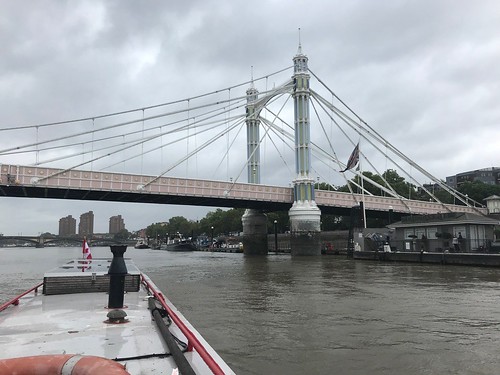
IMG_6300
Recently restored Albert Bridge.

I was pleased that the engine chugged along quite happily. Further downstream I'd pushed the throttle much harder than I’ve had to before to maintain steering in the heavier water but it was all fine. The engine temperature rose a bit but stayed well within tolerances. It might be noisy, and leaking oil, and a bit smokey and smelly, but that engine is getting the job done these days.

Adam calculated we’d take about 3-1/2 hours to get to the lock at Brentford. Normally it’s 3 hours, but I’d warned him that the Lucky Nickel is not built for speed. In the end we pulled into the channel for Brentford Lock almost exactly 3 hours after we left, a bit ahead of schedule. And while the boat with which we’d shared the lock at Limehouse had steamed well ahead of us, they’d simply had to tie up and wait on arrival at Brentford because the lock didn’t start operating that day until 12:15. (Their hours are synced with the tide). And I hasten to add that approaching Brentford from the east is much less stressful than the other way around. The downstream right hand turn is not bad at all.

IMG_6312
We only had a short wait, so we tied up alongside a ladder in the embankment wall and Adam departed to get the train back to town. Thanks Adam! (Aside: If you ever need Adam's services, get in touch and I'll pass on his details. He was sooooooo worth it.)

After getting through the Thames Lock and the Brentford Gauging Lock, we were back on the canal and quickly moored very near where I was just a few weeks ago. By this time it was quite rainy and chilly and though things had gone really well both Piran and I admitted we were kind exhausted and shaky at the same time. Adrenalin perhaps? After another cup of coffee and fortifying gala pork pie he headed off and I went for a short run to shake things off, still grinning like an idiot.


And that was the London Ring. It's been a few days now, but I still smile every time I think about driving my boat under Tower Bridge.

The Grand Tour: Big Finish

Thursday, July 18, 2019

Day 22: Kingston to Brentford:

When last we left our hero she was moored in Kingston upon Thames with an impromptu support group of two other boats, all of us nervously awaiting the next morning’s trip through Teddington Lock. The entrance from the Thames back into the Grand Union Canal, is about five miles downstream of Teddington at Brentford Lock, meaning an hour or two of travel on the tidal part of the river Thames. Until Teddington, water levels and flow is controlled by the series of locks I’d travelled through, with accompanying weirs alongside.

IMG_5873
The weirs regulate the water level along the river, locks allow boats to navigate past them.

Teddington is the last downstream lock on the Thames, meaning that after Teddington the water level rises and falls with the tide. The force of the tide ebbing and flowing can be substantial so for a small, flat-bottomed, and relatively under-powered narrowboat to have a hope of navigating the distance between Teddington and Brentford in a controlled fashion travel must be timed precisely with the tides. Going downstream, the recommendation is to leave Teddington half an hour before high tide (over what’s sometimes called slack water) when the tide is about to turn. As the water starts to fall, the current helps push the boat along. Leaving too early means very slow progress as the boat’s engine tries to “punch against the tide” and leaving too late means your speed at the entrance to Brentford lock will make it difficult to turn without being pulled too far downstream with the current. If you miss the turn into Brentford, the next (and only other) entrance to the canal system is the lock far downstream at Limehouse, and the amount of time it would take to get there means you’d be attempting that notoriously difficult turn in very unfavourable tide conditions. Next stop after that is, errr, Margate. Or possibly Dunkirk. Needless to say, I was a bit anxious about this whole procedure.

Luckily I had assistance in the form of the return of Day One’s able crew - Jeremy and Paola. They’re both experienced sailors so I thought they’d be ideal companions, and they were. We made the short hop from my Kingston mooring to the lock with ease and tied up along with several other narrowboats, all of whom were waiting for the tide to make the run to Brentford, each with a different level of apprehension about the manoeuvre. Adding to the confusion, the Experienced Guy I’d met the day before had been planning to leave at 11:20am, having devised a spreadsheet that calculated optimum times based on the tide tables. However, the lock keeper at Teddington firmly recommended 12:20pm, based on high water being at 12:50. It gradually became clear that the hour’s difference was a miscalculation between UTC (which is used on tide tables) and British Summer Time, and that Experienced Guy was going to need to revise his spreadsheet. We settled in to wait, chatting and passing the time until seven of us made for the lock at about 12:20.

IMG_5987
Here are the front four of a flotilla of narrowboats in Teddington lock. Lucky Nickel was bang in the middle of the pack, which was ideal.

Once we exited the lock, the boats spread out into a long chugging line. The trip was largely uneventful, though we did have to keep a close eye out for other craft, especially rowers, who have the disadvantage of not looking where they're going, and of being very wide and a bit unwieldy. There was also the usual ration of river cruisers, kayaks, dragon boats, stand-up paddleboards and RIBs, all of which I managed to avoid. Jeremy cleverly started up his chart plotter app, which gave a continuous readout of our speed so we had a good sense of how fast the tide was turning. My average speed on Lucky Nickel is normally about 2.5 mph, reaching a top speed of 4mph with a slight current on the regatta course at Henley. Riding the tide on the Thames we reached blistering 5 knots, or 5.7 mph. And of course Jeremy and Paola were perfect companions, having used the waiting time at the lock to gather some food supplies, so all I had to do was sit at the tiller, be fed, and have my picture taken.

20190713_131827
Like here, passing under Richmond Bridge.

Despite the lock keeper's estimate that the trip would be 45 minutes to an hour long, we were on the river for close to two hours before approaching the entrance to Brentford Lock. Frustratingly, the inlet is not sign-posted at all and is also hairpin turn due to the angle at which the River Brent meets the Thames coming downstream. We were all on high alert, with Jeremy spotting in the bow. We also had the advantage of seeing the boats in front of us start their turns. This, however, did not lessen my anxiety as we approached what I think was the most stressful left-turn of my life.

Of course it turned out fine. I started my manouevre quite early, having seen at least one of the leading boats take a very wide turn that looked a bit late. With Jeremy gesticulating from the bow and pointing out landmarks ("The big silver sculpture is on THE OTHER SIDE of the channel." Critical information.) I edged tight around the turn, coming very close the the upstream wall, but finally clearing easily and gratefully into the passage. Mission accomplished!

IMG_5992
Success!

IMG_6033
And here's a screenshot of the GPS track for the Scariest Left Hand Turn. Not bad.

We edged up to the bottom of Brentford Lock and waited while the first boats were cycled up and through. And I watched and waved and cheered as my nervous Kingston mates each appeared around the corner until all were safely gathered in. In the end it was not all that difficult, though I was very pleased to have had a spotter to help guide me in and provide moral support the whole way.

IMG_5993
Looking towards at the bottom gates of Brentford Lock, closing me off from the river - back in the loving embrace of the Grand Union Canal at last. Upstream parts of the river were fun, but the further downstream I got, the more stressful it was. It's really really nice to be back.

We moored not long after, exactly where I moored after the boat's first trip through Brentford lock back in 2014. It seemed fitting, and I was in no mood for more locks. I was in the mood to celebrate!

IMG_5999
And celebrate we did. Properly!

20190713_144613
Relieved skipper

IMG_6002
And trusty crew

It was a good day, but despite the momentousness of the occasion, I wasn't quite finished.

Day 23: Brentford to Home

I had hoped to recruit a crew for the last day, which involved going up the Hanwell flight of eight locks, but I was utterly unsuccessful in that attempt, meaning the last day of the trip would be a single-handed journey of six miles and ten locks. Perhaps it was fitting I finish on my own. I slept in, had a slap-up breakfast and set off.

IMG_6014
Here's the boat patiently waiting for me to prepare a lock, while paddleboarders frolic nearby.

The day's travel was smooth but long. Luckily, there was a fair bit of foot traffic on the towpath, so sometimes I got a bit of help from passers-by. And then part way up the flight I ran into a man out for the afternoon with his young son, who was fascinated with the locks and the boat. The pair stayed with me through at least four locks, helping work the gates and chatting while the shy little boy was quietly educated about the workings of locks.

IMG_6018
Here's my crew waiting by a gate paddle while the lock fills. They were just lovely. I even gave them a short ride on the boat between locks, which I was assured by Dad would be the highlight of the day, or possibly his entire life to date, for the little guy.

The Hanwell flight is interesting because several of its locks once used side ponds, which you can still see today. Side ponds are a way of conserving water by diverting the water draining from a lock into a nearby reservoir so that it can be used to partially refill the lock.


Explained well, if not exactly excitingly, in this video.

IMG_6016
And here's a set of side paddles overlooking a very overgrown side pond. Clearly they are no longer in use.

The other cool site on this part of the canal is Three Bridges, a spot where the canal threads between a roadway above and a rail line below. This was the last big project of GSWPL hero and frequent blog subject Isambard Kingdom Brunel, who engineered how the rail line was inserted under the existing canal and roadway.

IMG_6003
Taken from the roadway, you can see the canal on the left, which passes over the rail line in an iron trough.

I made it to the top of the Hanwell flight by about 4:30, finally completing the last of 175 locks on the trip.

IMG_6029
Hanwell top lock! Number 90 on the system, completed 23 days after lock 89 at Cowley Peachey.

And then it was just a few miles to the turn at Bull's Bridge onto the Paddington Arm of the canal and I was back in very familiar territory. A short hop later and I arrived back at the marina and moored up. Job done.

IMG_6034
This is the summary of the trip from Canalplan.eu, which I used extensively throughout the trip to estimate travel times from place to place. It was invaluable.

I didn't mention it at the time, but I made a purchase at a little shop at the bottom of the last flight of locks up to Braunston. You often see boats with small oval plaques fastened to the inside of their back doors. The cast metal and enamel medallions are just four inches across and feature the names of prominent canal landmarks or waterways. They're meant to signify that the boat to which the plaque is affixed has navigated that particular feature. Some denote particular tunnels or aqueducts or notable flights of locks, some whole systems like the Kennet & Avon Canal, and some are for what are called cruising rings - a circular route traveling a series of canals starting and ending at the same point. I have just completed the Thames Ring - going from London up the Grand Union to Braunston, down the Oxford Canal to the Thames, and along the river back to the Grand Union at Brentford. It seemed like tempting fate while I was standing looking at the display of plaques at Boat Shop near Braunston. But I did it anyway, though I worried outloud to the shopkeeper that I might be jinxing myself by buying the plaque before completing the journey. He thoughtfully tucked the item into an opaque envelope, taped it shut, and told me to hide it away until I finished.

IMG_6037
And now I'm finished, I think it's time to put this up. (I'm also particularly chuffed that of all the Cruising Ring plaques I can see online, this journey is the longest by quite a margin.) (And I know this says 248 miles and my summary says 246. It's because I started counting slightly after I left the marina. Rest assured I really did those first two miles as well.)

Now I'm enjoying a few days at the marina resting and blogging and catching up on laundry and all the life admin tasks I've been ignoring for the last three weeks. (Hello 2018-19 taxes!) However, I think I'll be back out again soon. As my fellow Aden Bowman alum said, "I've got the urge for going." I'm more confident in myself and the boat than I've ever been, so while the Grand Tour might be finished, Lucky Nickel still has plenty of places to go. And Astute Go Stay Work Play Live Readers may just get to come along for some of it.

The Grand Tour: The middle of the end

Monday, July 15, 2019

Day 19: Reading to Marlow

By this time I could smell the barn and was feeling slightly anxious about getting where I needed to be when. I had a friend coming for drinks on the boat in the evening, but I did leave late from Reading because I took a few minutes in the morning to see the Bayeux Tapestry.

IMG_5627 
You thought it was in Bayeux didn’t you? Actually, you’re right. This is part of a complete copy hand-embroidered in the late 19th century by 35 members of the Leek Embroidery Society, who spent just over a year on the replica, led by Elizabeth Wardle. Housed at the Reading Museum, not far from the river.

IMG_5630
Box ticked, I made my way around Fry’s Island to the good folks at Caversham Boat Services where they have a diesel pump on a long, narrow-boat friendly wharf that was easy to access. 105 litres of diesel and 5 litres of 30w motor oil and I was off on my own again, this time on the big bad river. (To clarify - the engine did not need an injection of 5 litres of oil in one hit, but I have been adding a few glugs most mornings, and I didn’t want to run out.)

Because this was my first day alone on the Thames, I had to figure out the rule for Thames locks that requires you to have two ropes from the boat to bollards while in a lock, which is obviously most easily accomplished with two people. Normally you use the bow and stern lines, but experienced narrow boaters will know the centre line is the best for controlling a boat single-handed. My solution, approved by the first lock keeper of the day, was to use the centre line to stop the boat (as normal) then keep that on one bollard, and add the stern line around another.

IMG_5643
Standing on the back deck, both ropes in one hand. No problem.

IMG_5793
And this is not something I was expecting to see in a lock… giant inflatable rubber duck on a raft. A fundraising scheme in aid of the RNLI.

The next notable milestone was a stately chug through Henley-on-Thames, home of the Henley Royal Regatta, an annual rowing competition that takes over the town each July. Run since 1839, the regatta is a highlight of the social calendar - attending is as much (if not more) about being seen than it is about watching rowing. The course starts at Temple Island and ends just above Henley Bridge. And because the race had finished just three days earlier, the floating booms that mark the course were still set up. And the arrows showing what way one is meant to navigate were clearly pointing onto the course so…


Lucky Nickel on the Henley Regatta Course! Completed at a speed of about 4mph.

I made it to Marlow in good time and found the last spot at a local park near the high street. Went into town to pick up a few supplies, and since I was waiting for my friend to arrive, I lingered for a bit at pub #17, The Chequers. Old housemate Paul made it to the boat by about 8pm and we had a nice night of G&Ts and chat before he caught the last train back to London. I’ll get there soon enough, though my route will be more circuitous.

Stats: 17 miles, 7 locks, 3.4lmph

Day 20: Marlow to Runnymede

A relatively uneventful day on the boat. Chugged along, ticked off the miles and the locks, and generally enjoyed the fact that the weather has been incredible for the whole trip. I’ve actually got little sunburned patches on my shins. Also, the windlass injury from Day 3 is healing well, and I’ve developed some pretty impressive rope-handling callouses on my hands. The first couple of days my hands were complaining a lot in the morning - tender and swollen and not at all happy about the excessive and particular demands of handling ropes that much. Now they’re tough as old boots.

Before he departed, Piran loaned me his English Heritage guide to the Thames Path - a walking trail that follows the course of the river from the Thames barrier to its source. The river is wide enough that I could have the book in my lap and consult as I go with little fear of veering so wildly off course that I hit anything. There’s a lot of room to move out here. The Thames Path guide calls this part of the river "Wind in the Willows" country, since it was the long time home of the author of the classic, Kenneth Grahame. This stretch of the river is the setting for the book, and several of the stately homes along the way are purported to have been the inspiration for Toad Hall. The Thames path guide has been a nice addition to my existing maps in the trusty Nicholson Waterways Guides.

IMG_5976
I haven’t shown you the Nicholson Guides yet - they cover all the navigable inland waterways and have been my constant companion. I love how the map just kind of fades out when you get too far from the water. I also love that they show you not just useful things like where the locks and water points and boat yards are, but also spend a good amount of time and column inches on local sights and pubs.

If Henley was a highlight of Day 19, then surely Windsor was the notable location of Day 20. I had thought I might moor up for the night in Windsor, but arrived quite early so I decided to push on.

IMG_5861
Not, however, without seeing this from a new and satisfying perspective.

IMG_5869
Definitely no mooring here, round the back of the Windsor Castle and near the site of Frogmore Cottage, current home of Prince Harry and Meaghan and baby Archie.

It was good that I kept going, because I ended up getting a really nice mooring on National Trust property right at Runnymede, which Astute Go Stay Work Play Live Readers will recall is the site where King John signed the Magna Carta in 1215. It was a secluded leafy spot with room for just one boat, marred only by the busy road that runs between the river and all the Magna Carta tourist spots. Poor planning. Luckily, my spot had a nice screen of trees which screened me from the traffic noise a bit though, it did nothing for the fact that I was also on a busy flight path.

IMG_5905
Private mooring.

I arrived just in time to pay my mooring fee at the National Trust tea shop, and though they were sort of technically closed the woman in the shop gave me lots of guides and information about the area, which I used to combine a run and a visit, including these notable sites:

IMG_5879
An artwork called “The Jurors” by Hew Locke. Twelve bronze chairs "each decorated front and back with images and symbols relating to past and ongoing struggles for freedom, rule of law and equal rights."

IMG_5881
The John F. Kennedy Memorial

IMG_5888
Runnymede Memorial to the Magna Carta, interestingly built by the American Bar Association

IMG_5892
And my favourite, a new “architectural artwork” called Writ in Water by Mark Wallinger, of Underground Labyrinth fame!

IMG_5893
It’s also a bit of a labyrinth

IMG_5894
With this at the centre

IMG_5895
A quotation from the Magna Carta inscribed in mirror image in a steel ring that surrounds a pool of water. The words are read in the reflection. Lovely.

I also climbed the hill up to the RAF Memorial but arrived just as the caretaker was about to shut the gates, so there was no time to look around. Instead I took the long way back to the mooring and had a very agreeable evening having dinner out on the back deck enjoying my bucolic mooring. Good day.

Stats: 20 miles, 8 locks, 3.7lmph

Day 21: Runnymede to Kingston

The goal for Day 21 was to find a mooring at Kingston-on-Thames, a short run away from Teddington Lock. Teddington is the lock that separates the tidal downstream part of the Thames from the non-tidal upstream bit I've been on. Irritatingly, there's a short bit of tidal water between Teddington lock and Brentford lock - the entrance to the Grand Union Canal. This means a few hours on the tidal Thames, which needs to be done at just the right time to catch the tides - as they're on the turn - minimising the current and giving a keel-less little narrowboat a hope of maintaining control and making the hairpin turn into Brentford. I'm a bit (read: a LOT) nervous about this manoeuvre, so I wanted to get to Kingston in good time to be able to scope things out.

The day itself was relatively easy. I ended up sharing locks with a couple who were heading for the River Wey. I've found that boaters are almost entirely a friendly, chatty and contented lot, and it was nice having someone to talk to while waiting in the locks. I was also chuffed that, as they faffed with their ropes getting sorted in one lock they commented, "I don't know how you do this on your own!". Maybe I'm getting the hang of this.

IMG_5914
Preparing to go through Shepperton lock, at the confluence of the Thames and the Wey Navigation

IMG_5915
Looking back at closed lock gates

I shared a couple locks as well with a boat that was also planning the Teddington-Brentford trio Saturday, and the driver passed on his knowledge of three previous transits, advising me to be in the lock at 11:20am. It was nice to have that bit of inside knowledge, and it chimed with the timings advised on the CRT website. Or so we thought...

IMG_5932
Passed another big site on Day 21 - Hampton Court! There were moorings a bit further on from this, which I maybe should have taken advantage of. Instead, I pushed on to Kingston to be closer to the lock for the big day.

Luckily, once I reached Kingston there were two small narrowboats moored at the very end of the public space and they kindly waved me in to double-moor. They also helped haul the boat alongside after I missed the first pass and had to turn and come in again. Peter, Sandy, Ian, Tess the dog and Gladys the cat were exceptionally welcoming, offering tea and crisps after I got tied off. We chatted amiably in the afternoon sun, and I found out they were also planning the Teddington-Brentford run, and were nervous newbies, so we commiserated together. It was a lovely little impromptu community of three boats.

IMG_5975
Tess on the neighbouring boat

I spent the evening walking the mile down to Teddington Lock to check it out with my own eyes, and got further advice from a narrowboat that had come through travelling upstream that day. Then I zipped back to Kingston and pub #18 - The Druid's Head - before retiring to the boat in nervous anticipation of the next day's challenge. More on that, hopefully with a triumphant report on the final leg, when we return.

Stats: 14 miles 5 locks 2.9 lmph