Showing posts with label engineering. Show all posts

Kirkaldy Testing Museum

Sunday, February 17, 2019

I recently got to spend a cold but sunny Sunday on a little jaunt that absolutely perfectly occupied the sweet spot in the Venn diagram of “Quirky London Sites” and “Things that interest Pam” and “Things that are bloggable” - a visit to the Kirkaldy Testing Museum.
IMG_3130
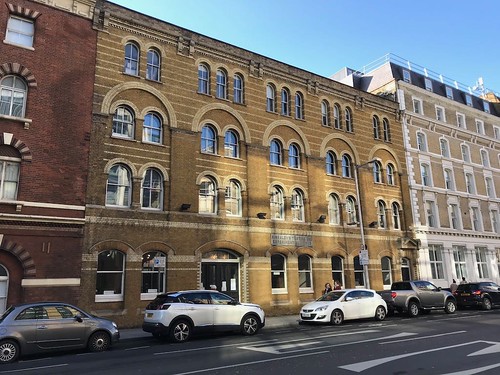
Hidden in plain site on Southwark Street, just a block from the Tate Modern.

David Kirkaldy was a Scottish-born engineer who pioneered the science and practice of methodical materials testing by establishing the first ever independent testing works to determine the strength of the new materials available to Victorian engineers - mostly cast and wrought iron. This was incredibly important because iron as a construction material is part of what fuelled the Industrial Revolution (along with mechanisation, steam power, and a ready supply shoeless orphans to dart around in all the shiny new mangling devices.)
IMG_3183
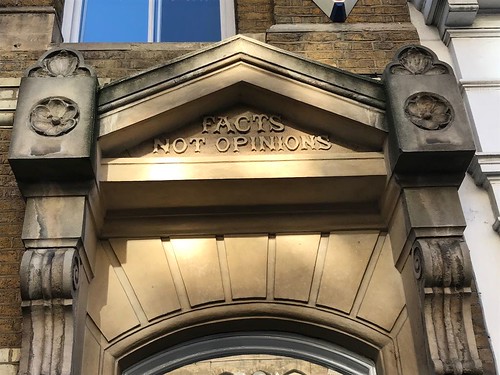
The pediment above the former main entrance to the testing works.

Kirkaldy’s testing works opened in 1866 in a location close to the current site in Southwark. The engineer then later designed his giant hydraulic “Universal Testing Machine" for evaluating different materials in tension or compression, had it built in Leeds, and installed it in a new purpose-built building where it’s still located today. (Mercifully, it’s very much built into the Grade 2 listed property so it would have been difficult to remove anyway. Plus it’s more than 47 feet long, so it’s not like a vandal could have just slipped it into his pocket.) The testing works opened on January 1, 1874 and ran for close to a hundred years, headed by two more generations of Kirkaldy engineers, David’s son and grandson. And along with routine testing of the countless links and bars and columns and beams that built the modern world, Kirkaldy conducted forensic testing on failed structural elements, such as those from the infamous Tay Bridge Disaster. He also continued developing new machines and techniques for analysing materials, and the works received test specimens from around the world.

Luckily, after the works closed the site was recognised by members of the Greater London Industrial Archeological Society, who helped get it listed for preservation. (And can I just say that discovering the existence of the Greater London Industrial Archeological Society was one of the best things about my day? How can they have escaped my detection for so long?) Thanks in part to their intervention, Kirkaldy's works have been a museum since 1983, and it's now open to the public on the first Sunday of every month, staffed with volunteers (much like the poor Kew Museum of Water and Steam which Astute Go Stay Work Play Live Readers will doubtless remember). A visit costs a mere £5 and for that you get a guided tour of the museum’s collection of vintage testing machines and - more excitingly - a live demonstration of some of them.

My guide was a small boiler-suited and bespectacled man who first showed us an introductory video in the basement of the building, and then a few of the smaller machines they keep.
IMG_3133
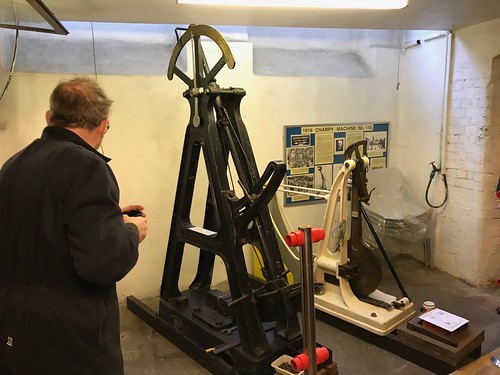
Like these pendulum impact testing machines, which, as any fool can see, are scientifically designed devices for whacking things in a very precise manner and measuring how much energy they absorb when they break.

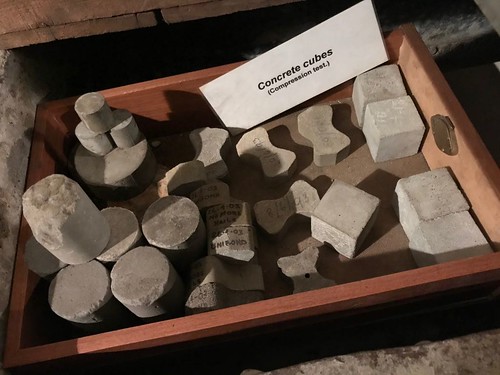
They also have an impressive collection of small moulds for making concrete test pieces, which are shaped like dog bones and used for testing the tensile strength of concrete by pulling the dogbones apart. They’re shaped like dogbones so that the machine has something to grab and so that the bit you grab is larger that the bit you’re testing, so you can be reasonably confident that the test pice will break in the right place and the results will be properly consistent.

IMG_3143
This machine slowly adds lead shot to one side of a set of balances, while the other side pulls on the dogbone. When the sample piece breaks, the flow of shot is cut off and then weighed to determine the breaking point of the concrete.

IMG_3141
They also make plain cubes for testing concrete's resistance to compression. Of course concrete is massively stronger in compression than in tension, which is why steel reinforcing is added to most modern concrete structures to increase their tensile strength.

Along with the surprising discovery of the Greater London Industrial Archeological Society, I learned another amazing thing at the Kirkaldy Testing Museum. As recently as 1977, an organisation called the London Hydraulic Power Company supplied high pressure water for hydraulic powered devices to businesses all over London, on both sides of the Thames, through a network of more than 150 miles of cast iron and steel pipes. Before it was established in the late 19th century, companies that wanted to power machinery hydraulically had to run and maintain their own boilers, often also needing to employ large accumulator towers for storing the energy they produced. With the establishment of the London Hydraulic Power Company, pipes ranging in diameter from 2” to 10” eventually stretched from Kensington to the Docklands, powering cranes, lifts, presses and other machinery of all kinds including, of course, Kirkaldy's large testing machine. At Kirkaldy’s they also employed a hydraulic intensifier to take the operating pressure up to an impressive 4,500 PSI.
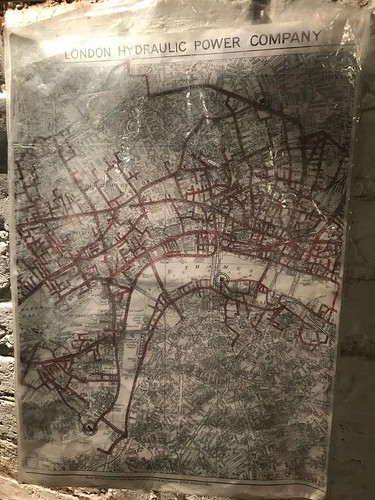
"Hydraulic power raised the curtain at the Royal Opera House, rotated the turntable at the Coliseum, raised lifts at the Bank of England (and thousands of other offices and flats) and opened dock gates on the Thames. In its heyday the company's hundreds of workers pushed out up to 30 million gallons a week at 850 pounds per square inch from its six pumping stations.” From Subterranea Britannica
Once electric motors became established as a means of powering machinery, the need for the system waned and it was eventually closed down completely in 1977. However, a clever group acquired the assets of the company in 1981, recognising the value of the vast system of pipes. Those same conduits are now used to run fibre-optic cables through the heart of London. And I just think that whole thing is fucking fantastic.

IMG_3139
A map of the LHPC network unceremoniously displayed in the basement of Kirkaldy’s

After viewing the impact tester, and the dogbone puller and a few other things like a 40’ long chain testing machine, we got to move upstairs and actually use one of the smaller devices to pull apart a piece of the devilish reinforced plastic strapping that gets wrapped around heavy pallets or packages and secured with those funny metal clips.

The tension mounts. Literally.

Of course the main reason to visit Kirkaldy’s Testing Museum is to see the big machine in action, which you can do if you stick around until 2pm on an open Sunday. (Or, happily, if you take in the other displays and then decamp to a nearby coffeeshop for a caffeine hit and a nice pain au chocolate and then return at 2pm.) I stationed myself with a good view of the area and watched while the grey-haired volunteers prepared the machine to rip apart a rusty steel bar cut out of an old street grate reclaimed from outside the building.
IMG_3187
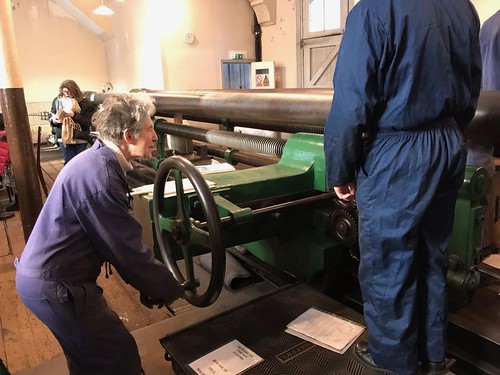
There was even one woman on the crew, which is very unusual in my experience. Here she is setting the moving end of the machine to the right position to accept the steel bar.

The hydraulics in the machine only work in one direction, meaning that the hydraulic ram has to be returned to its starting position by heavy counterweight in the basement. Switching the machine from pulling mode (tension) to crushing mode (compression) is quite labour intensive, so we only saw pulling mode. Also crushing mode tends to produce flying debris that is not conducive to public participation.

Once the carriage was in position another volunteer climbed into the machine to set the tiny steel bar into place. As I mentioned before, test pieces are normally shaped to give something for the clamps to grab, but in this case the bar was simply wedged with a series of tapered steel pieces banged in with a large sledgehammer. Nearby displayed showed lots of different wedges used for this purpose.

At the other end of the machine there's a large horizontal arm connected to the measuring part of the device, which consists of a balance arm and a series of counterweights. As the cylinder moves, the arm swings and transmits movement to the balance. The machine operator then slowly winds a gear that moves a counterbalancing weight to keep the big balance arm level, which simultaneously moves a pointer along a marked scale showing the pressure the machine is exerting. Once the sample breaks, the indicated measure can be noted. Or, if the sample is being proof tested, the pressure in the machine can be increased to that proof load to test that the material is adequate. Two out of every fifty of the giant links that make up the suspension chains in the Hammersmith Bridge were tested this way by that very machine.
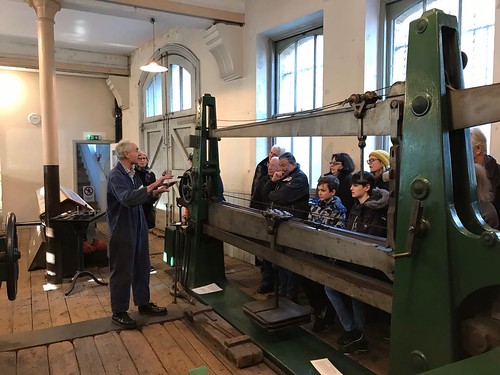
IMG_3192
Here’s the day’s operator gesticulating near the controls for the balance arm.

Our little test piece was about half an inch thick and two inches wide. And though it was impossible to perceive the movement of the cylinder as the test proceeded, there came a point when little flakes of old paint and rust began to fall off the test piece onto a sheet of clean white paper underneath. The volunteer running test then said, “We’re inconveniencing the material” which I thought was a masterfully understated way of putting it, considering that a machine capable of exerting loads up to one million pounds of pressure was, at that moment, attempting to rip apart the chemical bonds inside that poor little piece of metal.
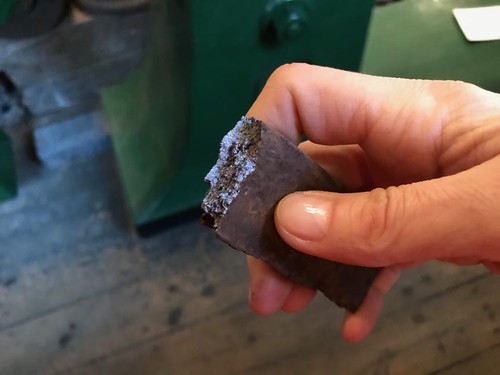
IMG_3197
Eventually the piece broke, after yielding about two inches. Disappointingly the break occurred inside the clamping jaws, so there was no big aha! moment. They did, however, manage to get the pieces out of the clamps, and passed them around.

It’s also possible to tour a part of the testing works office, which was quite lovely. There was a large glass fronted wooden bookcase absolutely filled with proper engineering books with titles like The Mechanical Testing of Metals and Alloys, Hydraulic Power Engineering, History of Strengths of Materials, and that classic page-turner, Theory of Elastic Stability. There were also framed copies of Kipling’s Hymn of Breaking Strain and a large framed copy of David Kirkaldy's obituary, published in The Engineer on February 5, 1867.
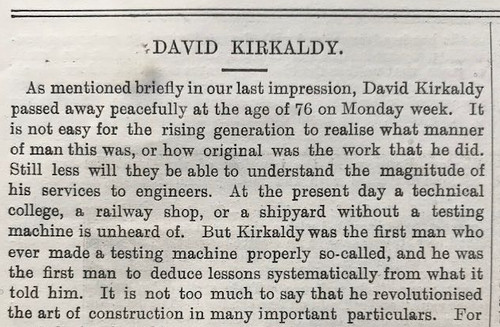
IMG_3170
This is just the first paragraph, but it's appropriately laudatory.

It’s really not over-egging things, this obituary. David Kirkaldy made a remarkable and unique contribution to the modern built environment. He was methodical, meticulous and, above all, scrupulously honest. To run a completely independent and unbiased testing works, free from outside influence, was absolutely vital to the safe development of all kinds of structures, which of course qualifies him for the Go Stay Work Play Live Hall of Heroes, where he takes up a position alongside Isambard Kingdom Brunel, Joseph BazagettteHarry Beck, Captain Picard, and whatever genius it was who invented sticky toffee pudding.
The Louvre Abu Dhabi

Sunday, November 25, 2018

In between working and battling stroppy appliances I've had a bit of time here in the Emirates to be a tourist. So at the first opportunity I found my way to the recently opened Louvre Abu Dhabi.

1024px-The_Louvre_Abu_Dhabi_(249423583)
This is a peek at the building. (Thank you to Francisco Anzola, who’s a much better photographer than me.)

It’s a bit odd to find an outpost of the famed Louvre Gallery here in the desert but the two museums are actually entirely separate entities. They're linked by a $525 million dollar branding agreement that allows the Emirates institution to use the Louvre name for 30 years, with further $747 million spent for “art loans, special exhibitions and management advice. And that’s just for the name and a bit of what’s inside. The other part of this equation is the building itself, which is frankly magnificent. I went with friend and colleague Mika, who, before I stole him away to join the ceremonies circus, was an unsuspecting architecture graduate in Baku. We were both more interested in the building than its contents, but dutifully took in a large percentage of the collection.

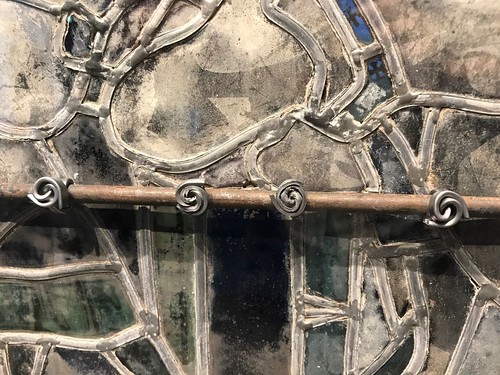
The Louvre Abu Dhabi is billed as a museum of art and civilisations (apparently that S at the end is important), so it has galleries for temporary exhibitions of artwork, but also has a permanent collection of historical artefacts arranged in twelve interconnected rooms starting with prehistory and speeding through the entirety of human existence up to the contemporary era. The most modern of the galleries were closed for re-fit when Mika and I visited, but to tell the truth we didn’t make it past about Room 6 before bailing out for coffee and pastry. Along the way I enjoyed the Egyptian room, which has a very nice sarcophagus. And I loved that a display of stained glass showed not just the front side, meant for viewing, but also the back of the piece, revealing charming curls of lead securing the glass to the supporting frame.
IMG_1844
I’m sure the front of this was delightful; sorry I neglected to take a picture of that. I’m sure Francisco would not have been so thoughtless.

IMG_1845
But I just found this too fantastic

We also spent a good chunk of time in a temporary exhibition of Japanese prints, and a really fun display about Japanese manga comics (which former Go See Run Eat Drink readers will recall from many many moons ago). That gallery let us colour in the walls!

IMG_2590
Me working hard at staying between the lines.

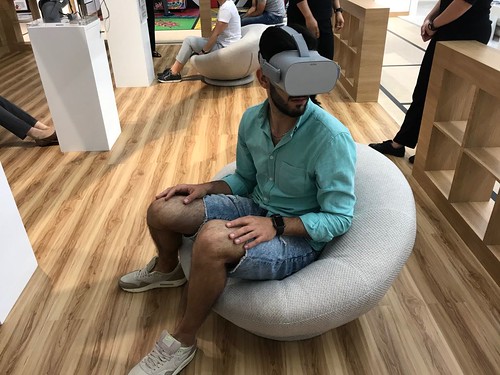
And they had interactive virtual reality goggles you could wear to “enter” some traditional Japanese woodcuts. We both chose a print of a boat on water with a range of mountains in the background. It was surprisingly immersive and impressive.

IMG_1837
Mika on the boat, turning around to discover there’s another passenger behind him!

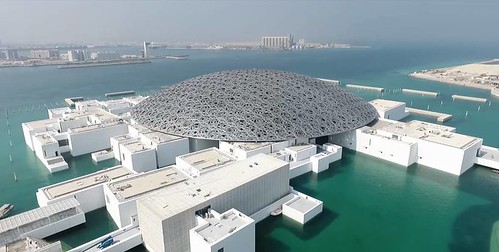
So we did take in the artwork at the Louvre, but that’s really not why we went. We went for the building. Because of this:

28218_6
That dome is unbelievable. (And of course I didn’t take this photo either, because I'm not travelling with my own drone, jetpack or private helicopter.)

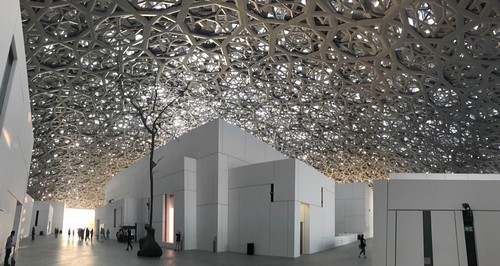
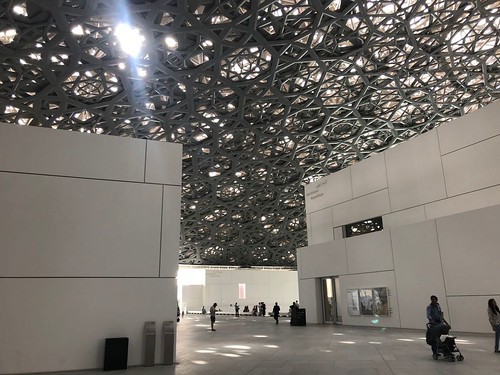
The design of the whole building is fantastic. As you can see, the galleries are a series of 55 smaller, almost discrete buildings arranged a bit like an Arabic souk with alleyways between them. The whole arrangement is completely surrounded by the sea, and the top is capped by that magnificent dome - 180 metres in diameter (almost 600 feet) and weighing in at 7,000 tonnes. (Articles about the dome inevitably mention that the weight is almost equivalent to the weight of the Eiffel Tower.) The entire dome is supported in only four places and appears to float over the “souk" giving cover to the buildings below, which are essentially outdoors, but still sheltered. The entire arrangement is completely beguiling but it’s the dome that makes it spectacular. It’s not simply that the structure is big, it’s that the roof is composed of eight separate layers of perforations shaped like eight pointed stars in different scales. Each layer filters the light, and as the sun moves across the sky the points of light that reach through shift and change creating what’s often described as a “rain of light”.

IMG_1847
Astonishing. On the day we visited it was a bit cloudy so we only got the full effect in the brief moments when the sun broke through, but it was still breathtaking.

French architect Jean Nouvel designed the building and has said that "Sometimes, in the solar noon, the brightness is so dense that it looks like light stalactites are piercing the dome.” Walking under the roof among the galleries and alleyways is exceedingly pleasant. In a climate like this where the temperature right now - in winter - often reaches 36 degrees celsius, indoor spaces are frequently overly air-conditioned. (This sometimes creates the odd effect of having your glasses steam up when going outside, an unsettling reversal for someone who grew up in Canada.) The indoor galleries of the Louvre Abu Dhabi are also air-conditioned but under the dome, while you’re still technically outside in the true climate of the region, the breeze from the sea and the shade from the roof make it temperate, and while I’d never describe it as cool it does feel right. (To be clear, it is NEVER cool in Abu Dhabi. The overnight lows right now hover around 24 degrees and in the summer it gets into the high 40s. Basically, the sun is trying to kill you.)

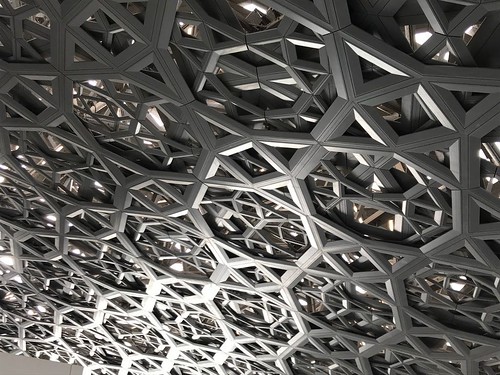
IMG_1820
Here’s a small taste of that stalactite action Jean was talking about.

Naturally, Mika and I were both fascinated by the design and engineering of the roof. As we stared up at it Mika, who actually went to school for this stuff, told me about a professor he had who dated from the Soviet era. This professor was a bit hidebound and taught his students, with unwavering certainty, that any structure must have a supporting column every six metres. No matter what. Every six metres. Which in the case of the Louvre’s dome would have resulted in a close to a hundred support columns around the perimeter as opposed to, er... FOUR. Luckily, no one called that guy to build the place, since he is clearly a twit.

IMG_1826
We stared for a long time but couldn’t see how the repeated pattern managed to curve to the shape. Actually, we couldn’t even see the eight different layers. The whole effect was mind-blowing.

The site for the building is the formerly-mostly-abandoned island of Saadiyat near the port of Abu Dhabi. It was in there, in 2007, and long before anyone started building support columns and galleries and domes, that a huge sand wall was constructed to hold back the waters of the Arabian Gulf while the museum's foundations were laid. Pumps ran 24 hours hours a day for years during construction expelling the seawater that seeped through the wall. This went on even during an almost two year hiatus resulting from the worldwide economic slump and resulting drop in the price of oil. When construction resumed engineers and builders installed a waterproof membrane around the entire foundation, which sits as much as 10 metres below sea level, and fitted every one of the 4500 concrete supports for the building with cathodic protection to prevent the concrete from corroding in the seawater. (Hands up everyone who knew concrete can corrode?)

Throughout construction the seawall held back the water as if the entire building was in dry dock and the partially completed dome was held up by a forest of temporary supports strategically places around the galleries below. But eventually the pumps were turned off and water was allowed to reclaim the land surrounding the museum. There’s a really good article about the construction here, which I highly recommend even if you just skip to the short video that shows time lapse footage of various areas of the build site as they’re cleared of equipment and gradually flooded.

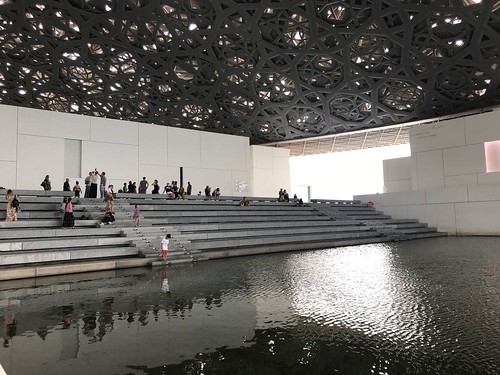
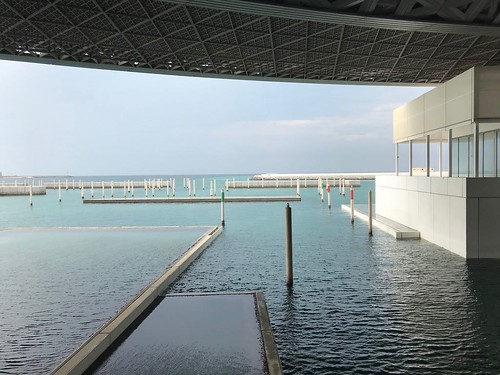
And that’s the other remarkable part of Jean Nouvel’s design - the water. It’s always there as you walk around under the dome. There are views out to the sea, and small, almost private spots where you turn a corner and find another unexpected bit of water. The sea doesn’t just surround the museum, it’s part of the place.

IMG_1823
You can walk all the way down to the water in some areas. In others there are raised platforms that are completely surrounded, and in other spots what look like man-made tidal pools.

IMG_1824
And every where you get views out to the sea. It truly is an island, with just three ways on and off. Look at it on Google Earth and you’ll see what I mean.

Saadiyat Island is very big. I mean it’s not exactly Baffin Island or anything, but there’s still a LOT of space to fill. Plans call for it to become a cultural centre, including a Guggenheim Abu Dhabi designed by Frank Gehry and the Zayed National Museum, along with a maritime museum, arts centre, schools and a residential community. So far though, it’s still mostly sand.

Mika and I thoroughly enjoyed the Louvre Abu Dhabi, but I also enjoyed the quiet evening at home that followed. Since then I've done a little bit more sightseeing, but work is catching up with me and the days are long. Mostly what I want to do in my small bits of down time is sit on the couch or on the beach, because it feels like a long haul since I left my frozen little boat last February and I'm getting a bit weary. I'm very much looking forward to getting this job done and being home - all of my different homes, that is - in time for Christmas.

Cockatoo Island

Sunday, October 14, 2018

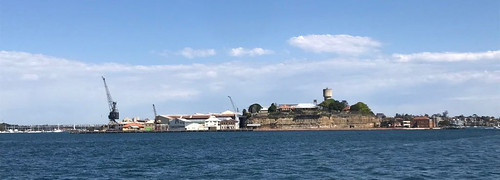
Brace yourself for another industrial wonder from down under! Cockatoo Island was the pick of a friend in Australia who clearly understands me well. When he said “Go to Cockatoo Island” and I asked “What’s that?” He came back with, “Don’t ask, just go.” And he could not have been more spot on. I mean, who wouldn’t want to spend a whole Saturday wandering around an abandoned convict prison and shipyard?

IMG_1432
It’s also a fast and pleasant ferry ride from Circular Quay, and the day was hot and sunny. 
And check out those cranes!

Largest of the islands in Sydney Harbour, Cockatoo is a UNESCO World Heritage Site for its association with Australia’s convict history, which began in 1839 when the island was designated a penal establishment. It remained so for 30 years, with convicts first being employed in the construction of their own prisons and guardhouses (#twisttheknife). The island itself, like, it seems,  much of Sydney, is basically a big chunk of sandstone, so once they’d adequately imprisoned themselves they went on to quarry stone for other building projects in the area, including the seawall at Circular Quay.

IMG_1437
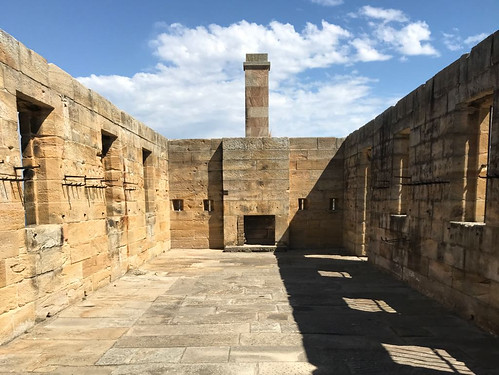
This is what’s left of one of the convict-built guardhouses. It’s actually much nicer than the cell buildings, with windows to provide some ventilation in the blazing Antipodean heat.

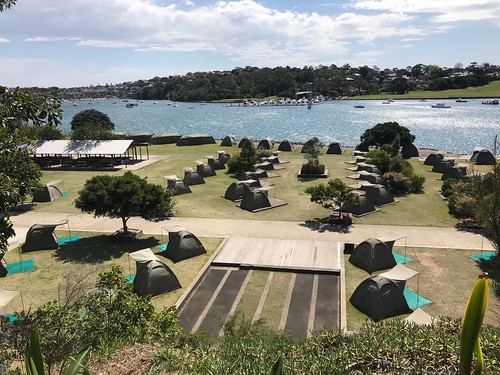
Getting to Cockatoo was easy, and as I mentioned, the weather was gorgeous. There’s also a nice information centre right near the ferry dock where they offer reasonably priced audioguides. Astute Go Stay Work Play Live Readers will recall I love a good audioguide, so I pounced on that and headed to the convict precinct of the island, which is sort of high up in the middle. Happily, the Cockatoo audioguide was quite good (unlike others in my experience - Roman Forum, I'm looking at you) and I liked that I could move at my own pace around the island, following the directions past the island's campsite.

IMG_1444
Bring your own tent, or go glamping in one of the ready-made tents shown here. Or if you really want to splash out, several of the historic building on the island have been converted for short term rental. Apparently it’s really popular for New Year’s Eve, which I hasten to remind readers is in the middle of summer. Summer in January… I swear I’ll never get used to that.

Along with quarrying limestone, the convicts of Cockatoo were set to the construction of Australia’s first dry dock - the Fitzroy Dock - which was built to service the Royal Navy. Not long after the dock was finished, the convicts were moved to the mainland Darlinghurst Jail (or Gaol, if you insist) and the convict cells and related buildings were turned into a reformatory for wayward girls. Around the same time, just offshore, a large, wooden, three-masted sailing ship was anchored and became a home and school for neglected boys. The girls were split between two institutions - one a reform school for those who had broken the law, and one an industrial school intended to operate more like an orphanage. In practise, the two halves intermingled as the girls were all housed in the same dire cells the convicts had recently vacated, drinking from troughs, eating without utensils and sometimes forced to sleep on the flagstone floor as a punishment. The boys, on the other hand, were led by relatively benevolent masters who, while strict, taught them nautical skills, gardening (in a plot on the island), shoe-making and other useful skills. The intent was to reform the boys into useful citizens. The girls, on the other hand, were treated as a lost cause, trained for life as servants, locked in gloomy cells twelve hours each night, and left with little to occupy them. Charming.

There are quite a few of the old stone convict-built building left, including homes for the island governors and other staff. And while the main buildings have been tidied up you can still get a sense of how miserable they must have been, especially in the intense heat of an Australian summer. But convict prisons were not really what I went to Cockatoo Island for, so I was very pleased to head to the industrial side of the island.

IMG_1445
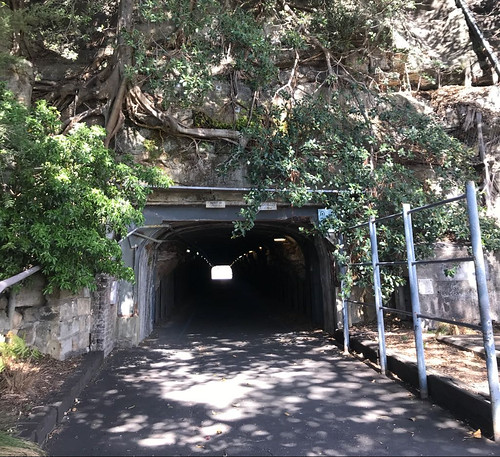
Which was extra exciting because I got to there through this tunnel carved right through the island!

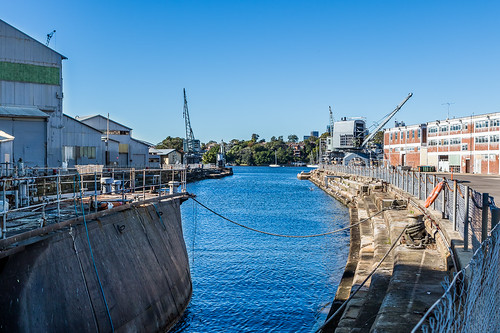
Even while the reforms schools were still in operation, ship repair and ship building activities  occupied the Fitzroy dock and surrounding area on the lower level of the island while the hapless girls were housed on the higher level of the island and the boys came and went from their ship, The Vernon, moored just offshore. The mix of shipyard workers with neglected boys and downtrodden girls led, inevitably, to some fraternisation, with the mistreated girls often seen as the source of the trouble. This went on until 1880 when the girls were transferred back to shore, though the boys stayed in The Vernon and then later in The Sobraon, until 1911.

Fitzroy_Dock
Fitzroy Dock as it appears today. (Well, actually as it appears when someone else took a picture, because mine didn't turn out.)

Once the juvenile delinquents finally left, shipyard activities became the sole focus of life on Cockatoo. Sutherland Dock, a second, even larger dry dock was built, and was for a time the largest dry dock in the world. Even before World War One, the island had produced more than 150 vessels - mostly dredges and barges. By 1913 Cockatoo Island was the official dockyard of the Royal Australian Navy. World War Two saw the island become the main ship repair facility in the southwest Pacific, converting commercial vessels for wartime use and repairing Allied ships who limped to its docks after suffering sometimes debilitating damage. After the war Cockatoo was busy converting ships back to civilian use and building new and impressive vessels, like the Empress of Australia. Launched in 1964, it was the largest passenger ferry in the world at the time, travelling between Sydney and Tasmania.

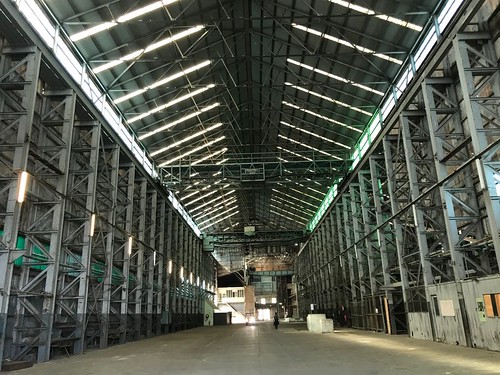
And this is where things got exciting for your humble blogger, because once I’d got through the tunnel, the audioguide turned its attention to the minutiae of ship-building and sent me through sensational, giant, abandoned cathedrals of industry.

IMG_1448
Like this enormous beauty where they did…you know... ship stuff.

IMG_1453
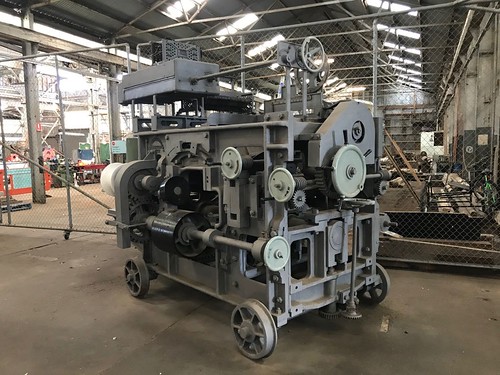
And I have no idea what this machine does but I LOVE IT. It’s like a set designer said, “Make me something with lots of winding handles and cogs and unexplained bits that could chew up your fingers. And it’s gotta be on wheels. No wait! Rails! Put it on rails!"

It was great. I listened to the audioguide talk about the different stages of shipbuilding, and wandered back and forth among the mostly empty halls. There was a lot of emphasis on telling the stories of the workers, which was absorbing. One of the upper island buildings had an extensive exhibit of old photos - again, mostly about the workers. There were also audio recordings of stories from former Cockatoo Island workers - apprentices, old hands, and union organisers. For a long time Cockatoo Island was a significant force in the Australian labour movement. Immigrant workers from English shipyards brought a strong tradition of trade unionism with them and as early as World War One there were more than 21 different unions representing Cockatoo Island workers, among them "boilermakers, blacksmiths, ship painters and dockers, gas fitters and plumbers, electricians, shipwrights, storemen and packers, timber workers and the biggest group of all, ironworkers.” (From the Cockatoo Island Website.)

IMG_1456
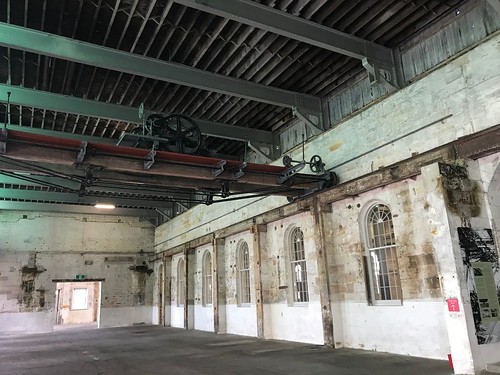
Gratuitous picture inserted for no reason other than that this is a lovely overhead traveling crane. My blog, my rules.

The tour also led through what was called the Mould Loft - the massive upper floor of one of the biggest buildings on site. While the plans for each ship would be created in the large drawing office on the ground level, the Mould Loft was where each piece of the ship - like the giant curved ribs and each steel plate that made up the hull - would be laid out in full scale with absolute accuracy. From that layout, wooden templates were made and sent for manufacture in the island’s workshops. This was the practice until computers arrived to assist in the 1980s.

Sadly, even as early as the mid-1960s, the logistical challenges of running a huge shipyard without rail or road access to ease the flow of materials, along with general decline in manufacturing in Australia, led to the dwindling of Cockatoo as a industrial powerhouse. For a time the shipyard survived largely on a government contract to refit the Australian navy’s submarine fleet, but in 1987 the government announced it would close the shipyard and in 1992 the site was shut, machinery sold off and many buildings demolished.

IMG_1458
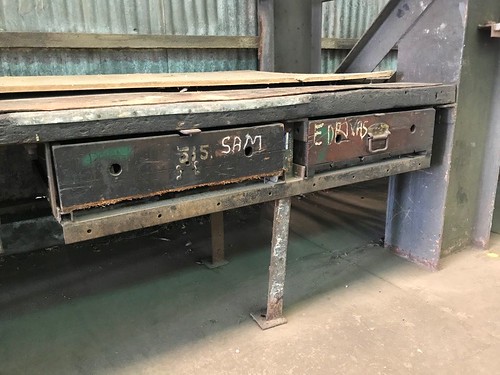
Poor Sam. Out of a job.

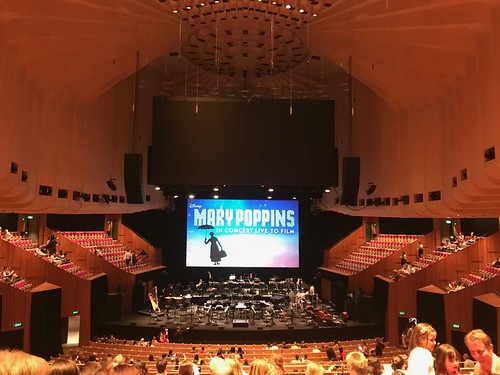
The island was neglected for about a decade until the Sydney Harbour Federation Trust started extensive renovations in 2001, eventually opening to the public in 2007. I was really captivated by Cockatoo Island - it’s presented well, and on the day I went there weren’t a lot of people around despite it being a weekend. I sense it’s not high up on the list for a lot of tourists. I suppose most people who visit Sydney want to tick off the big things like the Opera House and the Rocks and the Botanic Gardens and the ferry to Manly. (For the record - I also did all of those.) Clearly they don't have the discerning tastes of your humble blogger, or lack expert advice. Once I’d finally had my fill of Cockatoo I walked back to the dock through the other tunnel (Because of course there are two.) and caught the next ferry back to the mainland. By the time I made it to the apartment the full day of sun, wind, and giant rusty machinery had me craving a nap. But alas, there was just enough time for a short collapse followed by a shower because that evening I went out for something completely different but also excellent. I went to hear the Sydney Symphony play live to a screening of the original film of Mary Poppins (the one with Julie Andrews and Dick van Dyke and the world's worst Cockney accent). It was at the Sydney Opera House main concert hall.

IMG_1465
You could barely move for the number of 8 year old girls in attendance.  And sure, I love a good rusty bit of industrial machinery, but… Mary Poppins!!!

It was great. I love the movie anyway and seeing in that context, with the live music, was really fun. Plus I got to see the inside of the Opera House and (big bonus) I didn’t have to sit through an opera to do it! And then I had a gelato on the walk home. And when I got there I slept like the dead and took the next day off. There is, however, still more to tell about my Australian adventures, so watch this space.

On top of the bottom of the world

Sunday, September 30, 2018

There is a lot to say about Australia and I thoroughly enjoyed my time there. It turns out I’ve got a bit of a network of Aussie friends, many of whom are surprisingly willing to house me in their spare rooms or buy me dinner or chauffeur me around the country for days on end, which is both humbling and excellent. Now that I think about it, I guess I also may have a gang like that in Athens, and in New York City and probably in a few other places I can’t think of right now. This is one of the many fringe benefits of doing the kind of work I do. You end up with a widely scattered network of people you’ve been through the wars with who will almost always be happy to stand you a few drinks and give you a place to lay your head.

There's lots to say about Australia but for today we will concentrate on an iconic symbol of Sydney in particular and Australia in general, and one which Astute Go Stay Work Play Live Readers will be supremely unsurprised to learn captured my attention quite thoroughly: the Sydney Harbour Bridge!

IMG_1385
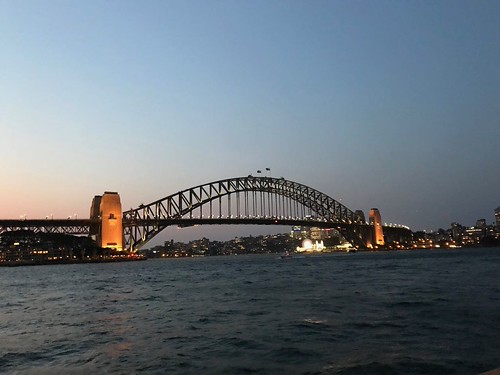
Here it is in twilight, as seen from the very charming Opera Bar, just across Circular Quay at the foot of the equally iconic Sydney Opera House.

There’s now a fairly extensive back-catalogue of bridge blogs, so truly devoted fans should have a troll through the archives for fond remembrances of the Golden Gate, Tower Bridge, the Rolling Bridge, Iron Bridge and the Clifton Suspension Bridge. Ah, bridges. It’s no secret I’m fond of a bit of mechanical or sturctural engineering in general, but bridges in particular are a firm favourite. In buildings and tunnels the engineering is there but it’s mostly hidden. Bridges are where engineers get to show off. It’s like they're shouting, “Look what we can make because we know how stuff works!”

(Standby for mandatory bridge backstory, because I actually bought a book!)

European settlement of Australia started with the arrival of the First Fleet at Sydney Cove on January 26, 1788, and by the time the last convict ship docked in 1840, Sydney was a thriving community on both the north and south sides of the harbour. The more the city grew, the more inconvenient the 50km trip around the harbour, or across by ferry, became. There were many proposals to link Sydney’s two halves, including a pontoon bridge, tram tunnel and even a earthwork causeway. In 1900 the New South Wales government formally advertised for tenders for the design and construction of a bridge but that project was scrapped after a change in government, despite having attracted twelve submissions over two rounds of tenders. It wasn’t until 1922 that legislation was finally passed to enable construction.

In the interim, an Australian engineer named John Bradfield was named Chief Engineer Metropolitan Railway Construction and Sydney Harbour Bridge. Bradfield spent several years traveling the world studying underground railways and long span bridges at the request of the New South Wales government. (It's like we’re we’re soulmates, Bradfield and I, except the government of New South Wales does not pay me to travel the world blogging about tunnels and bridges. I pay for that myself. However, any and all donations are gratefully accepted.) Bradfield's initial inclinations were towards a cantilever bridge design, but during his travels, he visited the gorgeously arched Hell’s Gate Bridge in New York, and the twice-failed cantilever bridge in Quebec and at the last minute allowed submission of arched bridge designs - mostly, I suspect, because he calculated it would cost £400,000 less.

Photo on 23 Sep 2018 at 7_22_13 pm
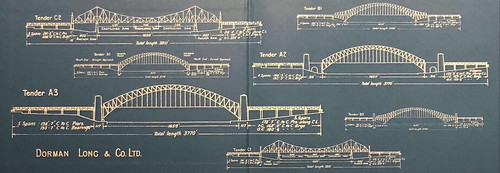
Tender C1 and C2 are cantilever bridges. The rest are through-arch designs. So-named because the roadway goes through the arch as opposed to passing over it (like this other famous arch bridge).

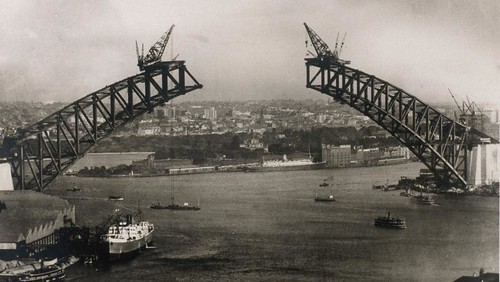
Whatever the reason, the proposal that eventually won out was the now-iconic design from Dorman Long & Co. from Middlesborough in the UK. Construction began in 1923 and the bridge was finally opened to traffic in 1932. Being an arch, the whole enormous load of the bridge itself (the arch alone weighs 39,00 tons) is supported where the bottoms of the arch rest on giant main bearings on the north and south shores. Each bearing is actually a huge hinge that allows for the expansion and contraction of the arch’s steelwork - in high temperatures the overall height can increase by as much as 180mm. Also, the arch itself was cleverly constructed with no supporting falsework underneath! Moving creeper cranes assembled the sections of the arch ahead of themselves, advancing as each was completed. The whole business was prevented from collapsing into the harbour by 128 heavy restraint cables on each side, which were anchored in tunnels in the sandstone.

Under Construction
Once each side of the arch was complete the cables were gradually loosened over the course of three and a half weeks before the two sides eventually met. And you notice how the granite pylon towers at the ends of the bridge aren’t there yet? That’s because they have no structural purpose - they’re simply to give better visual balance to the bridge. Bradfield was apparently fond of quoting John Ruskin on that score: “Life without industry is guilt, and industry without art is brutality.”

But enough of bridge history - even though I could go on for at least three more posts about the bridge and its construction and the 6,000,000 steel rivets that hold it together, and how I find it disturbing that the top chord of the arch doesn’t appear to anchor into anything very much. (Which prompted a short conversation and series of back-of-the-cocktail napkin sketches while sitting at the aforementioned Opera Bar and almost culminated in an email to one of the two different structural engineers I met on this gig, until Nick and I decided we’d pretty much figured it out.) Nope, no more about the history and engineering of the bridge - let’s get on with my up close and personal encounters with the Sydney Harbour Bridge.

First, I got driven across the bridge, and as a pedestrian I visited the southeast pylon, which now houses a nice little museum and gives you access to the lookout platform at the top of the tower for some pretty impressive views of the harbour.

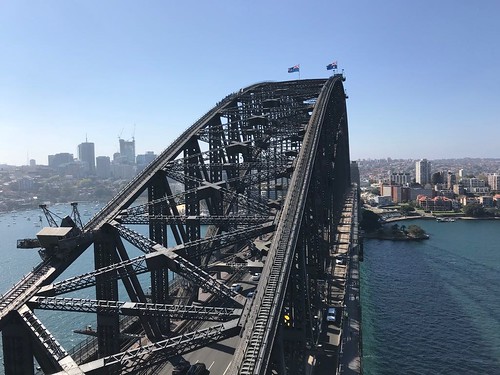
IMG_1406
Mmmm… steel trusses!

IMG_1407
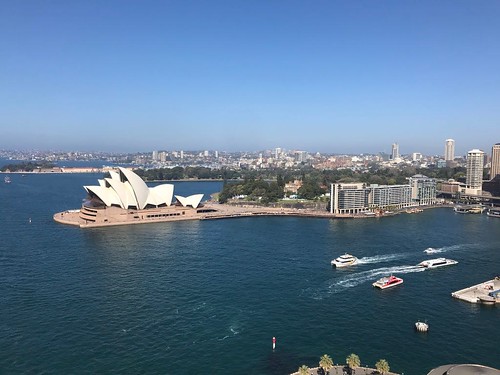
Yes, the pylon lookout is a pretty good way to appreciate the harbour and the bridge.

But wait, there’s more! It’s also possible to experience the Sydney Harbour Bridge in a particular and unique way: by climbing right over the top! BridgeClimb has been operating since 1998 and allows visitors to climb up through the structure of the bridge and walk along the top of the arch, right to the highest point. This activity was recommended to me by two (very) different people, so despite the hefty price ($303 Australian for the standard three hour experience!) I decided this was a chance not to be missed.

The BridgeClimb did not disappoint. It was a three-hour experience that I prepared for with a proper Aussie breakfast of smashed avocado and poached egg on toast and a flat white (If you think Hackney is a hotbed of smashed avocado on toast, think again. They can’t even hold Sydney’s coat in that department. It’s inescapable. I’m pretty sure if I’d gone to McDonald’s I could have ordered a McAvoSmash.) Unsurprisingly, there’s a fairly extensive health and safety briefing when you first arrive. This is reassuring, since the summit of the bridge is 134m above sea level and takes you over eight active lanes of traffic and a couple of working rail lines. The potential for mayhem is, shall we say, significant.

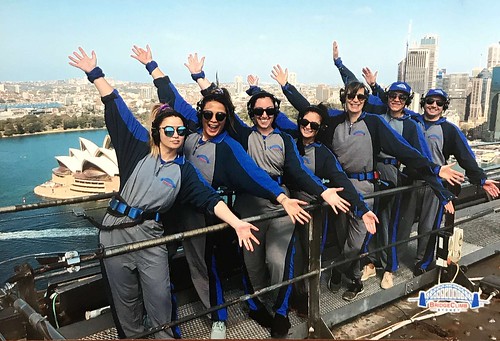
Everyone in my group of seven was assigned a fetching grey and blue jumpsuit. The colours are designed to blend in with the bridge and be less distracting to motorists, but I predict they will not be appearing on a fashion runway near you anytime soon. We were also instructed to leave everything in pockets behind: no loose change, no mobile phones, no watches, no cameras. Sunglasses were allowed, but they were tethered to the jumpsuits. We were also assigned a waist harness safety belt with a sliding tether line, a fleece jacket in case it got cold, a handkerchief, a yours-to-keep-just-for-playing Sydney Bridge Climb baseball cap, and a radio headset to be able to hear our guide, whose name might have been Brian.

Brian (or was it Brad?) ran us through a sort of BridgeClimb simulator set of stairs, ladders and catwalks that demonstrated how the continuous safety line worked. (I suspect I was the only one in the group who found the rigging of the safety system just a bit fascinating.) Then we were off to clip in and walk along underside of the roadway and up through the southeast pylon before climbing over the arch itself. Even though the elevation gain was large, it was a comfortable climb. We walked over the actual upper chord of the arch, on catwalks laid on top of the steelwork so the incline was fairly gentle. Brian (possibly Bruce) stopped at key points and chatted to us in the way of experienced tour guides - knowledgeable, peppered with well-worn jokes, slightly world-weary, but still charming. He knew a lot about the bridge, and graciously tolerated my unusual fascination with the stainless steel brackets and anchor system for the continuous safety line that runs throughout the catwalk system.

I said no cameras or phones were allowed, but Brian (Brent?) had a special (tethered) camera and we stopped at several points along the way for photo ops. Naturally, BridgeClimb were happy to take more of my money to have a couple of photos provided at the end of the experience, which is why I can show you this:

Bridge Climb Group
Everyone got this cheesy group photo.

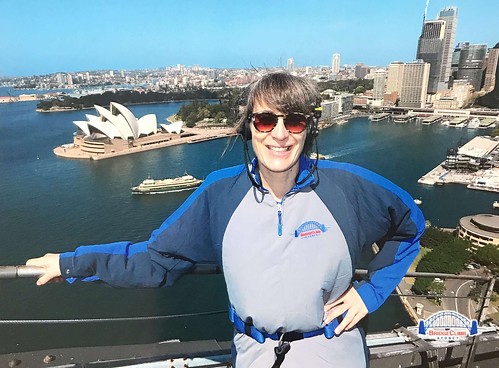
Bridge Climb Top
And here’s me near the top, with Circular Quay and the Opera House in the background. (Can I also add that this photo in the flattering grey jumpsuit makes it look like I’ve eaten at lot more than my fair share of smashed avocado but really it’s just that the jumpsuit was roomy and the wind was at my back. I promise I didn't actually come home from Indonesian looking like the Michelin Man.)

We finally made it to the very top, where there is a very very small platform that occasionally hosts special events like weddings or tiny expensive parties or those annoying segments on local television morning shows.

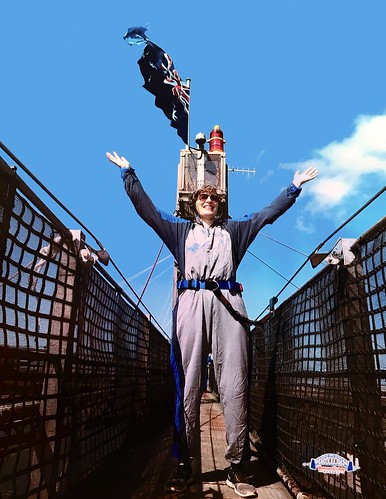
Bridge Climb Flag
One more photo at the summit before the climb down.

By the time it was all over three hours had elapsed, which coincided neatly with the arrival at a nearby pub of my two hosts for a well-deserved beer and lunch. The Australian Heritage Hotel is another Sydney icon, where I was able to sample the famous Coat of Arms pizza - featuring emu meat on one half and kangaroo meat on the other! This allows me to segue neatly into this fun but utterly unsupported fact I heard somewhere: Australians are the only people that eat both the animals on their coat of arms. Also, it's popularly believed that the reason the kangaroo and the emu are featured on the coat of arms is because neither animal can go backwards, which is supposed to be a metaphor for something noble, though of course if a kangaroo or an emu wants to retreat from something clearly all they need to do is turn around and run away like everything else on the planet.

IMG_1395
Good pizza. Though as with most exotic meat, it didn’t really have a distinctive flavour. I am, however, happy to say it didn’t really taste like chicken.

I was feeling pretty smug about my Australia experience by this point - climbed iconic bridge, ate iconic animals, had a nice beer - tick, tick, tick. That was to become the theme for my visit, as you’ll learn in weeks to come. So stay tuned for more kangaroos and associated odd animals, more engineering, more smashed avocado, a surfeit of ridiculously beautiful beaches, and an evening that turned out to be so quintessentially Australian it may as well have been scripted. Advance, Australia Fair!

Off the tourist track: Water and Steam

Tuesday, January 16, 2018

Happy New Year! And apologies for the disruption to our regular service. What can I say? It was Christmas, and then it was New Year’s, and boat has been obstreperous, and though I’ve been back in London for over a week following my annual pilgrimage home to Canada, I honestly couldn’t tell you what I’ve done in that time other than not blog and feel jet-laggy and go for occasional short runs and binge out on Netflix. (Which I can now stream unlimitedly to my iPad or computer because mobile data package costs in the UK are awesome. Unlike in Canada. And yes, I would like some cheese with that whine). London is mostly grey and rainy and it’s all a bit… January. I did go to the Geffrye Museum one Saturday, which has been on my list for a long time. But was mostly a disaster because it took forever to get there and then it was super crowded and a big part of it that I wanted to see was closed until the next day and now it’s closed for renovations for two years so bleah.

Instead, I spent last Sunday on a succession of buses to visit the London Museum of Water and Steam, which has also been on my list, especially since Karen and I passed it en route to Kew Gardens last summer. (Karen callously refused to stop for a quick visit but I forgive her.) So brace yourself for another blog about gears and pumps and giant machinery, in the grand GSWPL tradition, (like this and this and this from the deep archives).

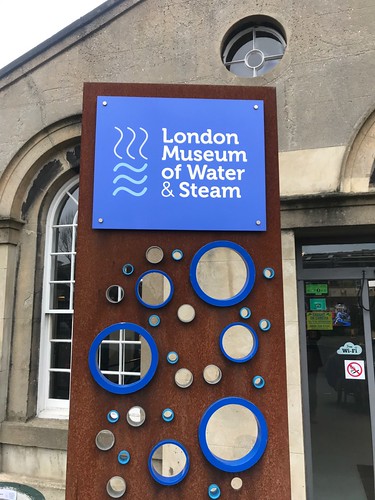
IMG_6574
Slightly boring photo, but I love the cleverness of the logo design

The Museum of Water and Steam is dedicated to restoring and maintaining no fewer than FIVE historic steam-driven beam engines, as well as housing an exhibition of the history of London’s water supply. The building itself is the former Kew Bridge Pumping Station, dating from 1838 and run at the time by the Grand Junction Waterworks Company. That warmed my heart little bit, because the water feeding the pumps when the station first opened was taken from the Paddington Arm of the Grand Junction Canal, where my little boat spends most of its time these days. Though not long after opening they switched to taking water from the Thames because it was cleaner than the canals. And if the canals then were anything like they are now I’d say that was a very wise move indeed.

The Sunday afternoon I went it was pleasingly unbusy so I got to play with all the interactive models without having to elbow some snotty eight-year-old out of the way. And I got to linger at all the other displays without feeling like I was getting in anyone’s way. This means I can now relate that, astonishingly, the first piped water came to London in 1237. And that’s not a typo. In the 13th century wooden pipes were used to bring water from Tyburn spring into London. (The first piped water to private homes was in 1528.)

IMG_6578
Wooden pipes like this were used for centuries (60 AD to 1810 according to the plaque). GSWPL fun fact!: Wooden plumbing pipes are where we get the terms “trunk line" and “branch line" from.

Wood gave way to lead (bad idea) and then to the king of plumbing: cast iron. There were also brief dalliances with steel and cement (neither as good as cast iron) but nowadays it’s all plastic. However, just like the brick-lined Victorian sewers that still handle much of London’s waste, one of the cast iron water mains at Kew Bridge is still in use today, making it the oldest cast iron trunk main still in use in the world. Along with the pipe display, the entry hall of the museum had some fun working models of different types of water pump, going back to Roman-era technology. And there was a whole wall of cisterns and toilets accompanied by various voiceovers that mostly seemed to be about conserving water which made me feel a bit smug, considering my miserly 100 litres/week consumption on the boat.

IMG_6579
The Wall O'Toilets

When dealing with the topic of water supply, it’s also natural to deal with the other end of the system, the removal of waste water. We here at GSWPL dealt with this topic in the critically acclaimed post Off the Tourist Track: Crossness Pumping Station, so I’ll just remind you quickly of the key points: London population boom + plumbed toilets = raw sewage in the Thames + yucky smell + cholera. Therefore: Joesph Bazalgette + huge brick sewer pipes + giant pumping stations = fresh water - cholera! Everyone got that? So the beautiful beam engines at Crossness Pumping station were for pumping sewage, whereas the ones at Kew Bridge were for pumping the fresh water supply from the Thames and then out to London.

While Thames water may have been slightly cleaner than canal water, it still wasn’t exactly pristine and healthy. This led to the introduction of the first treated public water supply in 1829, engineered by James Simpson for the Chelsea Waterworks company. He used a sand filtration system, wherein water was held in large sand-bottomed basins with the water filtering down through the sand, cleaning it of impurities. Sand filtration is still used today, though it’s ironic that Simpson thought it was the sand that does the cleaning whereas it’s actually the scummy layer of gelatinous gunk that forms on top of the sand that does all the work. That layer, amusingly called the Schmutzdecke (and I promise I am not making that up because I truly could not make up so absolutely perfect a word) is home to a bunch of bacteria and protozoa and other tiny beasties that filter out 90-99% of bacterial nastiness. Kew Bridge Pumping Station used to have acres of sand filtration pools, but now that area has been redeveloped into flats. (Full disclosure: I only wrote that paragraph so I could use the word schmutzdecke. And who could blame me?)

But enough about water treatment and on to the giant steam engines! As I mentioned, the Museum of Water and Steam is custodian of five steam powered beam engines, including two absolute monsters, the Grand Junction 90 inch and the Grand Junction 100 inch. Both are Cornish engines, meaning they’re a particular type of steam engine (developed in Cornwall, unsurprisingly) that uses the steam at a higher pressure, thus operating more efficiently and using less fuel. This was important in Cornish tin mines where the pumps were used to take water out of the mines but where coal had to be shipped in from other parts of the country, hence was used as sparingly as possible. The 90 inch and 100 inch measurements refer to the diameter of the main piston of the engine. The 100 inch is the largest surviving single cylinder beam engine in the world and the 90 inch is the largest working beam engine in the world.

IMG_6594
It’s hard to get a good picture of the engines since they completely fill entire huge rooms. So here instead is a partial shot of the outside of the Bull Engine’s cylinder, a mere 70 inches.

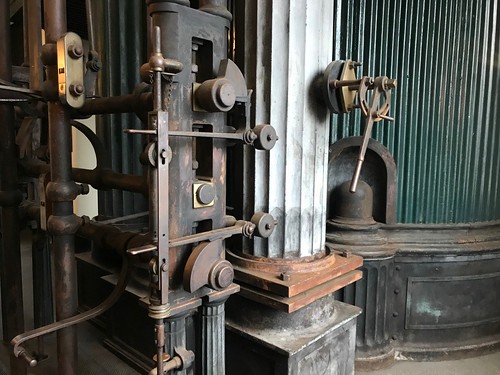
IMG_6609
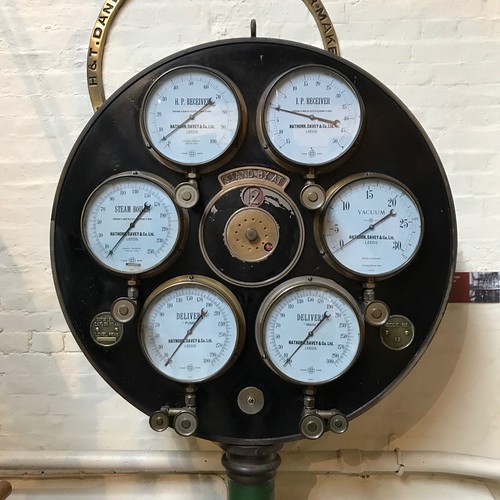
And a gratuitous shot of some very nice dials.

Apparently during the restoration of the 90 inch engine in 1976 the cast of Blue Peter climbed into the cylinder housing and had a tea party under the piston. So it’s, you know, BIG. The 90 inch could pump 2142 litres of water in a single stroke and the 100 inch could move 3255 litres. Working together, with their pistons alternating and synchronised, the two great engines could pump more than 63 million litres of water in 24 hours. And the 100 inch engine operated most of its working life with a crack in the 54 ton main beam - it was repaired in place and the engine continued to operate until it was last run in steam in 1958, though that was just a demonstration - by the 1940s the steam engines were no longer used for pumping water.

After looking through the chilly engine rooms I wandered into a smaller workshop where I ran into the only museum staff I encountered. The older gentleman was dressed in a boiler suit (coveralls) (Hang on a minute… steam engines... boilers... that’s why they’re called boiler suits!) and he was engaged in some sort of building task behind temporary barricades. I struck up a conversation with him, which turned out to be the most interesting part of the visit. It turns out he wasn’t doing anything really cool like aligning grappler flanges or lubricating the Boggs-Flinder Compensator. He was just hanging something on the wall, but he was very chatty and happy to share some fun tidbits about the engines and the museum.

IMG_6601
The workshop room. Apparently there's also a Victorian-era belt driven metal working shop were they still do work for the museum. Fantastic!!! Tragically, not open to the public. 

For instance, he told me that during World War Two (after the big pumps had been sidelined by diesel and electric units) the steam engines were still kept on standby in case of a loss of power or damage during the Blitz. Since all they required to work was fuel for the boilers, lack of power or diesel would not stop them from pumping water. Keeping the water flowing was critical during the bombing not for domestic use, but because of the constant need for water for fire fighting. To support that need, a series of diesel generators ran 24 hours a day to keep the pumps running (they didn’t end up needing the steam engines) so that even if bombing damaged water mains and water was running freely into the streets in places, there was still water available to the fire brigade.

I also got an apology because some of the engines were supposed to be running in steam - indeed that’s part of why I’d gone that day - to see the machinery in action. However, all was quiet on the West London front because the volunteers who’d been scheduled for duty had been unable to attend. This was astonishing to me - that someone might have the chance to tend and run glorious machines like that and then just not come.

Sadly, even if there had been volunteers available, the restored 90 inch engine still would have been silent because there are some small repairs needed on it that involve taking the lid off the main boiler. Apparently it’s not a difficult job, but the overhead beam they want to use to lift the lid can’t be rated for the lift. (Health and Safety, you know.) Also it’s a Grade 1 listed building so they can’t really risk damaging the building in order to repair the engine. The plan now is to create a ground-supported structure over the boiler to lift the lid, but that has to sit on the York stone flagged floor which is part of the listed building which blah blah blah… you see the problem.

And along those same lines, it’s apparently quite tricky to get insurance for a building like the Great Engine House. Ownership of the site recently passed from the developers of the nearby flats to the Kew Bridge Engines Trust, who are naturally keen to have it properly insured. However, most of the time insurance companies base insurance costs on a standard formula to do with the size and purpose of a building, and obviously in the case of historically significant one-of-a-kind buildings, that formula doesn’t really apply. So apparently they’re having to consult with the folks who run other historic sights to see what they do. (“Hello is this Stonehenge? Hi, it’s Kew Bridge Pumping Station calling. So look, if the stone circle were to burn down… what would that be insured for? Hello? Hello?”)  It was all things I’d never really considered when walk-in through a museum.

Most interesting though, was the notion that there’s room for newcomers on the team of volunteers who tend the giant steam engines. That seems like exactly the sort of thing your humble blogger might enjoy very much (other than the boiler suits possibly making my ass look fat). Someone please remind me about this when I get back to London in September.

Wait, did I say BACK to London? Yes I did. It’s time again for GSWPL to decamp to foreign climes for another big show. More on that another time. Until then, there’s really only one thing to say.

Schmutzdecke.

Off the tourist track in Prague

Sunday, August 13, 2017

Along with gorging on pork products and mocking tiny wax statues, Karen and I had a few adventures in Prague that were decidedly off the beaten path. One of them even involved GEARS, which required Karen to show near-infinite patience. (So I guess I can forgive her for flatly refusing to visit the Kew Museum of Water and Steam while we were in London even though we went right past it on the bus.) 

For a while now I've been aware of the existence of a particular type of elevator/lift that’s become increasingly rare for reasons that will soon become obvious. A paternoster lift is sometimes described less colourfully as a “circulating multi-car elevator”. Invented in the 1860s by Peter Ellis, an architect from Liverpool, a paternoster consists of two parallel lift shafts containing a chain of open-doored cabins that move continuously in a loop, up on one side and down on the other. The name is derived from the first two words of the Lord’s Prayer in Latin, because the chain of cars is thought to resemble the beads of a rosary. A bit of a stretch if you ask me, but I guess it’s better than “Circulating multi-car elevator” or “Death-a-vator” or “Lift of Doooooooom”.

Paternosters work like this: riders approach the car and step into the cabin as it’s moving. On reaching the desired floor, they step out. Simple and efficient. (Other than the ever-present chance of amputation of course, which is why they are becoming increasingly rare.) They are apparently quite popular in Germany, which has more than 200 still in operation. And luckily for me there are a handful in Prague, which I came to know about through the lovely people at Taste of Prague. (Tag line: “Because you didn’t come to Prague to lose weight, did you?”) 

(There’s a whole lot more I could say about Taste of Prague, not least that we did a really good food tour with them that included handmade ice cream sandwiches and artisanal gin and tonics, but for now I will just say that their Prague Foodie Map is awesome and included the almost-hidden line of text that led me to drag Karen across Prague to a semi-obscure YMCA building to see and ride in my first paternoster elevator, helpfully noted in the Taste of Prague interactive map of paternoster elevators. Honestly, how can you not LOVE these people? The next time I go to Prague I’m thinking about just paying some kind of flat fee so I can hang around with them and pretend that they are my friends.)

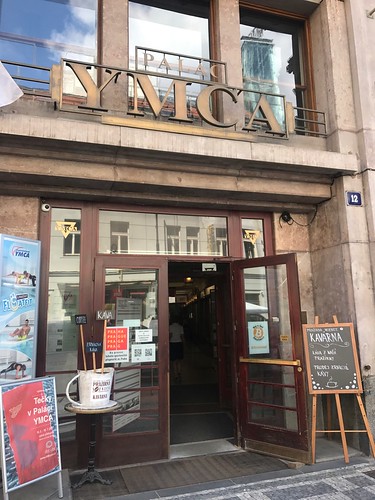
Anyway… the paternoster. It was Monday morning and Karen was in a very indulgent mood, so we headed out from our spacious and well-appointed AirBnb to find the YMCA building, where I was expecting to have to go on a little hunt to find the elevators. 

IMG_4457
The unassuming entrance to the YMCA

IMG_4448
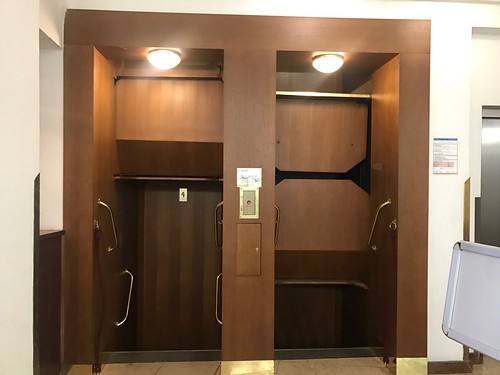
Instead, we walked into the main entrance just past the reception window and there it was, chugging away.

I think the guy at the reception desk might be used to having the occasional freak appear in his lobby to try out the lifts, though it’s just possible that other people don’t actually jump up and down a tiny bit and make clappy hands. Let’s just say I can get enthusiastic. Once I regained my composure Karen gamely climbed into an ascending car with me. Two people is generally the limit for a paternoster cabin, but that’s no big deal because there’s always another on on the way! We rode to the top floor and then got out to assess the next, much more daring move.

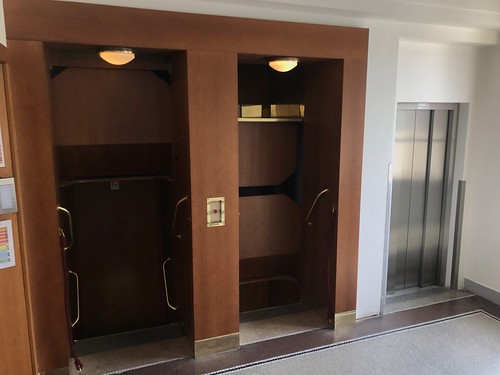
IMG_4454
Here’s the top floor. Karen insisted that I include the regular boring lift on the right in this photo as well, and that I let everyone know that many of the staff of the building seemed to be using that instead of the paternosters. Because obviously they are losers.

Astute Go Stay Work Play Readers may know what’s coming next. The obvious question with this sort of arrangement is “What happens and the top and bottom?” And that, dear readers, is what I was about to experience because I went over the top!

Paternoster
There’s a giant turning GEAR at the top and bottom of the lift shafts, fitted with a very very heavy chain that forms a continuous loop. The cabins are hung on this chain and when they reach the top they are pulled up and over the giant gear and proceed down the other side. Simple. The same thing happens at the bottom in reverse.

Naturally you’re really not supposed to go over the top because in addition to the ever-present danger of amputation, the giant chain meshing with the giant gear is clearly not the kind of thing you want to get up close and personal with. However, there is plenty of room in the cabin to squish yourself against the back wall, carefully tucking in any appendages, and see what happens.

Here’s what it’s like if you’re Karen and are patiently putting up with me.

And here’s what it’s like from the inside! Sorry this is not the greatest and most compelling video ever, though I like to think the long stretches of inky blackness add drama.

I’ll admit I was slightly nervous the first time I went over. It does really get quite dark, and I wasn’t sure what to expect. In the end it was no big deal and the movement of the car going over the giant wheel was relatively smooth, and there was light at the top, and you would really have to try to get any bits stuck in the gears. I went up and over four times, and Karen was very patient with me, though she resolutely declined to join in the fun. That didn’t matter though, because later that day we had another off-beat adventure that also deserves a mention.

I’ve already said that we stayed at an AirBnB in Prague, but it turns out that AirBnB are now offering “experiences” as well as accommodations. These experiences range from the sublime to the ridiculous. (As far as I can tell that last one is a real thing!) Karen and I discovered our experience at a tiny shop called Skoba in our Prague neighbourhood. Skoba specialises in making blank paper notebooks using recycled materials. Their workshop promised to teach us traditional bookbinding techniques, and it slotted into our schedule perfectly, capping off our stay in Prague with a fun, relaxing and very enjoyable afternoon of arty crafty activity.


IMG_4469
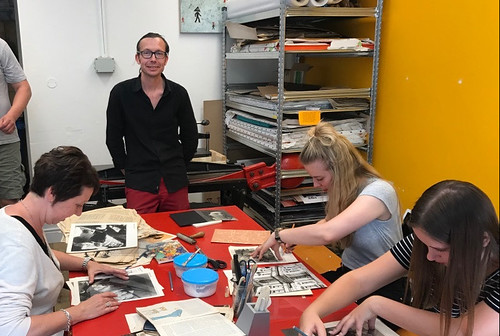
Gathered around the table

Václav was our host, seen at the head of the table above, and it turned out that we were his very first participants in his very first public workshop. We started by searching through a large collection of old books and papers to find the materials to make the covers and dividing pages of our soft-sided notebooks.

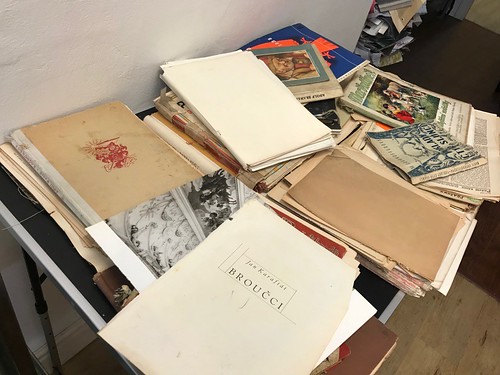
IMG_4476
The assortment

IMG_4472
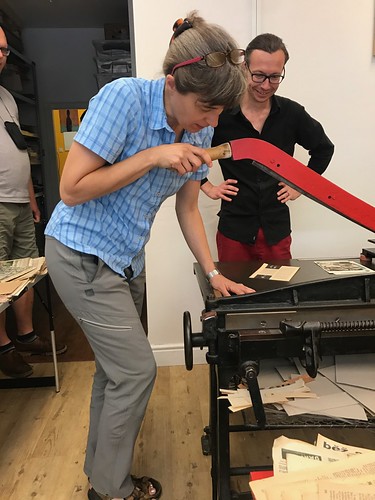
The cover pages were reinforced with a coating of sticky-back plastic, and cut to size with handy templates, or on this excellent giant chopper. 

The notebook pages themselves were already cut to size, but we got to add custom divider pages from the pile of stuff. Most interesting was the actual glueing together of the pages.

IMG_4479
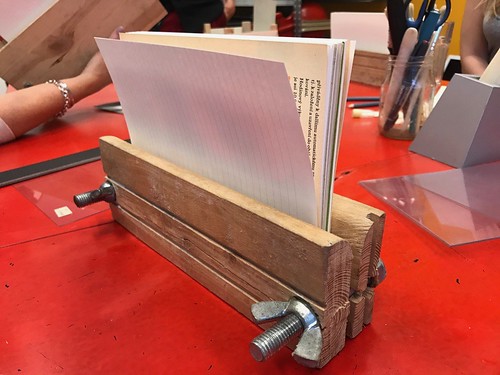
We had to secure the pages together in a wooden clamp...

IMG_4480
...and then fold them over to expose a tiny bit of the edge of each page, which were then roughed up with sandpaper...

IMG_4482
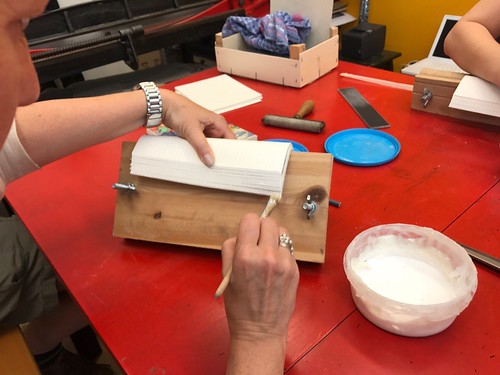
... and smeared with special book glue. 
(I always wondered how they got enough glue along the vanishingly tiny edge of a piece of paper to make them stick together. Now I know. And so do you. Just another service from the good people here are Go Stay Work Play Live World Headquarters.)

IMG_4483
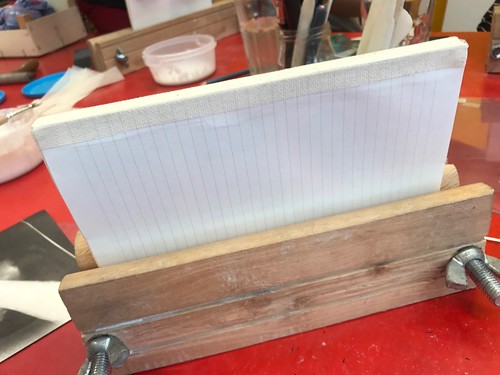
Then the whole thing is covered in a strip of cloth. Very clever!

The covers got glued on after along with end papers, and we even got to add an accordion pocket inside the back cover, with a pencil sleeve. The most magical part was after the glueing, when Václav took each rough book to the special cutter in the back of the shop and carefully trimmed the top and sides of the notebooks so they looked perfect and super-professional. 

IMG_4507
The magic cutting machine. I was hoping for more cast iron and giant screws and maybe a gear or two, but as you can see, this was a boringly modern device. Though still impressive in that it chopped through 200 pages with ease.

IMG_4510
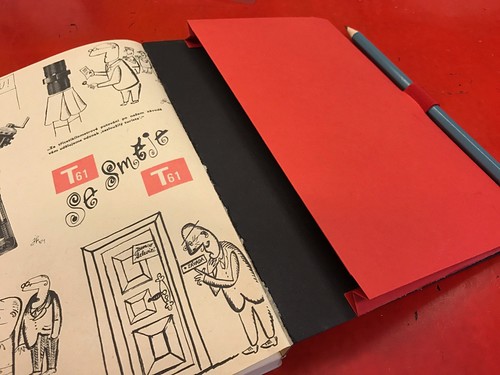
My finished notebook, showing the back end paper and pocket, and a Koh-i-noor pencil, which turn out to be Czech in origin. (Fun fact: Koh-i-noor patented the first graphite pencil lead in 1802! They also originated the practice of labelling the hardness of pencil leads with the H/B plus number system, which is still in use today. There are 21 gradations, but you probably knew that already.)

The bookbinding workshop was a great experience, and during the brief pauses when we were waiting for glue to dry, Václav even provided homemade cake and beer (I think it’s required by law to provide beer in any gathering in Czechia involving more that three people or lasting more that 30 minutes.) The whole thing turned out to be a really excellent finish to our Prague experience and gave us a chance to wind down a bit and have a quiet afternoon following the previous few days of marathon walking and whole-pig consumption. And of course we each got handmade souvenirs to take home with us along with sore feet, and a third-degree pork overdose. Love ya, Prague!

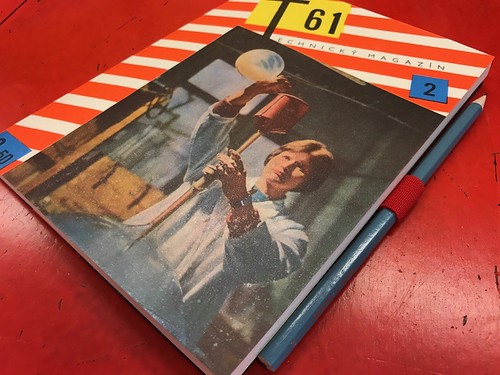
IMG_4508
Here's the finished product, featuring the cover from a vintage Czech technical magazine. This woman is clearly creating some kind of chemically-enhanced lacrosse stick. Or possibly toilet plunger. Yay science!