Showing posts with label Baku. Show all posts

Tourist Stuff: Mud Volcanoes!

Sunday, June 4, 2017

I survived! Opening Ceremony on May 12 (link here) and the Closing Ceremony on May 22 (link here). Both went reasonably smoothly, though Closing in particular was somewhat miraculous given that they were still building the stage on the afternoon of the ceremony, when we started rehearsing. Though I hasten to add that this is no reflection on my colleagues who were in charge of the staging. Mostly it’s just that these sort of events invariably have a tedious period of sport that happens between the Opening and Closing Ceremonies, which means you have set up the Closing Ceremony in about 36 hours. So the fact that we had a stage at all is amazing. If you do click through on those links I think you’ll find that these were two quite prop-heavy ceremonies, so I’m greatly relieved that we actually pulled it off.

Now we’re even finished the packing up and moving out of the Props Tent, leaving a week or so of sorting out files and reconciling budgets and going in late and going home early. And the weather is sunny and warm now so I suspect there may also be a measure of sitting on terraces with a cold beer. In other words, a bit of hard-earned down-time.
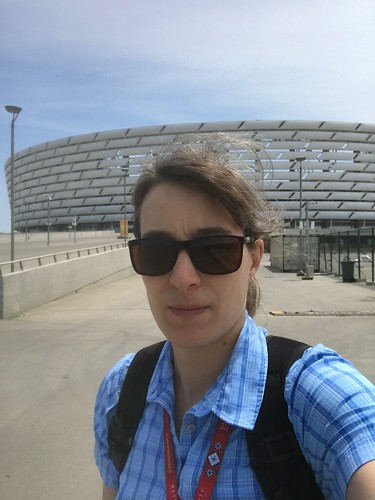
IMG_4060.JPG
Last day at the stadium. And not a minute too soon.

However, with the clock running on my time in Baku, I still had a few things to tick off the list. So in preparation for my first two-day weekend in months I decided to enlist the help of the Intrepid Raul for another wacky adventure, this time to see the famous mud volcanoes near Gobustan, about an hour’s drive out of Baku.

I say world famous though really, who outside of Azerbaijan even knows what a mud volcano is? This is probably partly because about half of the world’s thousand-ish mud volcanoes are in Azerbaijan. Mostly they’re quite small and relatively docile protrusions caused by more of Azerbaijan’s famous stores of underground petrochemicals bubbling up to the surface. Astute GSWPL Readers will recall another instance of leaky flammables near Baku, though that one was a bit more dramatic. Unfortunately, mud volcanoes are decidedly petite and mostly don’t erupt dramatically or spew giant globs of earth miles into the air or disrupt the flight path of incoming aircraft (errr.. except sometimes… see below). 

Tourists usually combine a trip to the mud volcanoes with a viewing of the much more famous petroglyphs at Gobustan, which I visited on my first sojourn in Baku. On that trip there wasn’t the time to tack on the Mud Volcanoes, and it felt like something that really needed to be seen. So trusting to Raul’s extensive experience of the local Baku buses, we set off on a sunny Saturday.

Despite Raul's encyclopaedic knowledge of Azerbaijan public transit, we were stymied partway there and had to resort to a taxi. This was, for me, a happy occurrence, because the last few months have been long and hard and I’m now generally inclined to grant myself whatever little indulgence comes along. So while I’m sure the hour on the local mashrutka would have been a culturally much more authentic, I was secretly quite happy to fork over the cash and be conveyed in relative luxury right to the target destination.

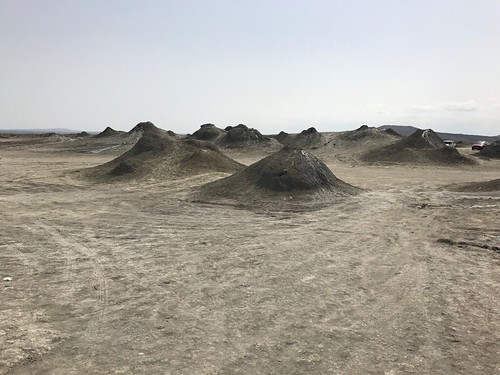
And how was the destination? It was kind of... other-wordly. 
IMG_3997
It really is an odd landscape. Apparently NASA scientists have concluded that Mars is a lot like this, geologically speaking. But with fewer Ladas parked nearby.

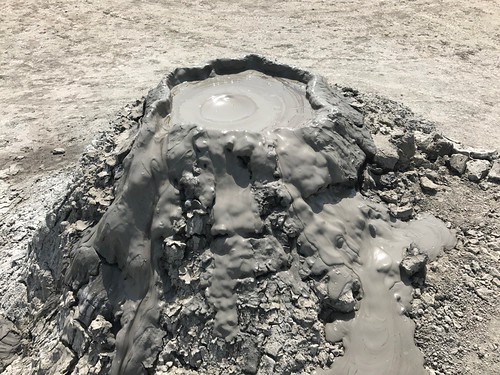
The mud volcanoes ranged size from really tiny - a few inches across - to about 15’ high. Not huge at all. And some are more active than others. Generally though, they look exactly like the picture that appears in your head when you hear the phrase “mud volcano”.
IMG_3990
See? It’s got the bubbly bit in the middle, and the slow flow of stuff on the outside, and the characteristic slope-sided shape of something that’s been building up for ages. 

The only thing that was lacking is the explosive eruption part though even that’s not strictly true. Azerbaijan's mud volcanoes appear small from the surface, but they sit on large reserves of gas and (according to Wikipedia):
"About 200 eruptions have occurred in 50 volcanoes in the territory of Azerbaijani Republic since 1810. Eruption of mud volcanoes is accompanied by strong explosions and underground rumbling. Gasses come out from the deepest layers of the earth and immediately ignite. A height of a flame over volcano reaches 1000 meters (Garasu volcano). Toragay volcano erupted 6 times from 1841 to 1950."
Apparently a huge eruption occurred in 2001, spewing mud and flaming gas into the air in an explosion that could be seen from 15 kilometres away. The fire was still burning three days later. And whole new islands have been formed in the Caspian when undersea mud volcanoes have erupted. Luckily, nothing quite that exciting happened when Raul and I visited. Though I did get a sort of fuzzy slo-mo video which, despite the lack of focus, is slightly mesmerising.


IMG_4016
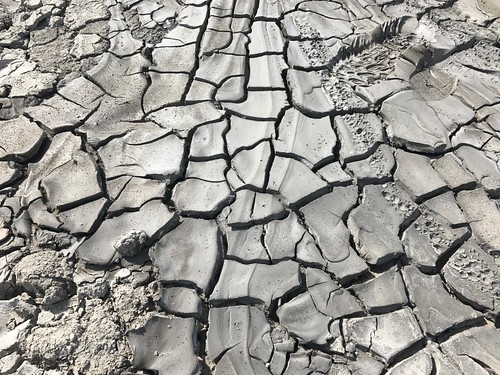
And I took atmosphere shots of the cracked earth
IMG_4008
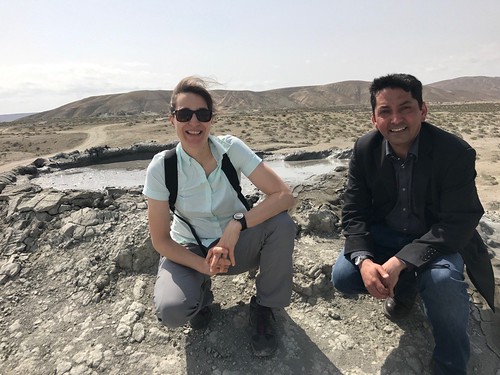
And our cab driver took a shot of me and Raul on top of the biggest of the not-very-big mud volcanoes
IMG_4022
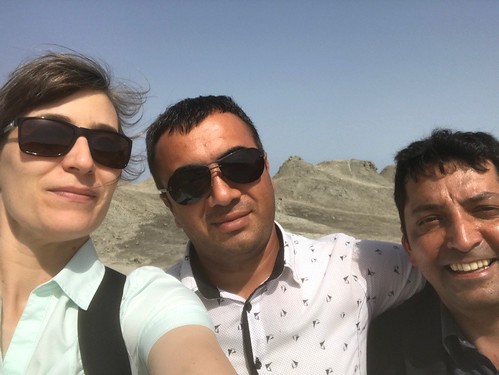
And then of course we had to take a selfie of me and Raul and the cab driver, whose name was Elvin. Or possibly Elman. But definitely not Elvis, despite the sunglasses.

And then there was not much left to do but get back in the cab and drive back to Baku. Because as interesting as the mud volcanoes were, there's only so much time you can spend staring at mud. Plus it was windy, and I was a bit tired. It always takes a while to get over the "what-the-hell-just-happened-why-doesn't-my-brain-work-anymore" feeling that comes from completing a big job, so I'm just taking it easy and counting down the days until I get home.

Soon.  So soon!
Tourist Stuff: Fire Mountain

Sunday, February 12, 2017

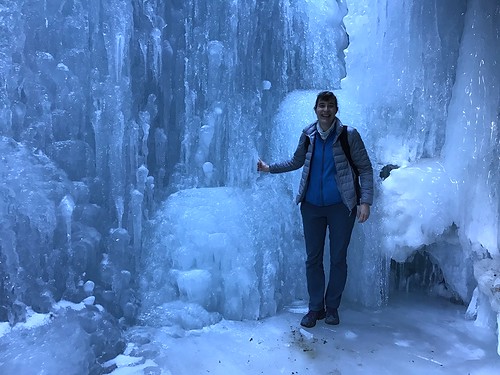
From ice to fire - Azerbaijan is truly a land of contrasts.

But enough of the touristic platitudes! (That one was for you, PW.) Though in this case it's actually true. My last day out was all about the ice, and just two weeks later I went on another of what I’ve come to think of as Raul’s Wacky Adventures, but this time it was a visit to the famous Fire Mountain, known in Azeri as Yanar Dag.

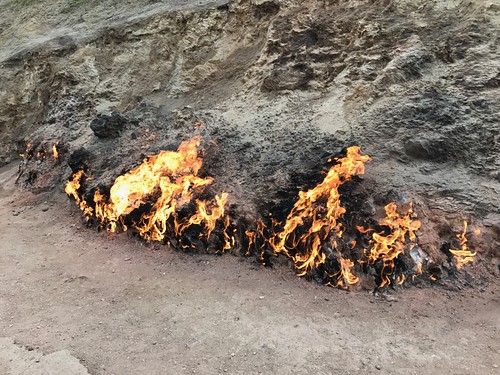
While the “mountain” part of the title may be generous to the point of hyperbole, there can be no doubt that there is definitely fire. Yanar Dag is a natural gas fire that burns constantly at the rocky base of a hillside a bit north of Baku. The gas seeps through the porous sandstone of the area and is striking evidence of how Azerbaijan is generally absolutely soaking in hydrocarbons. I don't think I've mentioned it here before, but the oil and gas industry is the lifeblood of this country. A striking graphic from 2009 shows that 81% of the state’s exports at the time were in crude oil, and the Wikipedia article states that "Azerbaijan is considered one of the most important spots in the world for oil exploration and development.”

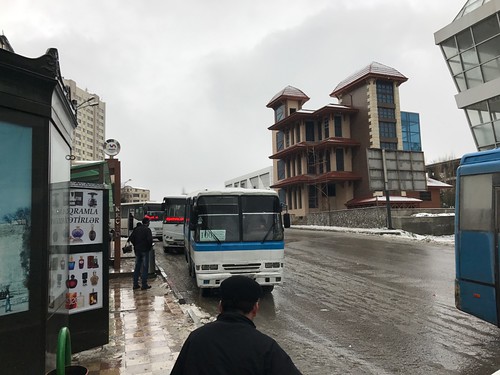
However, we weren’t thinking about that the Saturday morning that my colleague Leigh-Anne and I met the intrepid Raul at the main metro station for a quick tip out to Fire Mountain. A less hardy bunch might have simply hopped in a taxi, but that’s not how we roll on Raul’s Wacky Adventures. Instead, we took the metro to Azadliq station and then got out to find a small local bus to take us the rest of the way. Baku recently acquired a fleet of big modern red buses that look just like buses in modern cities everywhere. They take electronic payment cards and are efficient and boring. We did not take one of these buses. We took a small white(ish) jobbie run by an independent driver/owner. Apparently the routes are auctioned off and you pay for the license to operate on a given route, then it’s up to you to maintain your bus and drive the route.

IMG_2759
Here’s a few buses at Azadliq. We took the #274, which, helpfully, had a scrolling sign in the window saying “Yanar Dag”, so I was pretty confident we’d end up in the right place.

IMG_2762
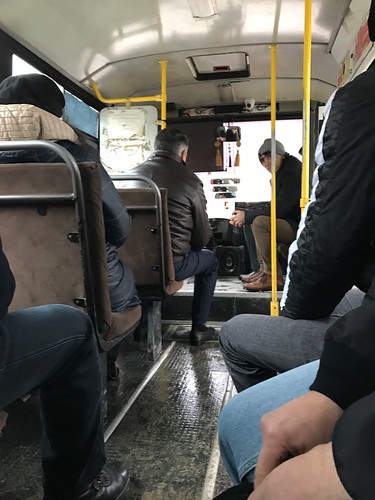
You don’t pay when you get on but rather when you leave. And if you get off the back you have to walk around to the front door to give your fare to the driver. Fares are about 20-40 qepik, depending on how far you go. (At the current exchange rates that’s less that 10-20 pence.)

The ride was long, and the snowy/rainy weather made the streets muddy and floody. They are not masters of drainage here. (You should hear Gerald, who is Dutch, go on about how they don’t know how to handle water.) Though in fairness, it’s largely because there’s just not much support of infrastructure, which is obvious pretty much everywhere. We did get to ride past some of the oldest commercial oil fields in the world, which we glimpsed through muddy, steamed up windows. It’s a bit of an otherworldly landscape - tall bits of scaffolding dotted everywhere, supporting pumpjacks that were, in some cases, still nodding slowly and pulling oil out of the ground.

When we finally made it to Fire Mountain we disembarked, walked across the road, and proceeded to the ticket booth, which is a recent addition. The Intrepid Raul reported that the last time he was there about a year ago, there was no booth and no supervision at all. You simply walked in and poked around on your own. This time we each paid 2 manat entry fee, which none of us begrudged. In a place like this I think it’s simple decency to put money back into the economy wherever you can.

And then we walked down and there it was… a mountain on fire.

IMG_2763
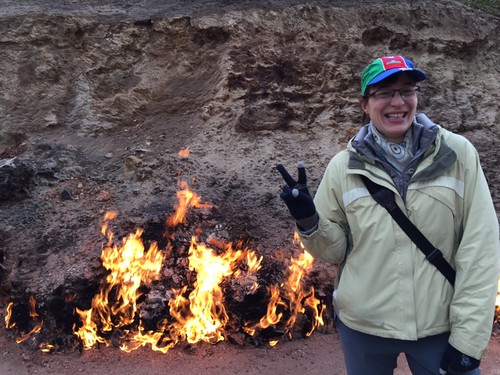
It really does look like the rock itself is burning.

IMG_2764
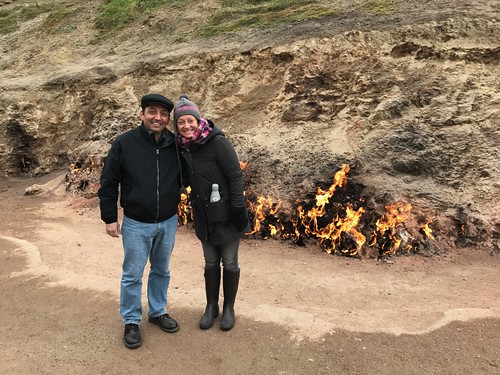
And here’s a look at Raul and Leigh-Anne, which gives an idea of the scale of the flames

There was a lone security guard hanging around, and a group of tourists from Bahrain. But no barriers, no health and safety notices, no anything between you and what was really quite an intensely hot wall of flame. It’s not a massive area. Perhaps twenty feet across, with the flames getting up to six or eight feet high. But on a cold and overcast day it was still undeniably impressive and a bit eerie.

We took photos and commented about how we should have brought marshmallows, and how someone was really missing a trick not having a tea house where you could sit with the comforting warmth of a samovar on one side and a burning rock on the other.


And Leigh-Anne introduced my to the Slo-Mo Video function of the iPhone which is super cool!

IMG_2786
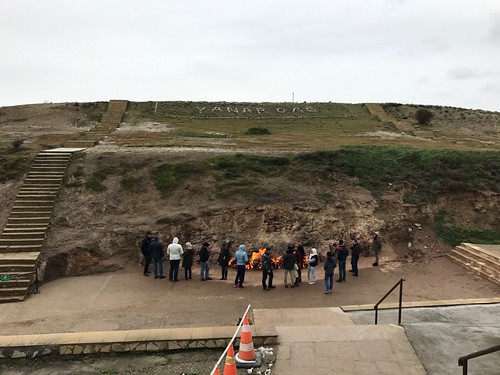
Here’s a long shot of the area, which shows the scale well. You can also see the lovey rock art at the top of the hillside, though the stairs were closed off.

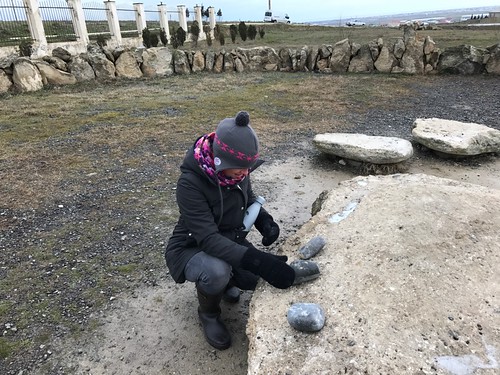
The whole site was… odd. First there was the fundamental strangeness of watching rock burn. But there was also an inexplicable circle of stones near the road that is obviously a new addition. At the centre were a few large flat pieces of stone and some smaller, harder rocks. It seems the intention was to pound the big flat rocks with the smaller rocks, which produced a nice resounding percussive note. This was briefly diverting.

IMG_2790
Leigh-Anne on the bass rock

IMG_2787
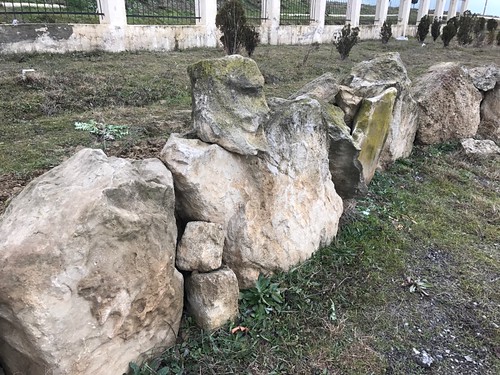
And there was this cool rock that looks a bit like it belongs on a mini Easter Island or possibly something in the inevitably forthcoming Flintstones vs. Transformers movie.

IMG_2792
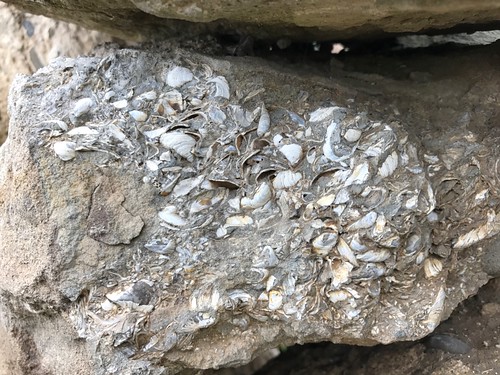
And it was interesting to look closely at the rock because it is literally just a compressed mix of dead prehistoric sea creatures. Azerbaijan is basically made of this rock. The ground is like this, and then they quarry it into big rectangular blocks and build everything from them - houses, office buildings, fences - everything. At first I thought it was a man-made composite in which they use shells as the aggregate but it seems that Azerbaijan is simply a porous, ancient seabed soaked in oil.

So there are the burning rocks, and the stone circle. But really the whole place had a generally neglected and run-down feeling. Mostly it all looked abandoned.

IMG_2783
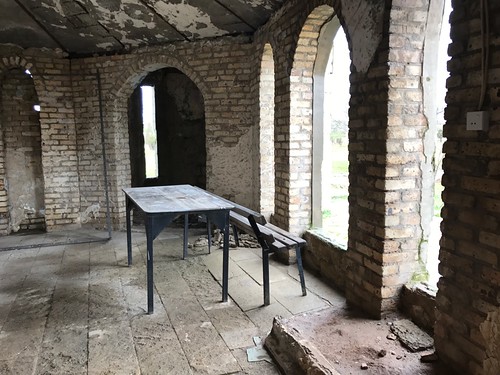
Like this place, which was a sort of stone gazebo at the top of the site which should have made a brilliant tea house, but instead was just filled with rubbish and rubble. Maybe it's livelier in the summer?

IMG_2779
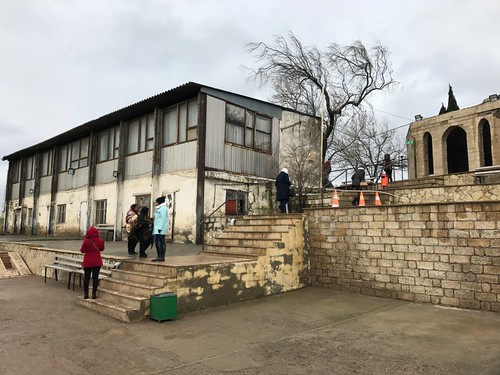
There was also this large building. It also seemed to be mostly abandoned, though you could see there was a small room where some of the workers were warming up and having tea. But truly, with a lick of paint and some patio furniture you could have a lovely little tea shop and a captive audience!

There was one bright spot, which was a tiny souvenir shop featuring the usual mix of keychains, fridge magnets and postcards. There I found the best running cap EVER, which is made of wide stripes of the blue, red and green of the flag of Azerbaijan, with Azerbaijan written across the top, and AZ on the brim and an Azerbaijan flag embroidered on the front. And, just in case there was any doubt, it’s also got “Azerbaijan” embroidered on the sizing strap at the back.

Best. Hat. Ever.
Best. Hat. Ever.  Leigh-Anne just got a boring coffee mug and some postcards!

And then there was truly nothing left to do. We’d managed to spend an hour at the site, which, judging by the others we saw who came and went while we were there, is about 50 minutes longer than most. Then we found another little bus and spent another 45 minutes bumping through the muddy suburban streets of Baku by a different route before getting back on the metro and finally returning to the familiar, relatively unchallenging centre of Baku. It was a good little jaunt, and while I enjoyed having the experience of the local bus, by that time of the afternoon I also would not have objected to a warm and speedy taxi home.

By the time we emerged from the metro station it was snowing in earnest, and I had that kind of tiredness that comes from being outside for most of the day in chilly weather. So I decided that the planned long-ish run along the Bulvar in the dark would perhaps be better reimagined as a quick 5k on the hotel treadmill followed by a glass of wine and a night of Netflix.

I have no regrets.

A Day Out: The frozen waterfall

Sunday, January 29, 2017

It had to happen sooner or later. Eventually, if I kept at it, there had to be a day when a Bag Baku expedition would end up falling in the tiny, magical intersection on the Tourism Venn Diagram where Spectacular Scenery, Perfect Weather, Interesting Activities, Delicious Food and Good Scheduling all meet. On my first weekend back from the Christmas break I finally hit that sweet spot on a trip to the frozen waterfall at Giriz.

Giriz is a vanishingly tiny village in the north of Baku, not far from the Russian border and well into the southern tip of the Greater Caucasus Mountains. It’s home to just 32 families.

IMG_2601
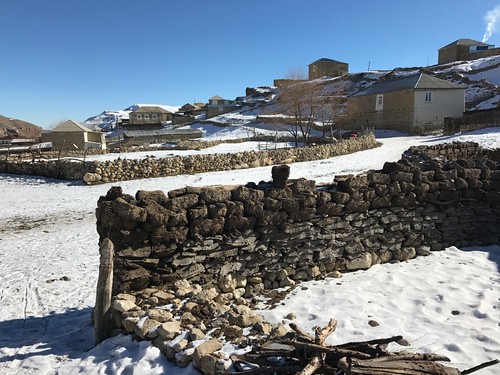
The heart of downtown Giriz. Also the suburbs. And the Business District. And… well you get the idea. The wall in the foreground is constructed partly from rough stone and partly from bricks made with animal dung and straw.

But I’m getting ahead of myself a bit. Back to the beginning, which was at Nizami metro station at 7:30am on my first Sunday back. Unsurprisingly we got a late start because our driver overslept. This turned out to be fine though, because there was a brightly lit cafĂ© nearby where our small group could sit and have tea and little pastries and warm up while we were waiting. It was a civilised way to start. Once we were underway it was a two hour drive in the minivan to Quba, the small capital city of the northern Quba region of Azerbaijan. And that’s when the real adventure started. Astute Go Stay Work Play Live Readers will recall my friend and fellow adventurer Raul from the rainy trudge up to Chirag Gala (an outing that, while worthwhile, definitely was not an ideal Venn diagram of tourism bliss). Raul came along for this trip too, and had warned that the road between Quba and Giriz was, er, challenging. And he’d warned that in Quba we’d have to leave our comfy minivan and transfer to a much sturdier 4x4 for the trip up the winding mountain track.

IMG_2561
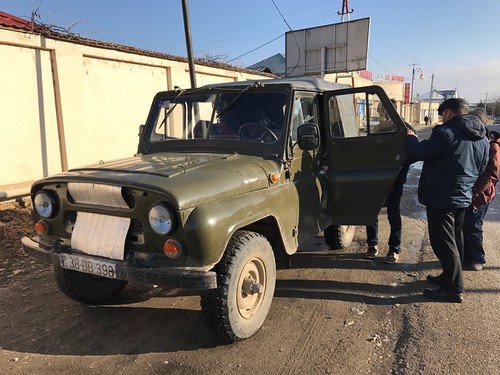
Here’s our ride. A 1986 UAZ. The UAZ is a legendary Soviet-designed off-road military vehicle now available to the public. UAZ (pronounced like a word: YOU-az) are renowned for their ruggedness, go-anywhere abilities and ease of repair. And apparently some are still made in Azerbaijan!
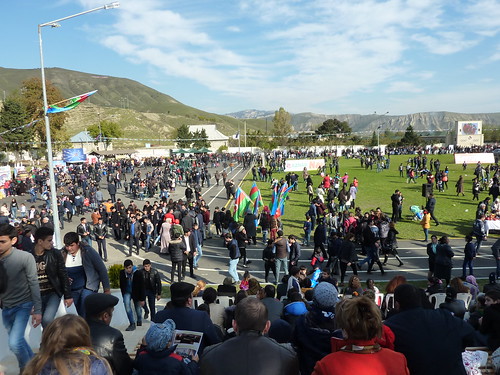
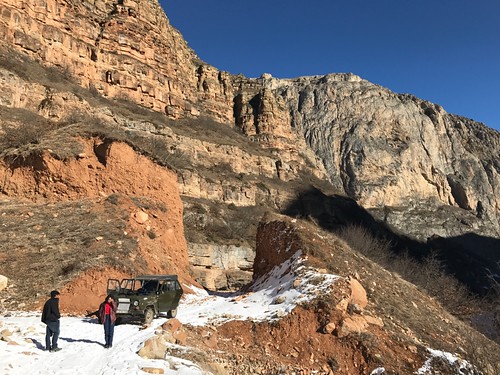
Eight of us crammed into the car - two facing towards each other in the far back, four squeezed into the  back seat, and one in the front with the driver. I’ll admit I was nervous about the drive. I’ve heard tales of these mountain drives from others and I had uncomfortable visions of tipping slowly over the side of an unguarded edge or ending up under a sudden rock slide. Obviously that didn’t happen, but I don’t mind saying I now truly understand, deep in my bones, the origin on the phrase “white-knuckle ride”. Luckily it gradually emerged that our driver, who was celebrating his 63rd birthday that very day, grew up in Giriz, moved to Quba thirty years ago, and has been driving this same road, possibly even in the same UAZ, ever since. It was very reassuring. It was also simultaneously reassuring and alarming that he stopped to put on tire chains after we lurched off the main road and onto the track for the last stretch up to Giriz.

IMG_2581
Stopping for the tire chains. As you might be able to tell from the photos so far, the weather was stunning. Perfectly clear blue sky with temperatures hovering just above freezing, but feeling much warmer in the strong sunshine. The only thing missing was the sunglasses forgotten on my desk back at the hotel, which is why most photos of me on the trip are decidedly squinty-looking.

As we finally rolled into Giriz, we saw an old gentleman waking up the road who turned out to be our driver’s 83 year old father, who still lives in the village with his mother. We also saw and waved to his mom in the distance who was busy with some outdoor chore near the family home. We, on the other hand, proceeded to a different family home where our guide Sabina had arranged for us to have lunch before we started the hike to the waterfall.

IMG_2608
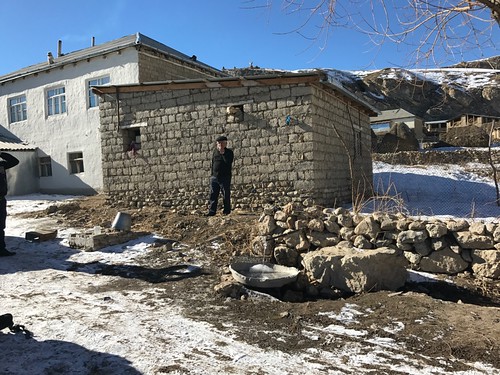
Here’s a not-great shot of the house - the two-story job on the left. With no plumbing inside, the family’s water source is the constantly trickling, icy flow of mountain run-off from the pipe in the foreground, dropping into a battered, flat metal basin, then overflowing and draining away. There was a bar of soap on the big rock.

The houses are constructed with thick walls from the same blocks of porous yellow stone that is the basic building material in Azerbaijan. And though the house had several rooms and a whole upstairs, all the activity was in the room with the stove. There was no furniture, but the floor was covered in layers of carpets and pillows. (“Where is my carpet, there is my home”) The walls were hung with coloured fabrics, and it was warm and welcoming. And there was a feast laid out on a big plastic tablecloth on the floor

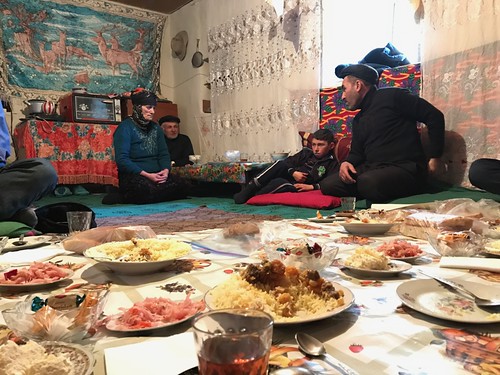
IMG_2593
There’s so much in this photo. The mom, wearing a traditional head covering that she’s probably worn every day of her adult life. Behind her is a high table with a two burner hotplate and an old electric counter-top oven, though all the cooking that day was done on the woodstove. Two of the men of the house, also very traditionally dressed. And the little boy, who never budged from his warm cushions, but often played with the remote control for the tv that was on constantly in the back corner. And the food! Homemade salty sheep milk cheese, plates of pink salt-pickled cabbage, and bread for days. Of course we also had a plov made with rice, lamb and dried fruit. And tea. Endless tea, with ample cubes of sugar.
IMG_2668
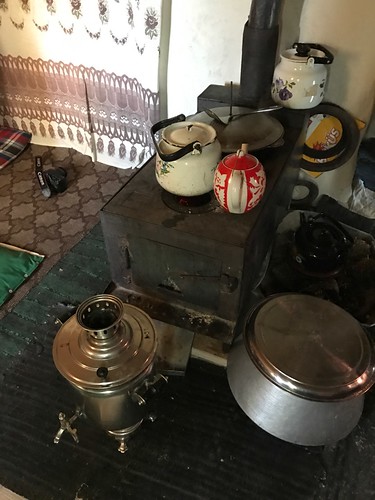
And here’s the heart of the room - the stove and samovar. Strong black tea is stewing in the red pot on the stove and the samovar holds hot water to thin out the potent brew. 

Fuel for the stove was dried animal dung. And the flat dish behind the teapots held the most delicious potatoes I’ve eaten in some time. I think they were approximately equal parts potato and homemade butter, with perhaps a touch of turmeric for colour, slow cooked into a soft and utterly irresistible dream. We had the potatoes when we returned to the house after the waterfall hike, so I’m getting ahead of myself a bit, but whatever. Also, weirdly, when I was commenting about the deliciousness of the potatoes that afternoon it came out as “Belicious topatoes”. I plead tiredness and extreme butter poisoning, but now whenever I think of that dish now I think “Damn, those really were some belicious topatoes.” When we came back for the topatoes, there were also tiny dishes of powdery, dirty coloured salt. This was another homemade treat where salt is ground with a blend of herbs and spices into a special mixture that complemented the topatoes perfectly.

Fortified with tea and plov, we set out for the walk to the waterfall, and it was lovely. A bit steep but not at all unmanageable. And the pace was pleasant, and the group was small, and the scenery was, to put it mildly, not bad.

IMG_2624
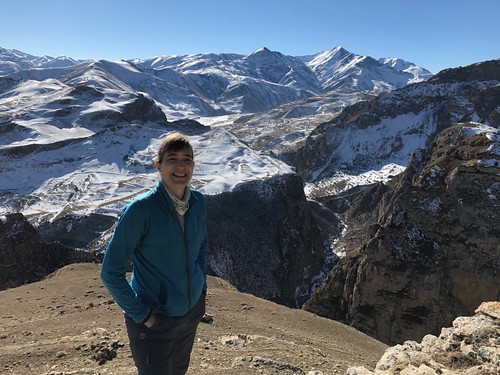
Me squinting in the sun with the mighty Caucasus behind me.

Vivek's Photo
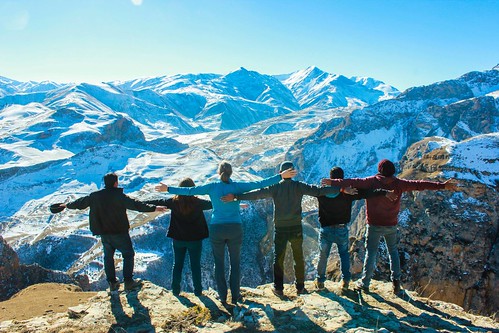
And here’s a fun shot of the group at our designated stopping point, where the rule seemed to be that you were supposed to stand on the very edge and have your picture taken posing like Leonardo di Caprio in “Titanic”. So we did.

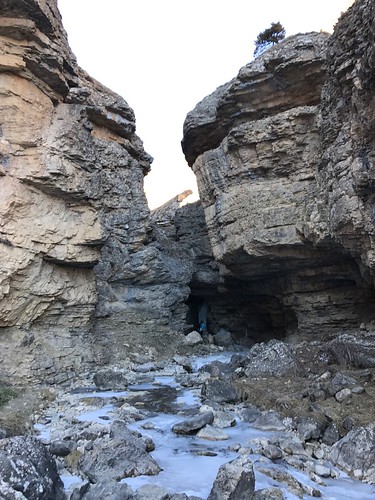
The hike was less than an hour long, though it didn’t feel hurried and it did feel like a proper effort. And I’m embarrassed to report I don’t even know the name of the watercourse that tumbles through the rocks and freezes into a fantastic, ever-changing sculpture every year.

IMG_2636
But we found it just inside here

IMG_2638
And I’d say it was worth the trip.

IMG_2651
It’s not big, but it is impressive, and we had it all to ourselves.

IMG_2641
Mandatory shot of me at frozen waterfall

You could hear the water running behind the ice, and see it dripping slowly down the face of the sculpture. We hung around taking photos, slipping on the ice, goofing around, and having a warming shot of tea-and-vodka thoughtfully provided by Julie, who’d done the hike three times before and clearly had things sorted out. (A fellow Canadian, naturally)  And then it was time for the hike back to the village for tea and belicious topatoes.

I think we’d all have preferred to curl up for a quick nap after the food, but we soon had to pile back into the trusty UAZ for the trip back down because it was VERY IMPORTANT that we not end up on the difficult part of the road after sunset. However, this didn’t prevent us from stopping the car on the way out of the village to greet the driver’s dad in person, who was once again spotted trudging through a field alongside the road. He was on the other side of a low stone wall, and came over when we stopped. A few of us went to help him over the wall but he brushed us off and nimbly stepped over like a man half his age.

Version 3
I think you’ll agree this guy is totally excellent. And has the best moustache EVER.

Finally there was nothing to do but confront the road. It was another white-knuckle job, perhaps worse because this time we were at least partially giving ourselves over to gravity. (I took a video of a short section of hairpin turn. It’s here.) Unbelievably, Sabina actually FELL ASLEEP for part of the descent, which I suppose I should find reassuring. And then were were back in Quba and saying good bye to our lovely driver, whose name I never learned but who got a deeply heartfelt thank you and happy birthday from me before we parted.

The drive from Quba to Baku was dark and quiet and sleepy. Raul and I chatted and contemplated what a completely different place Azerbaijan is when you get out of Baku. I’m glad I’m taking the opportunity to see some more of the country this time. As Raul often reminds me, about ten percent of the population of Azerbaijan are still subsistence farmers like the family we visited. They live off what they grow, the animals they raise, and a heartbreakingly tiny state pension. I’m also glad that some of the 50 manat we each paid for the day’s tour went to that driver and his trusty UAZ, and that family and their belicious topatoes.

IMG_2664
At some point on the hike I managed to get this panoramic shot that caught Raul being offered a bag of Lay’s from someone just off camera. I like to call it: 
“Behold the Grandeur of the Mighty Caucasus Mountai… Oooooh! Crisps!"


P.S. There are a lot more photos in a Flickr album, which I'd recommend having a look at, because they include a shot of... you guessed it... some truly belicious topatoes.

Gear for the jetsetting lifestyle

Sunday, December 11, 2016

Slightly off the beaten track today - no festivals, no food, no sightseeing. Instead I’ve decided to tell you about two new things that I’ve discovered in recent months and that have made a significant contribution to my quality of life as a certified International Woman of Mystery. And let me just say right off the bat that I’ve not received any kickbacks in consideration of my lavish praise for these products, though I would be very happy to do so. Anyone wanting to pay me off is welcome to get in touch at the email address below. No gift is too big or too small.

First is a product that came to me through Kickstarter. In fact, I’ve been kickstartering up a storm lately, though mostly that’s Gerald’s fault. He keeps sending me links to interesting clever things, and when something is really clever and useful and reasonably priced why wouldn’t you want to support it? Like, for instance, the Mogics Power Bagel - weird name, awesome idea. And perfect for someone who travels a lot.

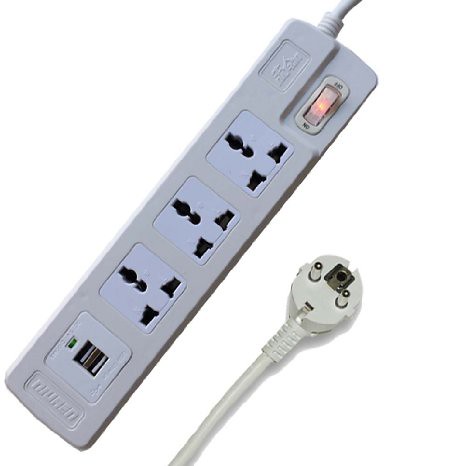
I’m a great fan of the international plug strips that have cropped up recently, like this one here:

2500watt-travel-outlet-usb-universal-power-strip-international-usb-socket-charger-plug-travel-adapter-220v-240v-3-universal-ac-outlet-with-6ft-european-power-cord-cable-dual-usb-travel-plug-power-adap_631532
In fact, I think that every plug outlet on the planet should be like this - accepting North American, UK, Euro and Australian plugs equally, and generously equipped with USB ports. Could the UN maybe look into this please?

For a traveller though, there are a few problems with power strips like this. First, they are big and bulky, which is a definitely drawback. Second, while they accept any style of plug, they are only equipped to plug into a particular type of socket, meaning you still need a plug adapter to be completely versatile. And finally, if you’re trying to plug in things with large adapters, often you can’t use every outlet because the fat pluggy bit on the thing you’re plugging in is so large it hangs over the adjacent outlet.

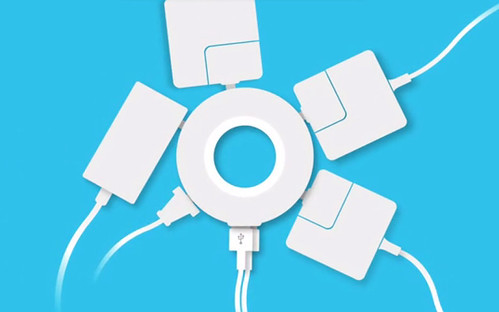
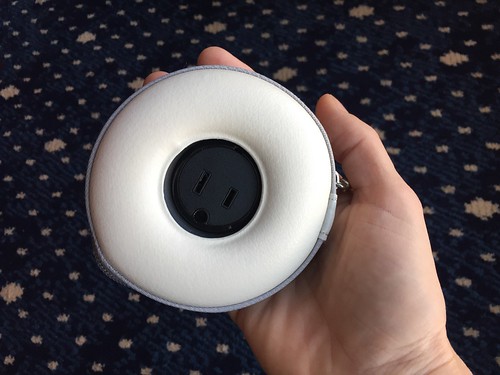
Enter: the Power Bagel! The big innovation with the Power Bagel is its shape - by turning the conventional strip into a circle the whole thing becomes much smaller. More importantly, though, the round shape means that when you connect something with a bulky plug it sticks out away from the circle, leaving room for something else in the next socket. It seems obvious when you see it.

Power Bagel No Conflict
No conflicts!

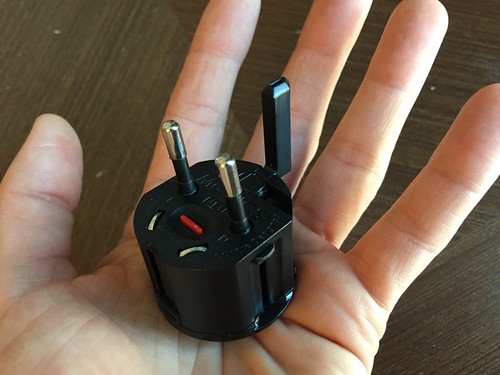
The cord for plugging in the Bagel wraps neatly around the outside and stays wrapped at the length you want without interfering with plugging stuff in. And though the plug on the end of the cord is the little North American style, you can also get a universal adapter that slots neatly into the hole in the bagel for storage. The adapter is very clever too, and the smallest plug adapter I’ve ever seen. And trust me, I’ve encountered a lot of travel adapters in my time.

IMG_2422
See how tiny!

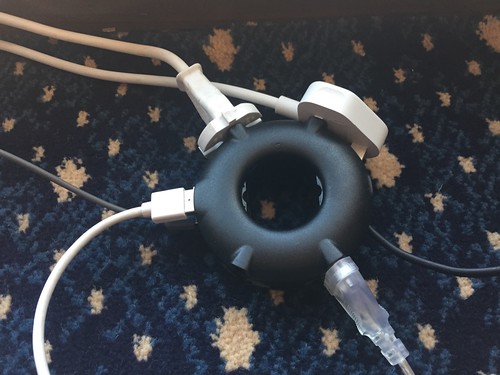
IMG_2369
And here is my Power Bagel in action in my hotel room in Baku. It’s currently powering the local euro plug standing lamp, the UK plug power for my computer, USB cables for phone and wireless speaker charging, and a euro plug for the desk lamp. And there’s still one universal and one North American plug left.

Mogics also offers something they call the Power Donut, which only accepts North American plugs. It’s the same diameter but a bit lower profile. I suppose the single plug style would be fine if you never left the continent and were just interested in having a convenient power source, but my feeling is that for the small extra cost it’s worth having the flexibility of the universal plug sockets. Why? Well, when I visited Belgrade with Rob and Wes, there was only one plug point near my bed, and it was taken up by the only lamp for the room. Because I had the Power Bagel, I was able to plug the euro style lamp into the Bagel, along with everything else I needed and still only use the one plug point. If I only had the ability to plug in things with a North American plug I’d have been sitting in the dark. Hence, the wisdom of the universal Bagel even for people who only own things with North American plugs. Both the Donut and the Bagel sell on the Mogics website for $49 USD.

I do have two quibbles though. The Power Bagel comes with a cute zippered case - it looks like a donut, including the  hole in the middle. However, the plug adapter thing slots into that hole for storage, meaning that the only thing that’s not attached - the adapter - is the only thing that’s not held into the case. For a company that’s smart enough to think up such a clever device, that’s just plain dumb.

IMG_2424
Dumb

The other problem is that I’ve managed to blow the tiny built-in fuse in my Bagel twice now, though perhaps that says more about the power supply in Baku than the Power Bagel. On the plus side, the Bagel comes with a spare fuse packed inside the device and another spare fuse in the adapter. This means that I’m still operational, though I’m now working without any spares, and the shipping policy for getting more from the Mogics website is challenging for a person of No Fixed Address. In any case, the Mogics Power Bagel is still a hugely useful and very clever thing, and I suspect I will never travel without it.

Next up in the Go Stay Work Play Live lineup of Things To Not Leave Home Without is less a product and more a service. Or app. Or something. Whatever it is, it’s become an absolute necessity in my current ex-pat lifestyle.

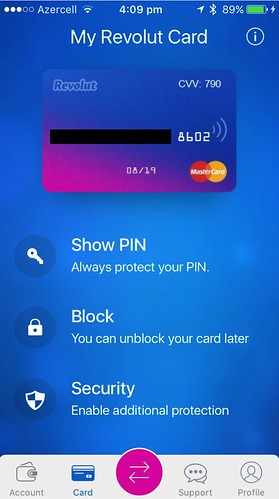
Revolut describes itself as "the only account you need to securely send and spend money anywhere in the world.” Basically, it’s a smartphone app that links to a pre-paid Mastercard debit card. After downloading the free app, you sign up and are instantly assigned a virtual Revolut Card that appears on the screen and is functional right away, even as you wait for the actual physical chip-and-pin card to arrive in the mail.

Screenshot 2016-12-10 21.17.36
Here’s what the virtual card looks like. The real one is just like that too, with the nice purple colour. And my name on it. And no big black box covering the number. But otherwise it’s pretty much that.

After signing up you connect your Revolut account to an already existing bank account, which allows you to top up your Revolut balance from that account from within the app. You can even set it to top up automatically when your card balance gets below a certain amount. This easy in-app top up feature is currently only available if your primary account is in the UK or Europe, but you can also use a bank transfer to top up, it’s just not as fast or cool. And whenever a transaction occurs - either when you use your card in a store, or withdraw cash - you get an alert on your phone that’s very reassuring.

But none of that is really the point. There are other pre-loadable debit cards out there, and lots of different Mastercard options. The point of Revolut is that it operates in more than 120 currencies and instantly converts to your native currency using interbank rates. If I buy groceries in Baku and pay with my Revout card, as soon as the cashier pushes the enter button on the chip-and-pin device, the alert on my phone pops up to say I’ve just spent £23.31, which is 50.56 manat, at a rate of 2.1695 manat to the pound. This usually happens before the receipt is even printed. And - perhaps most importantly - it happens with no fees. My bank statements used to be littered with “Non-Sterling Transaction Fees". On previous gigs they added up to hundreds of pounds. Now… nothing. I used the card traveling in Serbia, and it was equally seamless. And now I use it for any transactions (often online) when the currency isn’t pounds sterling. When I withdraw cash from an ATM it’s the same. I get the same great exchange rate, and no fees (Mostly. Keep reading). I’ve just had a look through some old bank statements from 2014 when I arrived in Baku for the first time and I can see one withdrawal of 200 manat cost me £7.67 in fees, or about 4.7%. That adds up very very fast.

True, last time in Baku I got a local bank account and bank card and could withdraw cash from there without fees, but that meant managing deposits into that account, and making sure that the total held in the local account didn’t get so high that I couldn’t get it out if I wanted. Manat are not convertible outside of Azerbaijan, so it’s best not to hold an excess of local currency. Now I just have the cash my pocket - less than 200 manat - and the rest is safely held in my UK account or in virtual Revolut-land.

Which leads us to a big question that comes up with online banking services - security. I think most people are now accepting (if maybe not always comfortable) with online banking portals run by big, known international banks, but might be nervous about something app-based that occupies the same sort of place in your head as Angry Birds or that one where you toss virtual bits of crumpled paper into a virtual bin. Fear not. Revolut stores customers' money in a pooled account at the actual grown-up non-Angry-Birds Barclays Bank. And they apparently use the same encryption systems as banks. (For anyone who understands: Sensitive data is stored in PCIDSS level-1 compliant data centre and all data passed between Revolut servers and third parties is 2048-bit SSL encrypted and transmitted by VPN tunnels. Phew!)

Ok, I said there are no fees and mostly that’s true. Revolut makes most of their money from the credit card fees charged to retailers when you use the card for purchases. However, there is a limit of £500 per month on free cash withdrawals. That hasn’t been a problem for me, but Revolut recently announced they’re slashing that total to £200 month in February 2017, with a 2% fee per transaction after that. Apparently the costs associated with dealing with ATMs across the globe have become unsustainable for them to maintain the £500 ceiling. There’s been a big uproar in the online community about this, but from where I’m sitting it’s still a good deal. 2% after £200 is still a lot less than 4.7% every time. Perhaps I could search around a bit more and find a better one, but frankly I can’t be bothered.

So that’s the big big advantage of Revolut: (virtually) no-fee life in a foreign currency. However, there are also other fun things too. It’s instantaneous and free to transfer money to other Revolut users, which is nice if, for instance, you’re out for lunch and one person picks up the tab. You can easily and quickly send them your share through the app. Gerald and I have been trading about £7 back and forth for months now. Though often Gerald pays me back in euros, because that’s the currency he operates in. Which brings me to another fun thing about Revolut - you can hold money in pounds, euros or US dollars - the app has three built in “wallets” in those currencies. So if Gerald pays me in euros it goes into my euro wallet. If I make a purchase in euros the app will automatically take it from the euro wallet if there’s enough to cover it. If I don’t want to hold euros, I can easily exchange them into pounds at the same favourable rates Revolut always uses.

You can also transfer to non-Revolut people by sending them a code they use to access the money. And you can transfer directly to other bank accounts as well - a process I’m testing out for the first time right now. If it works and is simple and cheap it could become my preferred method for moving money from the UK to my Canadian accounts. Mostly, though, Revolut has become my day-to-day card for life in Baku ad my go-to card for anything that happens in a non-sterling currency. It's definitely made my life better.

An in other News About Pam: work is very busy because we all pack up for Christmas next week so there’s a scramble to get a mountain of tedious contracting and paperwork done. I’m fly back to London for a few days before I head home to Canada for Christmas and New Year’s, and then have a few more days in London before it’s back to Baku when we move to the stadium and get settled in for the long haul.

And finally, a few pictures of Christmas in Baku:

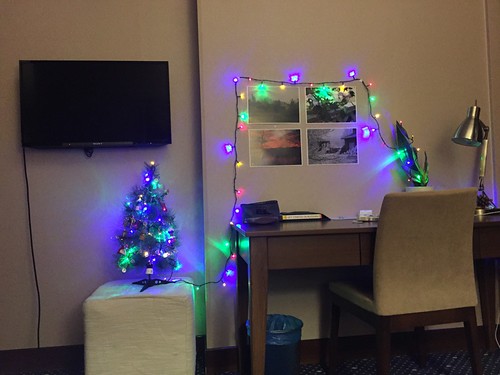
IMG_2404
Deck the hotel room with... cheap LEDs and plastic!

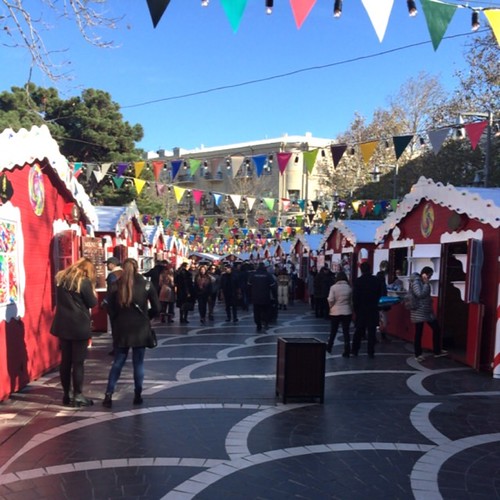
IMG_2418
And who'd have thought Baku would have a Christmas Market?

GRUB!: Azeri Style - The Pomegranate Edition

Sunday, November 27, 2016

After the previous week’s damp and misty outing, one might think I’d shy away from excursions for a bit. Dry out. Put my feet up. Enjoy a quiet Saturday. Then again, one might not know that the week after I visited Chirag Gala was the week of the annual pomegranate festival, and Sabina and Bag Baku were offering a day trip including transport, breakfast and, one had to assume, a lot of pomegranates. Pomegranates are, of course, one of the most traditional foods of Azerbaijan and are grown in many areas. One of those is Goychay, home of the Pomegranate Festival, and our goal for the day’s trip.

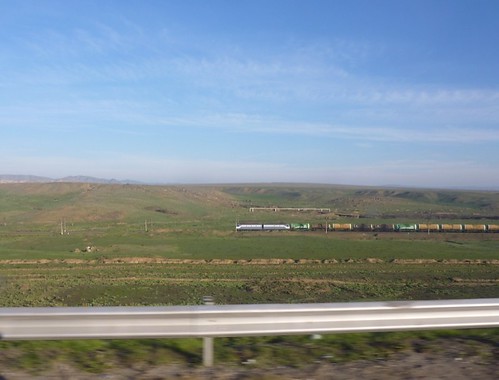
Goychay is quite a ways from Baku - the trip there was about 3 hours long, and started very early. This was fine on the way there, when the sun was shining and there was scenery to look at. I found the landscape weirdly familiar, as would anyone who’s driven across the prairies.

P1120007
Long straight road, railroad running alongside, generally flat land, and some hills off in the distance. What’s missing is fields of waving wheat and grain elevators, but all in all it was sort of homey.

The Bag Baku group this time was surprisingly diverse; I think this is the first time I’ve been the only native English-speaker in a tour group. We had people from Azerbaijan, Poland, Egypt, Germany, Switzerland, Singapore and Iran. Like I said, diverse. After arriving we all sat down to a traditional Azeri breakfast at a local restaurant, out in the late fall sunshine at one big table. The menu was pretty standard: sliced tomato and cucumber to start, along with some salty local cheese and lots and lots of bread, served with butter and honey. This was followed by hard boiled eggs in the shell and some alarming looking pink wieners boiled in their plastic wrappers. And of course lots and lots of tea. There was, however, one stand-out offering that I was delighted to discover: qaymaq! Astute Go Stay Work Play Live Readers will immediately notice the linguistic similarity with Serbian kajmak, and it turns out both are pronounced the same way and are a dairy-based sort of spread. However, while I thought that Serbian kajmak was more towards the butter end of the spectrum, Azeri qaymaq is certainly more like cream. Thick, unsweetened and maybe just a touch sour. Azeri creme fraiche perhaps? Whatever the case, it was delicious on bread with a drizzle of honey. And I’ve now noticed it on the supermarket shelves as well, hiding in plain sight all this time! It’s on my list to try again, though I hesitate to make it a regular part of my diet if only because it is really just very very thick cream and I have a limited number of pairs of jeans and I am already finding one pair a tad on the uncomfortably snug side.

But back to the pomegranates. After we were fortified with bread and qaymaq, Sabina let us loose at the festival site and we agreed to meet up again four hours later. Even at the time I suspected that four hours was an ambitious amount of time to spend at a small local festival, but off I went. The site was the local outdoor stadium, and when we arrived at about noon the place was already bustling. Around the outside of the running track there were dozens of folding tables set up with people crowded around so I pushed in to see what the fuss was about.

IMG_2277
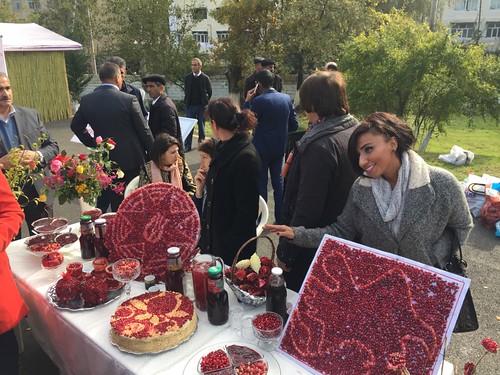
I’m not sure what I was expecting from the Pomegranate Festival, but it was not mosaic maps of Azerbaijan, rendered in different coloured shades of pomegranate seeds.

IMG_2279
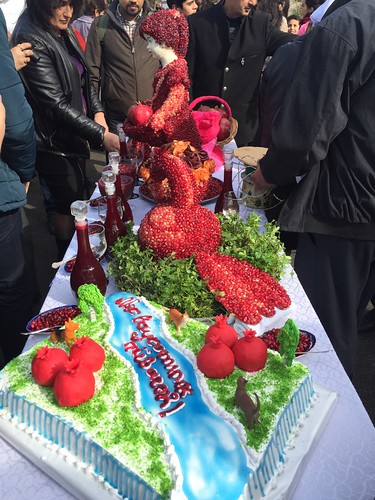
Nor, indeed, three-dimensional pomegranate peacocks. Or dolls. Or, in fact, pomegranates, made from pomegranate seeds (or perhaps just really really carefully peeled?) Though I suppose this is not miles away from the carved vegetable competition at the good old Lambeth Country Fair, so who am I to judge?)

It was an odd yet heartwarming display. Table after table of local people who’d taken the bountiful pomegranate harvest and tarted it up in odd and unexpected ways. There were also lots of plain pomegranates on display, and dishes of Nar Sherab, a sort of savoury pomegranate sauce that’s served with fish or grilled meat. (“Nar” is the Azerbaijani word for pomegranate. Short and to the point, which, given the popularity and ubiquity of the fruit here, is handy).

It took about half an hour to make a circuit of the track, and that included stopping the buy a small keychain souvenir half way around. (A hand carved wooden Maiden Tower, 4 AZN.) I also stopped at a stall to pick up some shower gel and hand soap made by a company that does really nice pomegranate bath products and was having a big big sale. Still, even after lingering at the pomegranate wine stall (No samples! Damn!) and doubling back to pick up Sabina and ask her a bunch of questions, there was still a LOT of time to kill, leaving me plenty of time to wander through another area full of food stalls, and, of course, people selling pomegranates.

But here’s the thing that really struck me about the pomegranate festival. It was very… homogenous. In a place with such a remarkable bounty/glut of pomegranates, I’d expected to see people doing all kinds of wonderful and interesting things with them. Pomegranate cakes and cookies. Pomegranate molasses and jam. Pomegranate t-shirts. Pomegranate hats. Pomegranate lip gloss. All the kinds of things you’d expect from a 21st century harvest festival in the western world. Instead, it felt like everyone was doing the same thing. You could buy pomegranates in many different varieties, or pomegranate juice, or nar sherab. With very few exceptions, that was it. The same was true with the food stalls. I'm used to seeing everything from cupcakes to jerk chicken at a festival site. Here, you could get kebabs. Or kebabs. Or, for a change, you could have a kebab. True, they were doing both the minced meat lule kebab and the chunks-of-meat on a skewer kind as well. And there were a couple of different meats available. Also, very popular among the kids was an offering of a large plain bun split open and filled with a cold wiener sliced long ways into quarters, with some kind of red sauce added (I’m guessing nar sherab, perhaps?). It reminded me of that popular kid’s treat - cold uncooked wiener. And there were sweets, all pre-packaged. And tea. Very little diversity of any kind.

P1120008
Then again, that’s kind of emblematic of Azerbaijan in a way. It’s a very homogenous society. Have a look at this picture.  See anyone tall and blonde? Probably not. Or if you do, I guarantee you it’s a foreigner.

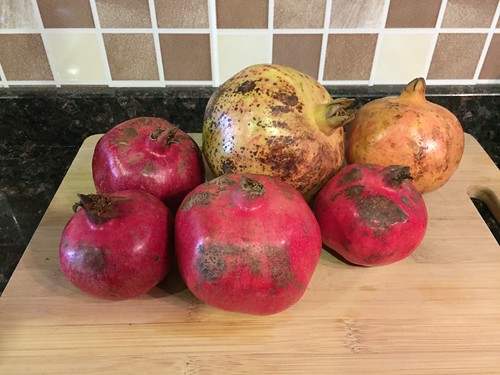
Our time at the pomegranate festival eventually ran out, about 3 hours after one might have wished, but not before I bought a few pomegranates. These included some less common pale yellow varieties, including one very large one that I paid an extortionate 4 manat for. A lot of money in that neck of the woods, but I did not begrudge it. And finally we gathered again for a quick, late lunch and found our way back to the bus for the trip home. Which was an interminable, dark and dull drive and that’s as much as I’ll say about it.

IMG_2298
The haul of pomegranates

What I will do, though, is pass on my now-standard method of tackling the somewhat tricky pomegranate in the kitchen. Real pomegranate neophytes may not know that it’s only the seeds inside the fruit that are edible - the outside peel and the inside membrane are bitter and unpleasant. The seeds - called arils - consist of a seed kernel nestled inside a tart and juicy outer layer where all the flavour is. Sadly, pomegranates are a bit like beets in that tackling them unwarily can stain your fingers, hands, clothing, kitchen, wallpaper, and anyone passing nearby, including housemates, children, pets. Worse still, pomegranates seeds that get ruptured have a habit of spraying their juice in a way that reminds one uncomfortably of a scene from “Dexter”.

Here’s the trick:

1. Place a large mixing bowl in the sink and fill with water.
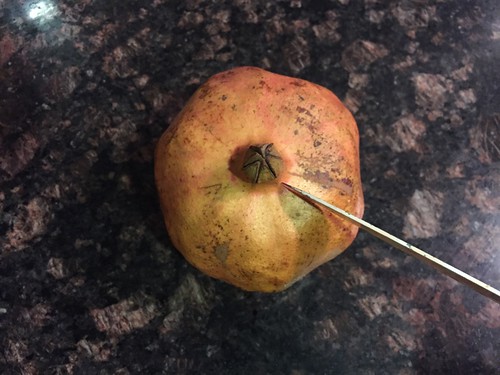
2. Using the tip of a sharp paring knife, score through the outside skin of the pomegranate along its “ribs”. These can be a bit tricky to identity, but usually you can see from the top that the fruit is not actually spherical but very slightly faceted. Score on the edges of the facets.

IMG_2325
It’s not absolutely critical to get these cuts perfectly placed, but it does help keep things tidy. It also helps to cut the crown out of the top of the fruit.

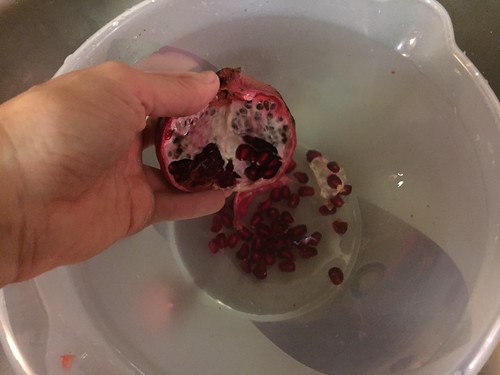
3. Hold the pomegranate under the water in the bowl and use your thumbs to open it up into chunks, a bit like separating a peeled orange. You should end up with 5-6 sections with most of the seeds exposed. The water will stop any spray, thus protecting your wallpaper.
4.  Keeping each sections under water, work the seeds loose from the pith and let them sink to the bottom of the bowl.

IMG_2324
In process

5. Discard the big sections of peel and let the small bits float to the top. Skim them off and discard them.
6. Once you’ve got all the seeds out, there will still be some seeds with bits of pith on them. I find if you rub the collection of seeds between your hands most of that comes loose and floats to the top.
7. Drain the water off, along with all the floating bits of pith, leaving a bowl full of tidy seeds, ready to eat. I store them in a tupperware container in the fridge and they stay fine for days.
8. Send a donation to Go Stay Work Play Live for making your life better. (This step is optional but encouraged for maximum karmic benefit.)

IMG_2328
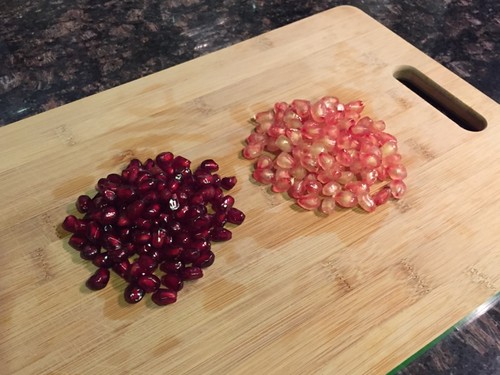
And here’s a look at the difference between the seeds from regular red poms and the less common yellow ones. And yes, they do taste different. The pale ones are much sweeter and lack the puckering acidity of normal red seeds. (Side note - it’s totally fine to eat the hard kernel inside too - that’s where most of the fibre is. And indeed it is mostly impossible to each the outside juicy bit and discard the kernel.)

These days I mostly just sprinkle the seeds in my morning bowl of fruit and oats, but they’re also really nice in salads. And they’re often added to pumpkin flavoured qutab too, which is lovely. Or you can sprinkle them over cooked meats. And supermarkets often have fresh juice stands sitting right in the produce section where a young guy will chop open a pomegranate and stick in a squisher device that looks a bit like a medieval torture instrument and extract you a plastic cup of fresh juice.

And that is truly as much as I can say about pomegranates.

A Day Out: Castle on a cloud

Sunday, November 13, 2016

I’m lucky to have the Baku Hash House Harriers to hang out with while I’m here. As an ex-pat working in the same office and living in the same hotel as a bunch of other ex-pats, there’s a real danger of ending up spending all your time working and socialising with the same people. (Or of not socialising at all.) Given the pressure-cooker that ceremonies work can become, I try to make sure I get to the weekly hash runs on Sundays and to the casual Thursday night runs as well. Having hashers to hang out with means that sometimes activities come up that don’t involve running too, which can often be a Good Thing.

One of the local Baku hashers I met last time is the lovely Raul, a UK-based professional living in Baku and working on something to do with the government. Or possibly agriculture or er, economics. Or maybe all three. As you can tell, I’m totally plugged in to the details of Raul’s professional life. Whatever his job is, Raul is a bright and unflinchingly cheery soul and is utterly intrepid about getting to know the city and the country as a whole. He’s been here for a couple years now, and seems to have filled every spare moment with trips and tours and solo adventures on local buses to distant landmarks. As such, he frequently suggests activities to shake out the cobwebs and escape Baku, including this week’s topic, a day trip to the beginning of the Caucasus Mountains near the tiny village of Galaati. This one was organised by an outfit currently called Bag Baku.

I never managed to see much outside Baku on my first stint and Raul promised that the weather forecast was good, so despite the fact that I didn’t bring the right footwear or jacket for autumn trekking, I fetched up at the meeting point on Saturday morning with a positive attitude, a packed lunch, and a pair of dry socks (just in case). After a surprisingly short wait, we set off in a minivan full of other expats only a few minutes past 8:00am, which is frankly astonishing for Azerbaijan. Raul is fond of reminding me that in his experience, the Azeri language does not have a way of expressing the concept of something starting exactly at a specific time. “FROM, not AT” is his frequent refrain, meaning that when you say “Be at work AT 9:00am”, in Azeri that translates to “Be at work starting from 9:00am” which I’m sure you can see is a very different concept. I’m skeptical about whether this is strictly accurate, linguistically speaking, but if it is it would explain a lot.

Our goal for the day was to visit a ruined castle on top of a mountain. Normally at this point I’d link you to a Wikipedia page, but the entry for this particular site is so ridiculously short I’m just going to pop it in here, in its entirety:
"Chirag Gala (which means Lamp (or Light) Castle in Azerbaijani) is a ruined ancient fortress overlooking the Caspian coastal plains north of Baku in Azerbaijan. It is located on the top of a mountain, in the Guba Forest. It was constructed by the Sassanid Persians in the 5th century and was used as a defense for the khanate of Quba in the 18th century. Today the Chirag Gala is a historic site and is frequently visited by tourists. Because of the large rocks and rough road the Chirag Gala is almost impossible to reach with any vehicle. Most tourists and people travel by foot to the top of the mountain."
It seemed like a good goal, though the closer we got the the village that would be our starting point, the worse the weather got. When we left Baku it had merely been overcast, but by the time we reached Galaati there was a light misty rain, so we donned rain gear and I resigned myself to the idea that my feet were going to be wet for most of the day and that my running shoes - the closest thing I have to appropriate footwear - would probably never be the same.

P1110954
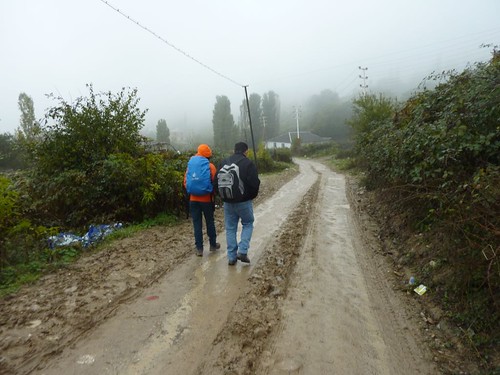
Here are Sabina from Bag Baku and Raul at the start of the trek, as we’re passing through the village. This was one of the better roads.

Sabina was our guide for the day, though “guide” turned out to be a strong word. Having been on many guided tours on several continents, I was expecting the usual running commentary as we ascended - historical context, local flavour - that kind of thing. Instead, it was mostly a companionably quiet trek in the rain. If asked, Sabina would venture an opinion but she was not a tour guide as we know it. This, coupled with the increasingly wet and muddy state of my feet, left me wondering if I’d made the right choice about how to spend my Saturday.

I trudged along with Raul and Sabina and the rest of the group strung out a long way behind us. They were made up mostly of two different categories of people - Turkish Language Students, and Locals With Even More Inappropriate Footwear Than Me. The Turkish language gang are around because their program had been diverted to Azerbaijan after the coup in Turkey. (The Azeri language is very similar to Turkish, and Baku was deemed a much safer location.) And the locals… who knows? I only know that one of them made it half way up the mountain in high wedge-heeled shoes before digging a pair of runners out of her bag (thus ensuring she ruined both pairs). And another woman made it all the way to the top and back carrying a large black leather purse and a separate tote bag. I think it’s safe to say we were a mixed bunch.

P1110960
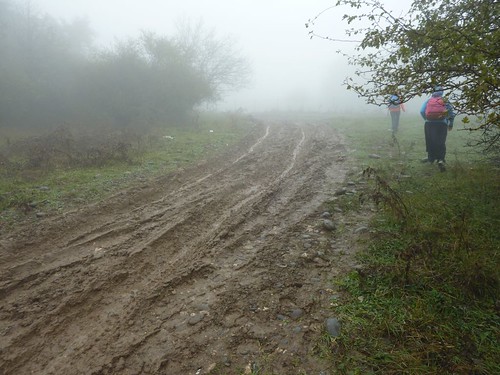
The road continued to get steeper and muddier, and the higher we got the more mist closed in. Often it was better to walk along the grassy verge.

It was a winding four kilometre walk from the village to the start of the Chirag Gala Path - the point where the vehicle road ends and it’s only accessible on foot. Though I would not want to drive a vehicle on much of that vehicle road. Raul, in his capacity as Guy Who Knows Way More About Azerbaijan Than Me reports that the government allocates just 3 manat (about £1.50) per person per month for services in the regions of the country outside the main cities. That’s for all government services - education, health care, postal services, water supply, infrastructure, dog-catching, patriotic red, blue and green bunting… the lot. So I guess it’s no surprise that the roads around Galaati are not exactly Autobahn quality. In any case, we eventually made it to the top of the road and paused there before heading on the final leg of the upward climb. We paused because there was a small tea house that would later be serving us hot tea, and it had a bathroom. It also had two lovely friendly dogs, a flock of geese and two turkeys. Naturally.

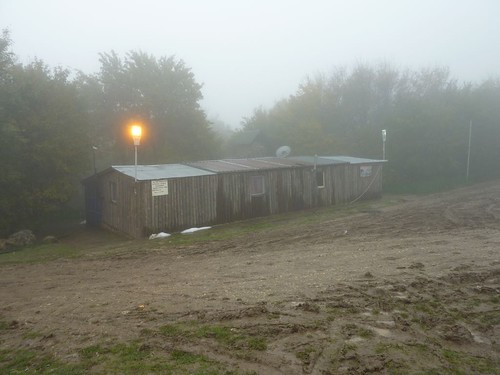
P1110961
Teahouse in the mist.

The last bit of the path was certainly the most challenging, not least because the weather continued to worsen the higher we got. Or perhaps it was simply that we were climbing higher into the clouds. Either way, the path was narrow and wet and slippery and the going was slow, though the two dogs seemed to have no trouble at all and accompanied us all the way up. Finally, the castle emerged from the mist.

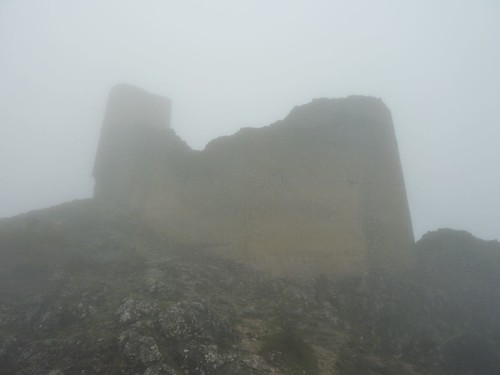
P1110964
This is as much as it emerged. Truly, I am not kidding when I say it was misty.

I’m also not kidding when I say it’s a ruin. There’s not much left of the castle, and it’s hard to get a sense of the shape it once might have taken. Still, it did feel like an achievement to get there and despite the fact that it was cold and wet, the mood of the group lifted as we clambered around on the slippery rocks exploring. It was the kind of thing that would give a UK-based Health and Safety Consultant apoplexy. Steep climbs, wet surfaces, and not a guard rail in sight. It might be a good thing that the mist was so dense, so we couldn’t see how high up we were.

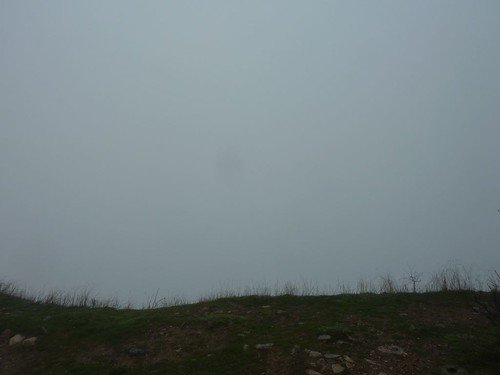
P1110971
The view from the top. As you can see, I was not exaggerating about the low visibility.

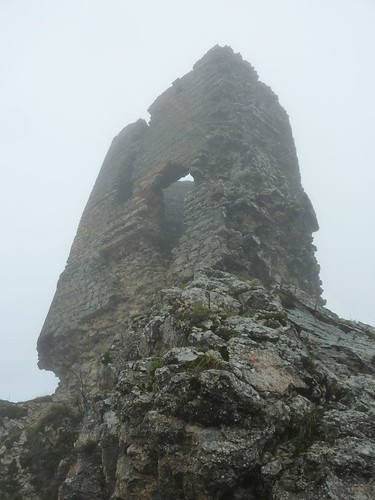
P1110975
The main tower. Another scrap of info I found online claims that the tower "was built over a seam of oil and gas which allowed for lighting up signal fires visible to the distance of several dozens of kilometers”.

P1110974
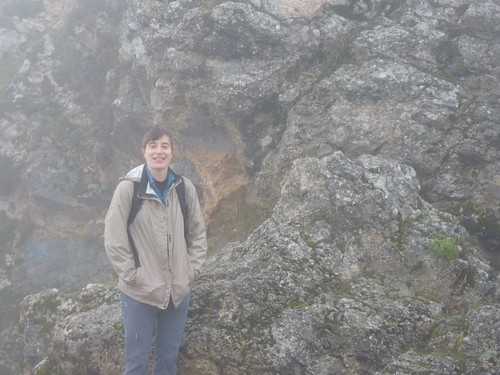
Me at the base of the castle

Eventually we all got tired of standing in the mist with wet feet. (Or maybe that was just me.) In any case, we picked our way back down the mountain, with appropriately comedic moments of slipping and falling in the mud, which happened at regular intervals to about half of us. When we finally made it back to the tea house we were directed out behind the main house to a sort of rustic outbuilding that did not look quite as cozy as one might like after hiking up and down a mountain in the rain. Luckily, it turned out the place had a nice little wood stove that warmed it up very well, and the table was set for tea in the traditional Azrbaijani style.

14918746_1876644882569999_5534143178148106290_o
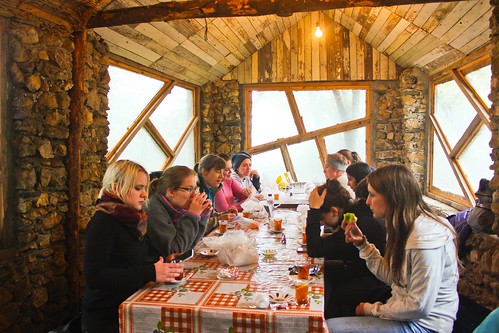
Tea in the outbuilding. It is not exactly Fortnum and Mason, but it could not have been more welcome. (Note: I got this photo is from the Bag Baku Facebook page. Because it was more interesting than my photo of the empty room.)

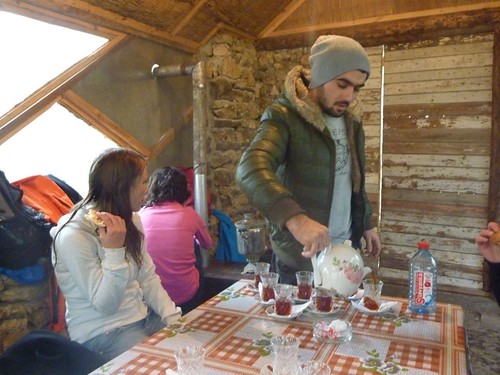
As we warmed up and draped wet clothing near the fire, one of our hosts brought out the samovar, which was set on the stove. The samovar holds water heated in the outside jacket by a tiny fire in the inside chamber, while the tea pot holds very strong black tea and sits on top of the samovar. When all was ready he filled each glass halfway up with strong tea and then topped up with hot water.

P1110989
Often it’s traditional to serve this sort of tea with jam. Not with jam in the tea, though. The jam is simply eaten with a spoon. A bit tooth-achingly sweet, but this is a truly sugar-loving nation. The candy section in my local grocery store is larger than the produce section. And Gerald reported seeing an Azeri coworker put eleven cubes of sugar in his coffee last week.

We sat around thawing and drying and chatting and eating our packed lunches. And I took advantage of having a few Russian-speaking locals around to brush up my language skills a bit, settling one and for all the distinction between ходить and приходить (Not). Once we’d thawed out and eaten and drunk our fill of tiny glasses of tea, we slowly moved out for the long walk back to the van. Happily, as is usually the case, the way back seemed shorter than the way out, and the weather improved as we went. And just as we reached the outskirts of the village, the clouds parted and we saw patches of green countryside and blue sky. And, of course, we saw our castle.

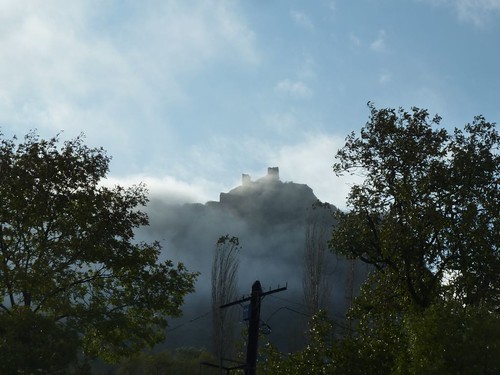
P1120003
How lovely would it have been to have been at the top when the mist cleared? Not so lovely to want to climb back up. At least not that day.

P1120005
Rounding the final corner with beautiful countryside spread out in the distance.

I got to put on my dry socks, but kicked myself for not packing dry shoes as well. Rookie mistake. And the trip back to Baku was surprisingly quick and quiet, with quite a lot of napping by quite a few people. Despite the fact that I was a muddy mess, I stopped in at a smart new qutab shop near the hotel where I warmed up and dried out a bit more. This shop is a definite keeper. They had three Azeri women making the qutab on the spot - rolling out the stretchy dough with skinny taped rolling pins, filling them to order, and then slapping them on the traditional convex shaped gas fired grill, which looks a bit like an upside-down wok. The qutab shop staff seemed to find me fascinating, asking about why I was so muddy, and bringing me a damp cloth to wipe the dirty spots off my day pack. I managed to sort of explain what I’d been up to with broken Russian and photos and hand gestures, and ended up having a perfectly lovely time waiting for my takeaway order.  And when I finally got home and put my feet up with my fresh qutab and a glass of wine I was suffused with the satisfaction that comes from sitting comfortably after a day of chilly physical effort and minor discomfort.

And of course the next day was the most perfect, bright, warm, sunny fall day you could imagine. Then again, my running shoes dried out fine so, you know, it's all swings and roundabouts.