Showing posts with label work. Show all posts

It's not rational...

Sunday, May 25, 2014

It feels like a hundred yeas ago, and it's hard to believe that I've only been back in the UK full time for about a month.  I’m busily at work on a new show, and my diet actually includes fruits and vegetables at most meals, and I’m running or cycling every day and everything kind of feels… normal.  It’s delicious.  On the other hand, there are a few anecdotes I just have to tell you about Russia, so here goes:

On the fickle nature of hotel laundry:

I've said it before, but that gig was HARD.  The hours were long, we were way behind schedule, and, as I mentioned before, the living conditions were not ideal.  There was one good thing about our hotel though - they did laundry, and they did it cheaply.  The fantastic posh hotel in Moscow also did laundry, but given that it cost about £6 to get a pair of running shorts washed I didn't use that service often.  At the good old Ekodom Hotel in Adler, getting a normal load of laundry washed, dried and folded cost about 70 roubles (£1.25). This was a godsend. Except, of course, there was a catch.  In Russia it seems there's ALWAYS a catch, though this one applied only to women.  I noticed it after I got my first batch of laundry back.
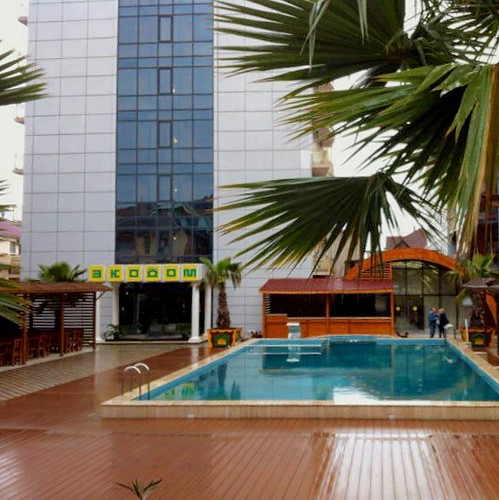
Ekodom Hotel
The Ekodom...

Everything seemed normal, but for one small oddity.  All of my underpants had been separated from the rest of the laundry, secured in their own plastic bag (knotted shut) and tucked in with the rest of the load.  I thought this was a bit odd, but at that stage I’d been in Russia long enough that this quirk was barely enough to register on the Russian Weird-o-Meter, so I took them out of the bag, shoved them in the closet, and got on with life.

Later that week I pulled out a pair of underwear and noticed that it wasn't clean.  “Odd," I thought.  "That one must not have made it into the laundry bag."  The next week I sent another bag of laundry in, including underwear.  Again, it came back with all underwear neatly sequestered, and this time I confirmed that NONE of it had, in fact, been laundered.  I marched down to the front desk with my bag of dirty underwear and asked them to please send it back because when I sent my clothes in to be cleaned I naively assumed that the people I was paying for the service would actually clean ALL of them.

The next night I stopped back to pick up my clean underwear.  And it's worth noting here that this was probably at about one o'clock in the morning, after a fourteen-ish hour day, so my nerves were slightly raw.  And then... then the truth came out.  Once again my underwear was not clean, but now there was an explanation (or what passes for an explanation in Russia). They simply didn't do women's underpants.  At all.  No exceptions.  Men's underwear was no problem.  Other women's undergarments were ok too.  But women's underpants?  No way.

As I stood at the front desk, mouth gaping, trying to think of something to say, a female colleague who was also staying at the hotel said something to the effect of, "Oh yeah. The No Underwear Thing.  Didn't anyone tell you?"  Well, no.  No they didn't.  And what kind of a ridiculous freaking rule is that?  I trudged back up to my little orange shoebox of a room clutching my plastic bag full of dirty underwear and sat on the edge of my bed and tried hard not to cry.  "Typical," I thought.  "I'm working on the biggest show on earth, under huge time pressure in bizarre circumstances, and the thing that almost pushes me over the edge is the fact that they won't wash my knickers."  And then I snapped myself out of it, probably with the help of a drink.  And the next morning I filled the bathroom sink with hot water and dish soap and I hand-washed my underwear and hung it to dry in the shower.  And I did that every three days for the next ten weeks.
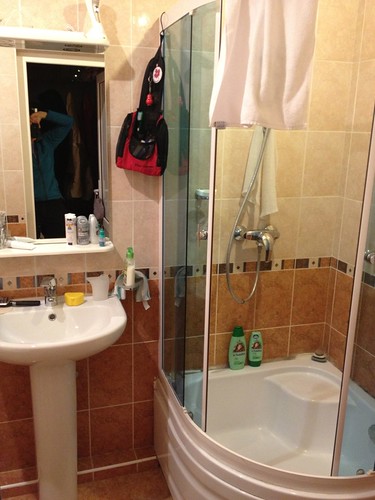
IMG_4571
The bathroom sink and shower in question

I can't remember whether we were talking about this exact little quirk of life, or some other equally odd happening, but I was having a conversation with a colleague about this sort of thing and he said one of his suppliers had coined a term for when he was confronted by the sheer bloody-minded, unbelievable frustration of it all.  "It's not rational," he'd say.  "It's Russian-al".

Truer words were never spoken.


On overcoming obstacles:

I've already mentioned the problems we had with food on the Olympic Park site. (But I didn’t mention this… one day in the canteen one of the dinner options included LIVER FRITTERS. Seriously?  How is that even a thing?)  And I mentioned my successful method for smuggling in food stuffs to help me survive.  It also happens that I had a reasonable stash of that most Canadian soul food imaginable - Kraft Dinner.  At some point along the way I realised that there were microwave instructions on the KD box, which was a revelation.  While I didn't have a microwave in the hotel room (they were forbidden, of course) we did have them in the office.  So I decided that I'd risk trying to smuggle in a box of Kraft Dinner.  I had enough boxes that if I lost one it wouldn’t be an unmitigated tragedy, and the idea that I might be able to stop for a few minutes and have a bowl of KD in the middle of the maelstrom was a powerful draw.  So I opened up the box and poured the macaroni into a ziploc bag (also imported from Canada) and shoved it into the toe of one of my big fuzzy socks.  The envelope of cheese powder went into the other sock, and both got twisted and turned inside out so that it looked like I was simply carrying two pairs of big fuzzy socks through the security checkpoint.  Perfectly normal, or at least normal-ish.
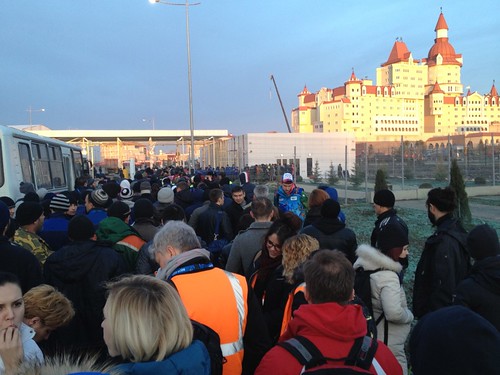
IMG_4632
One of a number of exceptionally long queues to get through security.  We're heading for the small square white building.  The wacky castle is... well, we just called it Wacky Castle.  It seemed to be associated with an amusement park right outside the Olympics Park gates.

No matter, I got in.  (As I've mentioned before, the Big Fuzzy Sock Method was one hundred percent successful.  The only time I had food confiscated was when I forgot I had a Snickers bar in my jacket pocket, which really doesn’t count.)  Later that day, after a really tough afternoon, I finally found time to sit down and contemplate how to assemble my contraband KD.  I had a fairly large plastic tupperware sort of bowl (but a Russian one, so the lid didn’t actually stay on).  And we had water coolers that dispensed really hot water, so I was able to fill the bowl with the right amount of water and then pour in the macaroni in preparation for the microwave.

Of course this was the point of not return.  Once the macaroni hits the water there’s no going back.  No chance that I could change my mind and postpone.  It was now or never for that Kraft Dinner.  So I turned around to put my plastic bowl of happiness in the microwave. Except… the microwave was GONE.  Both machines that had been sitting on the table next to my desk for weeks had vanished.  I stood there, stricken.  A colleague noticed my expression and asked what was wrong.  (Or perhaps I just might have attracted some attention by exclaiming, rather more loudly than might have been appropriate, “Are you fucking KIDDING ME????”)  Whatever it was, I soon found out that the Russian catering department had decided to start feeding the cast hot meals and to that end had commandeered every microwave in the building and taken them to the rehearsal site to heat up food.  Of course.

So let's review:  I’d managed to get this Kraft Dinner all the way from Canada.  I’d smuggled it in my socks to get it on site.  I had the time, the bowl, the hot water… and yet still Russia had managed to thwart this tiny bit of homey happiness.  Once again, just like with UnderwearGate, I almost cried.  It really is the little things that kill you sometimes.

But wait!  This story has a happy ending.  It turned out that one lone microwave had survived the cull.  So I carried my precious bowl across the compound to the canteen, where I found the skankiest microwave I’ve ever encountered.  And I put that bowl in and watched it boil over.  And I cleaned up the boiled over sticky pasta water with a thousand paper napkins. And it boiled over again.  And I cleaned it up again.  And then I carried the burning hot bowl back to my desk and mixed in the cheese stuff and a bit of milk and mayonnaise (because I didn’t have butter) and damn, it was GOOD.

And actually, that’s kind of what it was like a lot of the time.  You’d expend a massive, ridiculous, disproportionate amount of effort to make something happen.  And then just when you thought it was sorted out, six other things would get in the way.  And you’d just have to put your head down and keep plugging, and eventually something pretty ok happened.
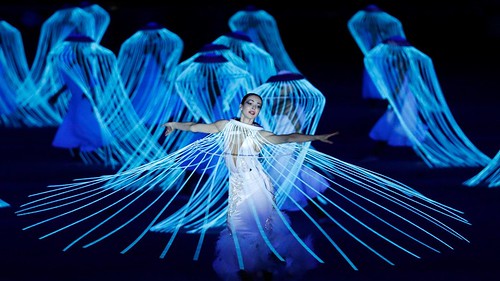
winter-olympics-opening-ceremony-photos.jpg
Like this.  These light-up spinning head-dress things were props, and despite numerous ridiculous obstacles, they ended up looking really cool.

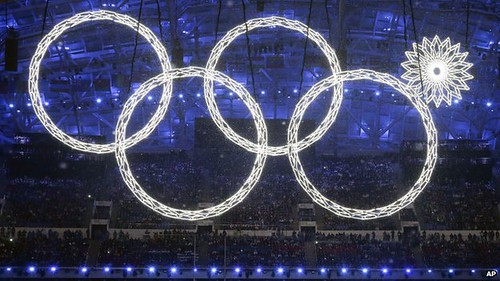
Thoughts on Russia

Sunday, April 27, 2014

First things first.  This was NOT my fault.  Not even my department.  Nothing to do with me.

_72839813_72839807
And the rumour that the guy responsible showed up dead in his hotel room the next day? Complete rubbish.

Moving right along... Hi!  I know it's been a while, but I did warn you.  Here's a bit of catch-up: I finished work in Russia on March 21, spent a quick weekend in Moscow with the lovely Moscow hashers, had a short stopover in a London to do laundry and re-pack, and then was off for a week of vacation in New York City, followed by two weeks of visiting with family in Canada.  I finally got back to London and unpacked my suitcase for what I hope will be a long long time just a week ago.  So the job ended about a month ago, and yet it seems like a hundred years.   For those of you who haven't been paying attention, I was living in Russia and working on the Opening and Closing Ceremonies for the Sochi 2014 Winter Olympics and Paralympics.  All of it feels impossibly, deliciously distant in a way that I wouldn't have believed when I was in the middle of it.  I arrived in Moscow at the beginning of August 2013 and I left at the end of March.  Eight months, including a punishing stretch of more than five months without a trip out of the country.

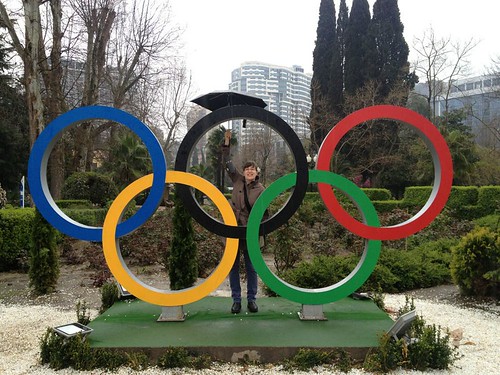
Me and the Rings
Me posing with some rings in Sochi.  I'm smiling because this was taken on the day before I left!

I'm struggling to know where to start.  Astute Go Stay Work Play Live readers will remember that I worked on the ceremonies for London 2012.  So this wasn't my first ceremony, and in many ways it was quite similar to London.  I suppose any ceremony is going to have the same elements.  Unrealistic schedules that shift continuously, gruelling hours, a determination to push the bounds of the possible, a scale that boggles the mind.  That kind of thing.  Maybe what I need to do is focus on what was different...

Different thing #1:

This will be stating the blindingly obvious, but did I mention I was in RUSSIA?  With the London ceremonies, even when it was crazy, I was still going home every night.  That was a huge comfort.  I slept in a familiar bed.  I cooked and ate normal food.  And on the rare occasions when had a day off, I had friends to visit and a normal life that I could dip back into, even if only briefly.

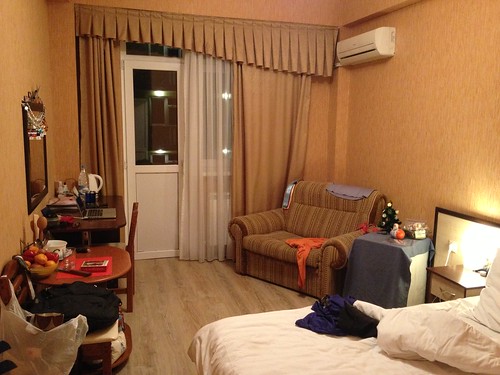
In Russia I lived for the whole time in various hotels ranging from gorgeously well-serviced (Moscow) to eminently pleasant (Krasnodar) to three star orange-wallpapered, saggy-furnitured shoebox (Sochi).

photo
The orange shoebox.  It was quite a come-down from Krasnodar and Moscow, though I did eventually make my peace with it.  Not that I had a choice.

Also, in London there were people in my life who had nothing to to with ceremonies.  I saw them occasionally when I dragged myself in from a long night and they were up finishing the end of a bottle of wine and I was reminded that normal life continued for some people.  In Russia I got on the staff bus in the morning with the same people I'd work alongside all day. We ate lunch together.  We ate supper together.  We moaned and complained together.  We waited for the bus home together.  And then when we got home to the same hotel, the only people to have a drink and unwind with were the same people you'd just spent the whole day with.  Luckily, there were many excellent people and I formed some really great friendships. But still, it was relentless and unnatural.

Different thing #2:

Once again in the blindingly obvious category, most people in Russia speak Russian. There was a large contingent of international English speaking consultants (me included... we were all there in what was technically called an advisory role...), and an equally large number of local Russian people, some of whom were bilingual and some who were not.  The Props Team in particular seemed quite integrated.  Our international and local Russian staff worked alongside each other every day, which happened less in departments that had mostly international staff and contractors.  And of course outside the office on the street, it was all Russian all the time.

"Wait a minute," you astute GSWPL readers might say. "Didn't you take a few month of intensive one-on-one Russian language lessons before you went?  I'm sure I remember a whining blog post about that…" Of course you're right.  I was one of a handful of international staff who had made an effort to take formal lessons (I think there were four of us) and it definitely made a difference.  By the end of my eight months I could make myself understood most of the time with out uni-lingual Russian crew, though I was largely limited to bread-and-butter stuff like, "After rehearsal we need all props in Tent B." Or "This is very very important."  Or frequently "I'm tied, hungry and cold." Not bad, eh?  Unfortunately, as is the case with my French, I speak Russian much better than I understand it.  So while I can phrase a comprehensible question, parsing the answer was often beyond me.  Nonetheless, it made a difference.

For instance, the Transport department had English and Russian staff, but it was the Russians who really held the reins.  So whenever I needed a truck for one of the endless back-and-forth moves of props from the stadium to the rehearsal venues and back (honestly, it was like we were doing laps with them) I had to speak to Transport.  Eventually the English Transport Manager just said, "Look, you just need to go across the hall and talk to Albina, because that's all I'm going to do anyway.  She doesn't speak English, but someone will translate for you." So across the hall I went and started to make my request in English, but when I understood some of the related Russian conversation and responded in Russian... well!  The transformation was miraculous.  Suddenly it was all, "You speak Russian! Sit down! Where did you learn Russian? What do you need again?"  I felt a bit like a dog walking on its hind legs, but on the other hand I never had trouble getting a truck again.  So there you go.  Like anywhere, if you make a little honest effort, people respond.

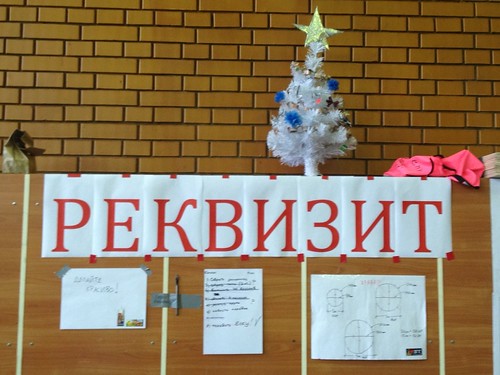
Props
A very important word!  РЕКВИЗИТ means PROPS, of course. (And the bushy white thing with a star on top is a ёлка.)

Different thing #3:

Food.  Or, to be more accurate, Lack of food.  In Moscow it was no problem.  There was the lavish breakfast buffet at the hotel and there were normal (-ish) grocery stores stocked with (mostly) familiar things.  In Sochi… not so much.  We lived in a little town called Adler, part way between the city of Sochi and the Olympic Park.  Adler is a funny town.  Its main reason for existence is to service Russian summer holidaymakers with its proliferation of bars and souvenir shops and its unfriendly rocky beach.  Being there in the off-season meant that it had a lonely and forgotten vibe

Beach
The beach, on New Year's Day.

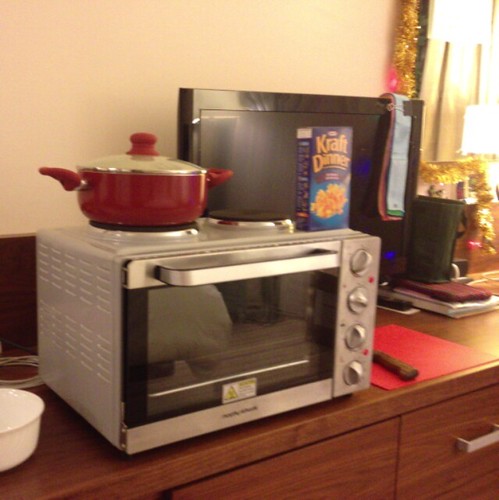
Anyways, the supermarkets were not great in Adler.  And of course you might notice from the picture of my hotel room that I did not have a kitchen.  I anticipated this fact before arriving and actually bought a portable toaster oven sort of thing that I schlepped from London to Moscow to Krasnodar and finally to Sochi.  And what did I find out when I got there?  The hotel had banned all such devices.  Of course.

photo (1)
Here’s the device in action briefly in Krasnodar, cooking up a pot of Kraft Dinner on one of the two top elements.  It was a great appliance.

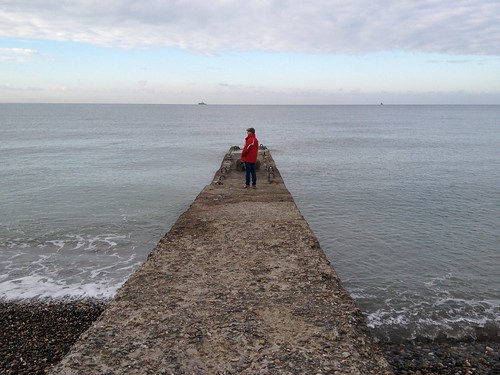
We never got a really clear reason WHY this was the case.  Sometimes they cited fire regulations.  Sometimes they claimed there wasn’t enough power.  Sometimes they said that you could use a device if it had an automatic shut-off timer, like a kettle or a toaster.  My next-door neighbour and partner-in-crime Gerald (pictured above, posing on the pier on New Year's Day) cleverly bought a multi-cooker that was like a quick crockpot sort of thing.  It seemed to tick all the boxes and we enjoyed one really nice meal out of it before it, too, was banned.

Add to this less-than-ideal hotel situation a total prohibition on bringing food or drink into the Olympic Park.  Total.  Every day we had to line up at the security gates for an airport-style x-ray and pat-down.  Every day people had food confiscated.  Some people even had packs of gum or breath mints taken away.  And sometimes this was after we’d stood in line for 45 minutes just to get to the point where they’d take your stuff.  It was really dehumanising. Most people developed systems for smuggling in small amounts of food (mine involved balling things up in a particularly thick pair of sock.  "What?  Food?  Nope.  No food here Mr. Russian Policeman.  Just some warm socks for later.  Yep.  Nothin' to see here...")  Even though I was one hundred percent successful in my smuggling efforts, it generally wasn’t enough to keep body and soul together which meant that at least once a day you’d have to take your chances on the staff canteen.

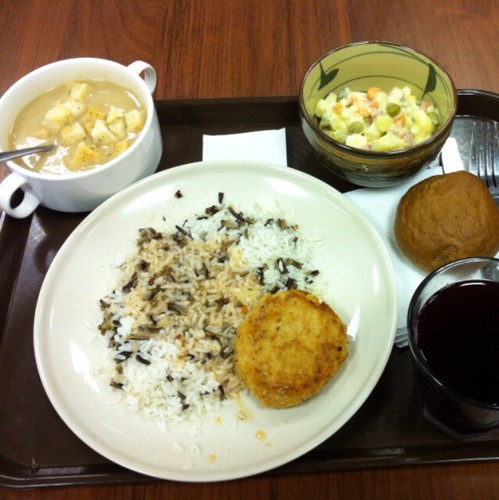
The canteen was... Overcrowded.  Overpriced.  Overcooked.   Just really disheartening.  The fixed price was 300 roubles (About £6 or $9).  For that you got a salad course, usually a choice of something heavy on the mayonnaise and potato, or a plate of scary sliced luncheon meat, or a bowl in which beets featured prominently.  Then soup (though only at lunch), which was usually thin and highly average.  Borsht.  Solyanka.  Creamed vegetable.  Meh.  The main course was usually the worst.  A few kinds of potato or rice, or sometimes a boiled vegetable. Plus a choice of some kind of dodgy meat product, often a sort of processed cutlet, or maybe fish, or maybe chicken.  It was all just maddening and nasty a lot of the time.

foto 3
Clockwise, from top left: cream-of-something soup, pototo-mayonnaisey salad, bread roll, glass of compote (a juice-like beverage) and a plate of rice with random sauce accompanied by processed meat cutlet of some kind.  Typical.  You wouldn't go hungry, but then again, you might just end up with scurvy.

In fairness, they did improve things after a few near-riots caused by crushingly long line-ups and inflexible opening hours.  Eventually you could get fresh fruit and yogurt and take-away pizza and real coffee.  But they never relaxed the food ban and it was always an issue.

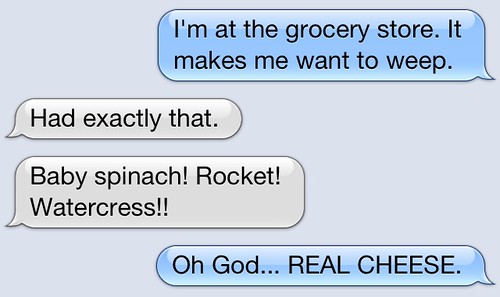
I could probably go on and on about the food but maybe that’s enough for now.  Just looking at those photos makes profoundly grateful that I can walk around the corner to a large grocery store where I can buy fresh spears of asparagus and sweet potatoes and spinach and, well, this exchange of texts with Gerald on my first day back kind of sums it up:

photo (2)
I don't know why, but Russian cheese is kinda awful.

So yeah, I think that's enough for now.  Enough to start giving you an idea of life in the Ceremonies Salt Mine that was Sochi 2014.  And enough to get me back on the blogging train. I might just skip ahead and tell you about my trip to New York next, or I might tell you some more random tales of Russia, but either way I'll try to do it soon.

It's good to be back.

Off the tourist track: Brixton Windmill

Saturday, May 11, 2013

Gosh it's been a while, hasn't it?  Sorry about that, but I've been really busy.  You may recall the expended period of unemployment that followed the finish of my work on last year's Olympic ceremonies.  Well it turns out that freelance production management work in London seems to operate on the same schedule as the buses.  That is, you wait ages for one to come along, and then two arrive at the same time.  In my case the two were gigs for Soho Theatre and Hampstead Theatre. The schedule was not ideal, with the tech period for the Soho show starting a mere three days after the Hampstead show opened.  This meant that I spent most of April in a sort of mad haze dashing from theatre to workshop to theatre and back.  And with this size of theatre production management is very much a hands-on affair, which resulted in a fair bit of time lifting heavy things on and off trucks or standing at the top of a ladder tangled in miles of black string or cursing an M10 nut that had rolled just out of reach under a dusty bit of deck, in the dark.  Luckily for me the end is in sight and I hope to return to my former life of indolent café-dwelling in about a week or so.  Luckily for you I've actually had one or two days off in which to do blog-worthy things, some of which were far-flung, and some of which were almost in my own back yard, like the topic of today's long-awaited return to blogging: Brixton Windmill.

Untitled
No really, it's an actual WINDMILL.

I know I get a bit gushy about London sometimes, but honestly how can you not love a city where you can walk one block off a main road and find a restored 19th century windmill sandwiched between a rather large housing estate and a prison?  (And on a prisons-related note: London is home to two of the most brilliantly named prisons ever. The well-known Wormwoods Scrubs in northwest London held my personal title as Most Excellently Named Prison until it was supplanted when I learned of the now-disappeared institution formerly located in Clerkenwell called Coldbath Fields Prison.  You just couldn't make this stuff up.)

But back to the windmill.  There was a rare confluence of events a couple of Mondays ago: I had the day off, and it was a Bank Holiday, AND the weather was pleasant and sunny.  There were even bluebells out!  (Bluebells have a sort of cult status here, and their arrival in the spring is a notable event.  It's a popular past time to go walking in bluebell woods to see the forest floor carpeted with them.)

Untitled
Not exactly a carpet of bluebells.

Brixton Windmill was built in 1816 and leased by a Quaker family - the Ashbys - who used it to mill stoneground flour for a couple of generations.  By 1862 the increased density of building in the area reduced the amount of wind available, meaning the mill was no longer functional.  It remained dormant until 1902 when the Ashbys returned and equipped it with a steam-powered Provender Mill, a tiny device that could produce as much milled grain in a day as the wind-powered mill could, and could do it consistently.  The mill ceased operation in the 1930s and the sweeps were taken down.  In the 1950s it was listed as a Grade II property and a small park was laid out around it called Windmill Gardens.  The windmill itself was partially restored in the 1960s, with the sweeps reinstated.  However, it continued to decay and was vandalised and somewhat forgotten until it was officially recognised as being "at risk" in 2002.  In 2003 Friends of Windmill Gardens were set up to try to restore the windmill once again.  They campaigned for and won lottery funding and the restoration work tool place in 2010.  The newly restored windmill was opened in 2011, and holds regular Open Days, one of which was on the aforementioned sunny Monday.

Long before my schedule exploded,  I'd pre-booked a guided tour of the windmill, a necessary step because they only allow four people on the upper levels of the mill, meaning that one guide can take three people at a time, so the slots fill up quickly. The restored windmill is gorgeous inside.  There's lots of whitewashed brick and big honey-coloured timbers and precipitous staircases and lots and lots of giant cogs and bits that are supposed to spin and such.  (Warning to Karen: gears aplenty coming up!)

Untitled 
 I like to call this one "Sunlight on Gears"

My tour guide, Robert, was quite knowledgeable, and explained how the mill worked.  In brief: wind turns sweeps, turning sweeps cause grindstones to spin, grain between stones gets ground.  However, there's a lot more to it than that.  First of all, getting the sweeps to catch wind is a bit of a production.  The Brixton Windmill has sweeps equipped with two kind of sails: common sails and patent sails.  Common sails are an open lattice work that have to be covered with a big bit of canvas in order to catch the wind.  This means that the miller would have to climb the sails themselves to rig the canvas, which was a bit of a pain.

Untitled
One of the common sails, unrigged.

The general annoyance of dealing with common sails lead to the development of patent sails.  Patent sails are equipped with a set of hard louvres that could be opened or closed with a hand crank and are therefore way easier to deal with than the common sails. Sadly, patent sails are not nearly as good at catching wind as common sails, which is just typical, isn't it?  That's why the Brixton windmill has two of each type.

Untitled
A patent sail.

The sails are attached to the cap of the windmill, which looks a bit like an upturned rowboat and sits on top of the windmill.  The cap cap actually be turned from the inside (with gears!) which allows the miller to orient the sails to the wind.

Untitled
The cap of the windmill.

Once the sweeps are turning, the shaft of sweeps spins and that horizontal spinning motion is converted vertical spinning motion with - you guessed it - gears!

Untitled
Fascinatingly, anywhere gears mesh in the mill only one gear in the pair is metal.  The other is always built with wooden teeth.  This is to eliminate metal-on-metal contact which might cause sparks in the highly explosive atmosphere filled with finely ground dust. (Karen: don't try to pretend that's not interesting.)

The vertical spinning shaft is attached - a few floors down - to the millstones.

Untitled
The actual grindy bit

The unmilled grain is poured through a hole in the top stone (called the runner stone), and is ground between the top stone, which spins, and the bottom stone (called the bed stone), which stays static.  The resulting flour works its way out to the edges of the stones and is collected.  (And in a wordy aside: any unmilled grain is called grist, as in the phrase "it's all grist for the mill".)  The resulting flour could be milled again to produce a finer grind.  And the stones themselves are actually cut in a pattern, which also affects the grind.  Sometimes mills would even be equipped with two sets of stones to mill two kinds of flour, all driven from the same central shaft through the power of gears!

Untitled
An old millstone on the lawn outside the windmill

As I mention earlier, the mill was revived in 1902 when the Ashbys returned and equipped it with a Provender mill. A Provender Mill is a small, freestanding cast-iron device invented to mill grain without the need for giant buildings with unwieldy sails.  It's somewhat ironic that the Ashbys chose to site their Provender Mill inside the old windmill when they could just as easily have put it in a warehouse or a barn.  Maybe they missed all those nice gears.  The Friends of Brixton Windmill are hoping to get the provender mill running again so that they can actually produce flour, but they're running into money problems and Elfin Safety issues and such.  Still, they're hoping to get grinding again by 2016, which is the mill's 200th anniversary.

Untitled
The provender mill, which originally ran on steam power, and then on gas, and has now been converted to run on one tiny little electric motor.  Boringly, most of its gears are small and hidden.

The actual tour of the windmill only took about 45 minutes, and the surrounding festivities - a slightly sad tea room and bake sale and a somewhat ragtag group of musicians - were not overly compelling.  Still, the place was full of people enjoying the sunshine, and kids frolicking in the adjoining playground, which I'd say is largely due to the drawing power of a really nice big bunch of gears.

Untitled
Me, and a bit of the windmill in the background.

You know what I did last summer

Sunday, November 18, 2012

"One of the keys to happiness is a bad memory." 
- Rita Mae Brown
A little while ago I told you a few things about my summer job (which we will still generally avoid referring to with the "O" word, just in case) and implied that I'd have some more to say at some point.  I've finally managed to bash out a few hundred more words about some of the odd and random things that happened over the summer, so here are some recollections you might appreciate.

Hasn't this happened to us all?

Maybe I imagined it, but my list of projects seemed to have more than its fair share of downright weird stuff on it.  This is not to imply that it wasn't all pretty weird.  Managing the procurement of 350 bespoke light-up hospital beds is by no means normal.  Nor is the production of 600 umbrellas equipped with colour-changing LEDs, neither of which projects were my problem (thank God).  But how about this for not-precisely-run-of-the-mill?: The supply of the equipment and expertise necessary for fifty volunteer cast members to create giant soap bubbles, on cue, for thirty seconds.  I can't say that's been on my To Do list before.  (Then again, it was only fifty and by that time in the process it was hardly worth the effort to get out of bed for less than a hundred of anything.) Nevertheless, I located an extremely dedicated man who was fiercely devoted to the production of bubbles, and procured from him the equipment needed. He also agreed to come and instruct our cast in how to get the most from their bubble gear, so schedules were arranged.

The first time we tried to rehearse the bubbles in the stadium was in conjunction with rehearsals for another segment - the space was often shared because there was so much to accomplish in so little time.  On the night of the bubble rehearsal we'd barely even started when the wind direction and the bubble production conspired to create a, err... slight slip hazard for the other segment. Rehearsals were quickly suspended while we scrambled to clean things up and I wondered if my career would survive the distinction of bringing the entire ceremony to a sudden and crashing halt with nothing more than a few buckets of soapy water.

Naturally, the next time we did a bubble rehearsal I had to find another space where we could bubble away to our heart's content without loss of life.  To this end I scouted out a lonely stretch of grass beside a canal outside the stadium. It took about ten minutes to get the cast and their bubble gear and the bubble man and the stage managers out there, but I was confident that once we arrived we'd be free to bubble in peace.

Bubble rehearsal
See? What could possibly go wrong?

What did I discover when I finally arrived with my bubble entourage? Of course we weren't alone after all. Certainly not. The ceremony was far far too big for it not to have reached into this forgotten corner of the park. So when I saw a member of our Special Projects team sitting in an inflatable dinghy in the canal next to my rehearsal site I suppose I shouldn't have been surprised to learn that my empty patch of earth had been designated as a possible landing zone for the helicopter jump rehearsal that was about to take place.  I should have known better.  I mean who among us hasn't had their giant bubble rehearsal interrupted by a helicopter jump? Certainly not me.

'Queen' parachutes into stadium
In the end both the bubbles and the helicopter jump went off without a hitch. Though the jump received just a touch more media coverage than my bubbles, which didn't even make it into the broadcast.

I'll take "Flags of the World" for $500, Alex

One of my other things was flags. You know the flags that the athletes march with when they enter the stadium? Those are props, and they were on my list. This was actually one of my favourite bits though as with much of the ceremony, the scale was defeating. For instance, on the day we first took delivery of the flags and opened up the boxes and started putting them in their specially designed racks, it was undeniably cool and very very olympian.  But even in this coolest of moments, the scale was defeating. We started out all bright-eyed and excited: "Kenya!" "I've got Lesotho" "Madagascar here!"  But there were 204 nations competing so the novelty wore off pretty quickly. After about 50 flags it got a bit work-a-day. And by the time we unearthed Zambia and Zimbabwe arms were aching and brows were dripping. And that was just the first time we racked those flags.  The process was repeated every time we used them in rehearsal, and every time we packed or unpacked them to move them to or from the stadium, which was depressingly often.

Flags
The flags, still fresh and clean and unused.

Flags are important. It's important that you have them all. And it's important that they're clean and tidy and unwrinkled, which is no mean feat when they spend most of their lives outdoors. Most of all though, it's important that you get them right. The Koreas, for example, are tricky.  However, I'm happy to report that we got the right flag into the hands of the right flag-bearer one hundred percent of the time. And did you know that Malawi changed their flag quite late in the game? You would if you were the one ordering six new Malawis on short notice.

Eventually, though, the flags became old friends. This culminated on the afternoon of the Paralympic Closing ceremony when we racked up the flags for the last time. The day before we'd rolled them each onto their poles and covered then with protective plastic sleeves for the trip to the stadium, which meant that just a sliver of colour was visible on each pole. Yet when we unpacked them I was able to recognise a disturbing number of them from just a snatch of colour. Botswana and Micronesia both feature a lovely shade of light blue.  Qatar is the only only with a dark purpley-maroon colour, Leichtenstein has brown.  Mozambique has a machine gun on it, Uganda has a rooster, Bhutan a dragon. It was a bit freakish. Even now when I encounter a flag in the wild, I've got a pretty good shot at identifying it.  A few weeks ago I was walking down a random street in London and thought to myself, "What's the flag of Barbados flag doing on that building?" And while on a hash run in the embassy district a while ago I correctly identified both Bahrain and San Marino which are not exactly up there with the Union Jack or the Stars and Stripes in the Name-That-Flag Game. These are things that simply wouldn't have entered my head before this job.  Just another small hangover from my summer.

Flags on Tor
All my flags planted on the Tor.  I thought this looked bloody fantastic.


Did that really just happen?

Does anyone remember these?

Speech Bubbles
They were called the speech bubbles.  Or, to be more precise, the f***ing speech bubbles.

I thought not.  They ended up being a vanishingly small part of the Opening Ceremony. Nonetheless, they required an awful lot of effort to make happen.  I won't go into the details since they are tedious in the extreme, but I will tell one short story that illustrates the "Did-that-really-just-happen?" kind of thing that happened more or less all the time.

I hope I'm not bursting any bubbles (Bubbles! Ha! I can't escape!) when I reveal that there were short segments of the ceremony that were filmed ahead of time.  Everybody knows about the Queen's parachute jump of course, but there were one or two other small bits that were filmed in advance, and my speech bubbles appeared in some of them.  And because the filming took place far in advance of the actual ceremony date, there happened a day when complete and perfect speech bubbles in a variety of sizes and fonts had to be present on set for their big moment.  And as is the way with such things, it was all just a trifle last minute. So it was that I found myself rushing from our workshop to the studio to hand deliver the props to the set.

I'm a theatre person from way back, but a film set is a foreign place to me.  Completely foreign and slightly scary.  I was petrified that I'd inadvertently walk into a shot and ruin everything, so I crept around on eggshells until I finally located the man I needed to talk to: the director, Danny Boyle.  I needed a decision from him about something to do with the speech bubbles, but he wanted to see them in context, on the correct set.  I, on the other hand, didn't even know how to find that set.  When he discovered that Danny said, "Have you never been on a film set before?" (Not in an angry way, just slightly bemused or possibly disbelieveing.)  I allowed that this was indeed that case, and when he heard this Danny proceeded to take me on a little tour of the studio en route to the set in question.

At the time I can remember thinking, "Damnit Danny, I just need you to tell me which one of these bloody speech bubbles you like so I can get the rest made!  I don't have time for this!!" And then I took a mental step back and thought, "Whoa.  Danny Boyle, the Oscar-winning director, is giving you a personal tour of his film set.  This is not an everyday occurrence. Just settle down and enjoy it."

And so I did.


Sometimes I love my job

This was one of my things too, a large representation of the S.S. Windrush that was built sort of like a giant kite.

Windrush
You've seen this picture before, but it's the only remotely decent shot I've got.

The S.S. Windrush was the ship that carried the first large group of black Caribbean immigrants from Jamaica to the London port of Tilbury in 1948.  It was a watershed moment in English social history so it was included in the bit of the ceremony that was known as the History Parade, and which included, among other things, suffragettes, Chelsea Pensioners, Pearly Kings and Queens, a steel drum band, Jarrow marchers, Notting Hill Carnival dancers, and two large inflatable yellow submarines.

The hull of the boat was a very cleverly built tensioned fabric structure in four sections, and was carried by volunteer cast members.  The masts and funnels were backpack-mounted structures worn by people on stilts.  They were lovely people, my stilt walkers, and though they required a lot of attention, they were grateful for everything we did to help get them and their stilts and all their other bits and pieces working.  It was a long long haul but finally, on a rare sunny afternoon a few days before the ceremony, we found ourselves putting the finishing touches on and feeling like things might actually finally be coming together.

As always seemed to be the case, there were a few other things going on in the stadium that afternoon.  While we were plugging away at the north end of the field, there was a sound check going on under the big bell in the south.  This happened a lot; headline talent (the really famous people) only had one or two rehearsals so it was important for them to have a solid sound check to make the most of the rehearsal time available.  So as I and the stilt walkers and crew were working, we started to hear some familiar piano strains coming from the other end of the field, though I didn't really pay much attention.  No one thought it was anything more than a techncian or roadie testing the mix.  Then we heard the voice: "Hey Jude... don't make it bad. Take a sad song, and make it better...".  So yeah, Paul McCartney was there, sound checking.  Gradually we realised that the office had emptied out and a small knot of people had gathered near the stage where Sir Paul and his band were playing.  And then a couple of the stilt walkers headed over there too, still on their stilts, so I went with them because I kind of had to, to make sure they were ok, right?  Purely selflessly, of course.

Sometimes - a LOT of the time - working on the ceremonies was a repetitive, soggy, impossible slog.  Then every once in a while, just often enough to keep you going, the rain would stop and the sun would shine and things that had once seemed impossible actually started working and you'd find yourself dancing with stilt walkers to Paul McCartney singing "Hey Jude".  And then your sixteen hour work day turned into fifteen hours and 56 minutes of hard graft and four minutes of magic.  I'm not saying that kind of thing happened every day, but there really was a sense of being part of something truly wonderful and insane and fantastic, which is good because getting through all the long hours and mad requests and unrelenting schedules and never-ending rain and other soul-destroying obstacles for anything less than the biggest show on the planet would have been a bit of a disappointment really. Maybe it's just because I'm still unemployed and aimless and don't have much to focus my attention, or maybe I've got a serious case of ceremonies-induced dementia, but damn, sometimes I miss it.


P.S.  And how lovely is this? After the ceremony, all our prop bits and pieces went to a huge logistic centre for sorting, re-sale and recycling.  Naturally, the Windrush went along with everything else.  And where was this logistics centre?  At the London port of Tilbury, exactly where the original ship had docked 64 years earlier.  And rather than sending the pieces of the ship for recycling, the port workers themselves were allowed to take the fabric that made up the skin of the boat to display in the port museum.  Awww.

P.P.S. And you know what else?  A lot of the Jamaican immigrants who arrived on the Windrush in 1948 settled in Brixton, which I now call home.  There's a big central gathering area at the intersection of Brixton Hill, Effra Road, Coldharbour Lane and Acre Lane, right at the heart of Brixton.  I go through it almost every day.  In 1998, on the fiftieth anniversary of the arrival of the ship, that space was renamed Windrush Square.

Windrush Square
Windrush square in the November gloom.

And we're back!

Saturday, October 13, 2012

Ok that was a long break, punctuated on my end by what was easily the most difficult, demanding, insane, wonderful job I've ever had. My contract ended on Sept. 16, but I haven't been rushing to my computer to blog because there's a certain amount of time that needs to be spent simply staring at a blank wall trying to process what I've just done.

(Actually, I'm not doing that at all. I've just spent a week lazing about on a rather nice yacht cruising up and down the Croatian coastline, followed by a week in Venice. So all of you people who are busy getting kids off to school or doing your spouse's laundry or scraping the frost off windshields can eat your heart out. I may eventually die alone surrounded by cats who will eat my partially decomposed body, but right now things are pretty sweet.)

Jump!
That's the life!

And what was I doing for the last six months instead of blogging? I was working on the opening and closing ceremonies for a few sporting events we had in London this summer.  To be slightly more specific, I was part of a small but feisty team tasked with delivering the props for those four ceremonies, which I suppose sounds terribly exciting and glamorous, which I suppose it was.

I've tried several times to get this blog post going, partly because I suppose that a few of you out there are probably interested to hear about what it was like, and partly because it feels like a thing that needs to be blogged about before I can, in good conscience, get back to the usual blather about sticky toffee pudding, or the Offside Rule, or the Cornish independence movement.  But every time I've tried to get some words down I've been bogged down because there is so much I could say that it would be easy to just disgorge it all for days on end, which wouldn't be healthy for either of us.  (Not to mention the fact that there's a chance the powers-that-be have spider-bot internet monitors that may crawl over to my little corner of the web and take exception to me telling you about these things. At which point they'll probably send their shock troops to rappel down from a black helicopter hovering over Starbucks and snatch away my iPad and send me to some kind of concentration camp where I'll have to sort out 18.6 miles of floating lane markers from the Aquatics Centre or something like that.  Which is why I am deliberately, and sometimes awkwardly, NOT using the "O" word.)

So after wrestling with it for a while I had a sudden realisation that I've actually "written" a lot already.  Since emerging from the maelstrom and re-entering society, I've had countless conversations with people about the whole thing, and the same questions tend to come up over and over again, and I tend spit out the same answers.  And I realized that what I really need to do is just put that all in a blog post and most everybody would be sort of satisfied.  So here goes:

What parts did YOU actually do?

Good question.  It feels like I did a lot.  For instance, do you recall seeing the big fluffy clouds that circled the Green & Pleasant Land at the start of the first ceremony?

Clouds

I did the clouds. And when I say "I did" I don't mean I designed them and I don't mean I built them.  What I mean is this: I wrote the "Invitation to Tender" documents that outlined exactly what we wanted the clouds to be. ("The clouds shall be sealed helium filled inflatable structures measuring approximately 8 meters long x 4.5 meters wide by not more than 4 meters high and shall be covered in a material to simulate a fluffy effect and shall be supplied with bespoke storage bags and shall be built to withstand prolonged exposure to an outdoor environment and shall be finished to a level appropriate for HD broadcast and blah blah blah...").  And I sought out appropriate suppliers who might want to quote on the job. And I assessed their responses and submitted my recommendations to the Procurement people. And I spent endless hours in consultation with the designer and the successful bidder about exactly how the clouds should look. And I monitored the progress of the build and visited the supplier's workshop. And I helped the supplier get all the right accreditation so that their staff and vehicles could get into the stadium. And I arranged for the delivery of the clouds and the staff and volunteers to manage them.  And I procured the helium to fill them and arrange the delivery and storage of that. And I wrote and revised risk assessments and method statements for the use of the clouds and the helium. And I made sure they were filled and ready to go for each rehearsal. And I liaised with stage management about how the clouds should be cued. And I carved out and fought for precious real estate in the stadium so we'd have a place to fill the clouds before each rehearsal.  And, finally, I watched them enter the field of play on the night of the ceremony with the same pride a parent must feel at the Christmas pageant when their 6-year old appears as a shepherd wearing a cotton wool beard and an old bathrobe.  And then I packed them up and sent them back to the supplier to be recycled.  Basically, I production managed the clouds.

I also production managed a lot of other inflatabes, and all the fences and gates in the Green & Pleasant Land, and the balloons with numbers on them that exploded on cue during the countdown (do NOT ask me about the stupid number sixes):

Countdown balloons

... and rain cloud that rained on the little house, and those ratchet sort of things that people cranked back and forth on during the industrial revolution:

Ratchets

... and the two inflatable yellow submarines, and Mike Oldfield's tubular bells, and the Windrush boat:

Windrush

... and the cartoon-like speech bubbles that you probably don't remember, and the giant soap bubbles that didn't make it into the broadcast, and the flags and country placards in the Athlete's Parade (you know, the signs that say "Great Britain" and "Canada" and "Papua New Guineau").

London Olympics Opening Ceremony

And that was just the first ceremony.  I also had a few things on the Closing and a bunch on Paras Opening and, well, you get the picture.  I had my hands full, and I was no busier than anyone else on the team.

Was it a let-down or were you completely wired on the night of the show?  

Yes... and no.  One the day of the first Opening Ceremony, which is the show most people focus on and the one that captured most of my attention, the day was busy enough to be distracting.  And we'd also already done three dress rehearsals, one with a full audience, so mostly it just felt like another rehearsal.  And there was soooooo much to do. Even with a staff of 20, a paid crew of 32, and about a hundred volunteers, it still took eight hours to preset the show.  And that's just the props.  Eight hours for 150 people to make sure that every bed, fence, cloud, umbrella, flag, balloon, drum, bike and every other thing, was present and accounted for, in the right place, in the right orientation, and double-checked to the satisfaction of us and of stage management who were, let's just say, exacting.

During the show I seem to recall things ticked over pretty well.  The jarring thing was how quickly it was all over.  I know it seemed to you like the Athlete's Parade lasted approximately 11 weeks but in the stadium the end kind of snuck up on me.  And because the event in question includes a tedious amount of sport that takes place in the stadium in between the Opening and Closing ceremonies, there was a LOT of work to do immediately after the ceremony.  And I do mean immediately.  There were trucks waiting in the parking lot to start loading the props out that night, and a crew that stayed overnight to do that.  I was in the gang that ended up staying until about 2 or 3am and then coming back at 10:00 the next morning to carry on in a sort of zombie-like state for another 8 hours or so.  It was disconcerting how quickly things that I'd been obsessing about for a year went from being the most important thing in the world to being, essentially, rubbish.  It was hard to grasp.

IMG_2455
Me and a colleague taking a coma-break the morning after.  Don't recognise that blue cloth we're laying on? That's because it was a treat only for those in the stadium - an effect that happened before the start of the broadcast. With help of the audience we covered every seat in the stadium in that blue stuff, which looked quite cool if you were in the field, which I was.  And I turns out that when you pile up a few hundred enormous bits of blue cloth they make a rather impressive and comfortable pile in the parking lot.

But I digress. Getting back to the question - was there a big rush?  On the night, no.  There was too much to do and to much stress and exhaustion to have much chance to take it in.  I do remember the moment when my clouds made their first entrance though.  I hadn't really clocked it until it happened, but those clouds were the very first thing to enter the field of play that night.  And the volunteers who were wrangling them were so excited and keen and grateful to be there that I did get a bit choked up.

When it really hit me was the next morning.  Astute Go Stay Work Play Live readers will remember that one of my housemates works the night shift at a press clipping service.  This means two things: First, she is terrifyingly well read and therefore also a formidable Scrabble opponent. And second, she often brings home the daily papers.  Normally she confines herself to the ones that those of us in the house read, usually the Guardian, the Independant and the Telegraph.  But on the morning after the ceremony I came downstairs to find every one of London's dailies in a big pile on the kitchen table, and there are a LOT of those.  Even the Sun and the Star and The Daily Mail, which would normally never darken our door.  And every one of then had a huge front page photo, and every one of them was overflowing with giddy praise and excitement about the show. THAT was cool.  Partly because it was a huge relief that it had all worked, and partly because I think everyone had been a bit nervous about what the reaction would be because it was, after all, kind of unconventional. It was immensely gratifying.

APTOPIX London Olympics Opening Ceremony
This was a very popular shot on the front pages.  The burning rings.  Not my department, thank God.

That's also about the time when the emails and texts started.  Friends and family and a few friends of friends even, all sending little notes about how much they'd loved the show and how amazing it was.  It made me want to stand at the news agent in the Brixton tube station and gesture at the papers displayed there and say to everyone who passed "Hey everybody, I did that!  That was ME!"

So to answer the question (finally): No, on the actual night there wasn't a huge sense of awesomeness and achievement. But eventually it did sink in.

How did they do the chimneys?

They were huge solid brick structures on custom-made 30 metre long telescoping hydraulic rams that were built into the ground several stories down.  The chimneys were installed in late 2010, before they started building the stadium.

Ha! Just kidding! They were inflatable.  No, really.  They were big, scenically painted fabric tubes with some hard bits on them that came up on elevators and were picked up from the top at the same time as huge fans filled them from the bottom.  Good, eh?  Luckily, they were some of the few inflatables that didn't end up on my plate and were managed by a lucky guy in the Staging Department.

Chimneys2
Inflatable.  I promise.

So are you going to Rio?

Probably not. I think this was very much a once-in-a-lifetime thing.  To be able to do the biggest show(s) on the planet in a city that I love in my own language is not something that's likely to happen again in my lifetime.  Rio might be cool, but when I think about what was involved in this experience, and I think about trying to do that in a foreign country, in another language, far far away from either Canada or the UK... it just doesn't have the same appeal.

But the Commonwealth Games in Glasgow in 2014? Now THAT is something I would be very interested in.  Spending 6 months to a year in Scotland with a chance to work on a smaller pair of shows, armed with what I've learned on these ones... that is very appealing.

You must have an amazing CV after all that!

Well I'd like to think that I'm pretty attractive to a potential employer, but so are quite a few other people who worked on ceremonies and are now busily blanketing the UK with their CVs, most of whom had a professional network in place here before the Ceremonies.  So let's just say no one is beating down my door yet.  I'm optimistic that something will come up, and am trying hard not to get so nervous that I take the first thing offered even if it's managing, truck driving and guest-starring as one of the ugly step-sisters in a pantomime tour of rural Wales for £150/week, plus tea and laundry.

Are you going/coming back to Canada now?

No offense Canada (love ya!) but I hope not.  I've actually had a few gentle inquiries from companies in Canada since I left, and I've politely declined them all.  I just can't envision a life in Canada that would be as interesting and exciting and just plain cool as what I have here in London.  London is... special.  Or maybe it's just special to me.  Either way, I honestly don't think I'm finished here. Not yet.

The morning after
Me and the Canadian Flag from the Athlete's Parade, taken during a pause while carefully packing up all the flags the morning after the ceremony.

Was it hard?

Oh my God yes.  It was, and I'm going to use strong language here, FUCKING HARD.  It was certainly the hardest thing I've ever done.  Hardest, most demanding, most frustrating, most exhausting, most exhilarating, most rewarding thing ever.  I'm no stranger to long hours - that comes with the territory in theatre.  Doing a couple of 80-hour weeks in a row while getting a show up is routine.  But doing 3 months of 80-hour weeks?

And the scale of it all was just ridiculous.  Not one but five giant clouds.  800 feet of fences. 320 beds. 1,000 drums.  And even once you manage to procure 50 or 200 or 1000 of something you probably still have to get it unpacked, and maybe painted, or assembled, or modified in some way.  And then you have to pack it all again in some way that allows you store it safely and move it around the rehearsal area, and keep track of it through rehearsals, and then pack it into a truck, and fix it when (not if) it breaks, and replace it when (not if) it goes missing and blah blah blah.  It wasn't just hard mentally, it was a lot of physical work (outdoors, in the rain) and a lot of lifting and carrying and a lot of time on your feet in steel toed boots.

So yes, it was hard.

Do you miss it?

I don't miss how hard it was: the insane deadlines, the relentless schedule, the never-ending rain, the ridiculous requests ("You want WHAT? WHEN?  Have you looked at a calendar lately? You do remember that the games are THIS YEAR, right?"), the sleep deprivation, the despair.  But I do miss being part of something so big and amazing. And I really miss the people I worked with.  It seems like such a shame that just as we were getting the hang of this ceremonies malarky it was all over.  How odd that I'm not still in the office, gathered around a table carving up the list on another four ceremonies, agreeing that yes, I will do the 50 giant inflatable typewriters and the 750 custom-made feather dusters and the 5 metre tall representation of Winston Churchill rendered in goose fat and recycled Oyster Cards.  I mean no disrespect to anyone I've worked with before, but being part of that team was a bit like I imagine it might be like to go to war with someone (with the huge bonus that no one was shooting at us, of course).  Still, it was very much "we few, we happy few, we band of brothers", and that's a tough act to follow.  I miss them.

The gang long shot cropped
The gang, taken in November back when we were still getting not just days off but whole weekends, and 8 hours of sleep a night and regular hot meals served on actual china with metal cutlery and other dizzying things like that.  And back when our hi-vis vests were still shiny and new and you had to wear 5 point PPE at the stadium (That's Personal Protective Equipment - ceremonies is all about the acronyms.  5 point PPE is steel toes, hi-vis vest, gloves, eye protection and hard hat.  Of course.) 

Naturally there's a lot more to say.  I'm afraid that the ceremonies have now officially become my Specialist Subject. (That phrase will definitely have to appear in a glossary entry some time so anyone not in the UK can appreciate it.)  Even now, months after it's all over, I find myself not-so-subtly steering conversations in a way that lets me come out with, "Actually, I just finished working on the...".  But now that I've got a lot off my chest I feel like I can get back to "normal" blogging.  I do think, though, that there are just too many tidbits to share for me to close the book on the experience entirely.  So look for some short, random collections of anecdotes about a few more of the interesting or special or downright bizarre things that happened to me in the last year interspersed with the usual blather.

Oh, and it's good to be back.