Showing posts with label video. Show all posts

Woolwich Foot Tunnel and Ferry

Sunday, June 9, 2013

Life has fallen into a sort of pattern in the last week or two.  I get up in the morning and have breakfast, and then sit for an hour or two staring at lists of Russian verbs, or trying to remember how to say "It's getting late, I must go home." (For the record: становиться поздно. Мне пара домой. Of course.)  Then I take a break, and have a run, or something to eat, or do a few errands, and then I decamp to a nice café for a brisk session of conjugating verbs and so on.  And can I just say how much I appreciate the alternate keyboards that are available on iDevices?  I've had the Russian keyboard set up on my phone and iPad for a while now and it's great.

Russian Keyboard
See?  And the best part is, I actually kind of know my way around that mess now.

This leaves a decent amount of time for doing blogworthy things, and I took advantage of that on Wednesday with a trip out to Woolwich, in the Far East, to check out two things that have been on my list for a while: the Woolwich Ferry and the Woolwich Foot Tunnel.  The weather has finally turned nice here, so I've been cycling a lot, and I figured that the ride out to Woolwich would be a nice one, and not much further than my regular ride out to Blackheath which can be accomplished in a pleasant 45 minutes.  In reality, Woolwich turns out to be quite a bit further than Blackheath, and much of the ride was on rather busy roads past grim industrial estates with me regularly checking my progress on my phone only to find I'd covered a dishearteningly short distance since the last check.  Nevertheless, I eventually arrived with a plan to walk across the river through the tunnel, return on the ferry, and then escape for a cup of coffee in a nice café somewhere, since sitting in nice cafés occupies about 73% of my waking time right now.

I was a bit sweaty and dishevelled when I finally arrived at the ferry terminal and started searching for the entrance to the Woolwich Foot Tunnel.  These sorts of tunnels are normally marked out by a lovely round brick edifice that covers the entrance, so I was expecting to see this:

South Foot Tunnel Entrance
The south entrance to the Woolwich Foot Tunnel

Instead, I wandered around fruitlessly behind a hideous leisure centre bouncing back and forth between a sign pointing west saying "Foot Tunnel Entrance" and a sign pointing east saying "Tunnel Entrance" with very little evidence of a tunnel entrance of any kind in the intervening space.  I almost gave up until I finally followed the east-pointing sign along a series of bright blue plywood barriers, beside a chunk of Herris fencing, and towards an extremely nondescript and well hidden set of concrete steps and down to... Voila!

Untitled
Is this where you would have looked for the entrance to a turn of the century pedestrian foot crossing? Or is this perhaps where you might look if you wanted to discard an old sofa and not pay the tipping fees?  It turns out the entire lovely round brick edifice is positively festooned with scaffolding and barriers, making it mostly invisible.  It may as well have been "stuck behind a disused lavatory with a sign on the door saying 'Beware the Leopard.'"

The Woolwich Foot Tunnel was designed in 1912 by the excellently named Maurice Fitzmaurice, the Irish-born engineer who's also responsible for the Blackwall and Rotherhithe Tunnels.  An Olympics colleague and I have a soft spot for old Maurice Fitzmaurice, since we endured many late night trips through the Rotherhithe Tunnel on the way home from Opening Ceremony rehearsals.  In fact, the tunnel became a sort of touchstone of the journey.  It started with idle confusion about the distinction between the Rotherhithe Tunnel and the Thames Tunnel, which was cleared up with a quick bit of googling, leading to the discovery of the hero of our story, Maurice Fitzmaurice.  He was quickly characterised in our imagination as a straight-talking, no-nonsense type whose only line in our little drama was something like, "Come on lads, let's dig it long, and let's dig it deep!"  But back to our little foot tunnel...

The Woolwich Foot Tunnel was constructed to allow workers from the docks on the north side of the river access to the pleasant residential areas on the south, and it still serves essentially the same purpose.  At one time there were apparently quite lovely wood panelled elevators at either end, but those have long since been taken out of service.  In fact, the tunnel has undergone some major renovation in the last few years, which, judging by the state of the entrance rotunda, are still underway.  I think most of the money has been spent on safety issues like, for instance, ensuring the Thames doesn't flow impertinently into the tunnel at inconvenient moments. In this respect, the renovations have been a success, because I was able to traverse the whole length of the tunnel without getting my feet wet.

Untitled
The entrance stairs are wide and wrap around for about a hundred and thirty steps.  Also pictured, the disused lift entrance.

It's a bit disquieting, the tunnel.  It's cool and damp and when I was there, quite deserted, which gives one pause.  At a bit more than 500 metres in length, it's a long way to run for help if you're set upon by some ne'er-do-well.  Then again, you get a lot of advance warning of someone approaching because the whole thing echoes quite magnificently, as demonstrated in this video:


Untitled
The tunnel slopes up slightly at either end, so you can't see the ends from the middle.  
Like I said, a bit disquieting.

I strolled the whole length and it was largely uneventful.  I met one or two people coming the other way, but mostly it was just a long cool walk past half a kilometre of glossy white tile. Then again, I'm not sure I'd want it to be part of my regular commute.  It's just a bit too... inescapable.  Nevertheless, I emerged unscathed on the north bank through another scaffold-bedecked rotunda and made my way over to the dock for the Woolwich Ferry, my ticket back to the sunny south.

The Woolwich Ferry began operation in 1889, though there's been a ferry crossing at more or less the same spot since about the 14th century.  The army established its own ferry in 1810 to service the Woolwich Arsenal, and various other companies have run ferries as well.  The current service was established by the Metropolitan Board of Works, which had taken over operation of toll bridges in West London and removed the tolls.  The ferry was also free when established and still is today, for both foot and vehicle traffic.  It provides a useful alternative the nearby Blackwall Tunnel (Maurice Fitzmaurice, of course!), but sometimes the queue for the ferry backs up far enough that it's quicker to make for the tunnel.  The nearest downstream crossing is at Dartford, and includes the easternmost bridge across the Thames.

Untitled
Vehicles and foot passengers boarding the ferry on the north side.

It's a funny old thing, the Woolwich Ferry.  Very utilitarian.  Two vessels operate at a time (though there are three in the fleet) and they basically spend their whole working day switching places.  One boards vehicles and passengers on the south and chugs over to the north, while the other starts on the north and goes south, covering a mere 400 metres each way.  Then they switch places again, doing so about every fifteen minutes.  I can't help but think its not the most glamorous maritime career available.  It must be the nautical equivalent of driving an airport shuttle bus between terminals.

Untitled
The Ernest Bevin, chugging away.

The foot passenger area is below decks and ridiculously vast for the number of people it serves.  The licensed capacity of the boat is 500 foot passengers; on the day I traveled I was accompanied by six other people.  This left lots of room to wander around and take pictures of the decidedly basic but still somehow charming decor.

Untitled
Long, empty corridors, lined, incongruously, with Olympics-related artwork

Untitled
Very nice wooden benches

In contrast with the crossing via tunnel, a ride on the Woolwich Ferry on a sunny afternoon is a lovely and life-affirming thing.  You get a nice view of the Thames Barrier, with Canary Wharf and The Shard behind it.  And it's breezy and warm and thoroughly enjoyable, as you can see by my thoroughly contented expression here.

Untitled
Me, with the north ferry terminal in the background and a blue sky above.

Untitled
The aforementioned view

When the ferry docks on the other side, the entrance/exit ramp moves up and down to meet the boat, which means the fixed bit on the shore can adapt to the height of the tides.  This is accomplished with a really nice set of rack and pinion gears that moves the entire end of the ramp up and down and which, naturally, I took pictures of, because I knew Karen would want to see them. (There are more pictures of my day here at Flickr.)

Untitled
Approaching the south side terminal

Untitled
Nice rack!

Once I'd disembarked and found my bike again I pedalled off to Blackheath, which again turned out to be further and sweatier than I was expecting.  You may recall that I'd planned to find a nice café to sit in, but it quickly became clear that was simply not going to be sufficient.  Really, there was only one reasonable choice.

Untitled
Aaaaaahhhhhh.....

And so life continues, in a sort of odd, anticipatory, suspended kind of way.  I'm still waiting for the paperwork I need in order to apply for my Russian visa, which leaves me wondering whether I should be packing, or sitting tight, or searching for short term work or what. Theoretically I should be on a plane to Moscow in, er, six days.  I reality, I have to think that schedule is becoming more and more unlikely.  I which case, I guess I just continue my quest to remember the genitive, dative and accusative form of вы and my search for the for perfect flat white coffee and keep my fingers crossed.  All I can say is... stay tuned.

Games people play: Football

Sunday, January 27, 2013

It was a real stroke of luck, the fact that the first football match I've ever attended ended up being not just a Premiere League game, but a game between Chelsea and Arsenal, a somewhat classic rivalry.  It was thanks to the triplets, of course.  The wife of a friend of a friend recently gave birth to triplets, hence the friend of a friend, who has Chelsea season tickets, won't be allowed out of the house until approximately 2028, hence the tickets were offered to my friend Jeremy, who kindly invited me along.  Thus it was that I found myself sitting in the stands at Chelsea's famous grounds - Stamford Bridge - on the snowiest Saturday London has seen in a very long time.

Untitled
The entrance to grounds at Stamford Bridge

These tickets were especially coveted because Chelsea are in the Premiere League - the top tier of English league football.  I confess I have been perpetually mystified by the English football league system.  Premiere league, Championship League, FA Cup, (no to mention the UEFA cup and all those European teams...) It's all a bit difficult to grasp.  So as a public service I'm going to try to explain it here, with the aid of Wikipedia, and a very enlightening conversation had over dinner a few weeks ago.  Deep breath... here goes:

English League football is a massive system of interconnected leagues playing in what's often described as a pyramid structure, with the very best teams at the top of the pyramid, and more and more weaker and weaker teams making up the base.  At the heart of the system is the concept of promotion and relegation.  The teams at each level of play are not fixed at that level but can move up to the next level or down to the level below, depending on their performance each season.  Usually the top three in each division are promoted and the bottom three relegated each year.

Most people are familiar with the Premiere League, which is made up of the top 20 teams in the country.  Below that is the League Championship, then League One and League Two (Old timers will known these all as Divisions One, Two, Three and Four, but those names were not sexy enough for TV.) Together these four divisions comprise the professional clubs.  However, below that are another TWENTY layers comprising a total of more than 140 leagues, 480 divisions and nearly 7,000 teams.  It is a BIG pyramid. In fact, England has far more football clubs than any other country in the world, regardless of size or population.  (This is similar to Canada's stats on hockey.  Canada has more than 10 times as many registered hockey players per capita than any other country.)

The most beautiful thing about the English football league is that the super-highly paid professional players for Chelsea and Arsenal and Manchester United and such are in the same overall system as a small village team like Puddlemere United Amateur Men's Saturday Football Club and Benevolent Association.  It's kind of charming.  And, if Puddlemere really pulled their socks up and worked their way up to at least the tenth layer, they might eventually end up competing against a Premiere League team for the Football Association Cup, better known as the FA Cup, which is the grand prize in English League football.  It's a bit like the Montreal Canadiens playing a beer league team from Porcupine Plains for the Stanley Cup. I love that.

(There are actually other rules that might eliminate Puddlemere from mounting a challenge for the FA Cup, such as the lack of an appropriate stadium for hosting home games, but let's not allow that to cloud the essentially egalitarian nature of the whole thing.)

So that's the English league system.  Zillions of teams, promotion, relegation, FA Cup.  The other thing that's always puzzled me is why Premiere League teams occasionally hop over to the continent to play Real Madrid or Bayern Munich.  It turns out that the English League is part of another, larger league you may have heard of - the Union of European Football Associations, better known as UEFA.  The top four teams in the Premiere League play against the top teams in the leagues of other European countries, competing in the UEFA Champions League (Particularly confusing for those who've just got it sorted out that the ChampionSHIP League is the second tier of the English Football League.  Try to stay with me.)  Again, I find this strange.  To trot out the hockey analogy again, this would be like the Edmonton Oilers hopping over to Finland to play one of the top Finnish club teams, in parallel with the regular season.

Having got all that sorted out, let's get back to Stamford Bridge, home of Chelsea FC. Jeremy and I fetched up there after a drink in the Chelsea Ram, an appropriately partisan pub en route to the grounds.  (Correct terminology here: football is played on a pitch not a field, and the stadium is often called the grounds).  We had tickets in The Shed, which is the nickname for the south stands and home to the most ardent Chelsea supporters.  I was expecting to spend the afternoon slowly perishing from hypothermia - it wasn't THAT cold, but anyone who's attended a CFL game knows that sitting mostly motionless in an open stadium during a snowstorm is not the most comfortable experience.  Luckily, it turned out that our seats were quite sheltered, and much warmer than expected.

Untitled
Me in The Shed displaying an unflattering pose, wardrobe choice and expression.

I'd actually been worried that the game might be cancelled - it was snowing quite heavily, and it just didn't seem likely that men in shorts would take to that sort of thing.  However, apparently the revenue that Premiere League teams get from television rights is so great that they go to some lengths to ensure that weather is not a factor.  This means that the pitch itself is heated to prevent snow building up, which seems highly extravagant in this climate, but nonetheless did the job, as you can see.

Untitled
Snow in the air... no snow on the pitch

Sitting in The Shed was fun.  The Chelsea supporters had an impressive repertoire of chants that they employed for the entire game.  Some were quite simple, like the old favourite "Chelsea, Chelsea, Chelsea, Chelsea, Chelsea, Chelsea... etc." sung to the tune of Auld Lang Syne.  Along with that was the popular "We know who we are! We know who we are! Champions or Europe! We know who we are!"  (This because Chelsea won the aforementioned UEFA Champions League in 2012.)


The Chelsea fans also made use of this little tune for a few other ditties, including a clever one importuning Arsenal's famous French manager Arsène Wenger with the words "We want you to stay. We want you to staaay. Arsène Wenger we want you to stay."  I'm guessing they think he's a bit crap and hence the longer he stays at Arsenal, the better for Chelsea.

The game was enjoyable and though I've never been a big fan of football, I was impressed with the ball control those guys exhibit.  And I managed to get a reasonable grasp of the notorious offside rule and we got to see all three goals relatively close up, including one successful penalty shot by the famous Chelsea midfielder Frank Lampard (who has his own chant, of course).  And luckily the score was always in Chelsea's favour, which made things much more fun in The Shed and got the fans chanting all that much more.

Untitled
Our view of the goal. I was surprised at how close the stands are to the pitch.

Though the day was cold, I wouldn't have said no to a nice cup of beer to drink while I was watching the match, but it was not to be so.  This is because "drinking alcohol within sight of the pitch has been against the law since 1985, when it was banned in a bid to curb drink-fuelled hooliganism." (Quote from here)  In fact, the drive to reduce hooliganism has had impacts all over football.  For instance, it's normal to segregate home team fans from visiting supporters, and clubs will reserve a certain section and a limited number of tickets for opposing fans.  This meant that the small group of Arsenal fans at my game were tucked into a corner of The Shed making a loud little patch of red in a sea of Chelsea blue. (Oh, and when we were planning our day out, Jeremy took great pains to express how important it was that I not wear ANYTHING red.  I can't tell you how grateful I was that the only toque I have is bright blue.  Phew.)  In the bad old days, during the worst eras for hooliganism, fans were even segregated on their way to and from the stadium.

Hooliganism also used to be more prevalent in the days of the terraces.  Stamford Bridge, as with all top-flight grounds in England, is what's called and "all-seater" stadium, meaning that every person in the place has a place to sit.  This won't seem strange to any North American readers, but in the UK it used to be common for football stadiums to have standing areas called terraces.
"...terraces were located in the areas behind the two goals as a cheaper alternative to sitting in the stands, which were traditionally located at the sides of the field. Naturally the price of standing in the terraces was much cheaper than a seat with the result that over the decades they became the most popular spectators' area for younger working class men and teenage boys to watch the game."
Terraces were banned following a tragic accident at Hillsborough Stadium in Sheffield.  At that time it was common for terraces to be divided up with high steel fencing between sections and with fencing between the terrace and the field to prevent both home and away fans from invading the pitch.  At an FA Cup semi-final match in 1989 overcrowding in these penned-in terraces resulted in a massive human crush that ended up killing 96 people and injuring a further 766.  An inquiry into the disaster resulted in the removal of perimeter and side fences in terraces and eventually in the move to all-seater stadiums that are now the norm.

Untitled
Now they deploy lots of bouncers around the edges of the pitch to stop fans from invading after the game.  The people in green are photographers at the edge of the pitch.  The people in yellow are bouncers, crouched down to stay out of sightlines but ready for the end of the match.

And though hooliganism is much much less common now, as we left the grounds after the game, I noticed a local pub had signs in the windows reading "Home fans only".  It may be a long time since overcrowded terraces and over-boozed yobs itching for a fight meant that you could expect a brawl between rival fans as a matter of course, but people are still twitchy.

I don't think I'll ever be a big football fan.  After a lifetime of hockey it just seems the field is too big and the action too slow and the players too prone to writhing around on the ground when lightly jostled.  Also, being a football fan over here seems to require an intensity of devotion I have a hard time mustering for anything that's not edible.  Even so, I'd go to another game if the opportunity arose.  And there's no denying the deep love that the English have for the game at all levels, and the inescapable place it has in the country's psyche.  One look in any of the daily tabloids will confirm that.  Me, I think I'll be checking out a few home games of the Streatham Redskins, who are handily located at a rink just behind Brixton tube station and whose tickets can be had for a mere £8, which is a long way cheaper than the Premiere League.

But back to Chelsea v. Arsenal.  With the game safely in the bag and Chelsea fans happily streaming out of the grounds it was time for the long trip home.  Transport For London doesn't cope well with snow, and the snow we've had this week has been persistent.  Still, it was fun to see the hundreds of snowmen gracing Clapham Common as I rolled past on the bus, and the walk back to the house was pretty, and my bedroom was warm, and I was ready for a cozy night in.

Untitled
Rush Common in the snow and twilight.

Words from home

Sunday, December 23, 2012

The glossary here at Go Stay Work Play Live now boasts more than a hundred definitions for uniquely Brit-speak words and phrases, and my list of words to add (when the mood strikes) is at least that long again.  However, I'm home in Canada for the holidays now so my sister suggested I turn the tables and give my UK readers (all four of you) a few Canadian words to ponder. And you Canadian readers might be surprised to realise that some of the words, phrases and concepts we take for granted are completely foreign to, err... foreigners.


Saskatchewan =  Obviously this isn't an unknown word, but it's one that most non-Canadians find almost impossible to deal with. It's properly pronounced, by native speakers, as Sus-KA-chu-wn. When they find out I'm Canadian, well-meaning people in the UK will often ask me what part of Canada I'm from and I quickly discovered that replying, "Saskatchewan" tends to send people into a bit of a tailspin.  Now I usually say "the flat bit in the middle" and, if pressed, elaborate with "it's the part that most people fly over between Toronto and Vancouver".

Saskatchewan
Map of Saskatchewan, exceedingly easy to draw in elementary school.  I once even made a cake in the shape of Saskatchewan for a baking contest.  It had the main rivers on it and it had the names of the large cities spelled out in Alpha-Bits.

elementary school = The first eight years of formal education.  After pre-school and kindergarten, kids go to elementary school.  Called primary school in other places, elementary school in Saskatchewan goes from Grade One to Grade Eight.

Grade One, Grade Two, Grade Three, etc... =  The terms for the different levels of elementary school.  In the UK this tends to be referred to as Year One, Year Two or, for our American cousins, First Grade, Second Grade and so on.

bunnyhug = hoodie. A hooded sweatshirt, sometimes with a zip up the front, but more properly a pullover with one big double-ended pocket on the front.  Only ever heard in Saskatchewan, bunnyhug and is perhaps the best shibboleth for discovering is someone really is from that province.  (Also: shibboleth! Love that word!). I have no idea of the derivation of this term, but I know that when I went away to school in Montreal I was roundly mocked by my classmates for the term.

Roughrider hoodie
A Saskatchewan Roughriders bunnyhug.

toque = pronounced TOOK to rhyme with duke or kook or suq.  A warm knitted hat worn in winter.  Coming from the coldest English-speaking country in the world, I think we Canadians have a right to decide the word for this particular article of clothing so listen up people: it's not a wooly cap, or a stocking cap, or a bobble hat or a watch cap or a knitted hat or any of those other lame attempts to put a name to what is clearly, obviously, simply, a toque.

Wall O' Toques
Wall O' Toques in the Mountain Equipment Co-Op, Calgary

Vi-Co = pronounced VIE-co, it's a brand name for chocolate milk that was produced in Saskatchewan from the mid fifties until the company was bought out in 1995.  The term vi-co was once used generically to mean any kind of chocolate milk.  The term is still occasionally found on truck stop menus in small towns.

23 hundred, 45 hundred etc... = It baffles me that I can say "seventeen hundred" to a Brit and they won't batt an eye.  But try "twenty-three hundred" or "forty-five hundred" and it's like you're speaking Greek.  Can anyone explain that to me?  In Canada, all the hundreds are, quite sensibly, up for grabs.

"Givin' er" = a phrase used to indicate great effort expended, or great speed achieved.  As in, "Me and Doug helped push this lady's car out of the parkade this morning and jeez we were just givin' er!" OR: "He was just givin' er comin' around that turn."

parkade = multi-storey carpark.  Distinct from a parking lot, which of course is only on one level.

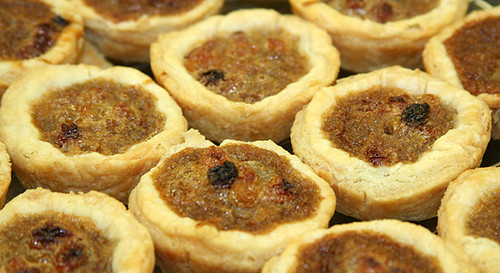
butter tart = An individually sized sweet tart made with short crust pastry and filled with a cooked mixture of butter, sugar, vanilla, and egg.  The filling is similar to an American pecan pie, but without the pecans.  The addition of raisins is a common and commendable practice. Butter tarts are sweet and syrupy and uniquely Canadian and a good accompaniment to a double double. And don't forget your serviette.

Butter Tarts
Home made butter tarts

double double = a cup of coffee with two spoons of sugar and two dollops of cream.  Most associated with Tim Hortons doughnut shops, but now passed into common usage.  Note the cream here will likely be half-and-half or creamilk, a 10-15% fat, mixture of milk and cream which, despite the country's general excellence in all things cream-related, is unaccountably unavailable in the UK.

serviette = a paper napkin

Krazy Karpet = a four to six foot long by two foot wide roll of heavy flexible plastic sheet with handholds cut into one end used for sliding down a snow-covered hill at high speed.  The Krazy Karpet was a staple item in the winter toy repetoire of my childhood that sadly seems to be gone. Note that the practice of sliding down a snowy hill is called tobogganing - not sledding - regardless of whether you do it on a toboggan or a sled or a Krazy Karpet or a chunk of cardboard.


How fun is that?

Goalie Target
goalie = goalkeeper. Usually a hockey goalkeeper.  And don't even start with me about how "hockey" is that thing you play on a field with those weird, too-short, curved sticks.  That is FIELD hockey. (Shut up Jeremy.)

deke = verb. A hockey term that started as an abbreviation of "decoy".  As in "And here comes Lafleur on the breakaway!  He dekes left and puts one through the five hole!".  Can also be used in non-hockey related conversation in phrases like, "That guy totally deked me out to get to the shorter check-out line."

five hole = the area between the goalie's legs.  Based on the numbering of the holes in a typical practice target.  The corners are numbered one through four, leaving five for the tricky shot between the legs.

Old Dutch Chips = Old Dutch Foods Ltd is an American snack food company that opened a potato chip plant in Winnipeg in 1954.  Old Dutch chips are a prairie favourite, and come in a few standard flavours that would be alien to the UK crisp-eater: sour cream and onion, dill pickle and ketchup!  They've also got a unique treat called Popcorn Twists that taste like lightly salted styrofoam packing peanuts but melt on your tongue.

Old Dutch Chips
Ketchup Chips! Popcorn Twists! Dill Pickle Chips!

Eavestrough = those long, narrow troughs that hang on the edge of the eaves of a house to catch rainwater from the roof and direct it through downspouts and away from the foundation of the house.  Known elsewhere as gutters, but don't I think anyone could dispute that eavestrough is clearly the most appropriate term.

Slough = pronounced "sloo".  A prairie term for a small pond or body of water formed in a depression in the land.

Slough
A prairie slough, complete with duckings!

Thongs = flip flops.  Where I grew up we called those cheapie slip-on summer shoes thongs, which has nothing to do with underwear, thank you very much.

Thongs
Warning: do NOT google "thongs" and expect to get 
anything related to footwear...

Pop = sweet carbonated beverage.  Called soda in America and fizzy drink in the UK.  Pop is a good thing to have with the iconic Canadian convenience food: Kraft Dinner.

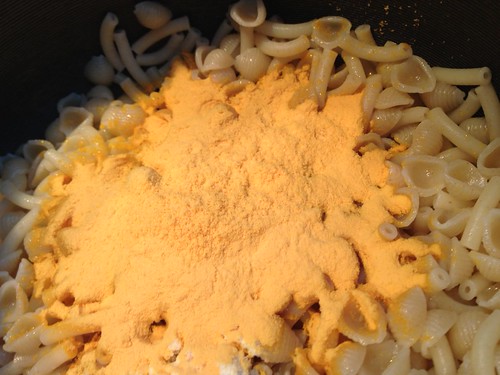
KraftDinnerKraft Dinner, or KD for short = marketed as Kraft Macaroni and Cheese in the US and Easy Mac in Australia, and referred to generically as "macaroni cheese" (note the absent "and") in the UK.  Kraft Dinner is as deeply ingrained in the Canadian psyche as hockey and jumper cables. Though the taste is in no way similar, I'd say it occupies the same part in the hearts and minds of Canadians that Heinz baked beans do in Brits. Consisting of a box of dry macaroni and an envelope of powdered cheese-like substance, KD is apparently the most popular grocery item in Canada.  In fact, the term "kraft dinner" is used to refer to any boxed mac 'n' cheese product.  It's a hands-down favourite with kids, a guilty pleasure for adults, and is often the first thing that young people learn to cook/assemble after leaving home.

KD
Powdery cheeselike substance, pre-mixing.
All that's required is a pot of salted boiling water.  Once the macaroni is cooked, the KD chef is instructed to add butter or margarine and milk, along with the nuclear-coloured cheese powder.  The directions on the box specify exact amounts of butter and milk, but most people use their inborn Canadian KD-sense to create their own perfect version, which will be somewhere on a continuum between soupy and stodgy, according to taste and upbringing.

Kraft Dinner is cheap and filling and comforting and infinitely adaptable. I like to add frozen peas in the last few minutes of cooking and then stir in canned tuna and extra cheese.  Many people add ketchup (yuck), or sliced wieners.  It's also quite nice with a dollop of condensed tomato soup for a creamy tomatoey bowl of yumminess.

You know, if there's room in my suitcase, I just might have to take a few boxes of Kraft Dinner back to London with me.  It never hurts to have a taste of home to fall back on when needed.

KD
The lovely and talented CB, playing the part of typical Canadian Kid With Bowl of KD


Ok that was kind of fun.  I might have to make this reverse-glossary-blog-post-thing a yearly tradition.  There's so much material to cover.  Like rice krispie cake, and Canadian Tire money, and chinooks and teen burgers and bumper-dragging and... well you'll have to tune in next year to find out.

Oh, and Merry Christmas!

Accent on... err... accents

Tuesday, December 18, 2012

I mentioned in my last post about the circuitous route I had getting back to Canada for Christmas this year. I started on a flight from Heathrow to Newark, New Jersey which was naturally populated mostly by Brits and Americans.  The hop from New Jersey to Denver was, unsurprisingly, full of Americans.  But when I got to the departure lounge in Denver for a flight from Denver to Saskatoon I could tell, right away, that this was a flight to Canada. There must be a sort of patriotic version of gay-dar that kicks in with ex-pats when they sense they are among their own kind. It might be a little bit about dress and temperament. But mostly, it's about the accent.  I listened in on conversations in that departure lounge and smiled to myself and thought, "These are my people!"

For most of my life I've been unable to hear my own accent and I think that's probably not unusual for people who grow up speaking English in North America.  This means that, despite the fact that "My Fair Lady" is one of my favourite shows ever, I didn't appreciate until I got to London exactly how important and defining an accent is over there.  The pervasiveness of the class system in England is a topic far beyond my ability to either explain or even comprehend so don't expect a scholarly essay on that topic here any time soon.  However, despite the fact that people would probably agree class plays a smaller role than it once did, it is still inescapable.  And one of the most blatant markers of class is accent.

Here's a little anecdote about how inescapably perceptions of class and power are tied to accent.  I have a colleague who told me a story about when he was called for jury duty.  His accent is what is often referred to as "Received Pronunciation" or sometimes "BBC English": a standard "posh" accent.  As Wikipedia says, "Although there is nothing intrinsic about RP that marks it as superior to any other variety, sociolinguistic factors have given Received Pronunciation particular prestige in parts of Britain.  It has thus been the accent of those with power, money and influence since the early to mid 20th century...". So my friend sat through the trial alongside his fellow jurors and eventually found himself in the jury room to deliberate the case.  As instructed by the judge, the first thing the group did was to decide on a foreman.  Whether they'd already had the chance to chat with each other, or whether they did introductions in the jury room is not clear.  What is clear is that my friend was the only one in the room with a posh accent.  What's also clear is that with no previous discussion or vote, the rest of the members of the jury turned to him and said, "So you'll be the foreman, then."  His accent clearly marked him as the leader, and everyone in the room simply acknowledged it and got down to business.

(This is the kind of thing that makes me realises I'll never truly understand the culture simply because I didn't grow up in it.  It's like trying to learn Japanese and being unable to master it completely without an inborn understanding of your status relative to everyone else in the room, which affects salutations and honorifics and verb forms, the subtleties of which make the choice between vous and tu akin to  Leonardo choosing between a 6" wide wallpaper brush and a medium pile paint roller when approaching the Mona Lisa.)


Here's another story about Received Pronunciation which may be apocryphal, but I never claimed to be an authority on the subject, and three-quarters of this blog is just crap I pull out of thin air anyways.  (Anyways!  Very Canadian that: anywayS instead of anyway.) Anywaaaaays - its quite common in the UK for front line call centre staff to have a Geordie accent.


Astute GSWPL readers will remember Geordie Mouse from a previous Words post, but I couldn't resist bringing him back.

Apparently there is something friendly and comforting about having your concerns listened to by someone with a Geordie accent.  However, if the conversation heats up and the call has to be transferred up the ladder to an authority figure, you can bet that someone will have an RP accent.  When Brits need to exhibit power and control, nothing beats Received Pronunciation.

But back to me.  I've been living away from Canada for three years now and it's taken that long for my ears to start to hear what for others my be blatant.  I think this is partly because Canada has relatively little variation in regional accents.  Apart from the obvious - the Newfie/Martiime accent (which owes a lot to Ireland) and the Quebec accent (which isn't really fair since French speaking Quebecers are naturally going to sound different when working in a second language) - Canadian English is a pretty homogenous thing.  I'm leaning heavily on Wikipedia here, but the good people there only list nine different varieties of Canadian English, which is frankly about five more than I would have guessed.  Contrast that with the UK, which has thirty three and that's not including Northern Ireland or the Republic or the Channel Islands.  Perhaps it's no wonder the English are so sensitive to accents - they are positively bathed in them from birth.

Then again, not everyone over here is a natural born Henry Higgins.  Some time ago I was standing on the sidewalk waiting for an errant truck to arrive to load something in or out of somewhere.  As I was peering up and down the street trying to locate my truck a woman walking on the other side called out to me, asking if I knew where the train station was.  I replied in my standard West/Central Canadian accent and when I finished she looked at me and asked, "Are you Welsh?".  Ummm... yeah sure... and the Queen is from Yellowknife.


Eve Myles and "Torchwood" taught me what a Welsh accent sounds like. Plus the show rocks.

So it's been three years now, and I'm finally starting to be able to hear whispers of what shouts at everyone else.  And I've realised that I dial my own accent up or down according to the circumstance (except when I've had a few pints, when the Canadian vowels apparently get a bit thick).  I think this flexibility comes from travelling so much and spending so much time interacting with people for whom English is a second (or third, or ninth) language. It feels natural to knock the corners off a bit and contract the vocabulary to give non English natives a fighting chance.  Maybe that's stuck with me now that I'm settled abroad; it's not that I expect people won't be able to understand me in an English speaking country, it's just kind of an instinct.  So when I'm in England, I keep my accent down to a dull roar.  Still, no one will ever mistake me for a local and I can never envision a time when I'd be able to say "I could have DAWNCED all night" without feeling like a complete fraud.  My foreign-ness is, however, still obvious enough that canny Brits I've just met will say something like, "I can't place your accent..." when really they mean, "You sound American, or maybe Canadian, but I can't quite tell the difference, and I know it might be insulting to assume you're American if it turns out you're Canadian, so help me out here."

For me, the difference between a Canadian and an American accent is usually obvious, and my spidey senses tingle when I hear the loud nasal tone of a gang of American tourists on the tube reading out the station names on the map.  Then again, even that instinct sometimes fails me.  I had a colleague on the Ceremonies who I was convinced was American.  He was just a bit too loud and annoying to be Canadian.  Imagine my chagrin when I found out he was a countryman.  It was like he was letting down the side.  I realise this makes it sound like I think all Americans are loud, nasal and annoying which is, of course, not at all true.  Many individual Americans I know are lovely people.  And as a nation they actually managed to elect and then re-elect Barack Obama so maybe I should lay off them a bit.  (Still, they do have a lot to answer for.  Like, for instance, aerosol cheese.)

But back to me again.  For the record, here are a few of the things I can now hear in a heavy Western Canadian accent.  We tend to say "tuh" instead of "to" and "in-tuh" instead of "into", "fer" instead of "for" and "yer" instead of "your".  And final "ty"s in words are often turned into "dy"s or lost completely.  As in, "I'm goin' tuh the store fer beer. I'll be gone fer about twenny minutes. Do ya need anything fer yer pardee at the Cummunidy Cenner?"  (This is obviously a broad interpretation, but I think it's pretty much right.  Or should I say "priddy" much?)

We've got a charming insistence on pronouncing every syllable in every word, a habit that's completely alien in places where "Leicester" is pronounced "Lester" and "Cholmondeley" is unaccountably truncated to "Chumley".  We also give the humble "R" its due and actually pronounce it, whereas Brits generally treat an R in the middle of a word as a kind of silent placeholder.  There's also... I don't know... a quality of earnest perkiness?  It's hard to quantify, but I know that whenever someone over there imitates my accent their voice goes up and it's a bit like they're pretending to be a cartoon character.  Sort of like this guy:


He's just givin' 'er.

Listening for accents has become a bit of a sport for me, and everyone in the country is my coach.  I'm forever nudging a friend or co-worker and whispering, "Is that Scouse or Brummie?  Or "Oh, I know that one... VERY Northern Ireland!"  I'm not good at imitating other accents myself, but my ears are definitely learning to hear not only the accents of others, but my own too.

But I'm telling you, I do NOT say aboot.


Bonus New Zealand accent joke: Recent studies indicate that men in New Zealand think about six every sivin minutes. (Hearing the difference between an Aussie and a Kiwi accent is a bit like hearing the difference between Americans and Canadians.  Subtle, and best left to natives.  Though the Kiwis really do have some odd vowel sounds.  For instance, they write with pins and surf the antuh-nit.)

Additional bonus generic Canadian joke that doesn't have anything to do with accents but is still funny: How do you get a group of Canadian out of a swimming pool in an emergency? You say: "Please get out of the swimming pool."

Apropos of Nothing, son of the sequel

Monday, November 28, 2011

More short, random observations of life on this side.

On the oddly bi-polar nature of driver's licences:
First of all, they're not called driver's licenses, they're called "drivING licences". I guess it's not the person that's licensed, it's the act.  I recently traded my Canadian driver's license for a UK one, which was relatively painless and not even that expensive.  The annoying thing is that driving licenses in the UK require you to take your test in a manual transmission vehicle if you want to be licensed to drive a manual transmission car.  Of course there's no way to prove that I took my driving test (27 years ago...ohmygod) in a manual transmission car because no one in Canada gives a damn about that and hence no records of that are kept (oh, also I didn't take my test in a manual, but that's not the point.)  The point is that I wasn't able to get a manual transmission license.  This, despite the fact that every vehicle I've ever owned and registered was a manual.  I suppose the fact that I owned them is no guarantee that I drove them.  So now I have to arrange to take a test to upgrade my license, because about 90% of vehicles in the UK are manuals, which is all kind of boring.  That's the first bi-polar thing about driving licence - the manual/automatic differentiation.

The other thing is the physical licence itself. It comes in two parts, like the old Saskatchewan licences.  There's the plastic photo card part that most people carry around, which is familiar. Then there's the "paper counterpart" which is a full A4 sized sheet and is a legal part of the licence itself. Theoretically you're supposed to carry both halves at all times, which almost no one does, partly because it's a pain and partly because it's just a flimsy piece of paper that will decompose in a wallet in no time flat.

Driving License 
It says: "Important Document - The photocard and paper counterpart should be kept together. Both must be produced when required."  And that's my photocard in the corner, the pink thing with the EU symbol and the unflattering photo.  Then again it's not nearly as unflattering as the ID photo on my new Olympic Park pass which makes me look 70 years old, three-quarters dead and supremely uninterested in everything. People gasp and make involuntary vowel sounds when they see it.  Then their eyes start bleeding...

On the similarly dual nature of laundry detergent:
Again, we've got a linguistic clarification to make here.  It's not actually called laundry detergent here, it's called "washing powder".  Also, dishwashing soap is called "washing up liquid" because doing the dishes is referred to as "doing the washing up". "Washing up" is apparently a phrase that refers exclusively to the dishes.  So it's "washing up liquid", unless it's "fairy liquid".  Not because it comes from fairies, but because the best-known brand of washing up liquid is Fairy.

Fairy liquid
Lemon Fairy Liquid, though it's most common form is Mild Green Fairy Liquid.
But back to the washing up powder, and something that baffled me for a long time after I arrived before I finally got off my butt and asked about it.  All washing powder over here is clearly divided and appropriately labeled as belonging to one of two camps: Biological and Non-Biological, usually abbreviated to Bio and Non-bio.

Bio vs. non bio
See what I mean? Clearly labelled.

And what's the difference?  According to our friends at Wikpedia (and let's just pause for a moment and consider that there are actually people out there who care enough about this subject to write a short but reasonably informative article about it) (Oh, and let's also have a short moment of reflection to admit that I am also in the process of writing about it.) (And don't forget you are reading it, so don't get snooty)... but back to Wikipedia, which says that biological detergent contains "enzymes harvested from micro-organisms such as bacteria adapted to live in hot springs... whose purpose is to break down protein, starches and fat in dirt and stains on clothing... for example food stains, sweat and mud."  Apparently those enzymes increase the cleaning power of the detergent, especially in cold water, which is odd if they're harvested from hot springs.  (And exactly how does one harvest micro-organisms from hot springs? With extremely tiny nets?)  I can't believe there are enough hot springs in the world to produce enough of these enzymes to fill the shelves at every Tesco, Sainsbury's , Lidl, Waitrose and Asda in the UK.  (Especially not the Asda at Putney Vale, which I think is large enough to be visible from the International Space Station.)  

No matter, the bio stuff supposedly works about 10-15% better. However the bio stuff is also harsher, probably because those enzymes must have to be pretty tough characters to survive in steamy, mineral-laden hot springs. Hence the existence of non-bio washing powder for babies, people with allergies and anyone who is generally just a whinging wimp. Nonetheless, the wholesale and absolute division of the entire laundry detergent world into two discrete types was disconcerting - a bit like walking into the grocery store to find the entire dairy section had separate areas for left-handed and right-handed yogurt.

On the most excellent nature of Christmas lights on Oxford and Regent Streets:
Oxford and Regent Streets are the hub of retail consumerism in London, centred at the intersection (or junction) of the two main roads, called Oxford Circus. There is handy tube station at Oxford Circus which I have NEVER exited without being completely disoriented.  This is because unless you were to conduct an exhaustively mapped, years-long, three-dimensional study of the various exits from Oxford Circus Station, I think it's completely impossible to know upon exiting which direction you need to walk to get to the Apple Store. I generally stumble up out of the tube and try to locate All Souls Church, which I firmly believed to be in an easterly direction along Oxford Street, and then orient myself from there.  Naturally it turns out that All Souls is actually north up Regent Street.  And surprisingly it also turns out that Regent Street and not Oxford Street is the one that curves south and east into Piccadilly Circus. Huh.  This goes a long way to explaining why I've always found Oxford Circus a tad confusing.

Navigational challenges aside, Oxford Circus is a shopper's paradise.  The area is home to big department stores like Selfridges, Debenham's, and the beloved Marks and Spencer (which really deserves a post all its own), and to the flagship stores for a lot of major retailers like Apple, Uniqlo, and the famous Hamley's toys store.  And because Christmas is high season for shopping, the Oxford/Regent Street businesses really do up the place with festive lights, which is really fun.

This, for example, is a Boots Drug Store (Chemist):

Boots Christmas Lights
Nice work Boots, but not quite as classy as:

Debenham's Christmas Lights
Debenham's, which I would say is roughly equivalent to The Bay.  But bigger, of course.  And highly skilled with the Christmas lights.

Lights like this are generally called "fairy lights".  So if it's Christmas time you could theoretically make a batch of fairy cakes and then wash up the bowl with fairy liquid all under the gentle glow of fairy lights.  How lovely.  Especially the cakes.  And not so much the washing up.

Brixton Station Steel Drum Band:
Lastly, a little taste of one of the things that makes living in Brixton fun and cool.  There is an Iceland store just next to Brixton Station (Iceland is another of the grocery chains,this one with a particular focus. And I'll admit now that it took me an embarrassingly long amount of time to understand that focus.  This after I'd had numerous trips to Iceland wherein I'd wander up and down the aisles thinking to myself, "Damn, they have a LOT of frozen food in this place. Weird."  Yep.  Iceland sells... frozen food.  Not one of my shining moments.)  Anyway, the front of the Iceland is a popular spot - usually for guys selling sticks of incense which is smelly and annoying and which I strongly suspect is a thinly-disguised front for drug sales.  The Bible-thumpers tend to hang out a little farther down the street around the same place as the Communists, but when the stars align the steel drummers come out, which is my favourite:


How fun is that?  All they need is some fairy lights and we'd have it all.

Off the tourist track: Open House London

Monday, October 3, 2011

All of London was off the tourist track for a couple of days recently, because it was the annual Open House London weekend. To quote their website:
"Open House London celebrates all that is best about the capital’s buildings, places and neighbourhoods. Every September, it gives a unique opportunity to get out and under the skin of London’s amazing architecture, with over 700 buildings of all kinds opening their doors to everyone – all for free."
What this means is that all over the city buildings that are normally closed to the public open their doors and welcome people in for a look behind the scenes. This could be somewhere as grand and monumental as the Bank of England or as small and quirky as a brand new eco-friendly residential house just down the street. They say it's free which is technically true, except that you really need the guide book to figure things out. The printed-and-mailed dead tree version of the guidebook was £6.50, but the downloadable PDF was only £3.50, arrived instantly, and was pretty friendly on the old iPad, making me feel very au courant. There was even an iPad app for $4.99, which might have been even better because I think it had interactive maps so you could fire it up, see where you were standing, and zero in on any Open House sites nearby. Perhaps next year...

Some of the site are very popular and require you to pre-book to hold a space when the program becomes available in early August. Because I was late to the party this year I was shut out of anything that required pre-booking, which meant my options narrowed a bit, though not a lot because as mentioned above, there were more than 700 sites. I eventually whittled down my choices and on a sunny Saturday morning I set out on the tube, leaving the bike behind to avoid a repeat of my continuing bike locking woes. I hit quite a few sites over the weekend because though I made certain plans I also stayed flexible, meaning that if I unexpectedly happened on the welcoming green Open House poster as I was on my way from point A to point B I was free to veer off to investigate point C. Some point Cs were places where I just poked my head in before deciding they weren't for me, and some were perfectly excellent. For the purposes of this blog post we shall concentrate on the excellent, glossing over the so-so. (There was, for instance, the archeological remains of the western gate of the Roman wall around the city, which were situated in a damp, locked, unmarked room that was part of an underground parking lot. That was only so-so, mostly because though the site was significant, there really wasn't much to see beyond a pile of rocks in the vague shape of a wall.  Also, the whole place smelled of exhaust and gasoline. And there was the aforementioned Bank of England, which I skipped because the queue was around the block.) Instead, let's talk about a couple of the hits:

St. Botolph's Aldgate Bells and Belfry:

My first stop on that sunny Saturday morning was to see the bells and belfry of St. Botolph's without Aldgate church (as distinct from St. Botolph's Aldersgate church, which astute GSWPL readers will remember from my blog about Postman's Park). The Open House program promised a visit to the belfry itself and a demonstration of bell ringing, which it turns out is a lot more complicated than just yanking on a bit of rope.

P1080450
St. Botolph's
I had to wait around a bit after I arrived because space in the bell ringing room was limited and demand was high. After a half hour wait, and armed with a numbered bit of paper for the 11:30am visit, I ascended the steep, narrow, winding circular stairs up to the ringing room to find a surprisingly comfortable, airy space dominated by eight ropes hanging down through holes in the ceiling.

P1080441
There was a gentleman there from the church's band of bell ringers who gave us some interesting facts about the bells and the craft. There are eight bells at St. Botolph's, which are normally rung in the change ringing style, meaning that a group of ringers will ring each bell in a sequence which changes as they go along. In order to be able to ring in such a controlled fashion, the bells are each hung in a rotating frame that's essentially like a giant pulley with the bell fixed inside it, upside-down. The ringer pulls on the rope, which runs in a channel along the outside of this giant pulley, thus rotating the bell down and back up the other way, almost 360 degrees. Along the way the bell's clapper strikes the side of the bell. The art of bell-ringing is in being able to time that strike to happen exactly on cue, even though the action of pulling the rope is separated by a second or two from the action of the clapper striking. Apparently it takes about six weeks before a novice bell ringer can reliably be expected to be able to, as the local ringer put it "make the bell go dong". And that's just the beginning. 

The real art comes in ringing the changes. This means that instead of simply ringing the bells from highest to lowest (1,2,3,4,5,6,7,8), they vary things by changing the order in which they ring according to a series of mathematical patterns which I will not attempt to explain because the charts they had hung up in the ringing room looked to the uninitiated like either 1) meaningless columns of numbers with coloured diagonal lines crossing through them or 2) a EEG with numbers written on it in apparently random places. The guy kept saying that it was all quite simple and all a ringer had to do was concentrate on his little bit of the puzzle and know where in the order he was without having to keep track of the whole thing. I am not buying it.


A video of ringing at St. Botolph’s.  (Sadly, this is not MY video of ringing at St. Botolph’s because I continue to be completely flummoxed by actually getting any of my videos to upload successfully to Blogger or Flickr or Youtube, which is starting to really piss me off.  Any technical assistance would be appreciated.)  

Hung around the ringing room were plaques commemorating the completion of what they call a "full peal" meaning that the ringers successfully completed every possible permutation of ringing eight bells in a different order (5,040 for those keeping track). A full peal is a bit like the marathon of the bell ringing world - it takes about 3-4 hours to complete one and you get no breaks once the peal has started. Also, if anyone screws up the peal is ruined and you have to just stop, give up, and go down to the pub to drown your sorrows. This means that full peals are only attempted rarely and on special occasions like the Queen's Jubilee or the appointment of a new rector at the church. I suspect that the ringing of a full peal is a bit of an event in the neighbourhood as well, since listening to ringing church bells is lovely for a few minutes on a Sunday, but for three and a half hours might start to be classed as tedious and possibly even unsociable. 

The eight bells of St. Botolph's range from the treble bell, (the name for the smallest one) to the tenor bell, which weighs in at 1.25 tonnes. All were cast at the Whitechapel Bell Foundry, which is just down the road from the church and one of only two bell foundries remaining in England. The foundry really deserves a blog post all it's own, since it was established in 1570 and is therefore the oldest manufacturing company in Britain. They cast the Liberty Bell and Big Ben! (And they do tours on selected Saturdays, though I think they fill up fast.) I even got to see that actual Whitechapel Foundry bells at the end of the ringing demonstration, when they took people up in small groups to see the belfry itself. 

P1080442
The treble bell, positioned in its upside-down ready-to-ring state. Note the writing on the side indicating that the bell was cast in 1744.
The whole experience was really cool, and exactly what the Open House thing is all about - seeing something you'd never get to see otherwise. That is, of course, unless you decided to join the band of ringers at St. Botolph's, who seemed a thoroughly likeable lot and included the landlord of the local pub. And just think, it would only take you six weeks of Friday evening practices to learn how to make the bell go DONG, which I bet feels amazing.


The Grand Entrance Hall to Brunel’s Tunnel under the Thames:

This was a site I discovered when I realised that the index of the Open House Program had a whole section devoted to industrial sites like pumping stations, distilleries, engine houses and even the Royal Small Arms Factory.  Naturally, being something of an engineering geek, I was immediately taken with the description accompanying the entry for the Brunel Museum:
“Guided descents of subterranean chamber half the size of Shakespeare’s Globe. Self guided train tours of Thames Tunnel, one time shopping arcade, banquet hall and fairground. Award winning river gardens.”
Subterranean chambers? Shopping arcade? Banquet Hall*? It all sounded worth a visit, even though it meant another trip to the dreaded Canada Water – far flung home of the bike shop I’ve visited too many times.  Off I went. (And now, while I make my way out to Canada Water, a little back story on the Thames Tunnel and the brilliant Brunels, pere and fils.) 

By the early 19th century shipping traffic on the Thames had increased to such a volume that unloading ships sometimes had to wait months for a space to open at a dock so they could unload their cargo.  Once cargo was finally unloaded it could only cross the river on small ferry boats or by means of the two nearest bridges – London Bridge and Blackfriars Bridge.  London Bridge was closest to the docks, but so congested that it could take days to cross.  An alternative crossing downstream of London Bridge was desperately needed, but any bridge would have to allow tall-masted shipping traffic through, and  these were the days before steam engines were powerful enough to raise bascules like those of Tower Bridge.  (Remember Tower Bridge was not opened until 1894.) 

Enter Marc Brunel: French-born engineering genius who is probably best know for siring his much more famous engineering genius son, the fantastically named Isambard Kingdom Brunel. Brunel Sr. decided that a tunnel across the Thames was the way forward, despite the fact that the ground under the river was notoriously soft and difficult to dig, giving rise to the problem of the river impertinently pouring itself into any previously attempted excavations. In order to make it possible to tunnel in soft ground, Brunel invented the tunneling shield, whose basic principle is still in use today. His son Isambard, despite being merely 19 years old, actually supervised the work on the tunnel from 1826 to 1828, when a catastrophic flood of the partially completed tunnel injured him seriously, and forced him to leave the project.

The whole story of the tunnel is of course much more complicated and interesting than I can go into here without causing your coffee to go cold while you’re reading (even though it’s already probably decidedly tepid), so on to the aforementioned “subterranean chamber”.  This turned out to be what was once the Grand Entrance Hall to the south end of the completed Thames Tunnel. It’s actually a large round brick structure that was built above ground and allowed to settle into the earth until it was low enough to become the start of the tunnel.  It was once beautifully finished with sweeping curved staircases winding around the interior walls to allow the great and the good to access the tunnel. 

The-Thames-Tunnel-The-Grand-Entrance-Hall
The entrance to the tunnel when it was opened.
Now, it’s a dank, bare brick hole which even the most imaginative would struggle to love:

Brunel Tunnel Chamber
The “Grand Entrance Hall” today. 
Far from being the “eighth wonder of the world”, as the Victorians (and the Brunel Museum’s website) claimed, it is in fact, disappointing.  However, we must pity the poor Brunel Museum, because the fact is that Brunel’s tunnel was so good means it’s actually still in use.  London Overground trains use it to pass under the Thames between Rotherhithe and Wapping every day.  If there were no railway, we could likely have descended into the tunnel itself, which would have been very cool.  Instead, visitors were offered the “self-guided tour” which was actually just a photocopied sheet with a few interesting facts that one could read while taking the train journey from Rotherhithe to Wapping.  I chatted with a woman from the museum to get her take on it and she confirmed my suspicion that there really isn’t much to see from the darkened windows of a speeding train.  Apparently last year during Open House weekend they actually agreed to slow down a few trains and turn the lights on in the tunnel so that people could see the grand arches and brickwork.   However, so many people complained about the slow trains that this year they weren’t available.  Because people suck.  

Still, I found the Brunel Museum quite plucky and charming, and even bought their little book about the Brunel’s and their tunnel (a mere £5, including an introduction by Michael Palin!).  They don’t have a lot going from them the poor Brunel Museum folks.  The location is not exactly central, and their big reason for being – the tunnel itself – is actually impossible to see properly.  The building the museum is in is the old engine house, and it’s small and a bit rough around the edges.  But they manage, and have some nice displays about the history, construction and opening of the tunnel.  And they have a good display of books for sale beyond just the one I bought, and they do actually have a lovely patio garden and a tea shop with nice looking proper cakes.

P1080493
See? It’s a nice spot on a sunny Sunday. 
So I was generally satisfied with my visit to the Brunel Museum, especially since it was free (Thank you Open House London) and the day was warm and sunny, and it afforded me the chance to wander along the Thames path towards a more congenial tube station than Canada Water, during which wandering I discovered a whole other hidden gem of a spot which I’m not going to tell you about now, because your coffee is either gone or stone cold and I think it’s probably wise for me to keep a topic or two in my back pocket for leaner blogging times ahead.  Also, it’s my bed time.
 
 
Tunnel Banquet* Ok, I should probably explain the “banquet hall” bit.  During the construction of the tunnel there were a couple of big floods.  After the first, smaller flood, investors needed some reassurance about the feasibility of the project, so Marc Brunel arranged a banquet in the pumped-out, dried out tunnel itself.

“In the western archway, draped in crimson, a long table was covered in white damask and elaborately set with silver and crystal for a sumptuous banquet. Fifty selected guests, lit by decorative candelabra from the Portable Gas Company, dined while the uniformed band of the Coldstream Guards  played the National Anthem, Rule Britannia and See the Conquering Hero Comes.”

(from “The Brunel’s Tunnel”, my £5 bargain.)

GRUB!: It's Pimm's O'Clock

Monday, August 15, 2011

First things first, since I suppose I MUST mention it: the riots.  I thought about devoting a whole blog to the subject since it’s been the dominant topic here for the last week.  But because of that dominance and the  accompanying media saturation (which has been, if possible, greater than that of a certain wedding of a few months ago) I’m a bit tired of it all.  Instead, I want to talk about something that seems much more English, and is in keeping with the season, which is warm, and with the news that England has finally climbed to number one in the international test rankings, which is most excellent. (That’s cricket, mind.  And I said it in a tweet, and I’ll say again here: I must be truly assimilated now.  Not only do I understand, but I can really appreciate the exceedingly rare and happy phrase: “Tendulkar out for 1.”  If you’re not familiar with cricket in general, and with the current giants of the game in particular, you’ll just have to wait until I get around to blogging about it to see what I mean.)

The weather here has finally turned into summer.  No, it's not 35 degrees (thankfully) but it's warm enough that people are commenting and wearing sandals and enjoying being able to moan about it being too hot instead of moaning about it being too rainy.  This means that it's the perfect time to introduce our first drink in the GRUB! series.  Shockingly, it's NOT beer, but that most quintessential of British summer tipples: Pimm's.

Pimm's O'Clock
Pimm's is the best known example of a fruit cup, which is a traditionally English summer drink made of hard liquor - usually gin - that's flavoured with a proprietary blend of  herbs, spices and fruit.  It's intended to be mixed with a soft drink like ginger ale or lemonade, and served over ice, usually with sliced fruit added.  (It also bears telling that over here when someone says "lemonade" they do NOT mean a beverage made by squeezing lemons and adding water and sugar to taste.  Basically, they mean 7-Up.)

Pimm's Cup Number One (there are six) is the original, and was invented by James Pimm in 1823.  It's made with a gin base, quinine, citrus, and some herbage, and is a sort of reddish tea colour with a whiff of orange and spice in the nose. Pimm produced it to serve in his oyster house as a digestive aid and it became popular enough that it went into large scale production in 1851, and was being sold by hawkers on bicycles by 1859.  That's what we need more of in this country I say: people selling Pimm's from bicycles.  Preferably wearing knotted handkerchiefs on their heads and sporting a sunburn and wearing socks with sandals for best and most English effect.  But back to Mr. Pimm, who, by 1865, had sold the whole shebang, along with the rights to the name, at which point we’ll leave the tedious narrative of who owned what when.

Along with Pimm's No. 1, there have been Pimm's Cup No. 2 (based on Scotch whisky), Pimm's No. 3 (brandy), Pimm's No. 4 (rum), Pimm's No. 5 (rye whiskey) and Pimm's No. 6 (vodka).  Of these spin-offs, only No. 3 and 6 are still produced.  Pimm's Cup No. 3 has been re-branded as Pimm's Winter Cup, and is intended to be mixed with warm apple juice and sliced orange.  No. 6 is rarely seen (or at least rarely seen by me). However, Pimm's No. 1 Cup, or simply Pimm's, as it is universally known, is seen just about everywhere.  Most pubs of a certain type will have it, as will lounges and restaurants and especially anywhere that has a terrace.  It's sold by the glass and by the pitcher and is sort of the English equivalent of getting a jug of sangria to share among friends on a warm Sunday afternoon.

The traditional recipe for mixing is:
  • 1 part Pimm's No.1
  • 2-3 parts chilled lemonade (the fizzy 7-Up kind)
  • sprigs of mint, and sliced cucumber, orange and strawberry  (Please do not ask me to explain the cucumber.  Just accept is as one of the English things like beans with breakfast and move on.)
Pimms-Serve-Image
I intended to take my own photo of my own pitcher of Pimm's made by my own self, and even stocked up on all the necessaries to do so.  But I ended up making rather merry with a group of West London runners last night and hence am not exactly in the mood for a pitcher of anything stronger than London tap water.

Pimm’s is one of the traditional drinks served at Wimbledon and the Henley Royal Regatta (the other being champagne, of course) and is also popular at polo matches so really, how much more stereotypically English can you get?  There are even a few variations on the traditional mix, a particularly paralyzing one of which is the Pimm’s Royal Cup.  It combines Pimm’s No. 1 (already at 25% alcohol content) with champagne and a single strawberry.  You wouldn’t need too many of those while sitting in the sun at Wimbledon before you’d not only have trouble keeping track of the ball, but the court, and indeed your own extremities.

I sense that Pimm’s is currently enjoying a certain retro popularity, which was started by a self-mocking ad campaign from 2003 featuring an endearing/annoying toff character called Henry Fitzgibbon-Sims (played by Alexander Armstrong) who would happen upon groups of people in odd situations and end up serving up glasses of Pimm’s all ‘round and spouting the catchphrase “I make that Pimm's O'clock!”  They are quite fun, and so I include a few of my favourites here, so you can get an appreciation for the genre:


Sadly, Fitzgibbon-Sims was retired and the current ad campaign is not quite so clever, though it does include Morris dancers, and socks with sandals, so it’s also worth a look. 

And there you have it: Pimm’s!  Luckily I am reliably informed by my sister, who developed a strong taste for Pimm’s on her recent visit, that the genuine article is available on foreign shores (or at least in Calgary).  So get out there and give it a try while the weather is still warm and the evenings are long.  Just don’t forget the cucumbers.


P.S.  Ok, ok, ok, a bit more about the riots, though there’s probably not much I can tell you that you haven’t already heard: riots started in north London on Saturday night, at first as a reaction to the shooting death of a young black man by police in a botched arrest attempt.  Rioting and looting spread to other areas Sunday night, and if there was any pretense that people were protesting the shooting it was long gone by Sunday.  The general opinion is that things devolved completely into opportunistic, thuggish vandalism and thievery.  One of the areas affected on Sunday night was my neighbourhood, Brixton.  Looters hit shops on the main street and a couple of big box stores a few blocks from my house.  Despite this, the whole event – in Brixton in particular and the rest of London and England in general - had no real effect on me personally.

Well, that’s not strictly true. What is true is that the effect on me personally was very small.  Here’s how my life was changed:
  1. When I stopped at the newsagent on Monday morning to pick up the paper they had no papers of any kind because there had been no deliveries, because of the riot. At that point on Monday morning I had no idea what had happened in Brixton Sunday night.  This is because I generally listen to the Canadian news from the night before over breakfast, and I don’t get the day’s paper until I leave the house.  So when the guy in the shop mentioned a riot I thought, “Riot? What riot?”  Then I cycled past the burned-out Footlocker store on the high street and the light slowly started to dawn.
    brixton-riot-aftermath-19
    The former Footlocker Store
  2. I had finally convinced my West London running group to come to Brixton where I was going to lead them on a run through the area on August 18th (including a lovely jaunt through Brockwell Park and a Pimm’s drink stop in my front garden).  As a result of Sunday night’s rioting in Brixton the powers that be at the group determined that Brixton had been a dodgy enough place to begin with that turnout would be too low (it’s not really especially dodgy, but those West Londoners are a twitchy bunch when lured out of the leafy suburbs).  Following the riot they politely told me to find a new venue, which left me annoyed and cranky for much of Monday.
  3. As a result of my general crankiness on Monday I decided I wanted to skip cooking and went to my local pub for supper instead, but it was closed because of the riots.  This is perhaps a good indication of how nervous everyone was on Monday night because really, CLOSING THE PUB???!!!
And that’s IT.  That’s the sum total of the direct effects the riot had on me.  I actually slept through the whole thing in Brixton on Sunday.  Yes, the shops on the high street were shuttered and boarded up for most of the week.  Yes, there was that burned-out Footlocker, whose door I had never darkened anyway. And there were endless conversations around the office at work.  But by the time the violence hit its peak on Monday there was basically nothing left to steal in Brixton, and everything was shut up tight, so it was a quiet night.

Morley's Boarded Up
A boarded-up local department store on Brixton Road.
There was a point somewhere around Tuesday morning where the messages I was getting from home made it sounds like the rest of the world was assuming that the entire city was in flames, which was simply not true.  There were a lot of areas where violence flared up, but the total area affected was miniscule compared to the overall size of the city.  Then again, there have been suggestions that the property damage was the worst and costliest in London since the Blitz and many small shopkeepers are expected to be put out of business by the looting since a large number don’t have insurance against acts of terrorism.  Luckily (for the shopkeepers and homeowners, if not the taxpayers) many will be entitled to compensation under the The Riot Damages Act of 1886, which pays out compensation for any building that has been damaged or suffered losses as the result of rioting.

Now, a week after it all kicked off, things are very quiet, though there are still shops with broken windows and an unusually high number of police on the streets.  And the newspapers are still solidly packed with articles about what happened and speculation about why it happened, and shocking stories about 11-year olds in court accused of looting bottles of wine, and straight-A students caught on CCTV cameras trying on stolen running shoes, and looters attacking Poundland shops (A Poundland is like a dollar store, so it’s hard to imagine getting your money’s worth looting one without giving yourself a hernia in the process.)  It’s expected somewhere around 2-3,000 people will eventually face charges, and the courts have been running 24 hour a day to process cases, so it’s safe to say we’ll be feeling the after-effects of this week’s events for a long long time to come. 

And that's all the more reason to bring back the bicycling Pimm’s salesmen, don't you think?