Showing posts with label Apropos of nothing. Show all posts

On the random excellence of London

Sunday, January 15, 2023

Sometimes you make a plan, and sometimes that plan falls by the wayside. This was the case on a recent Monday morning just before Christmas. I'd been in Southend-on-Sea for a very jolly Christmas Party the night before, and then for a group breakfast by the seaside the morning after (Salmon Bubble Stack, since you asked). I also had plans in the West End that evening, and since Southend-on-Sea is in the far southeast, and the mooring for the boat is in the far northwest, it wasn't really practical for me to get all the way home to the boat and then all the way back to the West End in time for my rendez-vous. Despite having not even started packing for my Tuesday flight home to Canada for Christmas, and even though there was a lot to be done on the boat otherwise (more on which later, if I can bear to recount the sad tale) I decided that sometimes you just need to let fate intervene. So on the train back towards central London I made a plan to visit one or more small London museums, most probably the Freemason's Hall, as a pleasant diversion to fill the time before my evening engagement.

The train from Southend-on-Sea terminates at Fenchurch Street Station, one of London's smaller rail termini. From there it's a short walk to an Underground station for the journey to Holborn, which would have been maximally efficient, but that's not the kind of mood I was in. Instead I thought I'd walk, since though it was cloudy and threatening, the weather was much warmer than it had been for ages and there was no urgency to my mission whatsoever. Moreover, I decided once again to put away Google Maps and find my own way. So began a meandering journey that should have taken 45 minutes, and ended up clocking in at about three hours and six kilometres. Because, as any Astute Go Stay Work Play Live Reader will understand, if you've got the time to stop and look when you're walking through London, you can't help but see some really cool stuff.

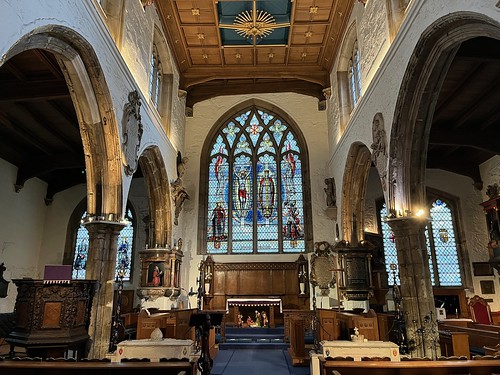
I figured it would be easiest to stay oriented if I was closer to the river, so I turned that way down a small side street near Fenchurch Street and was quickly distracted by the entrance to a nearby church - St.Olave's. And this perfectly illustrates my point about the density of cool stuff in London. Just by chance, less than a hundred metres from my starting point, I'd found one of the only medieval-era churches in the City of London to survive the Great Fire of 1666, which is also the final resting place of the famous diarist, Samuel Pepys.
IMG_3137
St. Olave's. It still sometimes surprises me that you can wander in and out of most churches in this country. I always hesitate, but I'm rarely disappointed when I take the plunge.

This version of St. Olave's (named for the Norwegian saint) was built around 1450, though there was a house of worship on the site from about 1050. (So that's less than a thousand years. Pfft.) The churchyard is quite nice too. Small but pleasant, with a mosaic labyrinth and a stone entryway dubbed the Ghastly Grim Gate (by Charles Dickens, of course) because of the tympanum of the gate features carved skulls. That gateway leads onto the melodiously-named Seething Lane.

From Seething Lane I turned west and south again before walking down St. Mary at Hill street. This time I didn't bother visiting the eponymous church, though I did linger outside Waterman's Hall, the home of The Company of Watermen and Lightermen of the River Thames, a livery company. From there, a slight deviation to the northwest brought me to The Monument. (Which really deserves its own blog, so I'll just mention that I thought it fitting that a fire truck went past as I was reading one of the inscriptions on the base of the column.) Notably, one of the designers of The Monument was Sir Christopher Wren, who has, of course, been mentioned in the blog several times before and who will feature again very shortly. But first, I headed towards an often-overlooked landmark near Cannon Street Station.

IMG_3144

It's believed this unassuming lump of oolitic limestone has sat at or near this spot (barring a few relocations for safekeeping) since (they think) the Roman era (maybe). And you can take my multiple parentheses as an indication of how little is definitively known about the stone. Most of its history is myth and conjecture, though it does definitely appear on the Copperplate Map of London from the 1550s. This fancy Portland stone enclosure is very new - completed in 2018. I fondly remember its former, much less grand home behind an unassuming cast iron grill at street level, which made it look more like a storm drain than the resting place of a (possibly) ancient and (sort of) mystical (-ish) artefact. 

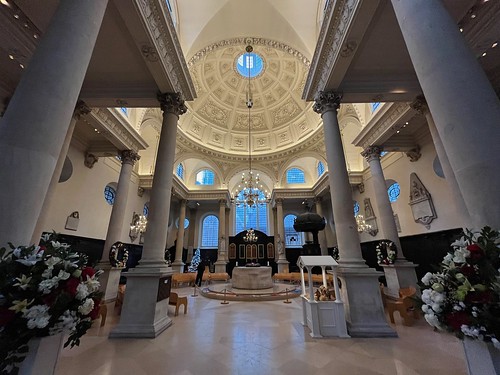
By this point it was becoming clear that the goal of visiting Freemason's Hall was fading fast and my afternoon was going to be spent in an aimless but diverting and fruitful wander through London, an idea that I wholly embraced en route to my next diversion, a dome that I spotted over the rooftops a few streets away and seemed worth a look.
IMG_3147
St. Stephen Walbrook. It was really, really worth a look.

The plaque outside indicated that St. Stephen's was another effort of Sir Christopher Wren, but even if I hadn't been told that I'd like to think I would have recognised this right away as a Wren church. Characterised by rounded arches and white walls, Wren's churches are a marked departure from the darker gothic style you can see at St Olave's. Apparently St. Stephen's was Wren's parish church, so he took particular care with it, crowning it with what some consider his finest dome. In all, Wren was commissioned to rebuild 51 churches after the Great Fire, of which 13 survive in their original form, St. Stephen's among them.

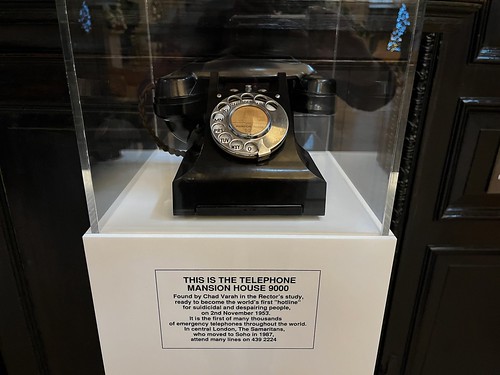
And because it's London and the history is laid on with a trowel, inside the church there was also this:
IMG_3149
St. Stephen's Walbrook is where the Samaritans was founded, in 1953. The Samaritans are a charitable organisation dedicated to providing support to anyone in emotional distress, and are best known for their telephone hotlines. They respond to millions of calls each year, and are largely staffed by volunteers.

I lingered for a while at St. Stephen's, before wending my way past the Mansion House and the Bank of England, stopping to read this plaque set in the pavement.

IMG_3156
"The Great Conduit lies beneath this spot. Built by the City of London in 1245 to provide public water supplied by pipe from Tyburn Springs. Removed after the Great Fire of 1666 and found during the construction of One Poultry in 1994" *heart*

And then, of course, there was another church. Another Wren Church. 

IMG_3162
The famous St. Mary le Bow

St Mary le Bow is the home of the famous Bow Bells. I've said it before but just for clarity (and word count), the Bow Bells are significant because a true Cockney must be born within the sound of their peal. Wikipedia helpfully notes that in 1850 the sound of the Bow Bells could likely be heard as far as Hackney Marshes, Limehouse and possibly even south of the Thames in Southwark. Tragically, urban noise pollution and the lack of any maternity hospitals in the vicinity make the birth of any genuine 21st century cockneys unlikely (though not impossible). 

IMG_3159
See what I mean about the Wren Churches? Round arches, white-washed walls, restrained (ish) baroque finishing

The Bow Bells also feature in the famed nursery rhyme "Oranges and Lemons" a Who's Who of London churches:

Oranges and lemons. Say the bells of St. Clement's.
You owe me five farthings. Say the bells of St. Martin's.
When will you pay me? Say the bells at Old Bailey.
When I grow rich. Say the bells at Shoreditch.
When will that be? Say the bells of Stepney.
I do not know. Says the great bell at Bow.
Here comes a candle to light you to bed,
And here comes a chopper to chop off your head!
Chip chop chip chop the last man is dead.

Next up were a few more livery halls - the Saddler's Hall and the site of the former Broderers Hall ("formed to promote and protect the fine art of embroidery"). And of course I wouldn't make it out of the City without another Wren church, this one the oddly named St Vedast-Alias-Foster, which sounds more like a What Three Words location than a place of worship. (For the record, one of the What Three Words locations covered by St Vedast is Sleepy.Covers.Fantastic.)

IMG_3168
Inside St. Vedast. Again... soooooo Wren.

St Vedast-Alias-Foster follows the formula of so many City churches: founded in the middle ages, damaged or destroyed in the Great Fire, rebuilt by Wren, bombed during the Blitz, and restored once again in the 1950s. Interestingly, this church was Wren's most economical effort, built up from the medieval foundations for a mere £2,958, as compared to a whopping £15,421 for St. Mary le Bow. (Only St. Paul's Cathedral was more expensive.)

St. Paul's was just down the street, but having been there before I skipped that most obvious of Wrens, past a gigantic construction site of what looks like it's going to be an awful lumpish office development just behind the cathedral. The last Wren site of the day was the former Christ Church Greyfriars which follows the above formulas up to the point of its substantial destruction in the Blitz. The outer walls and tower survived, and today surround a public garden. The nearby vestry building is now home to a dentist's office. Of course.

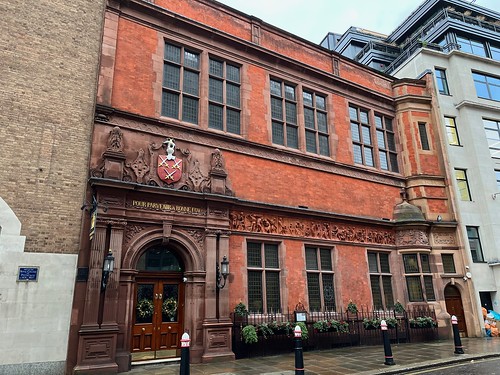
A brief diversion down Warwick Lane lead to the Cutler's Hall (another livery company) that boasts a really lovely terracotta frieze by Benjamin Creswick, depicting the different steps in the process of knife-making: forging, grinding, hafting, and finishing.
IMG_3175
Cutler's Hall survived the Blitz, which destroyed the Royal College of Physicians next door (commemorated by the rectangular blue plaque just to the left of the main entrance)


Photo-05-12-2019-12-26-36
Thank you to Look Up London for this close up photo. 

By this point I'd been dragging myself and my not-insubstantial overnight luggage around the City for a couple hours. A stroll past the Old Bailey was next, but we've heard about that already. Instead, I was still gamely diving down side streets and following my nose wherever it looked like something interesting might be found.

IMG_3178
Which is how I found this excellent thing. It's a very clever bit of shadowplay that tells office workers for that building where they can securely store their bikes. So it wasn't all Wren and livery companies.

Nearing the home stretch, and now slightly damp with intermittent drizzle, I headed along Fleet Street, famously the home of the printing trade and, by extension, to newspapers and journalism. Printing started in the area around 1500, and the first newspaper was published there in 1702. Dickens Pickwick Papers is partially set on Fleet Street and it's also the home of the equally fictitious demon barber. This was familiar territory, since Fleet Street is a major thoroughfare. However, I'd never noticed one laneway off a side street: Magpie Alley

IMG_3180
The alley features a long mural of custom tilework detailing the history of the print and journalism trade in the area.

By now it was well past time for cake and a hot beverage, and I was gratified that even though I was still navigating by feel, it wasn't long before I found my way to High Holborn Street, and a nice cup of tea. I did also eventually end up going past my originally intended destination - Freemason's Hall - but we'll have to save that for a whole other blog because by that time I was in very familiar territory and on my way to something even better than a nice cup of tea... a friendly few pints in a nice pub!

That was just one relatively short walk on a quiet Monday afternoon, with no overarching theme or purpose, that still managed to take in what I think is an astonishing number of unique or beautiful or quirky sites. Because... well, because it's London. And more than twelve years after I arrived, and nine years after I wrote this, I still love it.

Apropos of nothing: The Underground Edition

Sunday, August 27, 2017

It’s all London Transport all the time today, when I share a few quirky little things about the system that even some proper Londoners won’t know about, thus ensuring that Astute Go Stay Work Play Readers are equipped with the kind of random but meticulously fact-checked (read “occasionally looked up on Wikipedia”) nuggets that make up 31% of any GSWPL blog post. (The other 68% is made up of stuff about food, slightly out-of-focus photos, unrelated ranting, stuff about the boat, and dodgey math.)

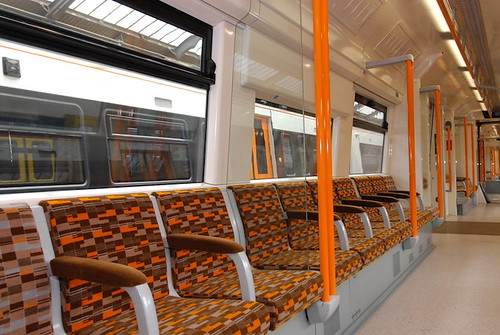
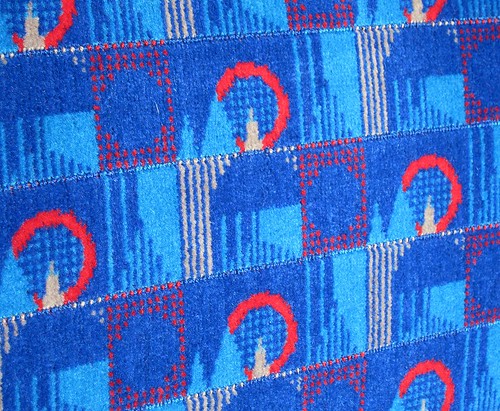
First, spare a thought for the poor seats on a tube train. I suspect most people only think about the seats when they don’t get one, but the seats on London transport have one thing in common - moquette. See? Already, a new word! Moquette is the name for the dense pile fabric used in carpet and upholstery and, most notably, as a covering for the seats in Transport for London conveyances of all kinds - tube trains, overground trains, trams and busses. 

Even the dopiest Londoners will have noticed that TFL moquettes come in a few different and distinctive patterns. This is because when you run an operation the size of the TFL with an annual budget north of £11 billion pounds, you don’t just slope down to the local neighbourhood upholsterers and pick up a job lot of whatever is going cheap. Instead, you have competitions to select designs and have them woven by the kilometre, resulting in this kind of thing:

1024px-Barman_moquette
A pattern called Barman, named after Christian Barman, London Transport’s publicity manager between 1935 and 1941. Barman appears in Central, Jubilee and Northern line trains. Can you find the four London Landmarks hidden in the Barman pattern? If not, check out this video.

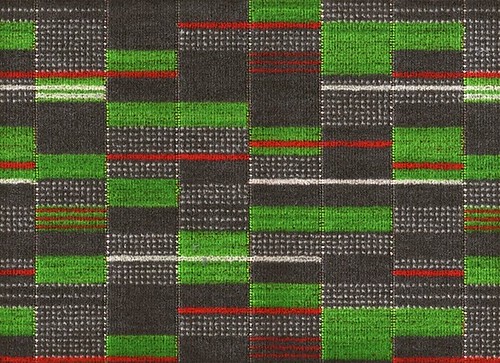
London-Overground
And here’s the design for the whole Overground system, which reminds me of being in an A&W in the 1970s. Oooooohhh... how great would it be if you could get onion rings on the Overground?

tram2
The festively coloured moquette for the Croydon Tramlink, perfect for Christmas.

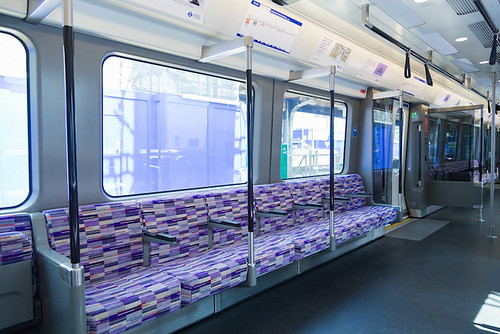
Crossrail Purple
And, excitingly, here’s a sneak peek at the moquette for the yet-to-be-completed Crossrail, now officially named the Elizabeth Line, after HRM. It will be coloured purple on the tube map. (Finally! How can the tube map have three different shades of blue (plus the DLR, so really FOUR) and no purple?!)

What do all of these patterns have in common? Here’s another tidbit for the GSWPL fact-o-meter: They were all designed by the same company. More surprisingly, it’s not a giant faceless mega-corporation, but a small team of two designers who work from a tiny shop near Kings Cross. I find it quite gratifying that the seats where millions of Londoners place their butts daily was dreamt up by a couple of independent designers a short walk from Angel Station. (Also, if anyone is struggling for gift ideas to express your gratitude for my EIGHT YEARS of faithful blogging, anything from here would be nice. I especially like the Bakerloo pattern...)

However, before you get to nestle your buns on a fuzzy Barman-covered seat, you’ve first got to find your way through a ticket hall and onto a platform. And in doing so, you might notice something unusual, like this:

IMG_4887
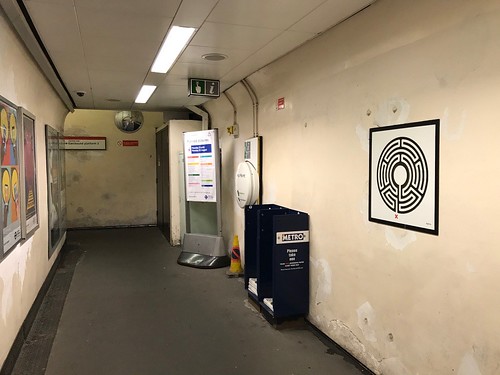
What’s that on the wall of this otherwise non-descript tunnel at East Acton station? 

IMG_4886
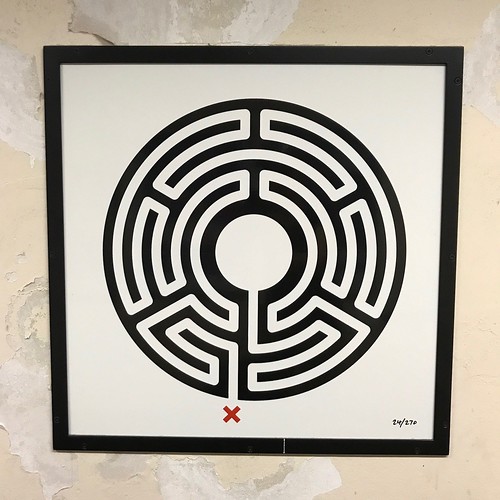
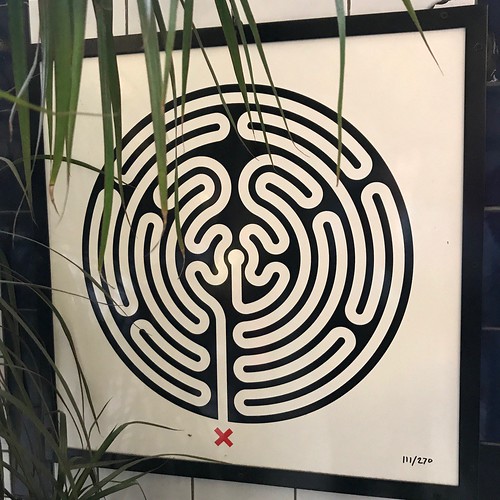
Here’s a close-up. It’s a labyrinth! (Additional bonus fact: A labyrinth is a single winding path usually set in a decorative layout and only ever containing one start and one finish point. This is distinct from a maze, which is a puzzle with many branching pathways and dead ends.)

This labyrinth at East Acton is just one two hundred and seventy different labyrinths - one for every station in the London Underground system. They’re all part of a major artwork installation commissioned by the TFL for their 150th anniversary in 2013. (So that’s where the £11 billion is going, obviously.) Each one is unique and was designed by Mark Wallinger, a Turner Prize winning British Artist. In fact, the TFL has a long history of supporting art on the Underground, with their well-known program called… wait for it... Art On The Underground. (And that’s just visual art. They also do poems, but that’s another blog.)

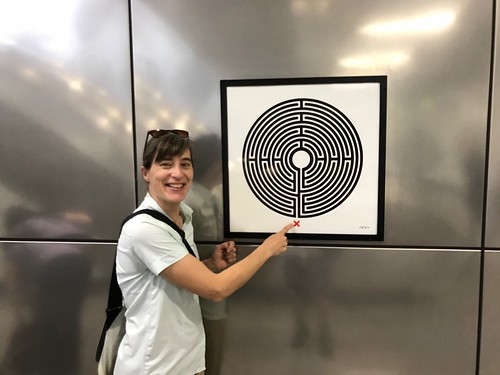
The labyrinths are depicted in black and white enamel on a metal background about two feet square, and they’re not all obvious. In fact, there are no descriptive plaques of any kind. No indication that they’re artwork. No credit to the artist. No explanation of any kind. They just… are. The graphic nature of them makes them a bit puzzling too, like they could be maps or advertisements or… who knows? They're also made by the same company and in the same dimensions and materials (sheet steel and vitreous enamel) as every station label roundel in the system, which makes them seem oddly familiar. The enamelling also gives the labyrinth a tiny bit of depth and texture, which makes is sort of pleasing to run your finger along the path, starting, of course, at the little red X.

Tottenham Court Road
Me pointing out where X marks the spot at Tottenham Court Road

IMG_4894
And here's the Swiss Cottage Labyrinth in situ, between a tube map and a photo booth. See what I mean? It could be anything.

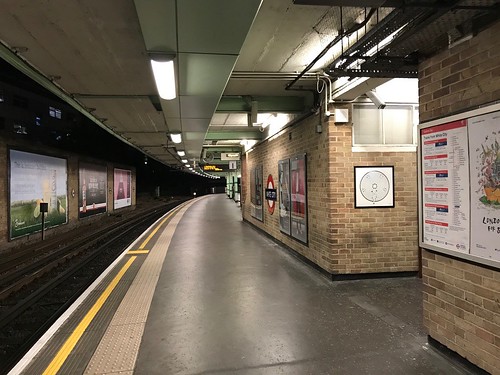
IMG_4912
Cleverly hidden on the platform at White City

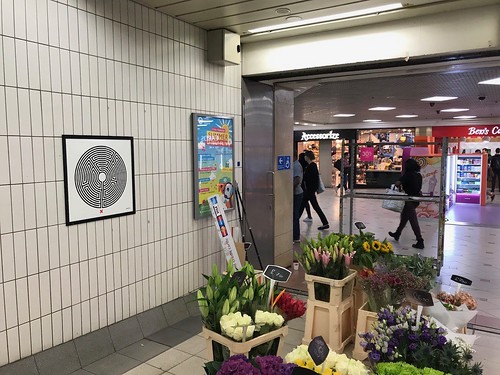
IMG_4906
Tucked behind a flower stall at Hammersmith

I recently started collecting the tube labyrinths, which really just means that when I come across one I take a picture. I’m up to 21 now, which is a whopping 7.7% of the system, but considering I’ve only been at it for about a month, I think that’s pretty good. If nothing else, it makes me pay a bit more attention instead of shuffling around tube stations like a zombie.

The labyrinths are all circular, echoing the shape of the iconic tube symbol, and come in a surprising number of styles that the artist put into categories like square, chamfered, woodcut, emboss, cretan, medieval, organic, and a few others. (There's a great documentary about the tube labyrinths here, which talks some about the mathematics behind labyrinth design and about the project as a whole.) There’s even a book of all the labyrinths, with photos showing them in situ and including interesting facts about the station. It looks lovely but large and hardcovered and not very boat-friendly in an overhanging, shelf-hogging kind of way.

And here's one more fun fact about the labyrinths - see the hand written numbers in the bottom right hand corner? 

IMG_4618
Here’s Camden North, 111/270 and cleverly hidden behind a large spider plant

They resemble the sort of numbering system that artists use when producing limited-edition prints. Which, in a way, they are. However, the number assigned to each station is not random, and has nothing to do with the the order in which they were produced. They’re part of another odd bit of tube-lore: The Tube Challenge.

The Tube Challenge is a competition for the fastest time to travel to all 270 London Underground stations, which has been a recognised Guinness World Record since 1960. The current record is held by Steve Wilson and Andi James, who completed the challenge in 15 hours, 45 minutes and 38 seconds on 21 May 2015. The Tube Challenge is a serious logistical puzzle that requires competitors to start early in the morning on the first train from a far-flung station, race on foot between nearby stations to optimise travel times, and pray there are no delays or signal failures. (And also deal with annoying, dead-end stations or ones that only operate on alternate Thursdays as dictated by the lunar cycle or some crap like that. Kensington Olympia and Turnham Green, I’m talking to you.) 

(Vaguely related aside: Sometimes the drivers and platform staff on the Underground can be really fun - joking and making silly comments over the public address system. My favourite example of this is one I found on a now-dead website of Tube lore: “Turn ‘em red. Turn ‘em yellow. Turn ‘em any colour you like, but this is Turnham Green!”) 

What does this have to do with my labyrinths? Well the numbering order of the labyrinths is based on the order in which each station was visited during Steve Wood’s 2009 record-breaking journey! (He subsequently bettered it twice, once in 2011 and once when he set the current record.) Chesham, at the far end of the Metropolitan line, is first on the list, which is not surprising considering it’s one of only two stations in Zone 9 so you really want to either start or end there. Heathrow Terminal 5 is number 270, which is a rough place to end up after 15 hours of sprinting and train-hopping. I wonder if they took the tube home after they finished their record-breaking journey?

So the Underground labyrinths, which most people already don’t really notice, have an even more obscure added level of tube geekery. And if that’s not the best, most obscure TFL fact you’ve ever heard, then basically you suck. 

Apropos of Nothing, return of the revenge of the son of the sequel

Sunday, March 10, 2013

A few more random thoughts for your consideration:

On the Unaccountable Presence of Corn in Odd Places:

There is something about corn here.  Or, more specifically, about corn niblets. (Or "sweetcorn" as it is known here, probably to differentiate it from its close cousin, sourcorn. Actually probably because the term corn is sometimes used to refer to any kind of grain, but really I digress.) What I was saying is there's something about sweetcorn here, and that something is that often appears in odd places. (Not odd as in on the bus, or the sock department at Marks and Spencer, or the House of Lords, but still, you know, odd.)  Some of you may be used to encountering corn in shepherd's pie, and that's common here.  But what about in your cold lunch?  Not difficult because it's basically impossible to get a tuna sandwich here without corn in it.

Corny
A tuna sandwich related sidebar: the tuna + mayo combination that we in North America call "tuna salad" is here generally called "tuna mayonnaise".  And it's chicken mayonnaise or prawn (shrimp) mayonnaise as opposed to chicken salad or prawn salad. A sandwich with "salad" in the name here is one with lettuce and sometimes other veggies added.  Which, if you think about, actually makes much more sense.  After all, what does mayonnaise have to do with salad?

And what Italian chef has ever stood at a counter staring at a partially formed pizza and thought to himself, "Aha! Obviously what this pizza needs is MORE CORN!"

Corn pizza

Every one us us has probably walked down the street at some point with a slight rumble in the stomach and thought, "Hmmm... What do I want?"

Cornier
Naturally, your first thought is probably, "Where can I get me a cup of corn niblets?"  And if that is your first thought, your're clearly some kind of freak and your next thought is probably, "Then for my main course, how about a lightly grilled stoat on a stick?  With extra cheese, please."


On the Disconcertingly Geographically Specific Nature of Air Hockey:

I like to think that I'm pretty well assimilated by now.  I've been living in London for two and a half years (!!) and I know how to read a bus map, I know it's a bumbag and definitely not a fannypack, and I can even sing "Jerusalem" without having to hum because I actually know all the words.  But still every once in a while I encounter something that makes me feel once again like a stranger in a strange land. That's what happened a few weeks ago when I went out for the evening with my friend Rob to an odd arcade / bowling alley / somethingorother on the south of the river at County Hall.  (For those of you trying to keep track of the Robs this was RobW, a relative newcomer, as distinct from RobH, frequent blog commenter and long hair fan, and Uganda Rob, now based in Nairobi.  Clear as mud.)  They had lots of video games, and old fashioned midway kind of things like those shove-penny machines and shooter games and claw machines and such. They even had coin operated bowling!  Weird, but fun.  They also had something that immediately caught my eye.

Many of you will be familiar with the game of air hockey.  A smooth table with bumpers all around and surface perforated with tiny holes through which air is forced, which makes a round flat plastic puck float on the surface while two player whack away at it unmercifully with a round paddle sort of thing.  The table surface is painted like a hockey rink with a white background and a centre line, face-off circles, blue lines, goal crease... all the things that make it look like hockey.

air hockey
Good, upstanding, god-fearin' air hockey.

I was delighted to discover an air hockey table in the basement of the arcade and happily inserted my pound coin for a quick game.  Then I did a double-take and realised, once again, that I really wasn't in Canada anymore.

Apro po of nothing
Weird, heathen GREEN air field hockey.

What the hell? Air FIELD hockey? They don't even use a PUCK in field hockey!  The whole thing must have shaken me up more than I realised because I ended up losing the game 3-2, which I blame entirely on the alien freakishness of the table. Obviously.


On the Greatest Queue Time to Event Time Ratio Ever:

One of the great things about London is that there is soooooo much going on.  Not just music and theatre and museums and such, of which there are boatloads.  There are also a ton of slightly off-beat things that crop up pretty much all the time.  I've recently subscribed to a daily email sent out by a great website called Londonist (which has the brilliant tag line: London. Londoner. Londonist.)  Every morning, by 7:00am, I get an email of a list of the cool things I could do in London that day, lots of which are free free free.

One of these emails recently noted that the art installation known as the Rain Room at the Barbican Centre was due to close soon.  I had vague memories of being told about this months ago and ignoring it completely, but since it was free, and since I still had a bit of time on my hands, I arranged with a friend to go down one morning in the last week of the installation to see what the fuss was about.  The Londonist warned that queues were getting long, so I reasoned that if we went first thing in the morning and planned to arrive about an hour before the room opened, we'd be fine.  Ha!

Of course it turned out that my estimate was laughably wrong.  London may have a ridiculous amount of cool stuff to do, but sadly it also has a ridiculous number of people trying to do it all.  By the time Ian and I arrived shortly after 10:00am the queue had already wound back on itself several times, and the Barbican had set out signs like this:

Rain Room
The queue

This caught us off guard a bit, but we quickly decided that we weren't going to wait five hours.  At least not that day.  Before we left Ian cleverly went to the front of the line and asked the people there what time they'd arrived that morning, so we could gauge when to make our second attempt.  So it was that we found ourselves settling in, second in line, at just before 8:00am the next morning, for a guaranteed three hour wait. (The gang of girls in front of us arrived at 7:00 and several people got there just after us, so I think we gauged it perfectly.)  The wait wasn't that bad.  At least we were indoors, on carpet, with ready access to toilets, free wifi and decent coffee.  And we had a deck of cards and are both skilled in the dying art of conversation, so the time passed pleasantly.

And what was it that we waited so long to see?  Well, the Rain Room is was an installation of cascading water that visitors were meant to walk through.  And before you point out the obvious madness of queuing for hours to stand in the rain when London provides ample opportunities for that on almost every day of the week, let me tell you the thing that made the Rain Room so fantastic.  The cascade was equipped with an array of sensors that turned the water off in the area in which you were standing, meaning you could walk through the deluge in a little bubble of dryness.  Yes, there were occassional drips even when the taps were turned off, and yes you had to move in a slow and deliberate way, but it was still quite a lovely experience.
Rain Room
(ARTY PHOTO ALERT!) Ian in the Rain Room.

They only let five or six people into the room at once.  It was mostly dark except for one bright spotlight, and the only sound was the water and the comments of the other visitors.  I loved looking up at the ceiling and then slowly spreading my arms out and watching the waters recede before them.  It made one feel a bit like Moses, if the Red Sea had been upside down, and if Moses and the Israelites had had to queue for three hours.

Rain Room
The ceiling, showing areas of wet and dry.

In the end we spent less than ten minutes in the Rain Room.  As cool as the experience was, there's only so much time one can spend not standing in the rain.  So we ended up with a ratio of about twenty minutes waiting time for ever one minute of Rain Room time.  Still, when we passed by the queue on our way out of the building (after towelling off the stray drips), we felt pretty smug, especially compared to anyone standing next to the "6 Hours from this point" sign.


On the Sudden Return to a Life of Toil:

And in other news: work, work, work!  My days as an unemployed layabout and full-time café dweller have definitely come to an end for the foreseeable future.  As seems to be the nature with freelance work, what started out as an occasional meeting and an infrequent hour or two with a spreadsheet has suddenly become a life filled with phone calls, lists, visits to scene shops, battles with budgets and looming deadlines on two different shows at two different theatres. All of this has been a bit of a shock to the system, but is also a relief and strangely kind of nice.  

I'd been quite worried that after a lifetime spent as a salaried employee ensconced in a building full of shops and people waiting to do my bidding (more or less) that I'd find life as a freelance production manager scary and difficult.  Certainly some things are harder, like having to go out and find people to build things instead of having them waiting in the basement, tablesaw at the ready.  It's also weird not to have a desk and a phone in an office, meaning that my café dwelling days aren't actually over, they've just morphed into something much less relaxing.  Then again, it's kind of liberating to be the master of my own schedule, and to have the freedom to, say, queue for three hours for a funky art installation before dashing off to a supplier to pick up samples, and then to the designer's studio to try and pitch him the stuff that's £8.40 a square metre instead of the stuff that £26.95.  Concatenating all the things I have to do and all the places I have to be is sometimes exhausting.  (Also: Concatenating!  That one was for both Robs W and H.)

All of this means that my blogging time has been severely curtailed.  But fear not!  I've got no intention of abandoning you any time soon.  But since my weekdays are quite full, weekend have become the best time for blogging, so you should all brace yourself for the advent of Monday morning blog posts (sorry Steve!).  

And finally, there is some quite interesting employment-related news on the horizon that I'll refrain from announcing until all the specifics are confirmed.  But I think it's going to be cool.

Scary. Big. And cool.  So stay tuned.

Apropos of Nothing, revenge of the son of the sequel

Monday, April 2, 2012

Another completely random selection of thoughts...

Quirky Budget Day Traditions on Two Sides of the Atlantic:

The government presented a new budget last week and just like in Canada, where they've also got a new budget, the media coverage was er... extensive.  In Canada the budget is presented by the Finance Minister.  Here in the UK the minister responsible for all financial and economic matters is called the Chancellor of the Exchequer, currently George Osborne.  The presentation of a budget is all pretty familiar stuff, but there is one tradition here that is quirky enough to make it worth blogging about: the red box.

Red boxes are the traditional cases used by British government ministers.  They look like little red briefcases, and are meant to be used to carry official government documents from place to place.
The design of ministerial boxes has changed little since the 1860s. Covered in red stained rams' leather, it is embossed with the Royal Cypher and ministerial title. The 2 or 3 kg boxes are constructed of slow-grown pine, lined with lead and black satin and, unlike a briefcase, the lock is on the bottom, opposite the hinges and the handle, to guarantee that the box is locked before being carried.

The colour red has remained the traditional covering of the boxes. The lead lining, which has been retained in modern boxes, was once meant to ensure that the box sank when thrown overboard in the event of capture. Also bomb-proof, they are designed to survive any catastrophe that may befall their owner. (Thanks again, Wikipedia!)
Fun, eh?  The most famous red box is the one used by the Exchequer to carry the new budget.  Unsurprisingly, it's called the Budget Box.  It's traditional for the Exchequer to pose for photos with the Budget Box outside of 10 Downing Street (the home of the Prime Minister and the UK equivalent to 24 Sussex Drive).  It is impossible to get through the week that a budget is presented without seeing at least 739 different photos of the Exchequer and his little red box in front of Downing Street.

Osborne Red Box
I will spare you the other 738...

And, for my 4 UK readers (Patrick, Anne, Paul, Jeremy... I'm talking to you) here is a fun Canadian budget fact: In Canada there is an inconsistently followed tradition that the Finance Minister will buy or wear new shoes on Budget Day.  There's even a Wikipedia article entitles "New shoes on budget day".

Jockey Wheels and Monkey Sprockets:

I'd like to take this opportunity, once again, to thank Cycle Training UK and Lambeth Council.  I've mentioned them both before, but their generosity regarding all manner of cycle training really deserves another nod.  Astute GSWPL readers will remember that I had two sessions of one-on-one cycle safety training in the fall, which made me eligible to take a full day bicycle maintenance course at no extra charge.  So that's 4 hours of on-road training and about 7 hours of maintenance training all for the grand total of £8.00.  I honestly still can't believe that.

I also can't believe how shockingly low the pressure in my tires has been, more or less forever.   That's just one of the things I learned last Sunday when I spent the day in a nice little workshop learning all about my bike.  It was a very small class of people - me and two other women, and a female instructor - which meant that we got to do much more hands on stuff with our own bikes than if there had been a class of 12.  I've already mentioned that I had an impromptu flat tire fixing lesson a few months ago, but we went over all that again on Sunday, and then got into some more interesting stuff.  I now know how to correctly apply a patch to an inner tube, and how to get my back wheel in and out without touching the chain, and I can replace brake pads and cables and adjust the brakes in two different places.  I can even make a stab at some gear adjustments.

Bike Hospital
Leila and Sarah, trying to adjust something on Leila's vintage racer bike, which was charming, but had lots of quirky old-fashioned parts that were making both of them sort of crazy.  My bike may be boring and heavy, but it's also pretty easy to fix.

I even rotated my tires, because the back one was terribly worn, especially considering I've had the bike for less than a year.  I must be cycling much much much more than I even have before.  Or possibly my tires, like the rest of the bike, are just kind of cheap and crappy.  No matter, the now-rock-hard tire pressure, plus a slightly higher seat, plus tuned up brakes, made the ride to and from work on Monday seem like a breeze.  I was cruising comfortably in gears I've barely used before and have cut about 5 minutes off my commute time.  I suppose the most surprising thing was how simple most of this stuff is.  The whole thing was ridiculously empowering.

As for jockey wheels and a monkey sprockets: one is a real bike part that needs occasional attention, and one is completely made up!  And I know which is which now.

Bike bits from the training room.  Not pictured: jockey wheels.  Also not pictured: monkey sprockets

The Zoology of London Road Crossings:

I've already mentioned zebra crossings, which are always marked with a Belisha beacon.  But since I've lately been forced to delve into the murky world of the Highway Code I've discovered that there is a whole zoo of crossings out there.  As a reminder, the zebra crossing is the one with the white stripes on the road and the magic flashing lights where you (theoretically) can just stride confidently into the road and everyone should stop. (Once again I'm compelled to point out that here it is pronounced ZEB-ruh.  Not ZEEB-ruh.) 

One down from the zebra crossing is the pelican crossing. No, I am not making this up.  Have a look at the Highway Code yourself if you don't believe me... it's gripping reading.  Pelican crossing are what the Brits call the ones where you have to press a button to make the little green man on the other side of the road come on.  Fairly standard.

Moving on from pelican crossings we have the puffin crossing.  They work the same way as pelican crossing except that the little red and green men are not all the way across the road, but instead are just above the button.  Puffin crossings are also equipped with "pedestrian detectors" that determine how long the keep the green man on.  Interesting.

Even more interesting are the toucan crossings, so named because they allow cyclists to cross at the same time as pedestrians without getting off their bikes.  So two can cross at the same time... get it?

Toucan Crossing
Green Man and green bicycle!  There are toucan crossings on my cycle route to work.

And finally, rounding out the menagerie is the very rare pegasus crossing, which I have not yet encountered in the wild.  Pegasus crossings allow controlled movement not just for pegasuses but also for any other of your hybrid mythical beasts including, but not limited to: griffins, manticores, centaurs, hippogriffs and minotaurs.  

Ha! Not really.  A Pegasus crossing allows people on horseback to cross the road, and have buttons mounted much higher up so you can reach them comfortably from horseback.  And of course they have little green horse-and-riders.

Pegasus Crossing 2
Cute!

The Big Brother Effect:

The UK is, I think, the most surveilled society in the world. (Karen - am I right about this?) CCTV cameras are everywhere.  I've always known this in an abstract sort of way, but on Sunday read a statistic that said the average Londoner is captured on camera 13 times every hour.  That made me sit up a bit straighter (not least because I didn't want to be caught slouching from eight different angles).  I did a bit more digging and came across a very interesting article in the Guardian (which is a very popular paper that I might actually be inclined to buy and read, except the crossword is bloody impossible) about some research done in Cheshire and extrapolated out to the whole UK.  That research figured the number of surveillance cameras in use in the UK is more than 1.8 million, or one for every 32 people.  

738px-Three_Surveillance_cameras
I admit I did not actually take this picture, it's from Wikimedia.  You can tell I didn't take it because the sky is NEVER that colour here.  Though on Tuesday it was a pleasing shade of much lighter blue, and the sun was shining and I ate my lunch outside along the Lambeth Cut Canal, which was really nice.  Footage of my lunch break is probably already up on YouTube.

More alarming still is the fact that apparently a huge majority of these cameras are owned by private companies.  This was a surprise because I assumed (as, I think, do most people) that it's the government that's watching our every move with cameras outside buildings like the ones pictured above.  Instead, it seems most cameras are indoors.  In the sample in Cheshire of the 12,333 cameras counted a mere 504 were run by public authorities.  That's just kind of creepy.

Also creepy: this photo I took on my walk to the Tube:

Lambeth CCTV
A Lambeth Council CCTV Enforcement vehicle.  Apparently they roam around behind their mirrored windows taking photos of parking violations and people driving in bus lanes and such.  Then they issue the tickets, sorry - Penalty Charge Notices, by mail.  I'll probably be getting a £50 PCN for illegally blogging about an enforcement vehicle without previously applying for a Lambeth Council Social Media Dispensation Approval (Form 127-A)

Less creepy, but still interesting, is the fact that the Tube system has 11,000 CCTV cameras across the network.  This doesn't bother me much though, partly because it means that when people do stupid things on the Tube it's possible that they'll get called out by sharp Tube staff.  For instance:
Tube Driver:  Stand clear of the doors please.  Mind the closing doors.  (Pause)  Please keep clothing and personal items out of the doors.  Do not obstruct the doors.  (Pause, Pause)  The train can not move out of the station until the doors are clear.  Please do not obstruct the doors. (Pause, Pause, Pause)  Would the lady in the third carriage who has inserted 3 wheelie suitcases, a picnic basket and a schnauzer between the doors please remove them?  You are causing a delay to the service.
And that's all I've got for you this week.  If you're lucky, and the stars align, and I get a long weekend off for Easter I may get to blog from some exotic near-London destination.  If not, I'll just rant some more about my driving test.  Stay tuned!

Random thoughts on home

Tuesday, January 3, 2012

It was a lovely trip home for Christmas.  I felt like I had a bit more time to relax than last year, and though there's never really enough time to see everyone as much as I'd like, it was still good.  This might be due to the fact that there was really no jet-lag at all, at least on the way over.  Last year I woke up at 3am on Christmas Eve, which was literally tiresome. This year I slept about 10 hours a night, which does remarkable things for one's whole outlook on life.  And though I had no major bloggy revelations while at home, there are a few things I did or noticed that made me stop and go "Huh."  And so onwards...

On Inside/Outside Nature Of Shoes:

This is something that always trips me up in London: shoes.  To clarify: it's not that my shoes literally cause me to trip.  It's shoes inside houses.  In Canada when you go over to someone's house - especially in the winter - you take your shoes off at the door and you spend the evening in your sock feet.  This clearly makes sense. Outside is a dirty, wet, mucky place.  Why would you wander around inside a house on its nice, clean, possibly carpeted floors wearing the shoes in which you just navigated the mean streets?  Ick.

Oddly, shoes-in-the-house is the rule in London.  Several times now I've been at house parties and taken my shoes off when I enter the house only to find that I am the only shoeless person in the building.  And keep in mind that London is a pretty comprehensively damp place a lot of the time, meaning that the odds of arriving at someone's house with wet feet are better than average. Still, the rule seems to be that shoes stay on inside the house when visiting.  Perhaps Londoners all have holes in the toes of their socks.

Whatever the reason, I was gratified to attend a pre-New Year's party in Winnipeg where everyone had their shoes off.  In fact, they took their shoes off outside the door of the apartment and left them outside.  When I saw the shoes piled up at two different doors in that condo building it gave me a little warm fuzzy feeling.

Shoes OUTSIDE
Shoes at the party - earlier in the night there were three times this many!
(The other advantage to this system is that if you like someone else's shoes more than your own you just have to make sure you leave before they do...)

On Other, Less Conventional Footwear:

I went skating for the first time since I left Canada! On New Year's Eve!  At the Forks!  It was good fun, even though I was obviously not as solid on my skates as I was when I was playing hockey regularly.  Also my skates were a bit dull, and despite the fact that the skating was very slow and the session was very short, there were still a few muscles that made themselves known the next day on a chilly New Year's Day hash run around my old neighbourhood.  Still, it was worth it, and I did manage to acquit myself a little more skilfully than the 5- and 7-year old in the group.  Phew.

Skates 
Picture of Pam's feet.  (It's just like the good old days!)

And in the "You'd Never See That In London" Department:

Even though neither the Red or the Assiniboine Rivers are frozen over enough for skating (surely a sign of the coming apocalypse) there were still skating trails at the Forks, which were equipped with these cautionary signs where the skating trail passed over a pedestrian trail. 
(In fact, the general Manitoba/Saskatchewan area was weirdly un-snowy.  There were maybe two or three inches of snow cover over all.  What the Hell is that?  There's probably more snow in Yorkshire right now than there is in Winnipeg.  It's Upside-Down World!)

On The Difficult Nature Of Stuff:

I visited my stuff.  By which I mean I went out to All Canadian Storage and threw open the rolling door on the 5' x 5' storage space that contains most of my worldly possessions. (I really went to get my skates, and pick over the much-talked-about package from Africa, but it was still a nice visit.)  It was good to see everything and remind myself that it's there, but the more time the stuff spends in Winnipeg while the owner of the stuff is in London, the easier it is to live without.  It makes me wonder why I'm hanging on to it.  And it makes me wonder a LOT about paying $65 a month to store it.  I suppose it's because I purged so much when I sold my house that I figure that what's left must really be the stuff worth keeping - the stuff I will want again some day.  Then again, does life in London really require a French Horn? Or a 40 year old 110-volt sewing machine? Or my grandmother's good china?  Probably not.  But that doesn't mean it deserves the bin.

It all comes down to whether or not I think I'll stay, and for how long, which is a question I'm not really equipped to answer.  It depends entirely on how long I can continue to get interesting work that pays the bills.  Professionally, there is nothing drawing me back to Canada, but visits like this one make me remember that I have family and good friends that will never be a proper part of my life while I'm an ocean away.  No easy answers here.

Aha!  THAT'S where I put that trombone! I've been looking for that...

On the Usurious Nature of So-Called Beer Sales at the Chili's in O'Hare Terminal Two:

I don't know why I did it.  Why did I choose to fly home through Chicago instead of Toronto?  Oh wait, I know why.  It's because I still have this lingering idea, perhaps brought on my extensive international travel, or perhaps by natural Canadian inclinations, to believe that anywhere NOT in  Canada is inherently more interesting than anywhere IN Canada.  Whatever the reason, I transited through Chicago O'Hare airport in both directions on this trip.  London to Winnipeg was the worst.  I landed at Terminal 5 and had to clear US customs (“Food products? Why no Mr. Friendly US Customs Man, I certainly don't have biscuits and cheese and chocolate and cake from Fortnum & Mason. Not me!”).  Then I had to reclaim my heavy, crippled, broken-handled suitcase and re-check it, then get the shuttle to Terminal 2, then go through security again, and THEN get to the departure gate.  Fun times.

Of course going through a third country meant I also had to get some US alternate currency to have a bit of supper while I was waiting for my (late) flight.  So I located a bank machine, figured $20 would be ample, proceeded to a handy Chili's restaurant with my new American twenty dollar bill and scanned the menu.  Oddly, there were no prices listed for the different (crappy) beers they had.  Naturally alarm bells should have rung at that point, but I must have been a bit too jet-lagged to hear them.  So I ordered a Sam Adams beer and a pulled pork sandwich  confident that $20 would cover dinner with room to spare.  (The sandwich with fries was about nine dollars, so this was not an unreasonable assumption.  Or so I thought.)

Ha!  The bill arrived and I just about choked.  $19.96 in total with all taxes, but before tip.  This means that my (mediocre, pale, American) beer cost just under 9 bucks.  NINE BUCKS FOR A CRAPPY AMERICAN BEER!  I just about called the waiter over to say something indignant like, “Mate, you are taking the piss if you think that glass of watery slop is worth five pounds fifty!”  Instead I fumed silently and picked my jaw up off the floor and pulled out my credit card. This is because I am a polite Canadian, and because I live surrounded by, and acclimatised to, a nation of people who would not raise a fuss for anything less than the severing of at least two major arteries (“Honestly Nigel, just use your school tie as a tourniquet and stop whinging.  People are starting to stare!”)

For future reference: the Chili's in O'Hare Terminal 2 is a gigantic RIP OFF when it comes to beer.  You are warned.

On the Utterly Desiccated Nature Of Winter On The Prairies:

I lived through 40 Canadian winters before I left the country, and I don't ever remember having chapped lips for two weeks straight.  Maybe I've lost my natural resistance having been away for too long, but about 1.3 seconds after arriving I started reaching for the Chapstick and ended up reapplying it about every six minutes.  How is it possible the nation is not populated entirely by a race of giant human/raisin hybrids?  It makes me think that breakdown of Canada's economy these days must be something like this:

Canadian Economy


On The Gratifyingly Dramatic Palette Of Sunrise On The Prairies:

Maybe it's just London.  Maybe there are spots in England where the sunrises and sunsets are as glorious as they are on the prairies.  But somehow I doubt it.  I've been conscious for a reasonable number of sunrises in London now, and they are almost always utterly unremarkable.  At least compared to this example from just outside Saskatoon.  Fantastic.
If anything, the colours are more muted in the photo than they were in real life.


So lovely, you have to look at TWO photos of this particular sunrise.

And that was my trip home.  It was 97% nice, 1% outrageously expensive crappy beer, and 2% Cheeseburger-of-Doom-on-New-Year's-Eve-at-The-Pancake-House-at-the-Forks. (Which was not nearly good enough to want to encounter again a few hours after it went down.  But enough said about that, because frankly my stomach is still a bit shaky three days later.)

I'm back to work tomorrow morning and I expect that within a few months work will become all-consuming so it was good to have a decent break over the holidays.  So it's nose-to-the-grindstone (if by grindstone you mean computer screen) and back to life in the big city.  Stay tuned for further exploits and, I hope, some much, much better beer.


******


P.S.  Dear Winnipeg:  Did you get the Jets back?  Really?  I never would have known.  You'd think that people would talk about that more.  And wear more Winnipeg Jets gear.  And complain more about not being able to get Jets tickets.

See what I mean?  The guy in the seat in front of me from Winnipeg to Chicago...

P.P.S.  Dear London: See? You're not the only ones who can't get tickets to major local sporting events.

Apropos of Nothing, son of the sequel

Monday, November 28, 2011

More short, random observations of life on this side.

On the oddly bi-polar nature of driver's licences:
First of all, they're not called driver's licenses, they're called "drivING licences". I guess it's not the person that's licensed, it's the act.  I recently traded my Canadian driver's license for a UK one, which was relatively painless and not even that expensive.  The annoying thing is that driving licenses in the UK require you to take your test in a manual transmission vehicle if you want to be licensed to drive a manual transmission car.  Of course there's no way to prove that I took my driving test (27 years ago...ohmygod) in a manual transmission car because no one in Canada gives a damn about that and hence no records of that are kept (oh, also I didn't take my test in a manual, but that's not the point.)  The point is that I wasn't able to get a manual transmission license.  This, despite the fact that every vehicle I've ever owned and registered was a manual.  I suppose the fact that I owned them is no guarantee that I drove them.  So now I have to arrange to take a test to upgrade my license, because about 90% of vehicles in the UK are manuals, which is all kind of boring.  That's the first bi-polar thing about driving licence - the manual/automatic differentiation.

The other thing is the physical licence itself. It comes in two parts, like the old Saskatchewan licences.  There's the plastic photo card part that most people carry around, which is familiar. Then there's the "paper counterpart" which is a full A4 sized sheet and is a legal part of the licence itself. Theoretically you're supposed to carry both halves at all times, which almost no one does, partly because it's a pain and partly because it's just a flimsy piece of paper that will decompose in a wallet in no time flat.

Driving License 
It says: "Important Document - The photocard and paper counterpart should be kept together. Both must be produced when required."  And that's my photocard in the corner, the pink thing with the EU symbol and the unflattering photo.  Then again it's not nearly as unflattering as the ID photo on my new Olympic Park pass which makes me look 70 years old, three-quarters dead and supremely uninterested in everything. People gasp and make involuntary vowel sounds when they see it.  Then their eyes start bleeding...

On the similarly dual nature of laundry detergent:
Again, we've got a linguistic clarification to make here.  It's not actually called laundry detergent here, it's called "washing powder".  Also, dishwashing soap is called "washing up liquid" because doing the dishes is referred to as "doing the washing up". "Washing up" is apparently a phrase that refers exclusively to the dishes.  So it's "washing up liquid", unless it's "fairy liquid".  Not because it comes from fairies, but because the best-known brand of washing up liquid is Fairy.

Fairy liquid
Lemon Fairy Liquid, though it's most common form is Mild Green Fairy Liquid.
But back to the washing up powder, and something that baffled me for a long time after I arrived before I finally got off my butt and asked about it.  All washing powder over here is clearly divided and appropriately labeled as belonging to one of two camps: Biological and Non-Biological, usually abbreviated to Bio and Non-bio.

Bio vs. non bio
See what I mean? Clearly labelled.

And what's the difference?  According to our friends at Wikpedia (and let's just pause for a moment and consider that there are actually people out there who care enough about this subject to write a short but reasonably informative article about it) (Oh, and let's also have a short moment of reflection to admit that I am also in the process of writing about it.) (And don't forget you are reading it, so don't get snooty)... but back to Wikipedia, which says that biological detergent contains "enzymes harvested from micro-organisms such as bacteria adapted to live in hot springs... whose purpose is to break down protein, starches and fat in dirt and stains on clothing... for example food stains, sweat and mud."  Apparently those enzymes increase the cleaning power of the detergent, especially in cold water, which is odd if they're harvested from hot springs.  (And exactly how does one harvest micro-organisms from hot springs? With extremely tiny nets?)  I can't believe there are enough hot springs in the world to produce enough of these enzymes to fill the shelves at every Tesco, Sainsbury's , Lidl, Waitrose and Asda in the UK.  (Especially not the Asda at Putney Vale, which I think is large enough to be visible from the International Space Station.)  

No matter, the bio stuff supposedly works about 10-15% better. However the bio stuff is also harsher, probably because those enzymes must have to be pretty tough characters to survive in steamy, mineral-laden hot springs. Hence the existence of non-bio washing powder for babies, people with allergies and anyone who is generally just a whinging wimp. Nonetheless, the wholesale and absolute division of the entire laundry detergent world into two discrete types was disconcerting - a bit like walking into the grocery store to find the entire dairy section had separate areas for left-handed and right-handed yogurt.

On the most excellent nature of Christmas lights on Oxford and Regent Streets:
Oxford and Regent Streets are the hub of retail consumerism in London, centred at the intersection (or junction) of the two main roads, called Oxford Circus. There is handy tube station at Oxford Circus which I have NEVER exited without being completely disoriented.  This is because unless you were to conduct an exhaustively mapped, years-long, three-dimensional study of the various exits from Oxford Circus Station, I think it's completely impossible to know upon exiting which direction you need to walk to get to the Apple Store. I generally stumble up out of the tube and try to locate All Souls Church, which I firmly believed to be in an easterly direction along Oxford Street, and then orient myself from there.  Naturally it turns out that All Souls is actually north up Regent Street.  And surprisingly it also turns out that Regent Street and not Oxford Street is the one that curves south and east into Piccadilly Circus. Huh.  This goes a long way to explaining why I've always found Oxford Circus a tad confusing.

Navigational challenges aside, Oxford Circus is a shopper's paradise.  The area is home to big department stores like Selfridges, Debenham's, and the beloved Marks and Spencer (which really deserves a post all its own), and to the flagship stores for a lot of major retailers like Apple, Uniqlo, and the famous Hamley's toys store.  And because Christmas is high season for shopping, the Oxford/Regent Street businesses really do up the place with festive lights, which is really fun.

This, for example, is a Boots Drug Store (Chemist):

Boots Christmas Lights
Nice work Boots, but not quite as classy as:

Debenham's Christmas Lights
Debenham's, which I would say is roughly equivalent to The Bay.  But bigger, of course.  And highly skilled with the Christmas lights.

Lights like this are generally called "fairy lights".  So if it's Christmas time you could theoretically make a batch of fairy cakes and then wash up the bowl with fairy liquid all under the gentle glow of fairy lights.  How lovely.  Especially the cakes.  And not so much the washing up.

Brixton Station Steel Drum Band:
Lastly, a little taste of one of the things that makes living in Brixton fun and cool.  There is an Iceland store just next to Brixton Station (Iceland is another of the grocery chains,this one with a particular focus. And I'll admit now that it took me an embarrassingly long amount of time to understand that focus.  This after I'd had numerous trips to Iceland wherein I'd wander up and down the aisles thinking to myself, "Damn, they have a LOT of frozen food in this place. Weird."  Yep.  Iceland sells... frozen food.  Not one of my shining moments.)  Anyway, the front of the Iceland is a popular spot - usually for guys selling sticks of incense which is smelly and annoying and which I strongly suspect is a thinly-disguised front for drug sales.  The Bible-thumpers tend to hang out a little farther down the street around the same place as the Communists, but when the stars align the steel drummers come out, which is my favourite:


How fun is that?  All they need is some fairy lights and we'd have it all.