Showing posts with label transport. Show all posts

Apropos of nothing: The Underground Edition

Sunday, August 27, 2017

It’s all London Transport all the time today, when I share a few quirky little things about the system that even some proper Londoners won’t know about, thus ensuring that Astute Go Stay Work Play Readers are equipped with the kind of random but meticulously fact-checked (read “occasionally looked up on Wikipedia”) nuggets that make up 31% of any GSWPL blog post. (The other 68% is made up of stuff about food, slightly out-of-focus photos, unrelated ranting, stuff about the boat, and dodgey math.)

First, spare a thought for the poor seats on a tube train. I suspect most people only think about the seats when they don’t get one, but the seats on London transport have one thing in common - moquette. See? Already, a new word! Moquette is the name for the dense pile fabric used in carpet and upholstery and, most notably, as a covering for the seats in Transport for London conveyances of all kinds - tube trains, overground trains, trams and busses. 

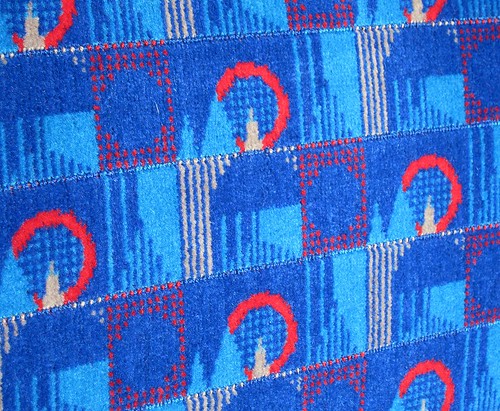
Even the dopiest Londoners will have noticed that TFL moquettes come in a few different and distinctive patterns. This is because when you run an operation the size of the TFL with an annual budget north of £11 billion pounds, you don’t just slope down to the local neighbourhood upholsterers and pick up a job lot of whatever is going cheap. Instead, you have competitions to select designs and have them woven by the kilometre, resulting in this kind of thing:
1024px-Barman_moquette
A pattern called Barman, named after Christian Barman, London Transport’s publicity manager between 1935 and 1941. Barman appears in Central, Jubilee and Northern line trains. Can you find the four London Landmarks hidden in the Barman pattern? If not, check out this video.
London-Overground
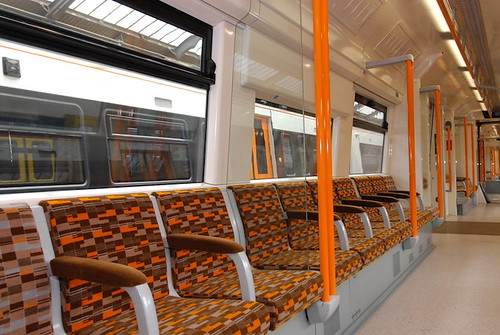
And here’s the design for the whole Overground system, which reminds me of being in an A&W in the 1970s. Oooooohhh... how great would it be if you could get onion rings on the Overground?
tram2
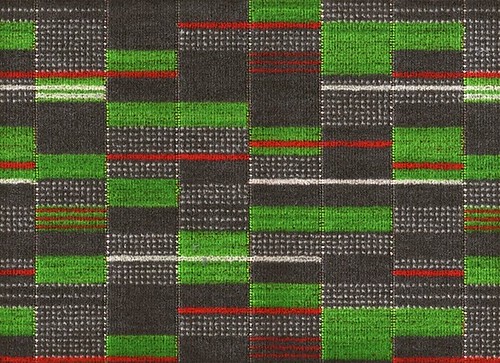
The festively coloured moquette for the Croydon Tramlink, perfect for Christmas.
Crossrail Purple
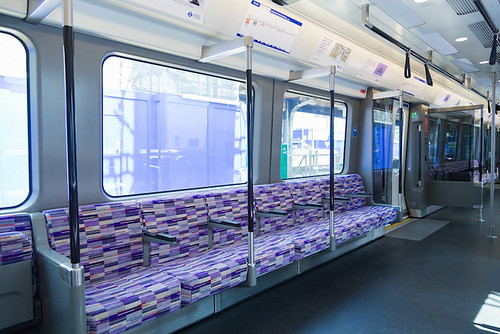
And, excitingly, here’s a sneak peek at the moquette for the yet-to-be-completed Crossrail, now officially named the Elizabeth Line, after HRM. It will be coloured purple on the tube map. (Finally! How can the tube map have three different shades of blue (plus the DLR, so really FOUR) and no purple?!)

What do all of these patterns have in common? Here’s another tidbit for the GSWPL fact-o-meter: They were all designed by the same company. More surprisingly, it’s not a giant faceless mega-corporation, but a small team of two designers who work from a tiny shop near Kings Cross. I find it quite gratifying that the seats where millions of Londoners place their butts daily was dreamt up by a couple of independent designers a short walk from Angel Station. (Also, if anyone is struggling for gift ideas to express your gratitude for my EIGHT YEARS of faithful blogging, anything from here would be nice. I especially like the Bakerloo pattern...)

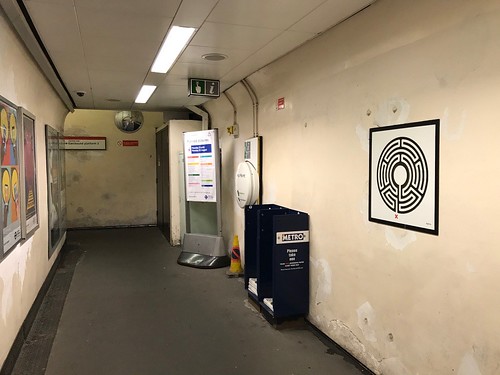
However, before you get to nestle your buns on a fuzzy Barman-covered seat, you’ve first got to find your way through a ticket hall and onto a platform. And in doing so, you might notice something unusual, like this:
IMG_4887
What’s that on the wall of this otherwise non-descript tunnel at East Acton station? 
IMG_4886
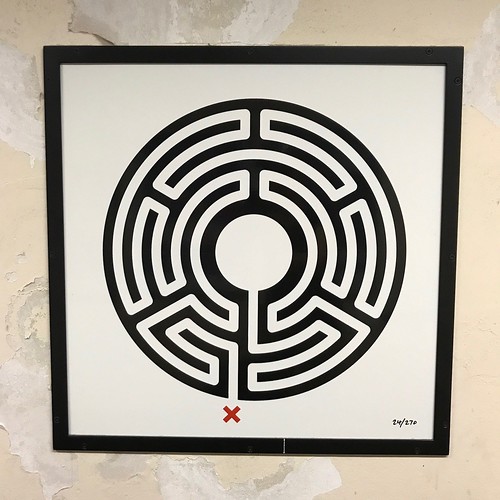
Here’s a close-up. It’s a labyrinth! (Additional bonus fact: A labyrinth is a single winding path usually set in a decorative layout and only ever containing one start and one finish point. This is distinct from a maze, which is a puzzle with many branching pathways and dead ends.)

This labyrinth at East Acton is just one two hundred and seventy different labyrinths - one for every station in the London Underground system. They’re all part of a major artwork installation commissioned by the TFL for their 150th anniversary in 2013. (So that’s where the £11 billion is going, obviously.) Each one is unique and was designed by Mark Wallinger, a Turner Prize winning British Artist. In fact, the TFL has a long history of supporting art on the Underground, with their well-known program called… wait for it... Art On The Underground. (And that’s just visual art. They also do poems, but that’s another blog.)

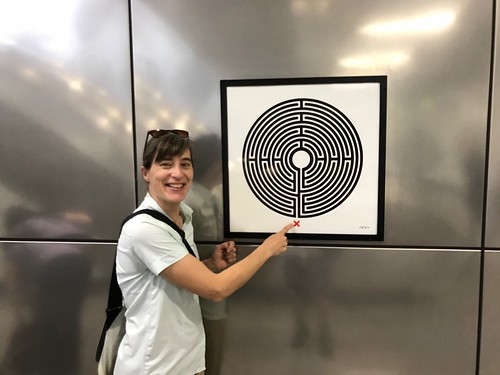
The labyrinths are depicted in black and white enamel on a metal background about two feet square, and they’re not all obvious. In fact, there are no descriptive plaques of any kind. No indication that they’re artwork. No credit to the artist. No explanation of any kind. They just… are. The graphic nature of them makes them a bit puzzling too, like they could be maps or advertisements or… who knows? They're also made by the same company and in the same dimensions and materials (sheet steel and vitreous enamel) as every station label roundel in the system, which makes them seem oddly familiar. The enamelling also gives the labyrinth a tiny bit of depth and texture, which makes is sort of pleasing to run your finger along the path, starting, of course, at the little red X.
Tottenham Court Road
Me pointing out where X marks the spot at Tottenham Court Road

IMG_4894
And here's the Swiss Cottage Labyrinth in situ, between a tube map and a photo booth. See what I mean? It could be anything.
IMG_4912
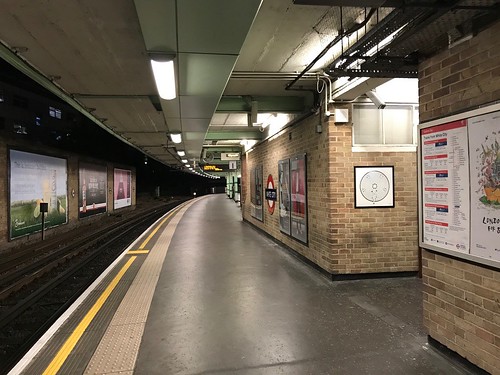
Cleverly hidden on the platform at White City
IMG_4906
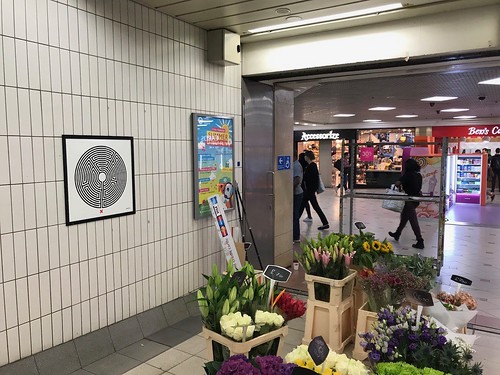
Tucked behind a flower stall at Hammersmith

I recently started collecting the tube labyrinths, which really just means that when I come across one I take a picture. I’m up to 21 now, which is a whopping 7.7% of the system, but considering I’ve only been at it for about a month, I think that’s pretty good. If nothing else, it makes me pay a bit more attention instead of shuffling around tube stations like a zombie.

The labyrinths are all circular, echoing the shape of the iconic tube symbol, and come in a surprising number of styles that the artist put into categories like square, chamfered, woodcut, emboss, cretan, medieval, organic, and a few others. (There's a great documentary about the tube labyrinths here, which talks some about the mathematics behind labyrinth design and about the project as a whole.) There’s even a book of all the labyrinths, with photos showing them in situ and including interesting facts about the station. It looks lovely but large and hardcovered and not very boat-friendly in an overhanging, shelf-hogging kind of way.

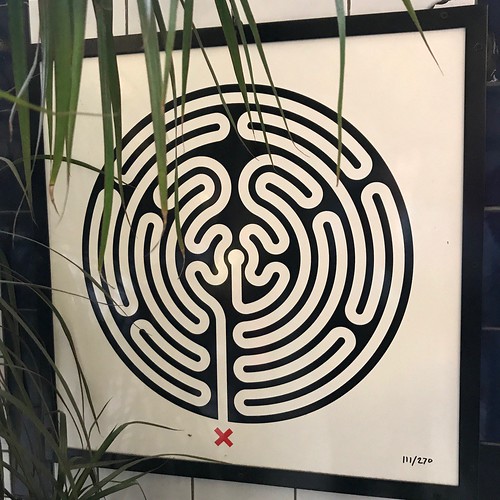
And here's one more fun fact about the labyrinths - see the hand written numbers in the bottom right hand corner? 
IMG_4618
Here’s Camden North, 111/270 and cleverly hidden behind a large spider plant

They resemble the sort of numbering system that artists use when producing limited-edition prints. Which, in a way, they are. However, the number assigned to each station is not random, and has nothing to do with the the order in which they were produced. They’re part of another odd bit of tube-lore: The Tube Challenge.

The Tube Challenge is a competition for the fastest time to travel to all 270 London Underground stations, which has been a recognised Guinness World Record since 1960. The current record is held by Steve Wilson and Andi James, who completed the challenge in 15 hours, 45 minutes and 38 seconds on 21 May 2015. The Tube Challenge is a serious logistical puzzle that requires competitors to start early in the morning on the first train from a far-flung station, race on foot between nearby stations to optimise travel times, and pray there are no delays or signal failures. (And also deal with annoying, dead-end stations or ones that only operate on alternate Thursdays as dictated by the lunar cycle or some crap like that. Kensington Olympia and Turnham Green, I’m talking to you.) 

(Vaguely related aside: Sometimes the drivers and platform staff on the Underground can be really fun - joking and making silly comments over the public address system. My favourite example of this is one I found on a now-dead website of Tube lore: “Turn ‘em red. Turn ‘em yellow. Turn ‘em any colour you like, but this is Turnham Green!”) 

What does this have to do with my labyrinths? Well the numbering order of the labyrinths is based on the order in which each station was visited during Steve Wood’s 2009 record-breaking journey! (He subsequently bettered it twice, once in 2011 and once when he set the current record.) Chesham, at the far end of the Metropolitan line, is first on the list, which is not surprising considering it’s one of only two stations in Zone 9 so you really want to either start or end there. Heathrow Terminal 5 is number 270, which is a rough place to end up after 15 hours of sprinting and train-hopping. I wonder if they took the tube home after they finished their record-breaking journey?

So the Underground labyrinths, which most people already don’t really notice, have an even more obscure added level of tube geekery. And if that’s not the best, most obscure TFL fact you’ve ever heard, then basically you suck. 

Woolwich Foot Tunnel and Ferry

Sunday, June 9, 2013

Life has fallen into a sort of pattern in the last week or two.  I get up in the morning and have breakfast, and then sit for an hour or two staring at lists of Russian verbs, or trying to remember how to say "It's getting late, I must go home." (For the record: становиться поздно. Мне пара домой. Of course.)  Then I take a break, and have a run, or something to eat, or do a few errands, and then I decamp to a nice café for a brisk session of conjugating verbs and so on.  And can I just say how much I appreciate the alternate keyboards that are available on iDevices?  I've had the Russian keyboard set up on my phone and iPad for a while now and it's great.

Russian Keyboard
See?  And the best part is, I actually kind of know my way around that mess now.

This leaves a decent amount of time for doing blogworthy things, and I took advantage of that on Wednesday with a trip out to Woolwich, in the Far East, to check out two things that have been on my list for a while: the Woolwich Ferry and the Woolwich Foot Tunnel.  The weather has finally turned nice here, so I've been cycling a lot, and I figured that the ride out to Woolwich would be a nice one, and not much further than my regular ride out to Blackheath which can be accomplished in a pleasant 45 minutes.  In reality, Woolwich turns out to be quite a bit further than Blackheath, and much of the ride was on rather busy roads past grim industrial estates with me regularly checking my progress on my phone only to find I'd covered a dishearteningly short distance since the last check.  Nevertheless, I eventually arrived with a plan to walk across the river through the tunnel, return on the ferry, and then escape for a cup of coffee in a nice café somewhere, since sitting in nice cafés occupies about 73% of my waking time right now.

I was a bit sweaty and dishevelled when I finally arrived at the ferry terminal and started searching for the entrance to the Woolwich Foot Tunnel.  These sorts of tunnels are normally marked out by a lovely round brick edifice that covers the entrance, so I was expecting to see this:

South Foot Tunnel Entrance
The south entrance to the Woolwich Foot Tunnel

Instead, I wandered around fruitlessly behind a hideous leisure centre bouncing back and forth between a sign pointing west saying "Foot Tunnel Entrance" and a sign pointing east saying "Tunnel Entrance" with very little evidence of a tunnel entrance of any kind in the intervening space.  I almost gave up until I finally followed the east-pointing sign along a series of bright blue plywood barriers, beside a chunk of Herris fencing, and towards an extremely nondescript and well hidden set of concrete steps and down to... Voila!

Untitled
Is this where you would have looked for the entrance to a turn of the century pedestrian foot crossing? Or is this perhaps where you might look if you wanted to discard an old sofa and not pay the tipping fees?  It turns out the entire lovely round brick edifice is positively festooned with scaffolding and barriers, making it mostly invisible.  It may as well have been "stuck behind a disused lavatory with a sign on the door saying 'Beware the Leopard.'"

The Woolwich Foot Tunnel was designed in 1912 by the excellently named Maurice Fitzmaurice, the Irish-born engineer who's also responsible for the Blackwall and Rotherhithe Tunnels.  An Olympics colleague and I have a soft spot for old Maurice Fitzmaurice, since we endured many late night trips through the Rotherhithe Tunnel on the way home from Opening Ceremony rehearsals.  In fact, the tunnel became a sort of touchstone of the journey.  It started with idle confusion about the distinction between the Rotherhithe Tunnel and the Thames Tunnel, which was cleared up with a quick bit of googling, leading to the discovery of the hero of our story, Maurice Fitzmaurice.  He was quickly characterised in our imagination as a straight-talking, no-nonsense type whose only line in our little drama was something like, "Come on lads, let's dig it long, and let's dig it deep!"  But back to our little foot tunnel...

The Woolwich Foot Tunnel was constructed to allow workers from the docks on the north side of the river access to the pleasant residential areas on the south, and it still serves essentially the same purpose.  At one time there were apparently quite lovely wood panelled elevators at either end, but those have long since been taken out of service.  In fact, the tunnel has undergone some major renovation in the last few years, which, judging by the state of the entrance rotunda, are still underway.  I think most of the money has been spent on safety issues like, for instance, ensuring the Thames doesn't flow impertinently into the tunnel at inconvenient moments. In this respect, the renovations have been a success, because I was able to traverse the whole length of the tunnel without getting my feet wet.

Untitled
The entrance stairs are wide and wrap around for about a hundred and thirty steps.  Also pictured, the disused lift entrance.

It's a bit disquieting, the tunnel.  It's cool and damp and when I was there, quite deserted, which gives one pause.  At a bit more than 500 metres in length, it's a long way to run for help if you're set upon by some ne'er-do-well.  Then again, you get a lot of advance warning of someone approaching because the whole thing echoes quite magnificently, as demonstrated in this video:


Untitled
The tunnel slopes up slightly at either end, so you can't see the ends from the middle.  
Like I said, a bit disquieting.

I strolled the whole length and it was largely uneventful.  I met one or two people coming the other way, but mostly it was just a long cool walk past half a kilometre of glossy white tile. Then again, I'm not sure I'd want it to be part of my regular commute.  It's just a bit too... inescapable.  Nevertheless, I emerged unscathed on the north bank through another scaffold-bedecked rotunda and made my way over to the dock for the Woolwich Ferry, my ticket back to the sunny south.

The Woolwich Ferry began operation in 1889, though there's been a ferry crossing at more or less the same spot since about the 14th century.  The army established its own ferry in 1810 to service the Woolwich Arsenal, and various other companies have run ferries as well.  The current service was established by the Metropolitan Board of Works, which had taken over operation of toll bridges in West London and removed the tolls.  The ferry was also free when established and still is today, for both foot and vehicle traffic.  It provides a useful alternative the nearby Blackwall Tunnel (Maurice Fitzmaurice, of course!), but sometimes the queue for the ferry backs up far enough that it's quicker to make for the tunnel.  The nearest downstream crossing is at Dartford, and includes the easternmost bridge across the Thames.

Untitled
Vehicles and foot passengers boarding the ferry on the north side.

It's a funny old thing, the Woolwich Ferry.  Very utilitarian.  Two vessels operate at a time (though there are three in the fleet) and they basically spend their whole working day switching places.  One boards vehicles and passengers on the south and chugs over to the north, while the other starts on the north and goes south, covering a mere 400 metres each way.  Then they switch places again, doing so about every fifteen minutes.  I can't help but think its not the most glamorous maritime career available.  It must be the nautical equivalent of driving an airport shuttle bus between terminals.

Untitled
The Ernest Bevin, chugging away.

The foot passenger area is below decks and ridiculously vast for the number of people it serves.  The licensed capacity of the boat is 500 foot passengers; on the day I traveled I was accompanied by six other people.  This left lots of room to wander around and take pictures of the decidedly basic but still somehow charming decor.

Untitled
Long, empty corridors, lined, incongruously, with Olympics-related artwork

Untitled
Very nice wooden benches

In contrast with the crossing via tunnel, a ride on the Woolwich Ferry on a sunny afternoon is a lovely and life-affirming thing.  You get a nice view of the Thames Barrier, with Canary Wharf and The Shard behind it.  And it's breezy and warm and thoroughly enjoyable, as you can see by my thoroughly contented expression here.

Untitled
Me, with the north ferry terminal in the background and a blue sky above.

Untitled
The aforementioned view

When the ferry docks on the other side, the entrance/exit ramp moves up and down to meet the boat, which means the fixed bit on the shore can adapt to the height of the tides.  This is accomplished with a really nice set of rack and pinion gears that moves the entire end of the ramp up and down and which, naturally, I took pictures of, because I knew Karen would want to see them. (There are more pictures of my day here at Flickr.)

Untitled
Approaching the south side terminal

Untitled
Nice rack!

Once I'd disembarked and found my bike again I pedalled off to Blackheath, which again turned out to be further and sweatier than I was expecting.  You may recall that I'd planned to find a nice café to sit in, but it quickly became clear that was simply not going to be sufficient.  Really, there was only one reasonable choice.

Untitled
Aaaaaahhhhhh.....

And so life continues, in a sort of odd, anticipatory, suspended kind of way.  I'm still waiting for the paperwork I need in order to apply for my Russian visa, which leaves me wondering whether I should be packing, or sitting tight, or searching for short term work or what. Theoretically I should be on a plane to Moscow in, er, six days.  I reality, I have to think that schedule is becoming more and more unlikely.  I which case, I guess I just continue my quest to remember the genitive, dative and accusative form of вы and my search for the for perfect flat white coffee and keep my fingers crossed.  All I can say is... stay tuned.

The Routemaster

Saturday, April 28, 2012

The red double decker bus is one of the most beloved of London's icons.  You'd have to be living under a rock to avoid them (And if you are, I hope you're not paying more than £500 per month, because despite the high cost of rent in London you should be able to find a nice rock in Zone 2 within walking distance of a tube station for somewhere in the neighbourhood of £450/month, not including utilities of course.)

When I lived in London in 1988 I used to take buses a lot and back then a red doubledecker bus was almost always a Routemaster (Pronunciation note: the "route" in "Routemaster" rhymes with "hoot" and "toot" not "out" and "about".)  The Routemaster was first introduced to London's streets 1956, and is best known for its distinctive open rear deck.  The driver is completely isolated from passengers in his own little cab, accessed from a separate little door on the traffic side of the bus.  The design of the buses was quite innovative for the time, using lightweight aluminum* and aircraft building techniques honed in the Second World War. This meant that, despite being 3/4 of a ton lighter than previous models, the Routemaster carries 65 seated passengers vs. the 56 of previous models.  Its light weight also made it more fuel efficient and therefore cheaper to run.

Untitled
A classic Routemaster, showing the driver's compartment

Because the driver was isolated in his own cab, a conductor was needed to issue tickets to passengers and generally make sure the level of mayhem on the bus was kept to a minimum.  Tickets were printed with a lovely little hand operated mechanical 'Gibson' ticket machine which hung around the conductor's neck and spat out paper tickets when the handle was cranked around.  This all seems quite charming now, but I do recall that it was a bit of a pain needing change for the bus all the time.  And the exceedingly open style made for a drafty, wet, cold ride sometimes.

However, all this was more than compensated for by the inestimable pleasure of being able to dash up to a departing Routemaster, grab the vertical bar and swing up onto the deck as the bus was pulling away.  Better still, you could hop off the back of the bus any time you wanted: in between stops, in traffic, when the bus was moving, whatever.  It was brilliant. Honestly, I can't think of anything that feels quite so perfectly LONDON-ish than hanging off the back of a Routemaster bus with the wind in your hair, waiting to hop off whenever the mood strikes you.  Preferably with Big Ben tolling in the background and a pint of real ale in your near future.

Untitled
Alighting from a Routemaster the boring way, with it stationary at its appointed bus stop.

Naturally, anything so excellent could not last.  Despite the fact that the design was remarkably robust (Routemasters outlasted several replacement designs) the last of the famous breed were withdrawn from service in 2005.  Several reasons were cited for this: newer designs without the open rear deck could be operated by the driver alone, carried more passengers, and allowed better disabled access.  (Interestingly, the last route to operate with Routemasters was the 159 between Marble Arch and Streatham, which goes right past my house.)  

However, the TFL also recognised that a complete lack of Routemasters on London's roads would be a tragedy to great to contemplate, possibly resulting in riots, or at least frequent tiresome moaning about the good old days when the post came twice a day and the pubs closed in the afternoon and you could get a proper cup of tea and a first class stamp cost 13p and blah blah blah..."  They therefore contracted for the operation of "heritage routes" that would operate Routemasters in parallel with regular buses along short sections of two routes in central London.  Thus it was that I set out on a rainy Saturday to catch the #9 from High Street Kensington to Trafalgar Square.

The Number 9
The #9, arriving at exactly the right moment to pick me up, which is lucky indeed since it was indeed a very rainy day.

They don't issue tickets with the magic machine anymore, but the conductor did come up to the top deck to check my Oyster Card.  It was an uneventful but really satisfying ride.  The old Routemasters are such solid beasts.  There's no plastic in sight, and the staircase that winds up the back of the bus is just how I remembered it, though I suppose I can see why people these days might be a bit wary.  A tumble down those stairs would pitch you right out into traffic.

Untitled
Taken from the top of the stairs of a moving Routemaster

I had the top deck to myself for a bit so naturally I sat right at the front for the best view through the rain-speckled, foggy windows.  I think it's almost a crime to sit on the bottom deck of a doubledecker bus.  Especially on a sleepy Saturday when you're on your way to nowhere.

Untitled
The top deck, blissfully empty.  Because it's a popular attraction, the Routemaster on the #9 route attracts a lot of tourists.  It wasn't long before I was joined by a large crowd on the upper deck, including a nice enough Italian couple, one half of which conducted what sounded like a pretty credible running commentary that went like this: "Italian Italian Italian Italian Italian Buckingham Palace Italian Italian Italian Royal Albert Hall Italian Italian Italian Italian Italian Italian Italian Kensington Palace Italian Italian Italian Harrod's Italian Fayed Italian Italian Italian Picadilly Circus Italian Italian Italian" etc...

As the clever Italian man implied, the #9 passes alongside Hyde Park, taking in the Royal Albert Hall, the Albert Memorial, Hyde Park Corner, Marble Arch, and Green Park, before ending up at Trafalgar Square, where I alighted (alas, while the bus was stopped).  The other Heritage Route (#15) starts at Trafalgar and passes St. Paul's en route to the Tower of London, also a highly worthwhile trip.  As I was getting off at Trafalgar I took a picture of the conductor, who was a pleasant enough guy, but more accustomed to taking photos of other people with his bus, than having his photo taken.

Mr. Routemaster

Interestingly, the death of the Routemaster has a bearing on a very current political debate here in London.  There's a mayoral election in London next week, on May 3rd.  I'll actually get to vote in the election, which I'm kind of keen about. The two main candidates are the current incumbent, Boris Johnson (Conservative Party), and the previous mayor, Ken Livingstone (Labour Party, known colloquially as "Red Ken").  Ken Livingstone was the one who started phasing out of the Routemaster in 2004 for all the reasons I've already mentioned.  He's also the one who introduced the single-decker articulated "bendy bus" to London's streets.

Alternatively, Boris Johnson is partly known for his election promise to introduce a new, modern version of the Routemaster to London's streets.  These new buses do have the open rear deck and the distinctive rear staircase, but the rear opening can be closed off during slow periods, meaning that the bus doesn't require a conductor at those times.  The bus also has doors at the middle and the front, and an additional staircase, which frankly seems excessive to me.  However, I like the swoopy sort of design.  Three of the New Routemasters are currently in service on the #38 route from Victoria but sadly they aren't used on evenings and weekends, so I couldn't try one out on my Routemaster Day.

New Routemaster
The new Routemaster.  Not bad.  Ironically, when Johnson was elected in 2008, he started scrapping Ken's bendy buses.  Now Ken is threatening to halt the roll-out of the new Routemaster if he's elected on Thursday.  It's Busgate, I tell ya.

And there you have it, a little look at one of London's icons.  I'd definitely recommend a ride on an old Routemaster the next time you're in town.  It's a fun, cheap treat and a bit of a time warp.  Just make sure to get off while the bus is moving for maximum effect. (Note from the GSWPL Legal Department: Go Stay Work Play Live bears no responsibility for any injury of death resulting from following the above recommendation.) (Note from the GSWPL Fun Department: Do it do it do it!) (Note from the GSWPL Peer Pressure Department: All the cool kids are doing it.  Come on, you know you wanna...) (Note from the GSWPL Extraneous Notes Department: Sorry about this, sometimes I just get carried away.)

In other vehicularly-related news - I passed my driving test on Wednesday, which is an immense relief.  Though I was very very nervous, I did have the lovely Mohammed with me this time, so instead of a harrowing two-hour last-minute lesson-cum-Spanish-Inquisition before the actual test, I had a very empowering, confidence building spin around the Hither Green area with Mohammed, and still had time for a sandwich and a coffee before the test. And when it was all over, the examiner actually complimented me on my driving. Yay for me!

In other Pam-related news, we passed the 100-days-to-go-to-the-Olympic-Opening-Ceremony landmark a short time ago, which everyone I speak to has been mentioning incessantly, which is simply rubbing salt into the wound, thank you very much, because I eat, sleep and breathe that schedule.  The workload continues to increase, and evenings and weekends off are fast becoming a rarity.  This is not unexpected, but I've come to realise in the last few weeks that I need to start cutting out all extraneous activities, which basically means everything except work, grocery-buying, laundry and the occasional moment sitting staring at a wall doing NOTHING.  Running, socialising, hashing, and, err... blogging... they've all got to happen only when I've genuinely got the time and the brain energy and the desire simultaneously.  So while I'll continue to write when the stars align, please don't be crushed if new blogs appear less and less frequently.  Just know that I'm engaged in A Great Work, and please tune in on July 27th.


* Ok, time to talk about The Great Aluminum / Aluminium Debate.  In North America, it's aluminum (Ah-LOO-min-um).  Here, it's aluminium - note the extra syllable (Ah-loo-MIN-ee-um).  This catches me out all the time, but is one place where I've kind of dug in my heels on the basis that the guy who first identified the element (Humphry Davy) settled on the name "aluminum" in 1812. 
But the same year, an anonymous contributor to the Quarterly Review, a British political-literary journal, in a review of Davy's book, objected to aluminum and proposed the name aluminium, "for so we shall take the liberty of writing the word, in preference to aluminum, which has a less classical sound." (Wikipedia)
What a poncey git.


Driven to distraction

Sunday, March 25, 2012

It was a tough old Monday morning here at Go Stay Work Play Live HQ back on March 12th, which will not be news to those of you who follow my on-again, off-again Twitter feed.


Yes, I had my driving test. No, I did not pass my driving test.

A little background is probably required here. I have been driving in Canada since 1985, and I think it's fair to say that is a respectably long time. To give a bit of perspective, when I got my driver's licence Ronald Reagan was President of the United States, Live Aid was raising money for famine in Ethiopia, and "Back to the Future" (the first one) was a summer blockbuster. So I think we can agree that I am not new to the whole business of safely piloting an internal-combustion-engine-driven conveyance around the roads. I've never even had a bloody speeding ticket. And because of Canada's preferred status as a Commonwealth nation, I was allowed to exchange my Canadian driver's licence for a UK one in a straight swap. Handy.

However - and this is the maddening, hair-pullingly frustrating thing about this whole business - UK licences are issued according to the type of vehicle in which you passed your test. If you drove an automatic transmission car in your test, you are restricted to driving automatic transmission vehicles only and there will be a little notation to that effect on your license. Want to drive a manual? Pass your test in a manual. When I tell people here that Canadian licenses don't differentiate and that the Canadian system assumes that if you don't know how to drive a manual transmission car you simply won't drive a manual transmission car their reactions range from mild incredulity to scandalised shock and disbelief. It's as if they envision an entire nation of drivers grinding their gears into fine iron filings and rolling backwards into other cars, cyclists, passing pedestrians and the occassional stray puppy. I promise, it's not like that.

At first I thought there might be a way to get some kind of documentation from Canada that would prove I was not new to the clutch and the gear stick. Something, say, that showed I owned, registered and insured a series of manual transmission vehicles for more than 20 years in Canada, perhaps? I got in touch with the UK authority for this kind of thing, the DVLA (Driver and Vehicle Licensing Agency). After politely asking what sort of document might solve this thorny issue, I was told I'd need to provide proof of having passed my test in a manual in Canada. But wait, I said, no one records that kind of information in Canada because NO ONE CARES. Was there not something else I could send?

Here is the response I got:

Unfortunately because the Canadian Authorities do not record the type of transmission used in a test, when a driver exchanges a full Canadian licence, the British licence will be restricted to automatics unless the driver can provide confirmation from the relevant licensing authority that a manual test has been passed.

Yours sincerely,

XXXX XXXXXXXX
Customer Service Representative
Driving Standards Agency

Is it just me, or is this circular logic? Here's how I read this: "We know Canada doesn't keep track of this stuff. Nevertheless, you have to produce a document (which we know does not exist) to prove this thing that no one wrote down 25 years ago. Thanks for playing."

Nonetheless that's how it is. If I want to be legally permitted to drive a manual transmission car - and almost all cars over here are manuals - then I have to pass a UK driving test in a manual transmission car. So I decided I'd just have to grit my teeth and take the test. However, I was not so arrogant as to think that, 25 years after I last took a driving test, and in a country where they drive on the wrong/other side of the road, that I'd be able to manage a pass without taking a few lessons.

So that's what I've been doing for the last few months. I booked a test date - March 12th, 9:07 am, at the Hither Green Test Centre (which sounds like it should be a sylvan paradise and is in fact a faceless London suburb somewhere to the right of Peckham). Then I booked a package of 10 hours of lessons with Red Driving School. The practical test fee is £65. The lessons were £250. This is not a cheap business.

It turned out that my instructor - Mohammed - was a lovely guy, and I got along with him really well. This is partly because he laughed at my jokes, and partly because he was pretty damned patient with me, and my sloppy haven't-had-to-pass-a-test-in-25-years driving habits, and my incredulousness about all kinds of quirks in the UK driving system.

Mohammed 
The lovely Mohammed, and the tiny black car.

Mohammed quickly determined that he didn't need to teach me how to drive, he needed to teach me how to pass the test, which are two very different things. There are lots of things to trip up on. For instance in North America the habit is to signal first, then check mirrors and shoulder check, and then carry on. Here the mantra is "mirrors, signal, manoeuvre". It's iron-clad. Signal before you check and you'll be assessed a minor fault during the test. 15 minor faults and you fail. Four minors of the same type and you fail. And if you cause another driver to slow, swerve, stop or swear (the four Ss) that's a serious fault and you might as well pack up and head home. One serious fault and all is lost.

Of course you've also got to demonstrate proficiency with a number of manoeuvres like the dreaded parallel park (here called reverse parking). There are five manoeuvres, one of which you'll be asked to perform during the test.  They are: reverse parking (parallel parking), U turns, bay parking (backing into a parking spot), emergency stops, and the baffling Left Reverse Around a Corner. Yep. You have to prove you know how to BACK UP AROUND A CORNER, a move that would likely see you clapped irons if you tried it in any Canadian city.

So Mohammed and I worked away on a series of Saturday afternoons. I drove and drove and drove, and he drilled me on the mirror-signal-manoeuvre business, and tried to get me to stop riding the clutch (a minor fault), and helped me get used to shifting with my left hand (weird!), and quizzed me on theory questions, and guided me through countless roundabouts, which are a bit confusing.

Roundabout By the time we got to the last lesson on the Saturday before my test, I was feeling pretty confident. Mohammed and I parted ways and he promised to pick me up at 7am on Monday morning so that I could drive to the test centre and then have a solid hour of warm-up, practice my manoeuvres, and a zip through a few roundabouts before the test at 9am. All in hand.

On the Sunday night before my test I was out at a lovely event with friends when I got a call from Mohammed who informed me that something had come up at the last minute and he would not be able to accompany me on my test the next morning. But I shouldn't worry because he'd arranged for another instructor from the same company to be there, in the exact same kind of tiny black car, at the same time, so it would all be fine. Suuuuuuure. I was nervous enough to begin with, and this did nothing to boost my confidence.

The next morning Omar arrived as promised, and off we drove. We did not get far. As soon as I'd moved off (we don't call it "pulling out" over here) he told me to pull over.
Omar: Did you notice that I'm not wearing my seatbelt?
Me: Er... no, I did not.
Omar: This is your responsibility as the driver.
Me: No one has ever mentioned that before.
Omar: Mmmm.
It turns out Omar said that a lot. "Mmmm." As in:
Omar: Why are you indicating right? (Translation:"Why are you signalling right?")
Me: I'm getting ready to move off right, so I'm indicating right. ("I'm getting ready to pull out right, so I'm signalling right.")
Omar: But there is no one to see you indicate, so this is unnecessary.
Me: I was taught to indicate when moving off.
Omar: If you indicate when it is not necessary this can confuse other drivers.
Me: That's not what I was taught.
Omar: Mmmm.
And:
Omar: Do you always grip the gear stick this way? We call this "The Claw". Do you know the "Palm Method"?  It is the preferred method.
Me: (grinding teeth) I've been shifting this way for 25 years. Perhaps 45 minutes before my driving test is not the best time to try to change this.
Omar: Mmmm.
And don't even get me started on the "dry steering" and the reverse parking manoeuvre. So you can imagine that I was not filled with confidence going into my driving test after two hours behind the wheel with Omar. I'm not in any way implying that Omar was not a good, competent instructor. It's simply apparent that there are different schools of thought about some of this stuff, and Mohammed and Omar are in different schools. It's also apparent that the time to change schools is not on the morning of your driving test, because by the time we got back to the test centre after the warm up my confidence was lower than the parking garage under the ninth level of Hell.

Given all that, I thought the test went fairly smoothly except for two things, which naturally were two things too many.  I don't really want to get into exactly what happened, but let's say that in one case there was honking on the part of another driver, and though no one ended up in an ambulance, I suspect that at least two of the four Ss were involved (swerving and swearing, I think).  It was not just a serious fault, but a dangerous fault.  Game over.  Of course the examiner was right to fail me on that, no doubt about it.  But damn, I can't help but feel that I was not in the best head space for that test.  It would have been stressful even with the lovely Mohammed in the car.  After dealing with Omar and his Mmmms it was headache, dry mouth, about-to-burst-into-tears, off-the-charts stressful.

I know I'm not even remotely objective about this, but it seems to me that the UK driving test is - and I think this is the technical term - bloody hard. 54% of all tests are failed, and only about 20% pass on their first attempt. People take an average of 44 hours of lessons before passing, though to be fair, most are new drivers who are figuring out everything for the first time.  I've talked to people who had to retake the test SIX TIMES, and these are not mouth-breathing cretins, these are normal intelligent friends and colleagues of mine.  (Incidentally, the record is 36 unsuccessful attempts at the practical test.) One friend failed the test for NOT driving in a bus lane when it was available to her.  I'm telling you, they take no prisoners over at the DVLA.

But here is the thing that makes me really crazy about this whole business. I HAVE A VALID UK DRIVING LICENCE. Her Majesty's government has deemed that I can be trusted on England's roads. In fact, before I traded my licence I could have driven any damned car I wanted, automatic or manual, on the strength of my Canadian licence. The minute I surrendered my Canadian licence for a UK automatic-only one I was suddenly no longer fit to drive a manual transmission car. Nothing changed about my skill level or experience, but now I'm a danger to myself and others if I get behind a gear shift. What the hell is that about? 

Ok, ok, ok, I just have to keep breathing calmly and get over this.  I'm taking a bit of time to cool off about this, and then I'm going to phone those dragons at the DVLA and book another practical test.  And then Mohammed and I will have another go at it.  And if we're all lucky, I'll pass the next time and I'll be able to put this all behind me and you won't have to read another two thousand words of me ranting about the injustice of the whole stupid thing.

Let's all just keep our fingers crossed.

Clever bicycles on a sunny Sunday

Saturday, March 17, 2012

I was supposed to go on a bicycle tour of the City a week earlier than I did, though this was not because I was particularly burning with desire to do a Sunday morning cycling tour of the City of London.

(I suppose here I need to explain the difference between the City of London and the city of London, which is something I don't think I've done yet.  The city London, or Greater London, is the whole shebang, (or conurbation, a word I just learned, thanks to the crossword...).  Generally meaning anything inside the M25 motorway, Greater London's population is about 7.7 million.  The City of London, usually just called The City or sometimes the Square Mile is the historic centre of London, originally settled by the Romans, whose boundaries have remained almost unchanged since the Middle Ages, and which is now the financial, legal and business hub of the UK.  Sometimes people say "The City" in the same way they say "Wall Street".  The City also has some odd political differences, like the fact that is has a Lord Mayor, and its own police force.  More about The City's oddities in another post perhaps.)

So as I was saying, I booked and paid for a cycling tour of the City not because I was particularly burning with desire to do a Sunday morning cycling tour of the City of London.  I booked it because this particular tour is conducted on Brompton folding bicycles, and I am dead keen on Brompton bikes.  I'm seriously thinking about getting one, but realised I'd never actually ridden one before and figured it might be a plan to do that before forking over the usurious sum of £800, which is the going rate for a basic Brompton.  And then I discovered that there's an outfit here called Spoke 'n Motion that does cycling tours on Brompton bikes so I could try the bikes, get a tour, and maybe squeeze a blog out of the whole thing for a relatively measly £19.  And when I discovered that the tour ended with a free pint in a nice pub... well you can imagine it didn't take me long to get out my wallet.

(I was going to have a little rant here about the grammatically dubious "n" bit of Spoke 'n Motion... and then I got it... ha!)

So as I say, I was all set to go a week earlier, and even SET THE ALARM ON A SUNDAY MORNING to get there on time, but when I woke up and heard the rain and then checked the forecast for the rest of the day my heart sank a bit.  Cold, rain, drizzle, mist, and then a bit of a downpour, just for variety.  No matter, I steeled myself and decided to go anyways.  London is the kind of place where you just have to accept that you're going to get wet some days.  Then as I was eating breakfast my phone rang and it was the guy who owns the company calling to tell me that if I wanted to skip the tour and take a refund or a credit, then that was totally fine.  How's that for customer service?  I was happy for the reprieve that day and toddled off to the Science Museum for the afternoon, which I intended to blog about, but which honestly didn't really fire me up much.  I told Ian (Mr. Spoke 'n Motion) that I'd take the credit and see him on the next sunny Sunday.

So I set the alarm again the next week, which promised to be a much finer day, and rode my normal, boring full-sized bike out to Bermondsey, where the tour started.  Ian was there, as promised, along with the only other participant in the day's tour, a pleasant but quiet guy from Singapore whose name I don't remember or wasn't told, so he shall henceforth be known as Singapore Guy.  First, Ian introduced us to the bikes, which were my main reason for being there.  Bromptons are exceedingly clever, and Ian demonstrated the famous folding system.

Singapore Guy and Ian, with my partially folded loaner Brompton, named Helga, in the foreground.  Ian's unfolded light blue bike is in the background.  When practised a bit the whole folding action takes about 20 seconds to go from functional bike to suitcase sized package. Watch the video on the website!

We walked over to where the bikes were stored, and I got to have a go at the fold, and take a short spin to get used to the riding characteristics of the bike.  Since the wheels are so tiny (just 16"! Cute!) a Brompton handles a bit differently than a bike with full-sized wheels.  They're not as stable, but are definitely what most people describe as "responsive" and "zippy".  It took a little getting used to, but soon I was totally comfortable.  Other interesting features are the fact that, because the main framing bar is so low, it's really easy to get on and off the bike, and they don't need a kickstand because that half-folded state pictured above - which takes as long to achieve as it takes to deploy a kickstand - will stay upright on its own.

So, in a word, the bikes are: cool.  But what about the tour?  Also, in a word: cool.  Though it was billed as a tour of the deserted City, we started on the south bank of the Thames and wended through a few interesting spots there before crossing into the City on Southwark Bridge.  We learned that Patrick Stewart (yes, THAT Patrick Stewart) was a nearby resident and part of the fight to prevent a giant new sewer outfall from besmirching the riverbank in the neighbourhood.  And we stopped at St. Saviour's Dock, where the subterranean river Neckinger meets the Thames.  It's also the site of the infamous Jacob's Island, a notorious Dickensian slum made even more infamous as the site of the fictional death of Bill Sykes, the villain in "Oliver Twist".

The Neckinger at low tide, and the buildings of modern-day St. Saviour's Dock.  Now it's super-expensive real estate.  Just to the left in this photo is apparently where a famous scene in "A Fish Called Wanda" was filmed.  It's the one where Kevin Kline dangles John Cleese out the window.  Ian even pointed out the exact window in question.  

We also stopped at another interesting site on the South Bank, near Tower Bridge.  However, it was so excellent and quirky that I think it deserves a blog all its own, so you get nothing more here beyond that tantalising snippet.  I will tell you that we also saw the only bar in London that does not require a liquor license.  Known as a "free vintner" the Boot and Flogger is allowed to sell wine (but not beer or spirits) inside the City and three miles beyond, and claim to have been granted that privilege in 1567 by the first Queen Elizabeth.  I know I say it over and over again, but these are the fun, interesting, offbeat things that crop up all the time in London.

Once we finally made it into the City we hit a lot of the usual hotspots.  Since I've done quite a few guided tours of one sort or another many of them were places I've visited before.  For instance, we stopped at St. Mary-le-Bow church, home of the famous Bow Bells (ironically, closed on a Sunday, like most churches in the City).  The Bow Bells are famous because, in order to be a true Cockney, it's said you have to be born within the sound of the Bow Bells.  (By the way, Bow rhymes with grow, not how.  Just so you don't embarrass yourself the next time you're there.)

We also had a stop at Postman's Park, which only recently reopened after being closed due to the Occupy movement protest near St. Paul's.  Many of the lovely small patches of green in the City were closed during the protest, to prevent people from pitching tents on them.  However, you loyal GWPL readers have been au fait with Postman's Park for ages, so no need to flog (or blog) that horse again here.  And of course you'll all recognise this landmark:

Looking particularly fetching on a sunny afternoon, I must say.

We also pedalled over to the Smithfield Market area, near St. Bartholomew's Hospital.  Barts, as the cool kids call it, is the oldest hospital in London, having been founded in 1123.  Famously, it is the site of the first meeting of Sherlock Holmes and Dr Watson (in "A Study in Scarlet").  More recently, it was the scene of the (apparent) suicide of a modern-day Holmes in the oh-my-God-sooooooo-good-you-must-watch-them-all-NOW BBC series "Sherlock".  The Barts/Smithfield areas is also the place of the martyrdom of the famous Scot William Wallace, who was hung, drawn and quartered in 1305.

Ian, ably demonstrating the "hung"part of hung, drawn and quartered, next to the plaque commemorating Wallace's execution outside Barts.

I haven't mentioned Smithfield Market before here - it's the city's main meat market, and has been so for, oh, 800 years.  Many shops and restaurants in London get their meat at Smithfield's, which is the only "grand" market left in central London (Covent Garden flower and produce market and Billingsgate fish market moved out to larger digs ages ago).  It operates from 4am to noon every day and nearby are the only pubs in London that are allowed to sell alcohol in the morning - for workers coming off the night shift.  There's also a pub called the Fox and Anchor which serves a breakfast so popular that you need to make reservations to secure a table.  Along with the usual full English breakfast offerings, it adds things like lamb's kidney's, calf's liver, kippers, and other Smithfieldian treats for a eye-watering £16.95.  Vegetarians beware.

After wending past a few more familiar spots like Guildhall and the Gherkin, it was finally time to turn our snazzy little bicycles southwards across Tower Bridge.  The whole tour took a little more than three hours, and though I'd visited many of the spots before, Ian had a lot of new stories and facts that I'd never heard.  And though the morning started out a bit grey and chilly it ended up being a glorious sunny day.  So when we got back to Bermondsey and Ian stowed the bikes away for storage and asked if we'd like to go down the road for a pint, which was included in the cost of the tour... well I think you can guess what the response was.

From left to right: the Thames, my beer, Ian's beer, Singapore Guy, Ian, and in the background, the Angel pub, Bermondsey.

I haven't made any decision yet about whether I'll be buying a Brompton bike.  But the Spoke 'n Motion tour definitely whet my appetite for them, so I think I'll plan to rent one for a week so I can see how those tiny wheels fare on my eight and a half mile commute and what it's like dragging the folded bike onto the train when I simply can't face the ride.  And the fact that I got to try one out, and have a very well curated tour of the City and a credible pint of real ale in the bargain means that I can heartily recommend a Spoke 'n Motion tour the next time you're in London and looking for something a bit more interesting than the same old hop-on hop-off double decker bus tour.

Two Wheels Good

Monday, January 23, 2012

I've been cycling regularly in London for a bit more than six months now.  I've had one bike stolen, landed on the pavement three times, sailed over the front fender of one exceptionally dense motorist, taken four hours of cycle safety training, learned how to repair a flat tire and survived one or two near misses.  So though six months is not a long time, I feel that I might have a thing or two to say on the subject of cycling in central London, which can sometimes feel like a bit of a battle.

Pam and the bike
Girded for battle, with game face on and trusty, heavy, war horse of a bike.
I'm not by nature a "bicycle person".  Cycling is not a hobby for me like it is for those with gear ratios in their heads and ultra-light frames and those brightly coloured skintight shirts with the big pockets on the back.  For me, cycling is a means to and end.  It gets me to and from work while simultaneously forcing me into a bit of exercise and saving me money on transport costs (which are not inconsiderable, especially after the TFL's annual New Year's gift of general fare increases across the board.  A one week tube pass for zones one and two now costs £29.20 which is up about £4 since I arrived a year and a half ago.  Those costs add up very very quickly.)

London has made a bit of an effort to make the roads safer for cyclists.  For instance, bikes are allowed to travel in bus lanes (along with motorcycles and scooters).  This usually gets you out of the main flow of traffic, but does mean you often end up leapfrogging buses as they stop to pick up passengers and then overtake on the way to their next stop.  This also means you end up sucking up a lot of doubledecker bus fumes.  Still, I'm happier in a bus lane.  Also, many intersections have marked areas in front of the stop line where cyclists can wait for the green light ahead of the vehicle traffic.

P1080695 
A cycle stop zone, thoughtfully NOT occupied by that bus.

However, the most visible cycle-friendly things in the city are Transport For London's series of "cycle superhighways".  These are planned cycle routes that link outer suburbs of London to the centre by marking out a wide strip of pavement as a planned cycle path.  Often they run on a less trafficked streets parallel to a main road, thus getting cyclists out of the heavier flow of traffic.  Sometimes they do run along the main road, but claw back a bit of the roadway on the left as a bikes-only zone. The pavement on the routes is coloured bright blue and marked with bicycle icons and the route number.

Part of Cycle Superhighway 3, on my route to and from work.  The scheme is sponsored by Barclay's Bank, whose corporate colours are... light blue and white.  The TFL claims that the colour was decided before sponsorship was secured.  Suuuuuuure.
I'm generally in favour of the blue routes, and definitely feel more secure when I'm on the blue than when I'm on an unmarked road.  However, these cycle superhighways are not a cure-all.  There is an infamous route (CS2) that travels up to the busy Bow Roundabout, very near my office.  Two cyclists died in that intersection in the space of two weeks this fall, in part because the blue zone extends up to the roundabout and then simply stops, forcing riders to negotiate the hardest part of the route unprotected.  Thankfully, there is now talk of changing the layout and traffic light timing of that roundabout in particular, and they're said to be examining a lot of other dangerous intersections as well.  In all, sixteen cyclists were killed in London in 2011.  Then again, Wikipedia estimates there are more than 500,000 cycle journeys per day in the city, so that's 16 fatalities in more than 182 million journeys.  However, you still really need to be on your toes out there.

IMG_1318
These signs get put up after, well, after fatal collisions, which usually involve either pedestrians or cyclists.  This sign was at an intersection I pass through on the way home.  It's a pretty innocuous junction, but I have to turn right there so I always dismount and cross as a pedestrian.  

Like I said, you need to be on your toes.  To that end, I decided it would be smart to take a proper cycle safety training course, and found a link to an outfit called Cycle Training UK.  They offer basic and intermediate cycle safety training, much of which is subsidised by different boroughs in London.  Luckily, my home borough of Lambeth is super keen to get people on bikes and so provide lots of funding for people who live or work in Lambeth to take these lessons.  I ended up getting two individual, one-on-one training sessions, each two hours long, for the grand sum of £8.00.  (That is not a typo.  EIGHT POUNDS. Two pounds per hour for one on one instruction.  Unbelievable.)  And, having taken that training I'm now also eligible to do a full day course on basic bike maintenance for another eight quid.  Thank you Lambeth.

The first two hour session started slowly, and was not aided by the fact that it was a chilly, windy, grey Sunday morning.  I met my instructor, Patrick, in a quiet park of Brockwell Park, very near the house.  He was a nice enough guy, and had proper clip-in pedals and everything.  He even spent the first ten minutes of the lesson adjusting my brakes, pumping up my tires and oiling my bike chain.  No extra charge for that either...  Then we did a bit of very basic stuff - changing gears and shoulder checking and emergency stops and such.  All fairly basic.

When we got on the roads, it got more interesting.  I'm sure many of you know this already, and I'd been told it by experience cycling friends, but had never really taken it to heart.  However, the truth is that the position most inexperienced cyclists gravitate to on the road is not always the safest or smartest place to be.  Trying to stay out of the way by hugging tight to the curb often puts you far enough over that impatient drivers have just enough room to squeeze past you without having to wait for a break in opposing traffic.  This means that if anything unanticipated happens, you've got nowhere to go.  It makes sense, but I know from experience it can be hard to do.  Apparently women especially have trouble being assertive enough to maintain a safe postion on the roads.  This is evidenced by a series of text messages I had with my friend Philip, who was trying to convince me about this last summer:
Phil: You should cycle in the middle, not on the left. And only let cars past when it's safe for you.
Me: How do you avoid being dragged off your bike and kicked to death by angry motorists?
Phil: Shout back at them.
Me: Yeah.  I'll shout really loud from the foetal position while I'm trying to protect my kidneys from some guy's boot...
So you could say I was resistant to the idea.  Now, I'm a convert.  I may not be in the middle of the lane, but I'm far enough out that the unexpected opening of the door of a parked car will not be the end of my trip.  And if a car wants to pass me, they can damned well wait until there's room in the opposing lane for them to swing out.  It really does work.  Thanks Patrick!  (And sorry I ever doubted you Philip.)

My route to and from work doesn't take me anywhere near the aforementioned killer roundabout at Bow, but it does go straight through another infamous roundabout at Elephant and Castle.  Luckily, my second lesson with Patrick was an intermediate level business, and he took me through a few of the tricky intersections on my route, including the Elephant.  We even stopped, locked up the bikes, and stood at the side of the road gesturing at possible approaches and discussing the merits of one lane over another before tackling things on two wheels.  And even Patrick admitted that trip through E&C from the direction of London Bridge towards Brixton is exceptionally snarly.  However, we did come to some conclusions, and had a couple of trips through on our bikes, and I'm pretty ok with Elephant and Castle now. (On a completely unrelated note: Did you know that Elephant and Castle can be anagrammed to read Aleph and Tentacles?)

So I'm all trained up now.  I've even had an unanticipated lesson in how to fix a flat tire (or "puncture" as it's known locally).  I came out of work a while back to discover my back wheel was making an odd squishy noise as I wheeled my bike towards the gate for the trip home.  It took me a ridiculous amount of time to diagnose the problem, but eventually I recognised that the tire was completely flat.  And even though I got a nifty bike repair multi-tool for Christmas, I quickly realised I had no idea how to use it.  Luckily, one of my colleagues is a former bike shop employee, so he advised me on supplies to get and spent half an hour the next day showing me how to remove the wheel, take off the tire, find the leak, locate the spot on the tire with the offending tiny sharp pokey bit in it, remove said tiny pokey bit, install a new tube and put everything back together again.  I finished with frozen fingers, blackened palms, and a ridiculously empowering sense of accomplishment.

These days I'm on the road for my commute on any day whose schedule permits it.  It's eight and a half miles each way, and every eight and a half miles takes me about an hour.  (Slightly longer on days when I have to stop at the intersection at Tower Hill to retrieve wayward bike accessories that seem to favour that particular location to make a break for freedom.  I've already had to dash into the road to retrieve both a U-lock and my front mud guard.  Then again, it does give a bit of a chance to appreciate one's surroundings while waiting for a break in traffic.)

The Tower of London, as viewed from the intersection where bicycle accessories go to die.

Yet despite a few scrapes and bruises, many lungs full of soupy London air, and the occasional hair-raising encounter with a heavy goods vehicle, I'd say becoming a cyclist in London has been a good experience.  And so I'll leave you with a few shots taken along my commute, which is certainly more picturesque than the inside of a tube train.

Special lights just for the bike lanes!

Along the Lambeth Cut Canal

Where the canal meets the Thames. (That's a Gordon Ramsay restaurant on the right!)

*****

And in the News About Pam Department...

I've had a few requests in comments to write a bit about my job on the Olympic Ceremonies, and to that end I whipped up a nice little post that I thought was general enough not to be a problem but still give the flavour of the thing.  Just to be safe, I sent it to a higher-up at work for approval.  And that's as far as that post will go for now, because the suggestion was not to put it up.  You will all simply have to sit tight and wait until my contract expires next September, when I'll be free to dust off that post, and maybe even add some juicy bits.  Until then, please stop asking.

The annoyances of London: A whining blog post in 4 acts.

Monday, September 12, 2011

Sometimes London really gets up my nose, you know?  Don’t get me wrong – I love the city and most of the time I feel happy and lucky to live here and all that palaver, but honestly sometimes it’s like the place is out to get you.

Take last Sunday for instance.  I had a lovely invitation from a visiting blog fan Phoebe and her husband John to meet for a stroll around Kew Gardens and a congenial pint.  Never one to turn down a gimme kind of blog topic like Kew and a beer in the bargain, I happily agreed.  I even set the alarm on a Sunday (which is practically criminal) so that I could get out there a bit early, do the guided tour, poke around on my own, have a picnic lunch and some quiet time with the crossword, and generally feel like I’d absorbed enough to be able to blog in my usual semi-coherent seat-of-the-pants fashion. 

And so it was that I set out early on my bike intending to collect a few bits for lunch and then cycle to Vauxhall and get the train from there.  It was a sunny day, and everything seemed right.  Then I got to the Sainsbury’s and encountered…

The Annoyances of London, Act 1 (Inadequate labeling of discount items and the perils of not paying attention):  They have this deal at Sainsbury’s (and Tesco and Marks & Spencer and blah blah blah) where you can get a sandwich, a bag of crisps and a drink for £3.

£3 deal
The £3 Deal, along with the fine print.
It’s a good deal, but because you can only choose certain things as part of the deal I’m forever arriving at the checkout with forbidden crisps or something because the labeling of what is and is not part of the £3 deal is often less-than-obvious.  And so it was that morning.  I ended up at the self check-out and watched everything tally up on the screen and trusted that my discount would be applied at some stage and only when I’d already seen my £5 note sucked into the machine did I realize it hadn’t been.  So I called over an employee to complain and she explained that I’d chosen the wrong kind of bottled drink (of course) and for some reason this aggravated me to the point where I actually made that gritted teeth “grrrrrrrrr” noise and then stomped back to the shelves to discover that the label on the drink I’d chosen was not only NOT for the £3 deal, it was for a 2 for £2 deal, so I’d therefore managed to benefit from neither discount.  I know I should have just considered the whole episode a £1.55 Not Paying Attention Tax, but it just really got under my skin and I left fuming and encountered:

The Annoyances of London, Act 2 (London Weather): Though I’d only been in the stupid Sainsbury’s for approximately 7.5 minutes, by the time I walked out the sky had turned from sunny and promising to completely grey and foreboding.  London weather.  Sigh.

The Annoyances of London, Act 3 (The need for an inconveniently extreme level of bicycle locking): I cycled to Vauxhall Station and managed to get sweaty and uncomfortable en route though it’s really a short, easy ride.  (How is it that I see business men every day on my commute riding bicycles in shirts and ties and looking perfectly cool and comfortable, yet I can’t get from Brixton to Vauxhall without looking like I’ve just completed a mountainous stage of the Tour de France?)  (To clarify: it’s the businessmen wearing the suits and ties, not the bicycles.)  And just getting to the right part of the station was a pain because it’s in the middle of a snarl of roads and rail lines and underpasses and one-ways and crap.  I finally got to the bike locking place under a railway arch (otherwise known as The Scene of the Crime), and commenced to locking up my bike. 

Scene of the crime
The Scene of the Crime
And here I have to explain something that has gradually become clear about my bike locks: they are a royal pain in the ass.  The first one (astute readers will remember there are two) is one of those rigid u-shaped ones.  I try to use it to lock the frame and front wheel to whatever immovable object I’ve chosen but the particular u-lock I bought seems to be precisely one millimeter too narrow and/or one millimeter too short to be useful in 98% of the locking situations I find myself in.  When I do find some scenario where it actually fits the two pieces have to be aligned so precisely in order to fit together that one wonders whether laser guides and micrometers are meant to be involved.  I’m not kidding, that lock has sometimes brought me close to tears and usually at least causes me to swear out loud.

The second lock is a heavy, enormous chunk of hardened chain covered in a nylon sheath.  It’s much more well-behaved in the locking/unlocking department, and being chain it’s much more flexible.  This lock’s downfall is the black nylon sheath that invisibly collects smudges of chain grease that are then transferred to my hands, face, clothing and belongings every time I handle it.  Every time.

But no matter.  After cursing for several more minutes I got everything secured satisfactorily and walked out of the bike-locking underpass towards the station entrance, sweaty and be-smudged.  Then the doubts started creeping in… I was, after all, leaving my new bike locked up in exactly the same place where the old one had been stolen.  But it was fine, right? I had two new (stupid) fancy (frustrating) expensive (heavy) locks.   Sure, the place was littered with lesser locks that had not withstood the test of Vauxhall Station, but my locks were better than those.  And there were TWO of them, so no worries right?  Then I spied exactly the same chain lock I’d just used on my bike lying forlornly on the pavement, still wrapped around the locking frame but certainly lacking the bike it might once have secured. 

Abandoned lock
Lonely lock.
F*ck.  So back I went to my bike, undid the stupid, frustrating, heavy, dirty locks, wheeled it out to a more public area, and sweated and cursed one more time until it was all secure again.  Then, and only then, did I proceed into the station for…

The Annoyances of London, Act 4 (The unreliable nature of public transit on weekends): I like Vauxhall Station mostly because it’s small and easy to navigate.  Big stations like Waterloo can have 15 or 20 different platforms and if you don’t get the same train to the same place from the same platform every day, you are required to stand in a huge crowd of people scanning 15 or 20 electronic signs to try and discover which platform your train will be leaving from.  This is further complicated if you’re not going to the terminus point of that train, because then you have to scan every stop listed on each of the 15 or 20 signs to try and spot your station as it scrolls past. 

Waterloo Info Boards
The information boards at Waterloo
This is complicated even further if you’re not supremely confident of the geography of southern England, since it means you can’t really safely eliminate many trains from contention.  Yes, I know Kew Gardens is not on the way to Edinburgh or Liverpool, but Portsmouth? Sutton? Guildford? Bognor Regis?  I have no idea.  It’s a stupid, frustrating, mostly non-functional system as far as I’m concerned.

That’s why I like Vauxhall; usually I can quickly scan the 3 or 4 signs in the corridor, figure out the right platform, and proceed apace.  Naturally, though, Kew does not appear on any signs at Vauxhall, and being in a somewhat fragile state of mind already I elected to simply ask a helpful employee on which platform one could expect the next train to Kew.  (I usually only have to resort to this tactic when facing the above-mentioned Bognor Regis Conundrum.)  So I waited politely behind someone else who was being served by an elderly gentleman who finished with that query and then proceeded to ignore me so patently that I was actually a bit incredulous.  He kept his head down so he wouldn’t have to acknowledge me and filled his time rooting around in the inside pockets of his jacket rearranging bits of paper in a decidedly leisurely fashion for such a length of time that you’d think he was employing the Dewey Decimal System.  I stood there for a long, awkward, annoyed moment, and then gave up and turned to his colleague who promptly told me that there was no train to Kew and I’d have to go to Barnes and get a bus from there.  “What? Is that normal? Or is that just today?” I said.  “Oh no, it’s just today.”  Of course.  And I’m honestly not exaggerating when I say this almost made me cry.  Yeah sure this sounds extreme, but keep in mind that my day had started out like an English Tourism brochure and in the space of about 25 minutes had degenerated into a sweaty, anxious, grease-smudged, increasingly time-sensitive blur.

Vauxhall Station, brighter
Vauxhall Station, looking deceptively innocent
So my choices were to get the train to Barnes and then get on the Rail Replacement Bus Service (four of the saddest words a train lover can hear) or give up on the train and get the tube, which would be slower and more annoying, but not as annoying as the bus.  The trouble was I’d already tapped my Oyster card at the gate to enter the train station, and if I left I’d be charged.  So I had to go downstairs to the ticket office to get my fare refunded, and then escaped to the tube, thus negating the whole point of riding my bike to Vauxhall in the first place since it would have been simpler to just get the tube from Brixton if I’d known there was no train, thus eliminating all of the stupid, sweaty anxious, grease-smudged bike locking episodes, and the utterly unsatisfying interaction with Mr. Paper-Shuffling-If-I-Don’t-See-You-You’re-Not-There.

So do you see what I mean about how London can sometimes really wind you up?  Luckily, by the time I actually got on the tube train things calmed down considerably, and I cooled off.  And Kew Gardens was quite nice, and Phoebe and John were lovely, and the sun even came out (eventually).  But now you have to wait until next week to hear about that, because after wading through 1,700 words worth of ranting and whining, you and I both deserve a break.


(Oh, except for this: I GOT A NEW JOB.  Yes, I know I only just got the job I’m in, but that was always likely to be short term, and this new new job is kind of a big deal and kind of the thing I came over here in the hopes of doing, so I’m kind of totally excited.  What’s the job?  Well, let’s just say there’s a certain major sporting event coming to town next summer, and there will be a little show or two involved in the opening and closing celebrations of said sporting event.  And I’m going to have a tiny part in putting those shows together.  And really, how cool is that?)

(And to answer your questions before you ask: No, I can’t get you tickets to the 100m Final, or the Beach Volleyball, or even the ceremonies themselves.  And no, I can’t tell you anything about the show.  There will, in fact, be a non-disclosure agreement, so just don’t bother.)

(!!!!!!!!!!!!!!!!!!!!!!!!!!!!!!!!!!!!!!!!!!!!!!!!!!!!!!!!!!!!!!)