Showing posts with label A Day Out. Show all posts

Amersham Fairground Organ Museum

Sunday, March 12, 2023

I’ve been spending a lot of time on the boat lately, and am happy to report that engine is now running again! (Pause for wild applause.) Also, the new batteries are installed and the new alternator seems to be functioning, even if the digital battery monitor isn’t exactly reporting that fact correctly. And I finally fixed the cracked and crappy top of the sliding hatch that covers the main entryway, which has been cracked and crappy since the day I bought the boat (there's no sense rushing into these things). And if it ever warms up properly I may make a dent in the exterior paint touch-ups that I started but had to abandon until the temperature outside cooperates. I know that compared to the reported -38 degrees from Saskatchewan a few weeks ago, I’ve got nothing to complain about. But that doesn’t change the fact that the rust treatment I applied to the back deck on a Wednesday was still not completely cured by the following Sunday.

So yeah, I've been doing a lot on the boat. But it's also quite easy to get busy with that for days on end and then suddenly realise that it's really time to get out and interact with other actual humans instead of just engine parts. Luckily, I'm on a few mailing lists that drop a tantalising rotation of diversions into my inbox every week (Thank you IanVisits). And that's how I found the Amersham Fair Organ Museum.

IMG_4502
Note the charming mock Tudor building in the background is NOT the Amersham Fair Organ Museum. It's also not a pub, which is what I was hoping.

Amersham is a leafy Metroland suburb at the nether reaches of the Metropolitan line, and is home to the Amersham Fair Organ Museum, a collection of mechanical fairground organs tucked into a small industrial building next to a removals company and a crossfit gym.  Run by volunteers, it falls squarely into the Small-But-Plucky category of museum also inhabited by the likes of the Pumphouse Museum and the Beatles Museum. Once each month, the good people of AFOM open the doors, turn on the tea urn, and crank up the machines, making it a perfectly bloggy destination for a grey Sunday.

IMG_4514
This small-ish room is pretty much the whole thing, and it houses eight or nine different mechanical organs. So when one is playing, you know it.

Mechanical organs, as any Astute Go Stay Work Play Live Reader will easily deduce, are pipe organs that are played automatically by a combination of air pressure and complicated mechanisms instead of human hands and feet. They were popular on fairgrounds through the 1800s because their loud volume helped attract crowds and could be heard over the general din of people and fairground machinery. They remained a fixture until electrically amplified music started to take over in the 1920s. Luckily, many have survived thanks to dedicated collectors such as the good folks of the Amersham Fairground Organ Museum. (In fact, there are apparently SEVEN collections of fairground organs in the UK alone. Who knew?)
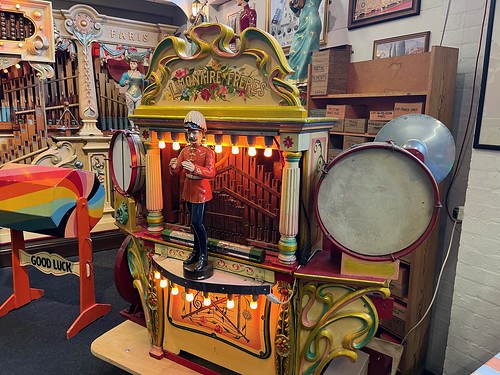
IMG_4532
Limonaire Freres was a particularly well-known manufacturer of fairground organs, so much so that "limonaire" became the generic term in French for this sort of pneumatic-mechanical instrument.

At first, mechanical organs operated sort of like giant music boxes, with rotating barrels covered with pins used to direct to air from mechanical bellows to the various pipes. Known as "barrel organs", these devices were cumbersome because changing the tune meant replacing the entire pinned barrel completely - a costly proposition. The barrels were also large and heavy to store. Other systems used paper rolls like a player piano, but they were fragile and required careful handling. To alleviate the shortcomings of these two systems, the Gavioli company patented a system of heavy cardboard pages linked together in accordion style which operated like a computer punchcard or a Jacquard loom. The Amersham museum has a LOT of these books.

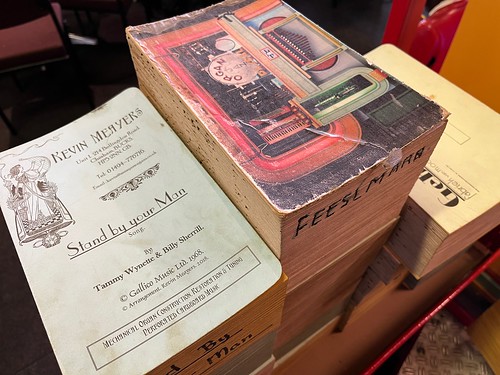
IMG_4531
This was just one shelf of many, most of which were tucked behind the machines. Each machine needs its own books, because each has different instrumentation.

I was surprised to see that the organs didn't simply feature air pushed through traditional organ pipes, but also included percussion! The same air pressure that moves past reeds in the pipes to create different instrumentation and pitches is also used to operate tiny bellows that move drumsticks!

Here you can see the book pages being expelled from the machine and the little white bellows that inflate to play the snare drum on the right, including some pretty impressive drum rolls. (Also, my profound apologies for the vertical letterboxing that Youtube has done on this video. It was very much a portrait orientation sort of situation, which Youtube seems unable to deal with in a visually appropriate way.)

The same air pressure also operates cymbals, hi-hats, bass drums and other assorted percussion. And you may have noticed the little conductor man in front of the Limonaire organ in the photo above. Naturally, he waves his arms in time with the music.

IMG_4539
As did the conductor of this fancy gang. The ones on the sides have little wands that hit the brass bells at the top of their staffs.

The complexity and decoration of these machines was fantastic and right up my alley. As was the the enormous woodstove that was cranking out heat on an unseasonably cold and grey Sunday afternoon. And, more importantly, the excellent selection of cakes and sandwiches on offer.

IMG_4515
Victorian Sponge (tick), Lemon Drizzle cake (tick), Carrot Cake (tick), Cookies (tick)... excellent job Amersham Fairground Organ Museum!

As we know, a nice hot beverage and a bit of cake is a vital component to a successful bloggy day out, so I was kicking myself when I discovered that the AFOM did not have a card reader, and I did not have cash. This necessitated a long walk almost all the way back to the station to what appeared to be the only cash machine in Amersham. And then all the way back. Luckily it was a good sandwich (brie, bacon and red onion marmalade, for those keeping track at home) which I of course supplemented with a credible piece of lemon drizzle cake, and a really really good cup of tea, so all was forgiven.

As the afternoon progressed, each organ in the room got its air time. Of course I missed a few while on my quest for hard currency, but there were still plenty in the queue when I got back. And the closer I looked, the more curious I became about how the relatively few "lines" in the cardboard music books could control so many different elements. I'd hoped that there'd be some explanatory text on display, or perhaps a break in the action for a bit of technical Q&A, but that's not how they roll at AFOM. Instead I had to flag down a friendly volunteer to get an explanation.
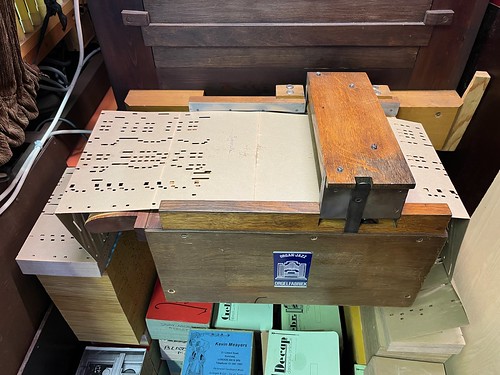
IMG_4544
Honestly, there are hundreds and hundreds of pipes, bells, whistles, drums, cymbals and miscellaneous waving arms. How is that all controlled by what looks like a maximum of about 20 lines?

Luckily, Paul The Volunteer was very friendly and managed to shout some information over the din of the nearby organ. Better still, HE LET ME BEHIND THE VELVET ROPE and opened up the back of an organ while it was playing to show me how hundreds of air lines are routed through the machine. 

IMG_4529
So very cool. It seems a lot of different elements get combined and are controlled by a single "line" in the book. For instance, the conductor's arm, the high hat, and the bass drum might all be controlled from the same line in the book. Still, I'd have liked the chance to understand it more clearly. 

Paul did really know his stuff. As we watched the cards being fed into the machine he could call out what was coming, "Drum roll here. Here come the piccolos..." etc. And, pleasingly, the higher pitched elements were at the top of the page and the lower ones further down, with the percussion at the bottom, which is obviously how it should be. Plus, and I simply can't overstate this enough, HE LET ME BEHIND THE VELVET ROPE. So he definitely wins a GSWPL Award of Merit.

Also pleasing is the fact that many of these organs have been restored to life by a company just down the road in Chesham. Kevin Meayers Organs has been in business since 1984 and not only restores and repairs mechanical organs, but builds new ones too. It frankly did not occur to me that, in the age of Spotify, anyone would still be making new mechanical organs from scratch, but Kevin Meayers will happily take that on. They also manufacture blank cardboard books for perforation, and create arrangements of new music as well, perforating the books on site with fantastic machines like this.

workshop-photos-117-002-crop
This photo is from the Kevin Meayers website, and demonstrates that it's perfectly obvious that Kevin Meayers should team up with the AFOM people to offer tours on the same day so you could do a whole northwest London mechanical organ outing in one go.  

IMG_4504
And to illustrate the wide range of musical genres Kevin Meayers can provide... how about a little Tammy Wynette?

The last organ in the round-the-room tour was a bit different. While all the others in the collection were a category I'm calling "Mostly Pipes Plus Other Bits (MPPOB)", this one was in a more modern style, and had a lot of real instruments on it. 

IMG_4538
Accordion, drum kit, xylophone, saxophone, and those wacky coconut shell things in the top corner. Let me tell you, you haven't lived until you've heard an autonomous accordion accompanied by what I think was a disembodied slide whistle playing "The White Cliffs of Dover".

The best part is that all those instruments were not just for show - they were all really playing! The accordion opened and closed and you could see the keys depressing. This makes a lot of sense, because the accordion is a natively bellows-operated thing to begin with, but the moving keys... that was lovely. And there's the line of little mallets played the xylophone. Even the saxophone had tiny wire linkages working the keys. My favourite, though, was the quartet of coconut things. They had a lot of personality for a collection of pneumatically-actuated smackers and hollow wooden shells. This organ was a definite highlight, which I lovingly videoed for the good of the blog:

Go Go Gadget Coconuts!

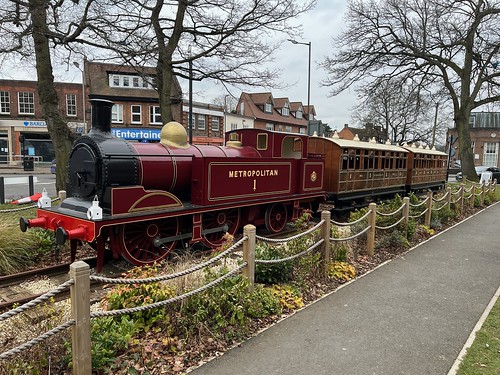
By the time I'd had my fill of the ghost accordion, I felt like I'd fully embraced the entirety of the Amersham Fairground Organ Museum experience, lemon drizzle cake and all. On the way back to the station I made a quick stop at the half scale model of the Metropolitan One steam locomotive as a nod to the Metroland origins of Amersham. (Yeah, now you see that you really should have clicked on that Metroland link at the beginning. I put effort into those links you know!)
IMG_4548
Nicely painted in the colours of the Metropolitan Line, of course.

And because it was going to be a long trip back to the boat, I did the only sensible thing and made a pitstop in Harrow-on-the-Hill between the tube and bus portions of the journey. It just made sense.

IMG_4554
I have no regrets. (Actually, that's not true. I regret that the pub was out of sausage rolls. Boo.)

In other GSWPL-related news... positively SEISMIC changes are afoot here, but I'm saving that news for another blog. Meanwhile, enjoy posts when they appear, which I know is less and less frequently, but as I like to remind everyone, I've now been blogging somewhere-or-other for more than fourteen years. So really, be thankful I'm still here at all, that's all I'm gonna say.

Scouse and scouse and scousers

Sunday, December 25, 2022

Merry Christmas! I got you a blog.

When last we left our doughty blogger, she was enjoying the delights of Liverpool. And while the Beatles may be inescapable in that northern city, they aren't the only game in town. So let's rewind to the start of the visit, but skip all that Beatles stuff you've already heard about.

One of my first stops in town was trip around the grounds of St. Luke's Bombed Out Church. (I promise that's really what they call it.) Set at a prominent intersection, the church was completed in 1832 and then struck by a German bomb in May of 1941. The interior of the church was completely destroyed by the ensuing fire, but the outer walls remained standing. Derelict for many years, the now-outdoor site has been redeveloped into a community space for live performance, markets and other community events, one of which was a vinyl record sale that afforded me a chance to wander the site on Saturday morning.

IMG_2905
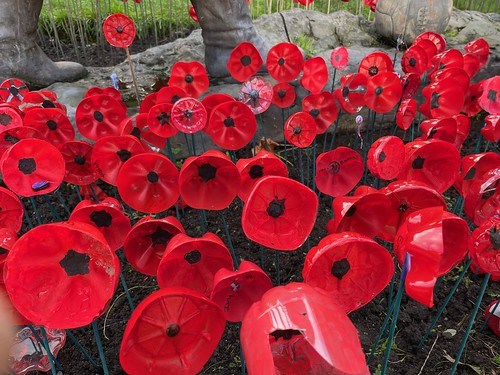
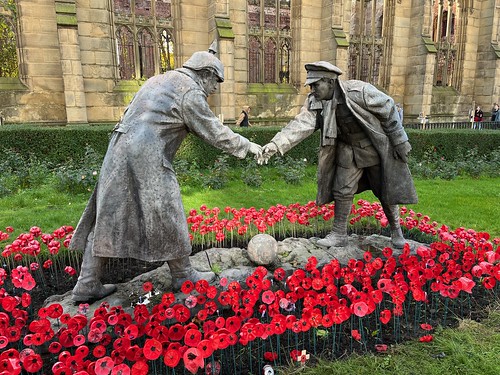
I particularly liked this statue commemorating the famous Christmas Truce of WW1. The poppies around the base were a temporary addition for Remembrance Day

IMG_2906
Very clever re-purposing of  plastic water bottles!

IMG_2968
The inside of the church

Much of Saturday and Sunday was taking up Beatling, but I did have a nice wander around the nearby Georgian Quarter of the city after my disappointing breakfast (about which you have already heard me rant, so I will spare you). The morning was clear and chilly and I had some time to kill and a lot of sub-standard french toast to burn off, so it seemed a perfect time to check out the neighbourhood.

The Georgian Quarter is a small residential area of central Liverpool that boasts a lovely collection of Georgian streets so impressive that it's frequently used as a filming location. (You may have seen the Georgian Quarter in "Peaky Blinders".) It was very pleasant for a stroll and found myself humming and tripping along the streets in a very contented mood.

IMG_2946
A typical street in the Georgian Quarter. You can just picture an episode of "Bridgerton" or "Downton Abbey", can't you?

After a short wander, I eventually found my way to Liverpool Cathedral. The Georgian Quarter is actually the site of two cathedrals, which could hardly be more different. The more modern of the two - the Roman Catholic Liverpool Metropolitan Cathedral - is popularly known as Paddy's Wigwam, for reasons that will be obvious to those who follow this link. I did not elect to visit that spot. However, the Anglican cathedral was definitely worth a visit, being the largest cathedral in Britain, and the 8th largest church in the world. (Other size-related facts of note: Liverpool Cathedral is the longest in the world, and the 5th largest by volume. So by whatever metric you use, the place is a behemoth.)

IMG_2941
Liverpool Cathedral, moodily backlit.

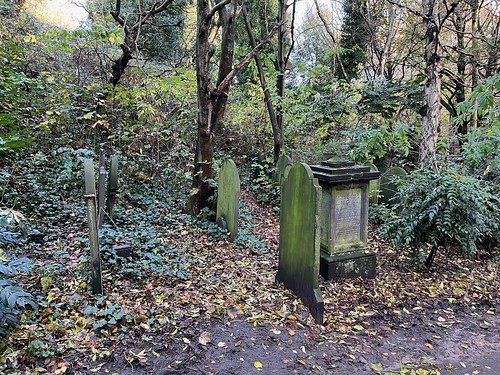
The cathedral is also surrounded by a very nice cemetery garden which I walked through. The cemetery and gardens lie in a sunken area around the cathedral site that makes the building itself even more imposing. Their sunken-ness is because the site is a former 18th century stone quarry from which the stone for many of Liverpools public buildings was cut. It became Liverpool's main cemetery between 1825 and 1936.

IMG_2952
It's a bit overgrown and Highgate-y now.

I also took some un-blog-worthy photos of a chalybeate spring coming out of one of the high cut banks surrounding the gardens. What is a chalybeate spring, you say? It's a natural mineral spring containing iron salts of course! Rather you should ask how one PRONOUNCES chalybeate, because I can virtually guarantee it's not what you expect. Certainly not CHAL-ee-beet, as you might think. Ho ho, of course not! Not in a country where Cholmondeley is pronounced CHUM-lee. How do we pronounce chalybeate?  Kuh-LEE-bee-utt. Yup. I know. Don't bother questioning. Let's just move on, while slowly shaking our heads.

IMG_3010
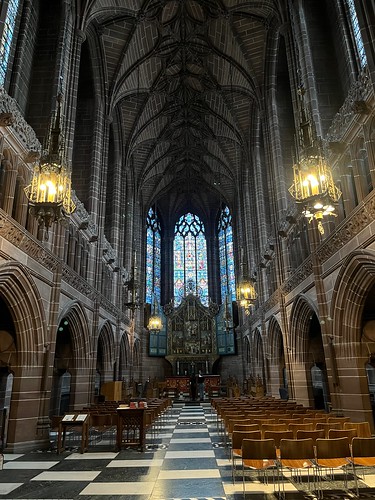
Once I finally made it inside, Liverpool Cathedral is equally massive. 

The reddish sandstone and the light coloured mortar give the whole place an unusual stripey appearance, like the columns are wearing jolly socks. And as you can see it's just HUGE. And despite it's quite traditional appearance, it's a relatively modern building. started in 1904 and not completed until 1978 (!). The arches are apparently the largest Gothic arches ever built, and the pipe organ is the largest in the UK (with a staggering 10,268 pipes. How is that even possible?). More exciting still, it also has the world’s highest and heaviest ringing peal of bells, housed in the monumental central tower. Even better, you can buy a ticket to ascend the tower and view Liverpool from above. Even EVEN better, there are lifts, for the comfort of both bell-ringers and tourists.

IMG_3017
When you finally emerge from the last of the lifts for the climb to the roof, you get a fantastic view of the bell support structure, which features a great tenor bell weighing 4.1 tonnes! (3rd heaviest in the UK, after Great Paul and the Olympic bell, neither of which are currently rung.)

IMG_3021
Naturally, the views from the roof of the tower are excellent, and I hit it at the perfect moment, when the day's rain had cleared off and the light was golden. Here's that same bit of the Georgian Quarter we saw moments ago, looking particularly fetching.

Other than the cathedral, I visited a lesser-known and more down-at-heel Liverpool site, the (formerly) grand Adelphi Hotel. Situated very near the main railway hub, Lime Street Station, the present Adelphi is the third hotel to occupy the site and is a Grade II listed building completed in 1914. It's very much in the grand tradition of railway hotels, which also extended to Canada, as Asute Go Stay Work Play Live readers will of course recall. (The second iteration, which opened in 1876, was for a time regarded as the most luxurious hotel in the UK outside of London, boasting, along with standard-issue sumptuous dining rooms and lavish guest suites, a set of heated tanks in the basement for keeping live turtles to be used in the making of fresh turtle soup. That's proper decadence.) (Also a bit creepy.)

A colleague recommended I check out the hotel, with the caution that I must not, under any circumstances, consider patronising the Adelphi as an actual overnight guest. The public rooms were worth a visit, but the quality of the guest rooms, and the service in general, has fallen to a precipitous degree since the days of fresh turtle soup. 

IMG_2995
He wasn't kidding about the public spaces though! Here's the Central Court, with skylights and pink marble pilasters. 

Closer inspection showed just how poorly maintained the place is. The furniture was an odd and bedraggled collection, and the skylights appear to have last been cleaned when Margaret Thatcher was in office. Given that rooms for the night go for as little as £38, I can't imagine they're pushing the boat out there either. Indeed, that seems to be borne out by this investigative video. 

I foolishly tried to get a cup of tea, and maybe a bit of cake, based on the advertised flyer stating that afternoon tea was available, but despite wandering through several public rooms I could find no evidence of service, at which point it became clear that the correct move was a tactical retreat to the pub. Of course. Following that diversion (to the Philharmonic Dining Rooms, about which you've already read), I finally made my way back to the scene of the previous night's disappointment to try, once again, to sample the famed local delicacy, scouse.

Liverpool is famous for its scouse, so much so that the residents are affectionately and proudly known as Scousers and the Liverpool accent is also called scouse. (And happily, scouse is pronounced exactly as you'd expect: sKOWs.) And here I'm required by UK law to mention that scouse is a contraction of 'lobscouse', which, despite the fact that it's a traditional stew eaten by sailors in northern Europe, has absolutely nothing to do with lobsters.

I realise now that I actually had very little idea what scouse was, so I'll admit to being slightly disappointed to discover it's nothing more than a bowl of beef (or sometime lamb) stew. 

IMG_3032
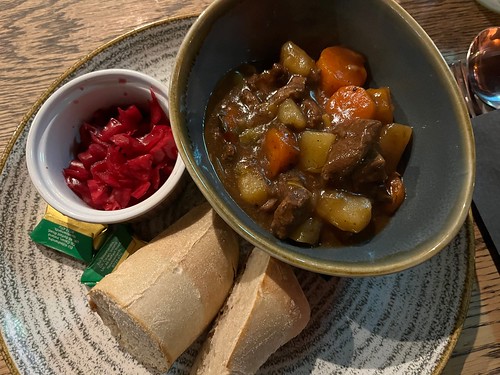
My eventual bowl of scouse, served with the traditional accompaniments of bread and butter and pickled red cabbage. I found this particular pickled cabbage quite harsh, but I can appreciate the concept. You can also get a vegetarian version that's always called Blind Scouse, which I find a charming appellation.

What was delightful was that this bowl of traditional scouse - beef, onion, carrot and potato - tasted exactly like the beef stew my mom used to make. I suppose when you combine those particular ingredients in a big pot and add stock and time the result is always going to end up tasting the same, wherever you make it and whatever you call it. So while it wasn't a new and exciting food, it was still a very pleasant and satisfyingly homey dinner for a cold night, and a fitting end to my time as a tourist in Liverpool.

And now I'm tucked up on the boat in the middle of a cold snap. There's ice on the canal basin and the coal stove is belting out heat. I've also recently invested in an electric blanket, which is a REVELATION. Don't get me wrong - I'm still a big fan of the classic hot water bottle, and use that frequently to combat icy toes. But having the ability to pre-heat the bed to toasty perfection before getting in at night is utterly delicious and still makes me squeal out loud with delight when I snuggle in. These days, when the temperature has been solidly below freezing for days on end, I even leave the blanket on all night at the lowest setting, which is very cozy indeed. It's not done wonders for my electricity consumption, the price of which has more than doubled recently (thank you, cost-of-living crisis) but it's cheaper than a space heater and much more efficient. It's also still disspiritingly cold when I get home after a long day away - usually in the 3-9 degrees range - but such is the price we boat people pay. (Along with the price of the new starter motor and the impending new alternator, new battery disconnect switches, new leisure batteries (x5!) and whatever else comes along.) Not for the faint of heart, that's all I'm saying.
Ticket to Ride

Sunday, December 11, 2022

She got a ticket to ride and she went there! There being Liverpool.

I had a work meeting in Liverpool on a Monday so it just made sense - at least in the logic of blogdom - to get the train on Saturday morning and spend the weekend. Best know as the birthplace of the most influential and best selling musical act of all time (no points for guessing this one), Liverpool is a port city of about 500,000 in the northwest of England situated at the mouth of the River Mersey. (Yes, the one with the ferry 'cross it. Because it's not JUST about the Beatles. There was also Gerry & the Pacemakers of ferry fame. Also Elvis Costello, Echo & the Bunnymen, Frankie Goes to Hollywood and some others that people younger than me might care about). The Beatles may be inescapable in Liverpool, but there are actually non-Beatles things to do as well, so I booked a cheap hotel and set the alarm early Saturday morning to get to the train station.

I arrived just before lunch and dropped my bag at the cheap hotel, which can best be described as "basic" and reminiscent of my hostel-dwelling days. (Though not nearly as bad as some in my experience.) After a bit of lunch, and some local knowledge from a friendly waiter,  I headed towards the docks to start my Liverpool Beatles Magical Mystery Tour. (Note: not actually magical or mysterious, but we all know I still had to say it.)

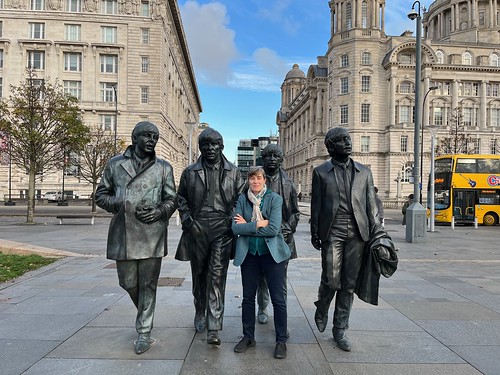
IMG_2916
Me and the Fab Four, at (supposedly) the UK's most-photographed statue. And given the queue of people waiting for photos, I can believe it. I was roped in to take a photo of a large group and they reciprocated by taking some of me, so here's one of those, showing off the fancy new tweed jacket that Karen made me buy. 

(Aside: What is it with people taking photos in portrait mode when the subject matter is clearly wider than it is tall? I know I've ranted about lots of other things , but this one is sooooo on The List.  When I was taking photos for that group - in landscape mode, because the statue, the group of people, and the horizon were all obviously proportioned that way - they stopped me and asked me to switch the phone around to portrait mode. What the hell? And what is it with people who have the orientation of their phone LOCKED to portrait mode? What is that? Kids these days! Pffft!)

After the statue it was a short walk through the refurbished Albert Docks area to the Beatles Story. Naturally I'd done some research about what to see before I got to Liverpool, especially on the various Beatles sites, which include two different museums. (Note: for "research" here read "hasty Googling on the train journey north".) Those two museums could not be more different, and the flashier of the two is the Beatles Story, a self-described "incredible immersive journey". Astute Go Stay Work Play Live Readers can probably hear my eyes rolling from here. Regardless, it had to be done.

The Beatles Story is a series of recreated locations from the history of the band, some more approximate than others, accompanied by a bit of  explanatory text and an audioguide. It was pretty good, though somewhat style-over-substance, with a few vexing top-notes.

IMG_2934
The best section was the recreated Cavern Club, which was quite good. (But that grafitti does say "Jerry and the Pacemakers", which is an unforgivable spelling error. Seriously Beatles Story, sort yourself out!)

Other sections seemed a bit... mixed up. The early bits were basically in order - Lennon and McCartney meeting at a Quarrymen gig at the local Church fĂȘte, the addition of George Harrison, their time in Hamburg, booting Pete Best and bringing in Ringo, signing on with Brian Epstein, Ed Sullivan, Beatlemania, and so on. But after Sgt. Pepper, things got a bit confused. It seemed to skip to the break-up of the group jarringly quickly, then into sections about each individual band member, before then back-tracking to deal with the band's time in India and then abruptly dumping out into the inevitable gift shop. I'm glad I went, but it was a confusing ending and it all felt a bit too "theme park" for my tastes.

Because I'd had a very early start, I was ready for a nap after the Beatles Story. This is the beauty of traveling on your own - you can check out of the day's activities at any time with no negotiation and no guilt. (To be fair, this is also true when traveling with Karen. Our recent trip involved many instances of the tactical late-afternoon retreat to the hotel for a little quiet time.) I followed this up with a long walk to a restaurant for the famous local delicacy - scouse, but was thwarted in that quest because the place I went to was all out of scouse by the time I arrived (more on scouse in a later blog, if you're lucky). This meant a long walk back through the centre of town. Luckily, I found a friendly neighbourhood place for a very credible plate of pasta, so the evening had a very pleasant ending (due in no small measure to the large glass of red wine that I had along with my pasta).

Central Liverpool is quite small and very walkable. Many of the streets are closed to vehicle traffic, which meant that on a Saturday night there were lots of people out enjoying the city. I passed several credible buskers, and what seemed like an over-representation of Hen Parties (this was later confirmed by my local contact: Liverpool is apparently home of the Hen Night.) Still, it was fun to be out in the buzz, and one group did do a very enthusiastic, if tuneless, rendition of "Mamma Mia" as I was going by.

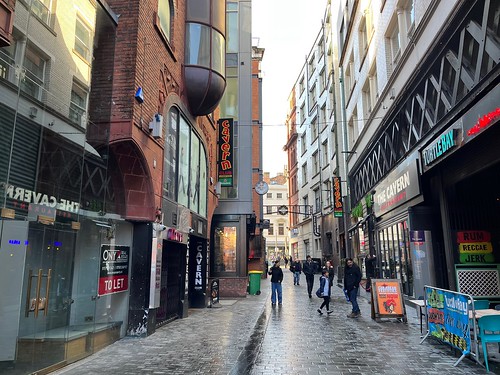
Because I was in the area, I took the time to check out Matthews Street, home to the Cavern Club - the famous underground music club where the Beatles performed almost 300 times. (And, I hasten to add where "Gerry and the Pacemakers" was correctly spelled on the back wall of the stage.)

IMG_2970
Matthews Street now.  

The original Cavern Club - the one where the Beatles played - was closed in 1973 after a compulsory purchase by British Rail to do with the construction of the underground Merseyside railway. It reopened across the street, but then closed again. And while efforts were made to revive the club at its original location, that proved to be structurally impossible. Instead, they salvaged many of the original bricks and recreated it a few doors down. (5,000 of the bricks were also sold as souvenirs for £5 each, with the proceeds going to Strawberry Field Children's Home, which is no longer a Children's Home, but another Beatles attraction, of course.) 

It was fun to see Matthews Street on a Saturday night, with the hen parties and tourists and other assorted revellers. The street also has other venues and bars with live music playing. In fact, as I wandered towards my back-up dinner venue it seemed like every pub in central Liverpool was featuring live music. I guess the city's reputation as a musical hotbed doesn't begin and end with the Beatles. And I also guess that if you want a quiet drink in a pub you don't want to be in central Liverpool on a Saturday night.

Sunday morning I planned a big treat breakfast at another local spot which was perhaps a bit too hipster for its own good. I decided on the peanut butter and jam french toast, which promised "two pieces of sweet brioche bread griddled in a homemade egg and vanilla batter. Deep filled with peanut butter and jelly. Served with Canadian maple syrup". All those are good things, so anticipation was high (though tempered by the fact that when I ordered the waitress cheerily informed me the peanut butter and jelly french toast was Elvis's last meal. I said "I hope that's not indicative of how the rest of my day will go" but she didn't seem to find that funny, so she is dead to me.) In the end, the french toast was profoundly disappointing, consisting of two comically thick slices of brioche that were very dry and utterly lacking in the soaked cooked egg-custardy joy that is properly prepared french toast. And what purported to be genuine Canadian maple syrup lacked any maple flavour whatsoever. And the bacon was bland. Disappointing, Moose Coffee, that's all I'm saying.  

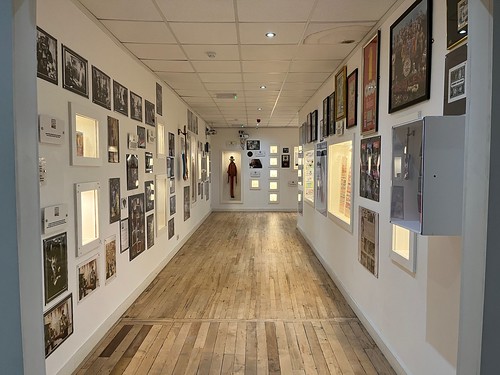
For the sake of completeness, I decided to visit the other Beatles museum on Sunday, which is a very different experience than Saturday's Beatles Story. The Beatles Story was flashy but superficial and sort of corporate. The Beatles Museum is more in the "small but plucky" category. Formed from the personal collection of Roag Best, it consists of three floors packed with posters, photographs, and artefacts. Roag Best is the brother of Pete Best (the original drummer for the band). His father was Neil Aspinall (the Beatles road manager for years and later head of Apple Corps) (not that one) and his mother was Mona Best (founder of the Casbah Coffee Club, where the Beatles practised and performed in the early days.) Hence, it's a much more personal, and almost ridiculously detailed.

 IMG_2984
These glass cases contain a seemingly endless amount of ephemera, some things more relevant than others.

DSC09438_Easy-Resize.com_ 
For instance, one of George Harrison's guitars is right on point.

IMG_2980
Paul's abandoned stamp collection, however, seems... largely peripheral to the overall Beatles story.

Nonetheless, I was pleased I took the time to visit and came away with a much greater depth of knowledge than I did at the Beatles Story.

At this point it was well past time for a pint, so I made my way to the famous Philharmonic Dining Rooms. Known locally as "The Phil" it's one of the most ornate and beautiful pubs in the country and is Grade 1 listed (other Grade 1 buildings include Buckingham Palace and the Tower of London). I was told to make sure to check out the toilets, but sadly the Ladies is of no interest whatsoever. Apparently the Gents is a sight to behold though, with urinals constructed of rose coloured marble. Indeed, photos online do indicate it would be a very fancy spot for a wee.

John Lennon was known to drink at the Phil, but I was drawn to a more recent Beatles connection related to an episode of James Corden's Carpool Karaoke. (For the uninitiated, this is an ongoing series on The Late Late Show in which the host James Corden drives around in a car with a celebrity, singing along to their own songs.) So as I enjoyed my pint and my cheese and onion crisps, I watched this, which I found really lovely.

It's long, but if you have the time settle in and watch it. Obviously this struck a chord with me because I was in a particularly Beatles-y head space at the time, but the ending especially is very fun, and it's gratifying to think that Paul McCartney might be as genuinely nice a guy as you hope he is.

It's hard to escape the Beatles in Liverpool, and there are lots of Beatles things I didn't see. Strawberry Fields is now an interpretive centre about John Lennon's Childhood, Penny Lane is a real street, you can visit the boyhood homes of both John Lennon and Paul McCartney, and Mona Best's Casbah Coffee Club is open to visitors as well. But there are also non-Beatles things to see and do and I've cleverly saved those up for a whole other blog. So... watch this space for cathedrals, Georgian splendour and, of course, scouse!

Forge Mill Needle Museum

Sunday, May 15, 2022

Welcome to the triumphant return of OG Go Stay Work Play Live! And by that I mean you’re about to read a normal post about a bloggy location here in the UK. There are now more than a decade of such posts, so Astute Go Stay Work Play Live Readers are very familiar with this classic formula: 

1. Take the train a modest distance on a sunny weekend morning, while doing the crossword.

2. Visit a diverting museum, gallery, castle, ancient ruin, park, village, trail, hill, barrow, stately home, bunker, etc. (Bonus for anything with Victorian machinery and exposed gears, most especially if powered by a steam engine that is actually running).

3. Take a lot of pictures and make notes while formulating bon mots in head for the blog.

4. Have coffee and cake in the tea room, preferably operated by smiling volunteers who are very friendly, if slightly harried, and maybe not entirely sure how the contactless payment thingy works. (Bonus if they have home-made flapjacks)

5. Poke around the gift shop. (Purchase optional.)

6. Go home and blog.

GSWPL is now coming to you from a temporary posting in Birmingham, working on the Opening and Closing Ceremonies of the Commonwealth Games (starting on July 28 for those who want to mark their calendars). In the Venn Diagram of my current schedule the overlapping area that includes both the Living-in-Birmingham circle and the Not-Too-Busy-To-Do-Bloggy-Things circle is exceedingly small. There are just three two-day weekends before we start rehearsals and the six-day work week starts. So on my first weekend in Brum I decided to check out a museum that Piran rated very very highly, despite its outwardly dry sounding name: the Forge Mill Needle Museum.

Located in Redditch, about half an hour from the central station in Birmingham, the Forge Mill Needle Museum is dedicated to the history and practice of needle manufacturing, commemorating a time when Redditch made 90% of the world’s needles. (Just in case you were thinking that it might not be what it sounds like. Oh no. It is EXACTLY what it sounds like.)

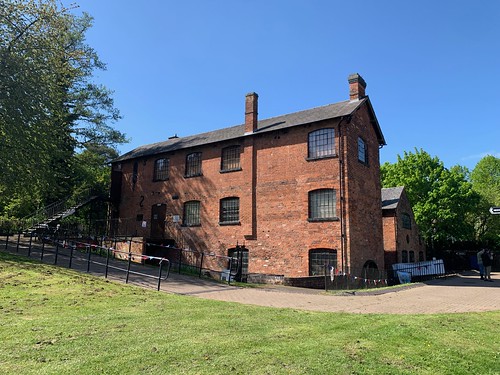
IMG_0438
The restored(ish) Forge Mill. 

I did try to get someone to come with me for this adventure. But Piran is now based in the far south and I'm now in the middle north, so I turned to my friend Tom, who's an Aussie interloper also working on the Commonwealth Ceremonies. (We colonials need to stick together.) Sadly, Tom did not immediately leap at the opportunity to join me, even when he found out that it wasn't just ANY weekend at Forge Mill

IMG_0432
Tom made little effort to disguise his lack of enthusiasm for the fascinating world of Victorian needle making. Clearly, he's not ready for this sort of varsity-level blogginess. Perhaps I needed to ease him in a bit.

So I set off on the train alone, which left more time for the crossword puzzle anyway (see above). It was a pleasant walk from the station to Forge Mill, and the evidence of 1940s weekend was apparent, with some jolly bunting up and a few folks wandering about in period dress. (Aside: I've done a lot of ceremonies now, and disappointingly small number of them have made use of a festive string on bunting here or there, which I think is a damned shame. It really cheers a place up.)

IMG_0437
I mean come on! Who doesn't like a bit of bunting?

One of the things that excited me most was that the Forge Mill website promised "Much of the original Victorian water powered machinery remains and is working on Tuesday afternoons and weekends (March to October)" (Once again see above, including much-beloved working machinery!). Sadly, the waterwheel at Forge Mill is currently utterly immobile and covered by a tarp (despite the fact that it was a weekend between March and October) so I couldn't even get a nice photo. Major disappointment, and one which I may take up with the management at a later date, though in the moment I soldiered on. 

The museum is set up to take you through the whole process of needle making, which you are now going to hear about in excruciating detail. Because that's how we roll here at GSWPL. The signage in the museum claimed that there were 30 different processes involved, though I struggled to define precisely all 30. Nonetheless it was certainly painstaking, starting with a heavy coil of thick steel wire, which requires the first step: drawing. The heavy wire is drawn through a series of increasing smaller dies to bring its diameter down to that of whatever size needle is being made. Originally this was done by hand by winding the wire on a large drum turned by a handle to give some mechanical advantage. 

Step 2 is to cut the wire to the length of two needles, because when making needles you do them two at a time for the first bits, so you can stamp and cut the eyes for two needles from one die, saving time. Step 3 - rubbing - straightens out the lengths of wire, which retain a bit of curve from having been drawn and coiled. 

Rubbing is done by packing hundreds wires into the centre of rubbing ring - two flat iron donuts (not one of Tim Horton's more popular varieties) connected together at the bottom but left open at the top. Once packed with wires, the whole double donut is placed upright so it can roll left and right. Along the open top, the Rubber sets a long flat piece of curved metal called a rubbing iron between the flat donuts and on top of the wires so he can press down hard on the hot iron, rolling the ring and wires back and forth under the weight of the rubbing iron, thus straightening the wires. (And yes, that would have been easier to explain if I'd taken a photo, but the whole rubbing ring display was under a very glare-y bit of plexiglass and - shockingly - Google images returns nothing appropriate for the search term "Victorian needle making rubbing ring" so you'll just have to use your imagination, aided by my brilliant description.)

IMG_0447
Next up, Step 4: Pointing, as demonstrated by this mannequin wearing a jaunty paper hat and some pretty inadequate PPE in the form of a kerchief tied over his face.

Pointing was a notably dangerous job (even by Victorian standards) therefore highly paid. Pointers sat at a spinning stone grinding wheel holding five or six wire blanks flat between their palms, rolling them back and forth while pressing them against the grinding wheel to create the sharpened needle point. This process naturally created a toxic cloud of stone dust and metal filings which the pointer breathed in constantly, causing a condition known as Pointer's Lung (a form of silicosis). Not only that, but the grinding wheel itself was known to break apart completely on occasion, which would have been at first surprising and then almost always lethal. Pointers rarely lived past 30. The display in the museum noted that hand-pointing is still used (with modern dust-extraction methods) for specialist surgical needles. Though judging by the sideburns on the gentleman in the accompanying photo I question whether that's still the case in the 21st century.

After pointing, the blanks needles must be skimmed (Step 5) to remove the scale created by heating and rubbing, leaving the middle of each wire clean for the next steps: stamping and eyeing (Steps 6 and 7). Stamping is accomplished with a kickstamper - a large press with a stationary bottom die and an upper die that drops on top of the blanks to create an impression where eyes of the needles will be. The Stamper raises and lowers the heavy upper die with a rope-and-pulley system operated by his right foot, and the best could process three blanks per second.

IMG_0449
Skimming machine, with kickstamper and fly press in the background. Steps 5-6-7.

The stamped blanks are then passed on for eyeing. Usually done by women, eyes in each two-needle blank are punched with a fly press, which Astute Go Stay Work Play Live Readers will remember from our visit to the Coffin Works, also in Birmingham.  

The next comes spitting, heading and cheeking (Step 8-9-10 for those keeping track), also usually done by women, often working at home. This sort of piecework was common and meant that women could remain at home and care for children (who might also be put to work) while also earning a wage. Stamping and eyeing leave sharp edges and flashing around the inside and outside of the eye which cut any thread thus rendering the needle largely non-functional. Spitting involved threading the two needle units onto metal spits which were placed in clamps to allow the flashing to be ground off by hand.

IMG_0459
Needles - still stuck together, threaded onto spits.

After grinding the outside, the needles are (finally) broken apart and the area at the break filed clean. Then batches of needles could be threaded onto wires and spun around, cleaning out the inside of each eye. 

At this point, the needles go back to the mill. Because they're made of mild steel wire, they must to be laid out on heavy iron trays and put into a furnace to harden them and prevent them from bending (Step 11). Once the needles in each tray reach a temperature high enough to turn cherry red, the tray is carefully removed with heavy tongs and its contents quickly dumped into a barrel of oil to cool. (The best oil for hardening came from sperm whales. Obviously. Nowadays, nitrogen gas is used.) At first water was used for cooling, but this had a tendency to curve the needles, thus negating the hard work of the Rubber back in Step 3. 

IMG_0460
Trays of needles ready for the furnace.

After the furnace the needles are hard but also incredibly brittle and fragile. This requires another trip into a cooler furnace for tempering (Step 12), and another oil bath. 

And at this point, gentle GSWPL Reader, I sense you may almost be fed up with the minutiae of Victorian needlemaking, but the fun is not over yet. Oh no! There are five more steps before we end up with a lovely packet of sharp and shiny needles. It's time to move into the next building where the water-powered machinery runs the scouring mill (or doesn't run, even if the website says it does. Boo.) Scouring is how the needles acquire their fine, shiny surface, and involves packing 50,000 needles and soft soap into a tightly bound sausage wrapped in burlap and called a sett.

IMG_0468
A tray for packing setts with a completed sett in the background of what we're going to call an art-shot, as opposed to an over-exposed failure.

Creating these setts is Step 13, after which two packed setts are placed under a runner of the water-powered scouring mill where they are pressed and rolled back and forth (Step 14). This process could take a day for lower quality needles, or up to a week for the brightest and best quality needles. 

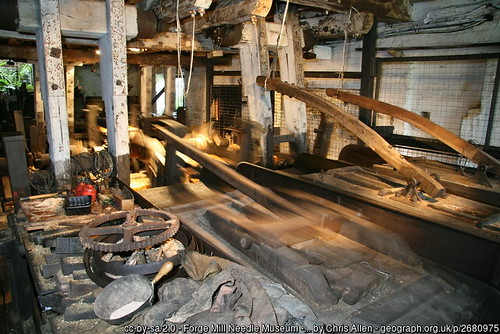
geograph-2680975-by-Chris-Allen
The scouring mill in action. Obviously this is not my photo, but that of the lucky Chris Allen who took it eleven years ago and posted it to Geograph (A seemingly-defunct bit of the internet that promises to be very useful for future blogs.)

Chris also posted this excellent description, which I see no need to edit: "The waterwheel drives a crankshaft via gearing and this drives scouring runners on two floors. The runner closest is moving while the two on the right are disconnected with their drive rods roped up. The white vertical wooden beams oscillate back and forth and pass up to the floor above to drive a further 8 sets of runners - the white beams have the onomatopoeic name of whee-whaws." Whee-whaws! Fantastic! (Chris also noted that this machinery was in commercial use until 1956!)

Following days of scouring, the setts are re-packed with a mixture of olive oil and tin oxide and put back in the scouring mill for 2-3 hours to glaze the needles for a final time. After glazing (Step 15), the needles are removed from the setts and washed (Step 16), then placed in rotating barrels of hot sawdust to dry. 

IMG_0463
Barreling is Step 17. These barrels of sawdust were rotated with power from the waterwheel and could dry a load of needles in about 20 minutes.

In order to separate the dry needles from the sawdust, the mix is placed in a fanning out tray, which, when skilfully tossed in the air, separated the heavy needles from the lighter sawdust. (Step 18... it's the home stretch now!)

IMG_0464
The fanning out process is similar to panning for gold or winnowing chaff from wheat. 

Finally, finally, finally, the finished needles are individually poked through a small sheet of carefully folded, black, acid-free paper and set into little books to be sent out to distributors. 

IMG_0474
A collection of decorative needlebooks in an upstairs display at Forge Mill. Apparently these novelty books of needles were sometimes given as small change instead of coins when making a larger purchase. Which, given how elaborate the whole process of making them was, seems a bit sad.

I think that's 19 steps overall, though each of those steps could probably be broken down further. Regardless, I think we can agree that the whole business was incredibly painstaking and also pretty clever. I think it's great that there was a time when we where smart enough to make big heavy machines to manufacture things, but still needed dozens of highly skilled people to operate those machines. Yeah, those people worked in pretty awful conditions, and some got horrible diseases, and they were paid meagrely, and worked long hours. But at least they had work. 

IMG_0462
Though really, those hours are shorter than some of the days in my upcoming schedule. 
Just sayin'.

Once I'd made sure I thoroughly understood the whole scope of needlemaking so that I could spend 2,000 words explaining it to you in unnecessary detail, I spent a bit of time poking in the upstairs displays. The mill wasn't confined to the manufacture of simple hand-sewing needles, they also made pins, knitting needles, surgical needles, fish hooks, hat pins, sewing machine needles, gramophone needles, bookbinding needles and gigantic mattress needles, used for stitching the two sides of a mattress together. There was even an example of what was claimed to be the longest needle in the world, at 6'1". These were made for attaching buttons longways through the sides of mattresses, and are definitely not something you want to encounter in a dark alleyway.

When I finally emerged into sunlight, I enjoyed a mandatory coffee and cake (carrot, though naturally Victoria Sponge was also available) and had another crack at the crossword puzzle. I also wandered around the 1940 Weekend displays of the Worcs 9th Batt. C Company Home Guard re-enactment group which was charming but fairly standard WWII fare. Lots of stuff about ration books, gas masks, and machine gun emplacements, with Glenn Miller on endless repeat in the background. 

IMG_0484
Still, it was a warm, sunny day and there are worse ways to spend a day like that than watching an octogenarian try to explain the model Enigma Machine he'd made in his basement to an utterly baffled pair of under-ten-year-old boys.

I also bought a few needles in the gift shop, including some useful looking curved ones, and a pair of wicked mattress needles about a foot long. Because how great is it going to be when some weirdo task crops up that requires a foot-long needle, and I've got not one but two standing by? Very great. Then it was back to the train station for a quick trip home, aglow with the satisfaction of having ticked all the appropriate bloggy boxes for the first time in far too long.

The brakes don't work backwards

Sunday, December 19, 2021

I’ve visited Brighton a few times before, though haven’t done some of the more classically touristy things there. Luckily, back before the Lord Mayor’s Show and before work got busy and before the winter weather arrived, I found a weekend to visit. This was mostly because Piran moved to Brighton during lockdown, which means I’ve lost a London-based friend, but gained one on the south coast, who now also boasts a very comfortable guest suite. 

I went down on the train Friday night, and we spent Saturday tromping around the South Downs, with stops at a couple ancient hill forts and a dew pond and, most notably, lunch at the Gunn Inn in Findon. Piran rhapsodised about a lamb dish he’d had there once, so it seemed a good bet. And indeed it was. The fact that I can’t remember what I ordered as my main course detracts not at all from the story because what I do remember, indeed what still fills my dreams at night, is that we started by splitting a portion of cheesy fries which were disturbingly, astonishingly, addictively delicious. They came dressed not just with melted cheese but with chunks of fried chorizo, garlic aioli (yes I know that’s a tautology) and a drizzle of spicy oil. (Probably the fat from the chorizo. With a liberal dusting of crack.) They were so good that we did not even pause to photograph the dish when it arrived but did manage to finish our mains and a pint or two and were even persuaded to order dessert.

WhatsApp Image 2021-11-06 at 1.59.25 PM (1)
Dessert was this. Prompting the above expression for me, which clearly translates as “Are you kidding me?”

So that was Saturday in Brighton. Rambling, cheesy fries, and dinner with some of Piran’s Brighton gang at another pub. Good day, but just a warm-up for Sunday which started with a leisurely breakfast but had two very Brighton-y gems in store. First on the agenda was the 125th London to Brighton Veteran Car Run, the world’s longest-running motoring event and a perfectly quirky, perfectly photogenic, perfectly bloggy thing.

Established 1896, the first event was dubbed The Emancipation Run”, to celebrate the enacting of the Locomotives on Highways Act 1896. This legislation marked the end to some of the more restrictive limits to the use of horseless carriages on English roadways, including a speed limit of 4mph in the country and 2mph in towns. It’s commonly believed the 1896 legislation also repealed the infamous Red Flag Act, which “stipulated that self-propelled vehicles should be accompanied by a crew of three; if the vehicle was attached to two or more vehicles an additional person was to accompany the vehicles; a man with a red flag was to walk at least 60 yd (55 m) ahead of each vehicle, who was also required to assist with the passage of horses and carriages.” The Red Flag act had, in fact, already been repealed in 1878, but it’s an enduring myth of the Veteran Car Run commemorated by the ceremonial tearing in half of a red flag at the start of each year’s run.

Back in 1896, with a exhilarating new speed limit of 14mph, a group of 33 vehicles left from the Metropole Hotel in London (after a commemorative breakfast, of course). 17 of the 33 managed the entire 54 miles to Brighton, with the first finishing in 3 hours and 44 minutes, just squeaking in under the limit at an average speed of 13.9 mph. This rather dismal percentage of finishers is an enduring feature of the race, with vehicles regularly conking out, sometimes being revived by specially-trained mechanics from the Royal Automobile Club, and occasionally having to be pushed across the finish line hours after the leaders arrive. However one shouldn’t be too dismissive, as the central requirement to participate in the Veteran Car Run is that the vehicle entered must have been manufactured before 1905. The oldest car to participate this year was made in 1894.

Photo on 28 Nov 2021 at 2_40_09 pm
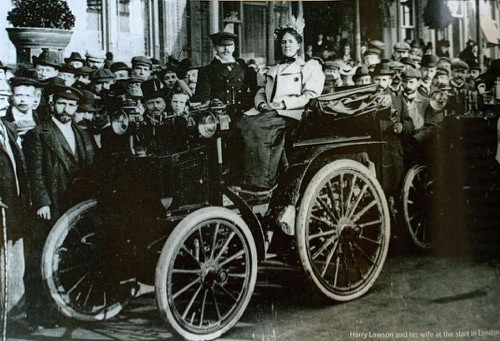
Harry Lawson, organiser of the 1896 Emancipation Run, and his wife, at the start of the inaugural event

So on a dazzlingly clear and unseasonably warm morning, Piran and I headed to the sea front to witness the arrival of the first cars, expected around 10:30am. The traditional route starts at Hyde Park and runs past Buckingham Palace, through Brixton and Croydon and down the A23, finishing on the Brighton sea front at Madeira Drive. However, at 10:30 there was nary a car to be seen. Nor at 11am or 11:30 or even 12. So we filled the time with a stroll down Brighton Pier and along the sea front and through Brighton’s famous Lanes. And since I’ve talked about sea fronts and piers before, let’s just skip over that and get to the part where the cars finally stared arriving.

IMG_8883
Here’s the final stretch, viewed from above, where each car stopped and the driver was interviewed about their journey, their vehicle, and, especially notable, the general excellence of the weather that day, all of which was broadcast over speakers to the assembled throng.

We made our way down to street level and found a spot near the pedestrian barriers to watch the cars trundle past close up.

IMG_8889
Like this one.

Finally we fetched up at the paddock where the cars were parked and where the drivers took a well-deserved break for refreshments in a nearby tent. Each car is also required to carry at least one passenger, and many people were wearing period dress, which definitely adds to the festive atmosphere. (Though I can imagine that in years when the weather does not cooperate one might fervently wish they had chosen Gore-Tex over tweed.) Some participants also carried picnics in special wicker baskets that were clearly part of the car’s design. Those were the days! Screw the satnav and the anti-lock brakes. Give me brass lanterns for headlights and a dedicated storage area for my stilton and champagne!

IMG_8901
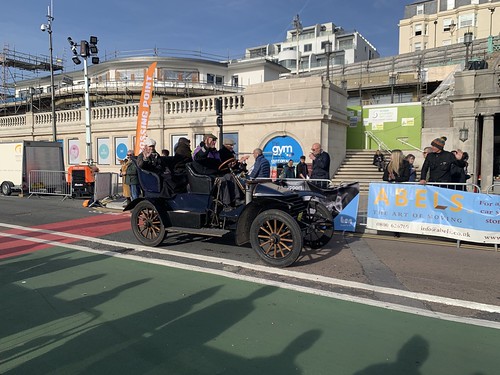
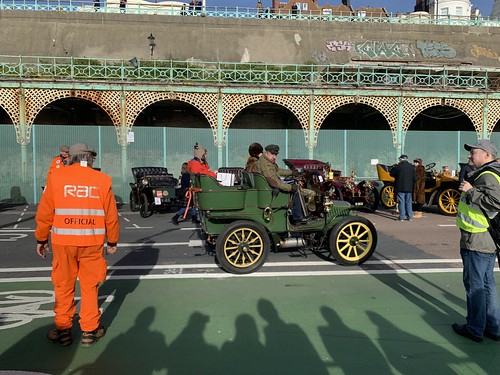
This fetching green-and-yellow beauty lurched into its spot with the aid of the his-vis-clad Royal Automobile Club Official, who helped stop it in place after the driver uttered the phrase of the day: “The brakes don’t work backwards!”

IMG_8896
This paint job was particularly festive, though all the cars we saw were clearly well-loved and well-kept. Many have been in the same family for generations, and at least one was bought new by the current driver’s great-grandfather or great-great-grandfather or some such. Possibly in France. (Perhaps I should have been taking notes.)

The parking area was an ever-changing feast of antique motoring, because cars were constantly arriving, parking up, then leaving and being replaced by new arrivals. There were more than 300 cars entered, along with a smattering of vintage bicycles (including four penny-farthings) and one 1903 Minerva single cylinder motorcycle. After a suitable rest period, some cars were then loaded onto car-carriers to return from whence they came. However, other drivers proudly declared they’d driven their cars from home to the start line in London, then to Brighton, and would then drive straight back home to their garage in Little Snerglington-by-Snort or wherever it was they came from. 

Eventually we tired of the never-ending rows of polished brass and glossy black and wandered to the city centre to try and catch a few of the cars in traffic. This was, for me, the most surprising part of the whole event. For some reason I’d assumed that the Veteran Car Run had some sort of priority lane from London to Brighton to keep these precious vehicles and their startlingly-poorly-protected passengers out of the regular flow of 21st century traffic. Not so. 

IMG_8917
All those cars were mixed in with everyone else on the road for the whole 54 miles! And some of them are so small. I mean look at those poor guys… that thing is basically a one hundred and twenty year old go-cart with a numberplate. Thankfully, participants in the Veteran Car Run and not allowed to exceed an average speed of 20mph.

By this time we'd had our fill of cars, however photogenic, and no one was offering US any stilton and champagne, so we wandered off. Astute Go Stay Work Play Live Readers will no doubt remember that I promised two very Brighton-y gems in the opening paragraphs of this post. However, it took me six weeks to get this written and posted, so I've decided to take my time and keep that in my back pocket for a future edition. In the mean time, I've opened a theatre show in London and done some work on another upcoming project, and continued battling with the boat engine, and put up the Christmas decorations and safely topped up my mince pie levels for another year. This post is shorter than some, but I'm taking the "done is better than perfect" view on this one. So, by the power vested in me as Supreme Leader of the Go Stay Work Play Live Global Consortium, I hereby declare this blog post DONE.