Another Day Out: Bristol and a bridge

Saturday, May 21, 2016

When last we left our hero, lo those many weeks ago (sorry about that) it was early afternoon in Bristol and she was full-to-brimming with the kind of satisfaction that can only be engendered by completing a highly bloggable visit to a well-presented and diverting site involving lots of Victorian engineering and gears, all before lunch time, and with the promise of more to come.

After leaving ship, I continued walking along the harbour but the weather turned and what started as a light rain - the kind that those familiar with UK weather will usually not even bother opening an umbrella for - quickly became something that while not quite torrential still required shelter of some kind.  Luckily, just as this was happening, I was passing by another lovely little site - the last surviving Fairburn steam-powered crane in the UK.

IMG_0628
Designed by William Fairburn and patented in 1850 - the salient feature of the Fairburn design is the elegantly curved jib that allowed it to reach further over the gunwales of increasingly large ships.  The strength of the jib comes from its construction as a series of box girders.

It's rarely open to the public, and in fact wasn't really open on that Saturday either.  But luckily, as I was passing and the rain was pelting down, I saw the door open and was invited into the small cabin along with another damp pedestrian, by a young man who was there as a volunteer cleaning out the boiler for the next time they planned to fire it up.  He proudly informed us that the crane is still safety certified to lift 35 tons.  And he let me take some pictures of lovely big, greasy gears.
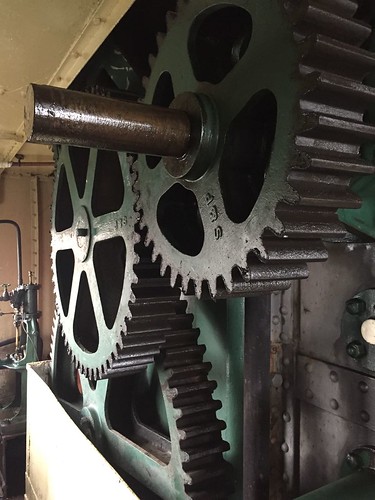
IMG_0626
Big, greasy gears.

It wasn't long, though, before the weather cleared and I left the young man to finish mucking out his crane (or whatever it is one does to prepare a steam engine for use) and ventured into central Bristol for coffee and lunch.  Bristol is a university town, so it is frankly bursting with small independent restaurants and coffee shops.  And in the kind of coincidence that restores one's faith in whoever or whatever one has faith in, there was also a food festival going on that weekend, so I kept stumbling into open public spaces filled with stalls selling artisanal charcuterie or fresh local produce or patisserie or ice cream or handmade donuts.  Really, the whole downtown of Bristol seems quite lovely, and the sun was shining, and I thoroughly enjoyed walking around while I gradually made my way north-ish and westward towards the next big Brunel site on my list: the Clifton Suspension Bridge.  The bridge was one of the things that drew me to Bristol in the first place, so I was keen to see it up close.  Little did I realise what a brilliant and fantastic thing it is.
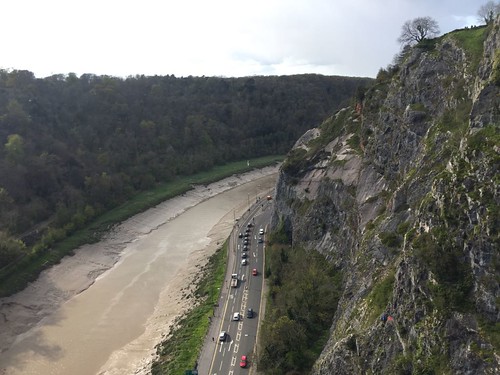
IMG_0649
The Avon Gorge.  It's even more impressive in person

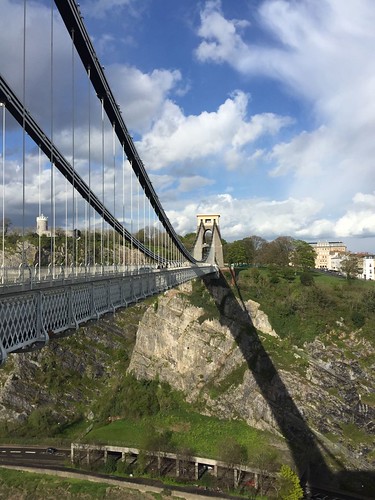
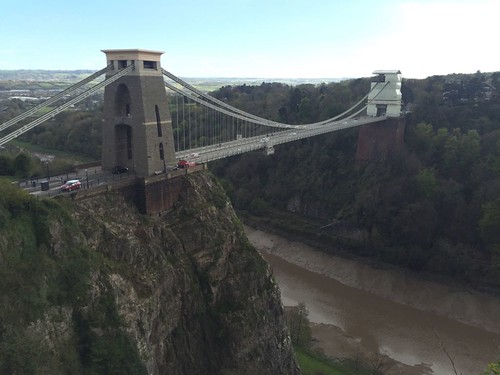
The bridge spans the Avon Gorge, a dramatic geological feature that's more than 700 feet wide and 300 feet deep at the site of the bridge.  It’s the (eventual) result of a sponsored design contest to devise a bridge that could span the gorge but also allow the passage of tall-masted sailing ships below it (a problem that Astute Go Stay Work Play Live readers will recall was solved in a much different way in London).  The contest elicited designs from 22 entrants, including no less than four from our man Brunel, never one to do things by half measures. Unfortunately, the contest was judged by the Scottish civil engineer Thomas Telford, who decided that none of the submitted designs were suitable, but was happy to provide one of his own that he naturally deemed ideal for the circumstance.  How lucky!

Luckier still, officials decided the cost of Telford's design was too great, and sought revised plans for a wrought iron suspension bridge, eventually choosing a design by Brunel (after what has to be admitted was a bit of jiggery-pokery-like strong-arming on Brunel's part).  Though perhaps he can be forgiven considering the estimated cost of his design was £10,000 less than Telford's stone towers.  Construction started in 1831, but was halted only days later by the Bristol Riots, which left the city's commerce struggling to recover and dried up funding for the bridge.  Work began again in 1836, but faltered once more and continued in an on-again-off-again fashion until it was finally opened in 1864.  However, Brunel was unable to attend the opening of the completed bridge, owing to the slight inconvenience of having died 5 years previously.  Some even assert that after the numerous revisions and compromises to the structure by other consulting engineers Brunel shouldn’t really be considered the bridge’s designer.  Or at least not its sole designer.  Nevertheless, it is a truly stunning structure.
IMG_0653
The rain continued in fits and starts but at this point the sun came out and this was the result.  Gorgeous. 
IMG_0663
Brunel's original design was a sort of faux Egyptian thing that called for the towers to be topped with sphinxes, but they were never added.  Boo!  
(Also boo to the fact that the whole south tower was swaddled in scaffolding.)

I took that second photo from the rocky crags near the Clifton Observatory.  The observatory looked like a very worthy site to add to my schedule because it's got a big camera obscura that shows a 360 degree image of the view from the top of the tower via a series of mirrors.  And there's a tunnel from the observatory to a cave on the side of the cliff where you can look out onto the gorge.  Sadly, it was closed by the time I got there.  Sadder still,  I never made it back the next day.  But on a happy note this means I'll probably have to go back to Bristol, because in addition to the camera obscura and the tunnel/cave combo there are also 371 coffee shops I never made it to.

What I did see, though, was a bizarre local landmark simply called the rock slide.  Don't be fooled, though, into thinking I'm talking about a place where rocks have slid off the side of a hill.  Certainly not.  The rock slide is a place where people go to slide down the rocks.  Of course.

IMG_0662
As the Guardian put it:  "this natural slide is nothing more than a sloping band of rock polished to shiny slipperiness by decades of dedicated bottoms".   As one who grew up tobogganing on proper snowy hillsides, my heart goes out to all the generations of Bristolians who've had to content themselves with this sliding experience.  Especially the early pioneers.  ("Come on Derek, let's hit the rock slide.  If we just keep at it, in 75 years our great-great-grandkids might be able to achieve yawningly boring speeds with only minor bruising!")

And that was about it for the day.  Considering the precipitous height of the gorge, you can imagine that there was some fairly significant uphill trekking involved in getting there from sea-level, where I started.  So having spent most of the day on my feet, I was pleased to realise that the sun was well and truly over the yardarm and quickly found a convivial pub where I had a well deserved gin and tonic (artisinally served with a sprig of rosemary, of course) and rested my feet before having supper and a passable sticky toffee pudding.  And then just to top things off I walked all the way back to the house, by which time my feet had just enough left in them to get me upstairs to bed.

A Day Out: Bristol and Brunel

Thursday, May 5, 2016

It's not the top tourist destination in the UK.  Not by a long chalk, and not with the over-hyped and over-crowded Bath Spa just down the road.  But I was looking for an easy place to spend the May Bank Holiday weekend - somewhere cheap and quick to get to, big enough to be diverting for a few days, and unlikely to be overrun by Bank Holiday tourism.  Having realised that many of the trains I've been getting on to take me to my current far-flung-ish mooring locations have had, as their terminus, Bristol Temple Meads station, I thought it was worth checking out.  And when I discovered that the city is home to a quite famous suspension bridge (A cool bridge! Wahoo!) AND to the first ever iron-sided, screw-propellor-driven passenger ship (designed by Brunel! Wahoo!) AND also the home to a highly rated walking tour of street art, including a bunch of Banksy (Banksy! Wahoo!) it wasn't long before I was booking a train ticket and making plans.

I know it's been a long time since the last blog.  I can only put it down to a potent combination of work and life distractions, coupled with an utter lack of inspiration.  Never mind all that though, because Bristol was positively packed with blogworthy stuff. So much so that I think I'll need to tackle it in two instalments.  So let's start where I started.

When I first decided on Bristol, I quickly fell down the Internet Hotel Booking Black Hole.  You knew the one where four hours later you look up from your computer having viewed 753 sites and booked nothing.  What part of town?  How much to spend?  How many stars?  This one is close to the centre, but doesn't include breakfast.  This one charges for wifi.  This one has some bad reviews.  It never ends. I did find somewhere in the trendy Clifton area, and then, on a bit of a whim, I thought I'd just check out Airbnb.  What a revelation (and yes, I know I'm late to the party here...).  I found what promised to be a "lovely room in Victorian terrace", which included breakfast and was a short walk from the historic harbour.  For £35 a night, plus a £10 fee.  Whaaaaa?  Are those prices from 1975?  Figuring I had little to lose, I quickly requested the reservation, hoping the host would accept me - an-reviewed, unknown quantity. Luckily I got the OK and I Ubered my way from the station mid-morning on Saturday.  (Check me out with my super modern sharing economy lifestyle!)

Jude and her housemate Rosemary were friendly and welcoming right from the beginning. Really, it was more like being at the Bristol branch of the Friendly House in Brixton.  The room was clean and bright and had all I needed.  And the first thing they did was invite me for a cup of coffee.  Five minutes after arriving I was sitting in the the kitchen and chatting away as if with old friends (but - crucially - old friends who hadn't already heard all my stories...) And they set me up with a good local map, and directions, and even had a free ticket to see the S.S Great Britain, which was going to be my first stop.  And it was sunny out.  So far, Bristol was scoring very very high indeed.

IMG_0654
The Avon Gorge, looking towards central Bristol

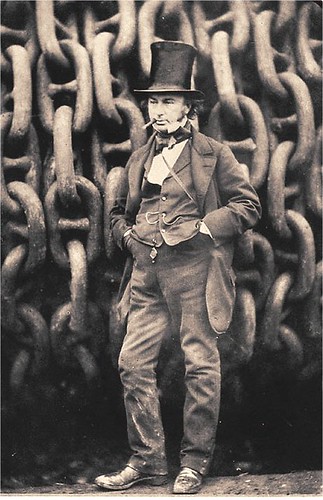
A bit of background now, since a lot of this weekend is going to be about sites related to one remarkable man - Isambard Kingdom Brunel.  First of all: awesome name (Also, Isambard is pronounced IZ-em-bard.  Not EYES-em-bard).  Second: Astute Go Stay Work Play readers will recall Brunel as the younger of the father and son team responsible for the Thames Tunnel.  In fact, Brunel the younger is widely regarded as "The most famous engineer in history." And a new biography I bought claims "Brunel's originality was matched by his breadth of mind: excelling as architect, surveyor, civil engineer, mechanical engineer and ship designer."  In 2002 he came second in the "100 Greatest Britons" poll, losing out only to Sir Winston Churchill and besting, among others, William Shakespeare, Charles Darwin, Isaac Newton and John Lennon.  Heady company indeed, but, as we shall see, every accolade is well-deserved.

IKBrunelChains
This is the iconic photo of Brunel, 
posing in front of the launching chains from the S.S. Great Eastern

When I started writing this post I had no idea how much of Brunel's work I'd already taken advantage of just in getting me to Bristol to begin with.  To start with, Isambard Kingdom Brunel was the chief engineer and driving force of the Great Western Railway running from... you guessed it: London to Bristol.  The train I boarded on Saturday morning originated at Paddington station, which was designed by Brunel.  Every mile of the tracks it ran on were surveyed by him, passing over viaducts and through tunnels he designed, and ending at Bristol Temple Meads Station, also a Brunel creation.  At which point I got off the train and went to visit a ground-breaking trans-Atlantic passenger liner he also designed and then finished the day at a spectacular suspension bridge also designed by Isambard Kingdon Brunel.  Tunnels, bridges, railways, building, ships… the man was a legend.

IMG_0620
Brunel's S.S. Great Britain.  Err, obviously.

The S.S. Great Britain was not the first ship designed by Brunel.  The first was the P.S. Great Western - a wooden-hulled paddle steamer.  The Great Britain was intended to be another wooden paddle steamer, but this is where it gets interesting.  By the time the ship was commissioned around 1839 Brunel’s reputation allowed him greater control over the design, into which Brunel incorporated two major innovations, which we’ll get to later.  The ship itself is now the star attraction of Bristol’s harbour, an extensive network of natural and man-made channels, locks and islands all dating from Bristol’s days as England’s second city and hub for maritime trade and travel.  The S.S. Great Britain is held in dry dock there - the same dry dock in which is was built - and is restored and open to the public inside and out.  There’s also an accompanying museum (and gift shop, natch) and the whole site is done up really well.

IMG_0563
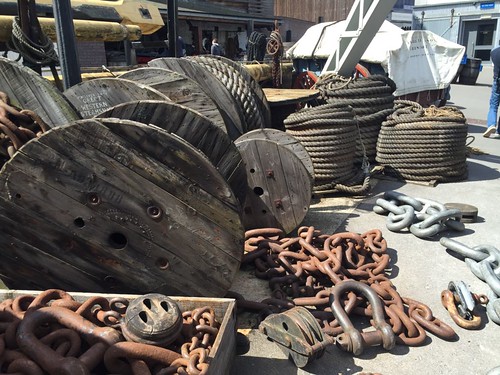
Picturesque giant chains and such-like, strewn artfully about the dockside

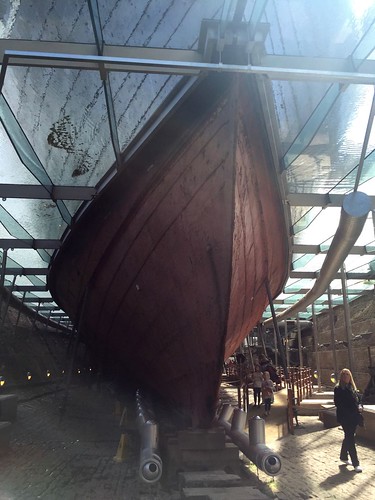
When you get to the ship you’re first directed into the dry dock itself, which is very cleverly presented.  The ship is held in place by big metal braces, and at the level on the hull that would match the waterline, a transparent glass roof is installed all the way around the boat, leaving the area underneath protected from the elements and allowing visitors to walk all the way around the ship.  And to add to the effect, the roof is covered with a shallow layer of water that gives the illusion the ship is floating, and makes lovely dappled reflections below while also insulating the space below, resulting in 10-20% lower energy costs.

IMG_0566
Not-great photo of the ship in the dry dock.  You get the idea.

But keeping rain off precious tourists’ heads is not the main reason for the glass roof.  That’s related to the first of those innovations I mentioned earlier.  Rather than building the hull of the ship with wood, as was traditional, Brunel decided to switch from wood to iron.  This may seem counter-intuitive, since we tend to think of iron as A Very Heavy Thing, but due to it’s massive structural strength an iron-hulled ship is actually lighter than a wooden one.  Iron hulls can also be built much longer and bigger, because they’re more resistant to the flexing forces of the waves under the hull. (Which is, interestingly, called “hogging”.  Or am I the only one who finds that interesting?)  Anyway, switching to iron allowed Brunel to make the ship much larger.  In fact, it was the longest passenger ship in the world from 1845 to 1854. However, after 150 years, the iron in the hull is in rough shape.  Having the lower hull protected protected from rain helps stop the rust.  What helps even more is a massive system of heaters that lower the humidity of the surrounding air to 20%, virtually stopping all corrosion and making it perhaps the dryest dry dock in the world.

IMG_0569
Not happy metal.  Above the water line, the iron hull has been scraped and painted to protect it and make it pretty and shiny.

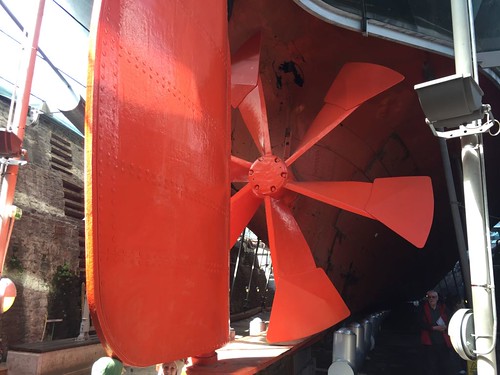
Brunel’s second big innovation was to scrap the paddle wheel and add a screw propellor. Paddle wheels had long been the favoured technology for steam driven ships, but having seen a wooden-hulled ship with a propellor, Brunel was convinced of the advantages and pressed for this new design.  In brief, propellors are cheaper and more efficient, and give the ship greater stability and manoeuvrability.  (Sadly, though, they greatly lessen the chances of attracting interesting characters like riverboat gamblers and spiritual-singing stereotypes.)  Thus, the Great Britain became the first propellor-driven, iron hulled steamer to cross the Atlantic.

IMG_0579
The six-bladed propellor.  Oh, and Brunel tinkered with the rudder too, adjusting the position where the tiller control was attached to make it much easier to steer.

After seeing the dry dock visitors are directed to a nice museum with some interesting displays that takes one only slightly too long to get through before you’re allowed up on the deck of the boat itself, and then down through the whole ship.  Again, it’s all presented really well.  You can poke your head into the first class cabins and dining hall, walk through the galleys and engine rooms (where the engines are actually moving!) and then see how the “other half” travelled in the lower class compartments and bunks.  You can even visit the hold of the ship where the cargo was stored.

IMG_0612
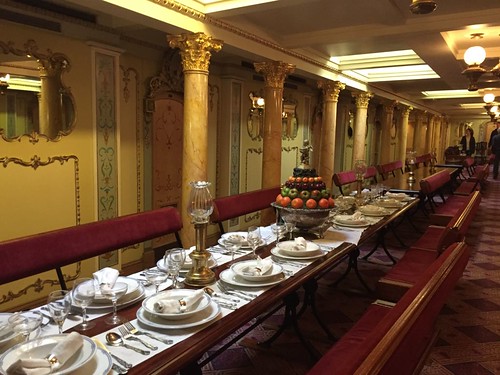
Check out the benches at the tables.  They’re stuck to the floor, but the backrest is double-sided and swings back and forth so you can face the table or flip it the other way and face the room.  I can’t figure out who invented that system, but it’s devilishly clever and has Brunel written all over it.

IMG_0609
These bunks are super skinny.  About 18” wide.  Interestingly, the First Class ones are the same width, and also double-stacked.  They're just in bigger, nicer cabins, with fancier bed linen.

The story of the ship’s life is fascinating.  It started out as a posh passenger liner crossing the Atlantic, then spent years delivering immigrants to Australia.  In 1882 it was converted to a sail-driven vessel and used for the transport of coal and other cargo but a fire on board damaged the ship beyond repair on a journey to the Falkland Islands in 1886 and it then became a floating coal bunker used for storage in the Port Stanley harbour.  The ships’s fortunes continued to fall until it was eventually towed to Sparrow Cove and unceremoniously scuttled in 1937.

And there the story might have ended, except that in 1969, naval architect Ewan Corlett, recognising it as a unique naval artifact, organised a campaign to save it from deteriorating beyond rescue in the waters of Sparrow Cove.  Corlett surveyed the ship and decided that despite years of decay and abuse - including having holes drilled through the hull to scuttle it, bits chopped out of it to repair a British warship during WWII, and a rather alarming and massive tear in the side - it could be saved.  They chartered a submersible pontoon and successfully re-floated the boat, while divers patched the ruptured hull with timber and old mattresses donated by local Falkland Islanders. (Really.  Donated mattresses.)  They then slowly made their way back across the Atlantic and two months later the ship returned to the dry dock in Bristol where it was built and restoration work began.  The museum goes into a lot of detail about the rescue, and it’s actually quite touching, showing old film of crowds gathered on bridges and waterside watching and cheering as this ship returned home.

I thought the while thing was absolutely excellent.  The story of the ship, the connection with Brunel and the engineering brilliance behind it (and yes, Karen, there were GEARS!), the restoration, the surrounding museum and shipyard… it was all top notch.  And better yet, but the time I’d had my fill of the boat it was only about one o’clock in the afternoon, which left me most of the day to explore more of Bristol’s attractions.  You however, will have to wait to hear about those because this post is long enough, and my out-of-shape blogging muscles need a break. Stay tuned and I'll try to get the next post out before July.

IMG_0592
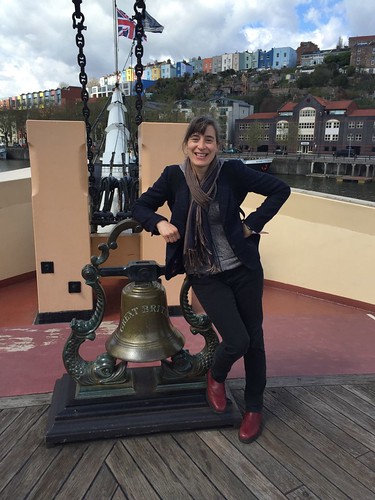
Happy Pam on big boat

Roses and Castles... Not!

Sunday, March 20, 2016

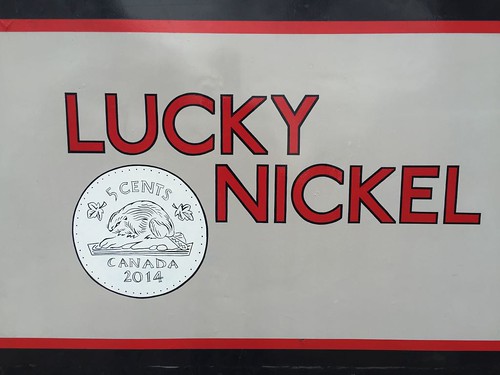
It’s an exciting time here at Go Stay Work Play Live World Headquarters, aboard the "Lucky Nickel".  This week, I engaged the services of a talented young woman to paint the name and logo on the side of the boat!  Astute Go Stay Work Play readers will recall that when I bought the boat it was named “Dragonfly”, which one might think is a nice name for a boat.  And if one did think that one would certainly not be alone in one's thinking because a quick search reveals that there are over a hundred boats registered in the UK called “Dragonfly” or some derivative of that.  It is surely one of the most common boat names in the country.  So it didn’t take me long to decide that along with repainting, my boat was going to be renamed, and I settled on the new name more than six months ago.  Sure, there's a superstition about it being bad luck to change the name of a boat, but I hold no truck with such things.  Besides, records that came with the boat indicate that it started life as the “Lisa Jane” and was changed to "Dragonfly" at some point along the way, so really the damage was already done.  Also there’s a school of thought that if you’re going to change the name you should do it when the boat is out of the water being painted, which I did, so I think I’m covered.

The question then became one of how to get the new name properly displayed on the boat. I’ve been on the canals full time for more than two months now I’m a little surprised at how many boats I see with no name visible at all.  I find this odd and a bit sad.  I suppose different boatowners have different priorities but honestly, have some pride, people!  For a long time I’d planned to simply have a custom vinyl sticker created from an online company like this one.  It seemed like a reasonably economical way of achieving the effect I was looking for, and they even promised they could take a digital image file of the nickel and create a sticker of that, along with the lettering.  Job done, I thought.

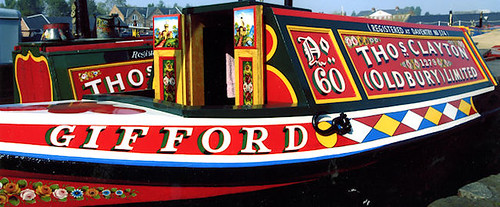
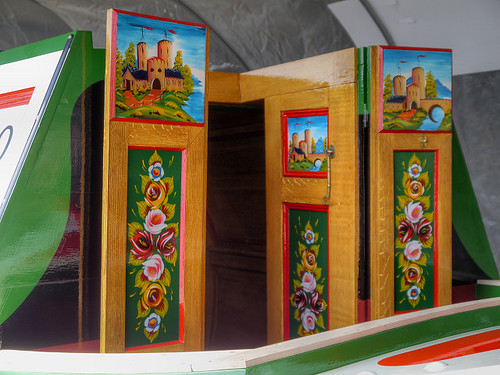
First, though, let’s have a little sidebar and delve into the rich and colourful history surrounding the painting and decoration of narrowboats.  And when I say “colourful history” I am definitely not speaking metaphorically.  Traditionally, working narrowboats operated and inhabited by bargemen and their families were be heavily decorated in what’s come to be known as the “Roses and Castles” style, which AGSWPLRs might suspect runs heavily to… er… roses and castles.  And of course they’d be right.

gifford1
I told you it was colourful.

At the peak of the working canal system - when narrowboats moved the raw materials and products of the Industrial Age along England’s canals, most bargemen were well-paid enough to hire on help and keep their families on dry land in canal side cottages.  However, the arrival of the railway brought a new way of moving cargo and a consequent decrease in the demand for and the earnings of bargemen.  As a result, many a bargeman was forced to give up his paid help and move his entire family into the cramped and dirty cabin at the end of his boat. This had the twin advantage of reducing living costs and providing free labour to help in working the boats.  But life with no fixed address made it difficult to keep children in school or develop community ties, and barge families gradually came to been seen as “apart” from normal society.
"Their response to this situation seemed to be to develop an even stronger trade mystique, to brazen out the common perception with a display to confound their critics. These 'dirty bargees' turned their boats into models of ostentatious cleanliness with polished brasswork and woodwork scrubbed to snowy whiteness, and their squalid little box cabins were transformed into domestic palaces of lace edged curtains and china plates. If they could not impress with quantity on their tiny floating homes they would dazzle with quality, and every surface was painted, every moulding picked out with strong colour, and every tin utensil smothered in painted roses and romantic landscapes.”
(From Canal Junction) 
2967994_5472cd90
One can certainly imagine that it might be nice to be surrounded with such colourful and romantic images given that life on a working boat was hardly a bed of roses.  
Or even a bed of castles, for that matter.

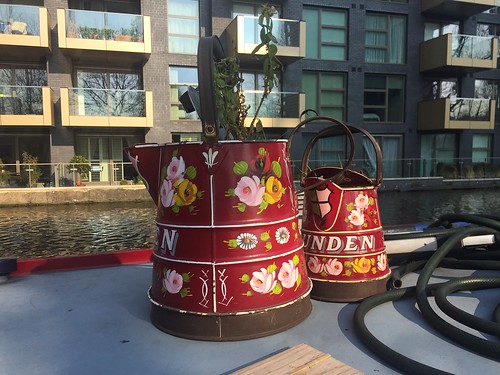
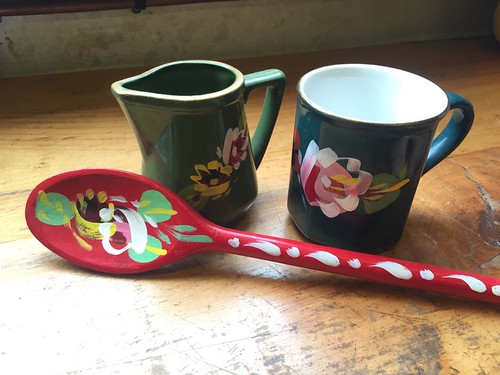
Heavily decorated boats are not as common as they once were, but there is still a significant part of the boating community that carries on the Roses and Castles tradition to a greater or lesser degree, and chandlers that serve the canal trade often stock painted canalware like mugs, creamers, spoons and the ever-present Buckby Can.

Bucky cans
Before the modern era of us pampered boat dwellers with our giant below-decks water tanks and hot water heaters and such-like, clean water was stored in a metal tin called a Bucky Can, normally stored on the roof of the boat and refilled at infrequently located towpath standpipes. (Actually, the infrequently located towpath standpipes are still the only source of clean water…)  Just as with everything that wasn’t nailed down (and many things that were) Bucky Cans were also heavily decorated.

I suspect no one reading this will be surprised to learn that Roses and Castles is not exactly the aesthetic I’ve been trying to achieve on the “Lucky Nickel”.  It’s clean and tidy and modern, and I like it that way.  Then again, if you were fortunate enough to be invited on board you might glimpse one or two nods to the old traditions tucked away.

IMG_0321
The "Lucky Nickel" collection of canalware

And now back to the “Lucky Nickel” and the question of how to properly adorn the boat with its proud new name.  Even if I was to order the vinyl sticker I’d still have needed to pay a graphic designer to do a proper high resolution cartoon of the nickel image, and that was going to add to the cost of the vinyl option.  Then I happened to pick up a business card for a London-based sign writer who specialised in narrowboats and decided to check out her website.

Hannah’s gallery features some traditional styles of narrowboat decoration of course, but it also shows a large variety of modern fonts and styles that I thought looked really smart, so I got in touch to ask about prices.  Of course anything done bespoke and by hand is going to be more expensive than something spit out of a large format printer, but I was actually surprised that the costs were reasonable.  Sure it was more than the graphic artist + vinyl sticker option, but not crazy more.  And it promised to be a much nicer job.  I’m not against new methods. I've got solar panels and LED lighting and streaming Netflix, so this is a thoroughly modern boat.  But getting this done properly, by hand, somehow just felt right.

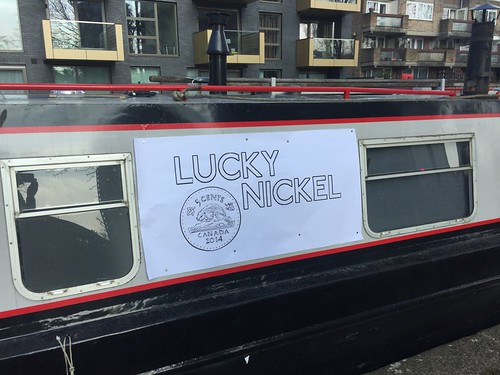
Many emails were exchanged that eventually resulted in the lovely Hannah arriving on Monday morning with a small backpack containing the tools of her trade.  We’d already agreed on the design, and she’d hand drawn a new image of the nickel that was absolutely perfect.  She then had the whole layout printed in full scale so we could spend a bit of time faffing around positioning the printout on the side of the boat, debating whether it should be half an inch higher or lower, until I finally agreed and disappeared to let her get on with it.

IMG_0309
The paper layout in position.

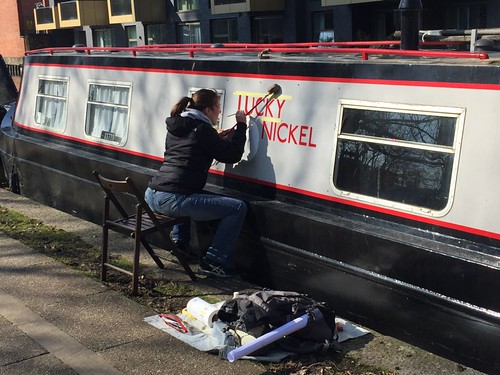
The process itself was interesting.  She used a piece of carbon paper sort of stuff and a straight edge and a steady hand to press through the printout and transfer the outline onto the side of the boat.  After that, she simply sat on the towpath with her tiny pots of paint and her even tinier brushes and meticulously filled in the whole thing.  And she never even went over the lines!  It took a bit more than two days, with a short break on Day Two for me to fire up the boat and turn it around so she could do the other side.

IMG_0317
Hard at work.  At least it was sunny the first day.

The end result is fantastic.  I’d originally thought the lettering should curve around the nickel, but this layout was one of Hannah’s suggestions and it’s much much better.  Astoundingly astute Go Stay Work Play Readers may recognise that font as a knock-off of the one used on all Transport for London signage.  It’s the tube font!

IMG_0324
This is NOT photoshopped!  This is just pure, un-re-touched, hand painted awesomeness.  I can’t tell you how excited this makes me.  It’s like the boat is finally properly reborn.

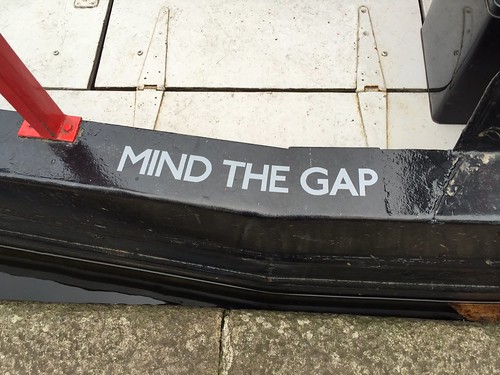
Mind the gap
And I couldn't resist this bit of fun.  After all, I did say I was using the tube font!  
And this is definitely not a gap you want to ignore!

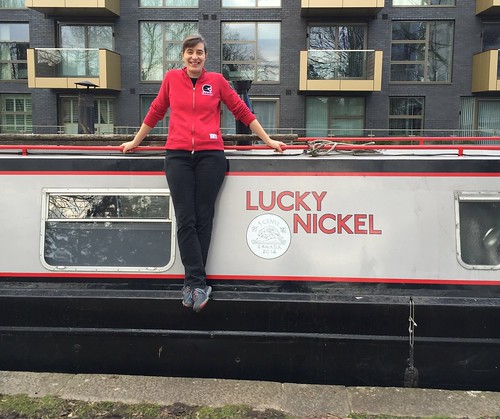
Boat
Me and my colour coordinated boat.  Happy happy.

Off the tourist track: Dennis Severs' House

Wednesday, March 9, 2016

"Aut Visum Aut Non!” ("You either see it or you don’t!”)
- motto of Dennis Severs' House
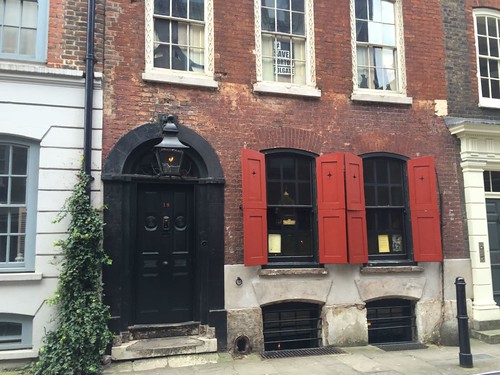
Dennis Severs’ House is… unique.  Outwardly unremarkable except for the gas lamp burning above the door, it’s an early 18th century Georgian terraced house in the Spitalfields area of London’s East End.  More remarkably, all five levels of the house - from basement to top floor - have been painstakingly dressed with period furniture and props to replicate life as it might have been for several generations of a family of Huguenot weavers in the 18th and 19th centuries.  More remarkably still, and much less prosaic, the house is often described as a “still life drama”.  It’s the work of Dennis Severs, an American born ex-pat who relocated to England in the mid-sixties and subsequently bought and moved into the house on Folgate Street in 1979.

IMG_0291
The outside of the house

At the time Severs bought the house it had not been modernised, lacking electricity service or contemporary plumbing.  But rather than renovating or restoring the house Severs decided, in his own words, to “… bring it to life as my home. With a candle, a chamber pot and a bedroll, I began sleeping in each of the house's 10 rooms so that I might arouse my intuition in the quest for each room's soul...  Then, having neared it, I worked inside out from there to create what turned out to be a collection of atmospheres: moods that harbour the light and the spirit of various ages in Time.”  As you might be able to detect, Dennis Severs was not, by any means, a conventional anthropologist, social historian or museum curator.  And the work he created in the house lies somewhere between museum and performance art, albeit without actors, hence the term “still life drama”.

With such an unconventional patron it's no surprise that a visit to Dennis Severs’ House is not intended to be as simple as pitching up, staring at some artefacts behind glass, reading a few carefully researched explanatory cards, and then finding the nearest pub.  Severs intended the experience to be much more.  Visitors are admitted in small groups, told to turn off their phones, and asked not to speak at all during the visit.  No photography is allowed. (Meaning that all the interior photos in this post are from the official Dennis Severs’ House Instagram page.)  The rooms are lit only with candles, firelight and whatever sun filters in through the windows (though I think it would have been improved if the curtains had been closed to block out the modern views outside).  Visitors are thus encouraged to enter into the world of the Huguenot weavers I mentioned earlier: the Jervis family, a creation of Dennis Severs’ imagination.

The house’s website explains this best:
"The game is that you interrupt a family of Huguenot silk weavers named Jervis who, though they can still sometimes be heard, seem always to be just out of sight. As you journey off into a silent search through the ten rooms, each lit by fire and candlelight, you receive a number of stimulations to your senses.  It is the smell of food that first aligns your imagination with the faces around you in portraits. Then… Mr. Jervis’ wig, is it not the very same one that hangs over the back of his chair? His meal is only half eaten; did he abandon it when he heard us arrive?"
As you might expect from the above quote, there are none of the usual explanatory cards I just mentioned.  You simply wander through each room, starting in the basement and moving up, and spend as much time as you want absorbing the incredible detail of each space.  And the detail is impressive.  Real coal fires burn in the grates.  A half-drunk glass of sherry sits on a side table.  A book of prayer lies open to the correct day’s date.  And the flowers in vases are real and fresh.  As a person who sometimes deals with historically detailed props in a professional context (and no slouch in the coal fire department either) even I was impressed. Add to that there’s the evocative smell from those fires and a very subtle soundtrack playing in each room.  Considering it's the work of one man with a very limited budget and no formal training it's frankly astonishing.

Close up
Table close up

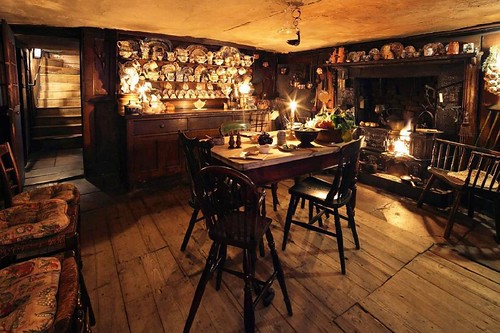
Starting in the basement, you first enter the kitchen.  It’s crammed to its very low ceiling with the kind of detail that gradually becomes familiar as you move through the house.  There’s a bowl of flour with fresh egg shells on the table, and a plate of sugar mice on the sideboard. Dishes are stacked and waiting for use, or sit waiting to be washed at the sink in the corner.

1_Kitchen Wide
Every surface is full and worthy of examination.

Basement
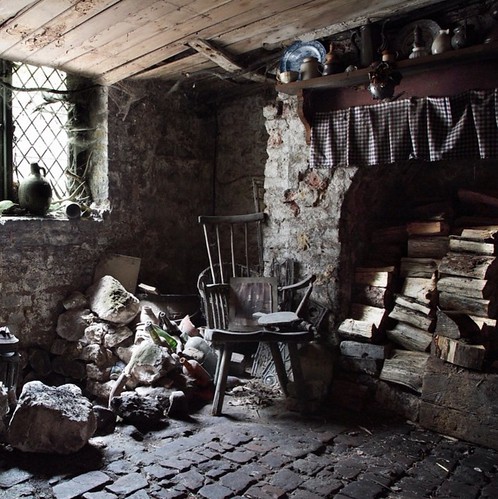
Next to the kitchen is a bare and cold cellar with cobbled floor that’s partially torn up allegedly showing the archeological fragments of St Mary’s Spital, AD 1197.  The tableau is striking.

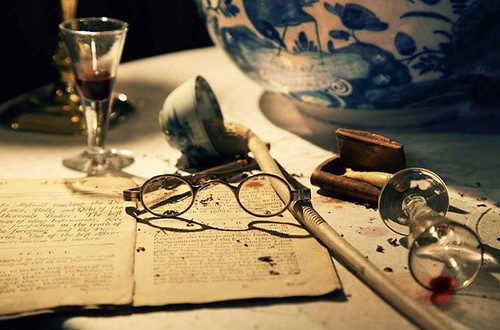
The ground floor consists of a front sitting room and dining room, where a pomegranate lies split open on the table, alongside other delicacies like whole glace oranges and items of everyday life - correspondence sitting open near a pair of reading glasses.  The next floor holds the Smoking Room, portraying a three dimensional copy of the Hogarth painting on the wall above the mantle “A Midnight Modern Conversation”, depicting a drunken party with chairs pushed to the floor, bottles overturned, and wine spilled on the table.  The main bedroom features a large fourposter bed and bed curtains but the bed itself is unmade as if the occupant just woke up.  Near the window a lady’s dress stands on a dressmaker’s dummy with a small note pinned to the bodice reading “Let out here”.

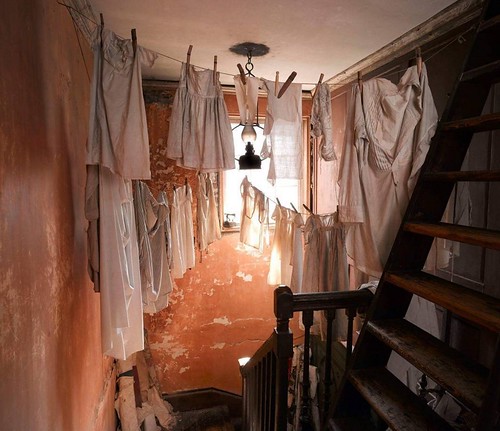
Perhaps most startling is the top floor, made up as a pair of very rundown lodging rooms rented out by the Jervis family, who, like the house itself, must have fallen on hard times.  It’s hard to tell what’s staged and what is evidence of the structure literally crumbling around you. Laundry hangs drying in the stairwell, and areas of the ceiling have collapsed exposing the wooden beams behind.  And if it gets quiet enough you can hear guns firing steadily on the soundtrack.  They’re a salute to the dead King William IV, signalling the accession to the throne of Queen Victoria.

1_Laundry
Peeling paint and photogenic laundry

1_Cat
I genuinely thought this was an exceptional work of taxidermy until it moved.  
Apparently Madge the cat lives in the house!

The effect of all this, floor after floor, could be remarkable.  I say “could be” because this kind of thing always exists on a knife edge.  You really need to buy in, as does everyone in the group, for it to have the effect Severs intended.  I visited in the middle of the day, but they also run what are called “silent nights” when the house is open in the evening, which I think would enhance the experience. And if you want to pay £50 instead of the £10 I paid you can attend an Exclusive Silent Night, where you enjoy the standard silent wander and then are allowed to ensconce yourself in the room of your choice, next to the fire, whereupon you will be served a glass of champagne and allowed a free conversation with a member of the curatorial team. (Plus there's mulled wine and mince pies at Christmas!)

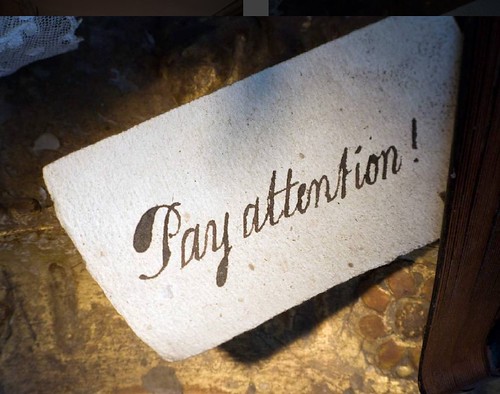
All of that would help, but in reality it is difficult to tune out the others in the group, most of whom arrive with companions and generally find it impossible to not make small comments to each other from time to time.  And there’s an inevitable amount of noise that comes from ten or twenty pairs of feet clomping around on very old floorboards.  And of course at some point someone’s phone will ring.  And sadly, almost every room had a handwritten note with some version of this text:
"Reminder. Every object in the house should be seen as part of an arrangement.  Each array tells a story.  To pick up an object in a shop is a risk, in a museum it is impossible; in a private house, particularly this one, it is simply insensitive - numb to Mr. Severs' vision."
1_Pay Attention
These notes are scattered around the house, tucked into tiny corners.  Another near the front door says: "Make no mistake... In this house it is not what you see, but what you have only just missed and are being asked to imagine."

Unfortunately, I fear I simply don’t have the temperament to make the most of this sort of thing.  This is not to say I didn’t find my visit worthwhile and enjoyable, though there are a few off notes.  For instance, despite the espoused time period of the house, there was a coronation portrait of Queen Elizabeth II above one mantle.  And I cannot fathom why there was a modern bottle of micro-brewed beer, complete with UPC coded label, on a shelf in the front sitting room.  I was so puzzled that I actually asked a staff member about it as I was leaving, thinking that perhaps some even less reverential guest than myself had left it there as a joke. The only answer I got was, “I don’t know.  Dennis was…”  Yeah.  Fill in that blank. Though whatever one might think of Dennis Severs, you have to give him credit for creating a remarkable time capsule.  And you have to be grateful to the Spitalfields Historic Buildings Trust, an architectural preservation charity, to whom Severs bequeathed the house shortly before his death in 1999.

So I did enjoy my visit, though it was short.  The whole tour, even taken at an appropriately contemplative and leisurely pace, only takes about 45 minutes.  By that time I was feeling thoroughly chilled by the effects of lingering in an old draughty house heated only by less-than-roaring fires and was very ready for lunch.  Luckily, the nearby Spitalfields Market has such an array of food choices it was slightly overwhelming.  I’d planned to simply hit a café and fill up on coffee and pastries, but was so hungry that I got a single meatball slider from a food truck, just to take the edge off.  And that slider... it was beyond good.   It was amazing. It was transcendent.  Eating that meatball slider was like looking into the face of God.

And I did eventually find a café, and after that even paid a short visit to Christ Church Spitalfields, a Nicholas Hawksmoor church from the 18th century, which turned out to be really nice.  They recently completed a very thorough renovation and it’s in fine fettle these days and well worth seeing.  Even the crypt is open and is now warm and bright and tidy and has a café and free wifi and public toilets.  Well done CCS!

And then I found my way back to Liverpool Street Station (which, by the way, has overtaken Oxford Street Station in my personal league table of Tube Stations Most Likely to Disorient You Upon Exiting).  And in a supreme act of willpower the level of which is usually reserved for hunger strikers and Leaf fans, I did not stop for eleven more meatball sliders.

A Day Out: Canterbury

Monday, February 29, 2016

I’ve been feeling a bit at loose ends lately.  Boat life is fine.  Work is picking up speed.  I run. I cook.  I watch tv.  But it’s all been getting a bit routine.  So I decided I needed to get out of town and do Something Officially Interesting.  Thus it was that last Saturday morning I set the alarm and got a train to Canterbury.  Astute Go Stay Work Play Live readers will of course know that Canterbury is famous for its cathedral, which is the seat of the Archbishop of Canterbury, the head of the Church of England.  As such it’s considered the Mother Church of the Anglican faith worldwide (that's Episcopalian for anyone tuning in from America).  It’s also a World Heritage Site, the location of the martyrdom of Thomas Beckett in the 12th century, a rather well-known site for Christian pilgrimage in the Middle Ages, home to the tomb of the Black Prince, adjacent to the quite posh King’s School, and conveniently down the road from a Pret A Manger (of course).  So it was clearly going to be easy to make a day of it.

The history of Christianity in England began when Augustine was sent by Pope Gregory to convert King Ethelbert in 597 AD, at Canterbury.  Of course the cathedral as it stands today came along much later.  Apparently at first they simply reused an old Roman church, because of course there’s always some kind of Roman connection in this part of the world.  Always. Really, if you go somewhere in south-east England and don’t come across a Roman archeological site you must have chosen a very dire location indeed if even the Romans shunned it.  Like possibly Willesden Junction.  Anyway, back to the cathedral, which in its present form was build between 1070 and 1077, though alternations and additions continued until 1834.

IMG_0236
Let’s just pause for a moment here.  Did you catch those dates?  Started in 1070!  
LOOK AT THIS PLACE.  This was built a THOUSAND years ago.  Are you kidding me?

I am now obliged to tell you about the martyrdom of Thomas Beckett, because you’re not allowed to talk about Canterbury Cathedral without talking about Thomas Beckett.  (That stricture is actually in the Magna Carta.  Little know fact.)  (Also not actually a fact.)  (Also apparently we don’t call him Thomas À Beckett anymore.  I don’t know why.  You have Google. You figure it out.)  Thomas Beckett was the Archbishop of Canterbury in the late 12th century, and was not best favoured by King Henry II, possibly because Thomas excommunicated Henry, which, to be fair, would probably tax the patience of even the most saintly of monarchs.  So you can maybe understand why Henry was sort of pissed off at Thomas and uttered some version of the famous quote “Who will rid me of this troublesome priest?”  Four of Henry’s knights, on hearing those words, interpreted them as a royal command and travelled back from exile in Normandy to Canterbury where, on the evening of December 29, 1170, they assassinated Thomas Beckett inside the cathedral at a spot now known as The Martyrdom.

IMG_0215
The location of the assassination.  The modern sculpture at The Altar of The Sword Point, alludes to the idea that one knight struck Beckett with such ferocity that the tip of his sword broke on the stone floor.  (Nearby, there’s a plaque on the wall commemorating a visit by Pope John Paul II, the first Pope ever to visit England.  The plaque says, “On this spot on 29 May 1982 Archbishop Robert Runcie and Pope John Paul II did arm wrestle over the concept of transubstantiation.”  Or something like that.)

But let’s back up a bit (or possibly fast forward, since we were just in 1170, and then 1982). When I arrived in Canterbury I didn’t actually go straight to the cathedral.  This is because it was quite a chilly day, made all the more bracing by a persistent wind, so of course I decided to visit a ruined castle very near the train station in stead of finding a nice warm coffee shop. (Clever of them to build the castle so close to the station though.  Presumably it made it easier to get good staff.)

IMG_0192
Here’s the castle.  It’s near the site of the original Norman motte and bailey built soon after the Battle of Hastings and replaced with this stone keep in 1123.  Sadly, while “motte and bailey” sounds a bit like an obscure cocktail (As in: “Barman, I’ll have a Motte & Bailey please.  And don’t scrimp on the Motte!) it’s actually a primitive fortification.  A motte is a large mounded earthwork with a fortification on top, and the bailey is an enclosure nearby.  Quick to build with unskilled labour, they were a popular first step when securing territory.  Think of them like a medieval conqueror’s starter castle.

And because touring the castle and walking into the centre of town didn’t chill me enough, I then cleverly elected to do a 90 minute walking tour around the town.  Astute Go Stay Work Play readers will remember I’m a big fan of guided tours, and the train arrived just in time for me to catch this one, which I thought would be a nice lead-up to the cathedral.  I joined the walking tour guide Karen at the Buttermarket - a square outside the main gate into the cathedral enclosure.  Karen was of course relentlessly cheery and full of interesting tidbits of information.  She led us through Canterbury's lovely old medieval streets, pointing out many of the surviving Tudor buildings with stout oak beams and second storeys that jut out over the pavement.

IMG_0197
Here’s Karen and the group standing in Mercery Lane, the traditional pilgrim’s route to the Cathedral itself.  (Pilgrim’s Route? Huh?  Read on…)

Just as you can’t talk about Canterbury Cathedral without mentioning Thomas Beckett, it’s similarly impossible to talk about Canterbury itself without mentioning The Canterbury Tales. Written by Geoffrey Chaucer in the late 14th century, the tales are presented as a collection of stories told by a group on religious pilgrimage from London to the shrine of the martyred Thomas Beckett at Canterbury.  The work is significant because it’s written in Middle English - the vernacular of the time - as opposed to Latin or French or Italian.  Also, the tales feature characters that cut across social classes, including clergy, tradesmen, women and nobles, giving a rare insight into the lives of different levels of society.  It’s considered one of the most important works of English literature.  (I have the Riverside edition of Chaucer tucked up in a box in Canada, which was the assigned text in a university course I took on the Canterbury Tales.  When asked why he’d chosen that particular edition as the course text, the professor said it was because the cover illustration featured a particularly nice shade of blue. Impeccable logic.)

One of the main Tales-related attractions in Canterbury (besides the cathedral itself) is a very touristy offering called, with singular lack of imagination, The Canterbury Tales.  Having taken that whole university course on the Tales, I felt this version might not have quite the level of scholarly rigour that I would find satisfying, and, based on the website, would include wax figures, costumed actors, scratchy audio recordings and, terrifyingly, the very real possibility of some kind of audience participation.  Also the admission price was £9.75, which is just 75p shy of the actual cathedral’s admission cost and about £9 higher than what might be appropriate. Instead I elected to spend my money on a very nice lunch of local cheese and toast, a chocolate flapjack and several cups of coffee, and did not regret my choice for a moment.

I didn’t do the guided tour of the Cathedral, but I did buy their small printed guidebook and, after a short break to restore feeling to my fingers and the tip of my nose after reaching the sheltered warmth of the actual cathedral, I wandered slowly through, starting in the nave.

IMG_0213
The nave.  178 feet long, 71 feet wide and 80 feet high.  
Again... built in the ELEVENTH CENTURY.

Of course it’s stunning.  It’s a mix of Romanesque and Gothic styles, which means it’s got some round and some slightly pointed arches.  It’s full of slender columns supporting fan vaults, and the outside walls have lots of stained glass and small side chapels, and there’s a beautiful quire with ornate wooden carved benches in the central crossing.  The tour also goes into the crypt, with a much lower ceiling, heavy columns and short round arches supporting the massive weight of the central bell tower above.  The crypt was also mercifully equipped with several commodious window ledges in front of which were piping hot radiators, so I lingered a while to soak up the ineffable mystery of whatever and thaw out a bit more.

IMG_0226
Look! Pilgrims on the road to Canterbury!

IMG_0228
And this candle marks the spot in the sanctuary where Thomas Beckett's tomb was during the height of the pilgrimages.  It used to be a gold-plated bejewelled shrine, but Henry VIII took care of all that, destroying it and Beckett's bones in 1538.

A circuit of the cathedral was enough for me, because I returned later in the afternoon to attend the evensong service in the quire itself.  This was not out of any sense of religious obligation (being the godless heathen I am) but simply because it’s a perfectly lovely way to see the church as it was intended.  Plus they have a fairly well-known boy’s choir, and the service was only 45 minutes long and the seats were padded and you can spend a lot of your time staring upwards contemplating the ceiling.  It was all very nice, until I realised that I hadn’t made any provision to put something in the collection plate when the time came, meaning that I was left scrabbling in my backpack to extract the only thing I had in my wallet - a ten pound note.  This irked me at first and then I reminded myself that £10 is a paltry sum indeed to enjoy a live choral performance in a thousand year old architectural miracle that probably could use an extra few pennies to stop itself from crumbling into dust.

I left feeling very satisfied and spent another hour or so wandering through the streets until it was getting close to dusk.  I started back to the train station, but not before exploring this diverting park near the city walls. (Of course Canterbury has long sections of Roman / medieval city walls that survive to today.)  Dane John Mound is an artifical mound that started out as a Roman burial ground, then became the site of the original motte from the Norman conquest.

IMG_0249
Now it's a nice lookout spot.

Having come full circle, it was a short walk back to the train station and a slow but warm train back to London, during which I managed to complete the Saturday Prize Crossword.  And later when I got back to my chilly little boat I was able to get the temperature back up to toasty in record time.  So really, not a bad day out: gorgeous cathedral, local cheese, hot coffee, nice singing, a proper motte, a successful crossword, and no digits lost to frostbite.

And GSWPL number 132 posted.

Things that go bump in the night

Thursday, February 11, 2016

Things are going well on my little boat, as you’ll see later in this post.  However, that doesn’t mean it’s all been smooth sailing*.  I spent about ten days moored up at Willesden Junction recently.  Extremely astute former Go See Run Eat Drink readers will remember Willesden Junction as my first home in London, back in August of 2010 (!).  It’s a particular unloved neighbourhood, but the canal is close to the tube and it’s got basic services and it’s not hard to find mooring space there.  I wandered back up to my old stomping grounds after tying up and spent a few minutes checking out the old ‘hood.  Sadly it is - brace yourself - even MORE of a shithole than it was five years ago.  Which I am sure we can all agree must have taken some concerted effort on the part of the residents, the Council, and anyone who has passed through. More shuttered shops; fewer actual services.  Unless you want a place to get hair extensions, buy fried chicken, or place a bet you’ll struggle.  Clearly the hipsters have not discovered Willesden Junction yet.

No mind though, it served its purpose for me, which was to provide a convenient mooring location where I could leave the boat while I was on a weekend trip to Bruges for a few days of running with hashers and drinking Belgian beer.  I felt ok leaving the boat because I’d made friends with a guy on a nearby boat and because I kind of need to get over the slightly queasy feeling of locking up the hatch and leaving the boat behind and having a very tiny suspicion that it won’t be exactly floating or even exactly still there when I get back.

IMG_0051
Moored at Willesden Junction.  Beautiful scenery, I’m sure you’ll agree.  The Powerday warehouse is particularly stunning at sunset.

So off I went to Bruges and ran around that beautiful city and drank a lot of really lovely beer and toured a brewery and ate chocolate and frites and moules and generally had a very nice time.  By the time the Eurostar pulled into St. Pancras Station on Sunday evening I think we were all done in, and I still had the schlep to Willesden Junction ahead.  And of course there were engineering works on the Bakerloo Line which meant I had to get off two stops before my destination.  And of course it was raining and windy.  An of course at this point I abandoned all forms of public transport, because there are fewer more dispiriting phrases in English than “Buses on Rail Replacement Service”.  I took a quick taxi back to the towpath and found my boat just where I’d left it.

IMG_0079
Me and a flight of Belgian Beer.  Oh yeah, they have things figured out over there!

Oddly, though, there was another boat moored against the Lucky Nickel.  Double-mooring is when a second boat pulls up alongside a boat moored to the bank and ties up alongside.   This is quite common in the more popular spots in London, because the amount of prime mooring space is much smaller than the number of boats in the system, but to find a stranger double-moored in the grim wilds of Willesden Junction was a bit surprising.  I was momentarily annoyed, but had more pressing matters to deal with because the stove had been out for two and a half days and the temperature in the boat was slightly above seven degrees.  I spent the next while getting the fire going again and waiting for it to catch well enough that I could bank it up and get some sleep.  I finally got to into my chilly bed at about midnight, with the rain and winds increasing, and the other boat knocking up against mine about every nine seconds as it was blown around.  Not the ideal recipe for a quiet night, but little did I realise exactly how not quiet it would be.

About three hours later - at 2:50am, to be precise - I was woken by a most unholy crash from the other end of the boat.  When I got up to investigate I found my wall-hung kitchen cupboard could no longer accurately be described as wall-hung, since it and all its contents were now jauntily strewn about the kitchen floor, wedged between the two counters.

IMG_0091
Lovely

On the plus side, the temperature in the main cabin was quite cozy by this time, so at least I was comfortable for the hour and a half it took me to gently pick my way through the broken wine glasses and the scattered canned goods and get the cupboard sort of back into place.  For the first while I loudly cursed that mysterious double-moored boat, whose incessant knocking had obviously caused the cupboard to leap to its death.  Then I looked a bit more closely at the brackets from which the cupboard had been hung and quickly redirected my mutterings to whatever mouth-breathing moron hung those brackets from a grand total of four tiny half inch screws sunk into thin and suspiciously ill-supported decorative tongue-in-groove siding.  I was reminded of when I owned an old house in Winnipeg and regularly muttered imprecations against the former owner for some inexplicably bizarre “home improvement” decision he’d made. And then I sighed, and rested the cabinet on the counter, securing it with four very long screws into the substantial stern wall of the boat, and a steel bracket for good measure.  And then I went outside and tightened the ropes on the offending boat so that I might be able to get a few hours sleep, and poured myself a large glass of port and retired to my bed once again.

(The next morning I met the wife of the couple on the other boat and of course she was lovely and apologetic about having to double moor.  Apparently they got caught in the heavy weather and didn't feel they had much option.  And she thanked me for tightening their lines.  And the next day her husband helped me slip out and continue down the canal.  So they were nice and friendly and perfectly reasonable.  But they still don't know how to tie a freakin' knot.)

So that was last week.  The cupboard is fine now, still resting on the counter, and now with its forward door bolted back on, because of course the screws in the hinges pulled right out of the particle board on impact.  And while I did lose a little metal-and-mirror side cabinet I’d been using for storing spices (bent and damaged beyond repair), I have to admit that having the cupboard a bit lower is kind of convenient.  And it’s all temporary anyway, because there’s no way that cupboard will still be in that kitchen once I finally get it all sorted out.

And how about some GOOD news on the boat renovation front?  Because I’ve got that too!  I spent much of my time in Willesden Junction working on the bedroom, and I’m really pleased with the results.  The ceiling and walls have been painted white, so it’s much brighter.  And I dismantled some old shelves and trimmed them down with nice curvy corners and re-purposed them by hanging them from the wall (with nice chunky steel brackets and proper screws, I might add…). Having stuff up off the floor makes a difference, and using much narrower shelves beside the bed means that I was finally able to unstack the two narrow mattresses and reconfigure them into a lower, wider version that is much more comfortable and grown-up.

IMG_5985
Here’s a picture of the bedroom last year.

IMG_0069
And here it is now!

IMG_0064
See?  Wall-hung things that won’t abandon their posts at the slightest tap!

IMG_0070
And here it is looking the other way.

Seeing what a difference a bit of paint and some other small, easy changes makes is hugely satisfying and reassuring.  Now I can look at my bedroom and imagine what it'll be like when the whole boat is more like this.  I've still got miles to go, but at least I've started down the road and it feels great.


* P.S.  I had a few suggestions about what phrase one could use to describe the act of moving the boat when "sailing" and "driving" both didn't seem quite right.  "Manning the tiller" was suggested, as was "under way" but I think the one I prefer it "piloting".  Thanks, PW!

Keeping the home fires burning

Sunday, January 31, 2016

Remember back when boat life was all new (actually, it still kind of is) and I talked to you about heating on the boat?  Well back then I was firmly of the opinion that the wood / coal burning stove that came with the boat was too much of a pain in the ass to be a viable, full-time, winter-worthy source of heat for the boat.  In brief, my concerns were:
  1. Coal fires are hard to get lit and burning properly.
  2. Storing a reasonable amount of fuel on the boat would be difficult.
  3. Keeping the fire going properly takes too much time and effort.
  4. It wouldn’t stay lit well enough to ensure a comfortable return home late at night in January, or a comfortable waking the next morning.
Well I am happy to report that I was WRONG ON ALL COUNTS.  Totally, completely wrong. And I will now happily explain to you in detail exactly how wrong I was.

1. Coal is hard to light

Actually on point number one I was kinda right, except it turns out that (as was patiently explained by several people with coal fire experience) you really do learn quite quickly how to get the thing going properly.  Within about four days of getting back on the boat, I’d pretty much cracked it.  In part, I'd been being a bit cheap with the amount of fuel I was using when I set the fire.  And I did a bit of Googling (of course) to pick up some tips.  So here’s my method:
  • Make a single layer of coals on the grate.  I use about 8 pieces for this - four across and 2 deep.  Don’t cheap out.  Position this layer at the back of the firebox.  This was a key breakthrough for me - I had been building the fire in the middle of the grate, meaning that there was a tendency for fuel added on the top to fall off the back.  Now I shove it all up against the back and it’s fine.  Amazing how such a small thing can be such a game-changer.
  • Add 4-6 small pieces of that kind of firestarter that looks and smells like white styrofoam soaked in gasoline.  (In fact, I suppose it could well be white styrofoam soaked in gasoline.  I don’t care.  It works.)
  • (Somewhat optional)  Add several sheets of newspaper twisted into relatively tight bundles.
  • Add a generous layer of dry kindling, again keeping to the back of the firebox.
  • Add another layer coal - at least 6 pieces.
  • Add more dry kindling on top of that.
  • Open the dampers all the way.
  • Light ‘er up!
If all goes according to plan, the kindling lights very quickly and surrounds the coal with lovely hot fire, while also drawing hot air up through the bottom layer of coal which becomes the base of the fire.  It doesn’t take long for things to get going, at which point you can close up the dampers some and let it just tick over.

IMG_9983
Ticking over!

2. Fuel for the stove is a pain to store

I've got what's called a "multi-fuel stove", meaning that it can burn wood or coal or a combination thereof.  I’ve elected to burn coal exclusively.  I’m not interested in faffing around with any of that foraged-on-the-towpath-piled-on-the-roof firewood crap.  It might be free but it's messy and bulky and wet.  I even buy pre-cut bags of dry kindling, because I’m posh/lazy like that.  Oh sure, if I’ve got scrap wood hanging around that’s an appropriate size to fit in the firebox, I’ll chuck it in.  But in terms of Heat Output vs. Volume of Storage, coal is king. (Sadly, though, the coal I buy is NOT mined in the UK because the UK’s last working coal mine closed in December. )

I burn processed smokeless coal (as required by local laws) that comes in consistently-shaped blobs that look like giant BBQ briquettes.  It comes in 25kg bags, and I can comfortably store six bags outside on the bow deck and still have access to the hatch that reveals the water tank and ample storage space next to the tank below for two 20-litre jerry cans of back-up diesel, 3 extra bags of kindling and a few packs of highly compressed wood logs that are also not bad but burn with more smoke than coal so hence are not great on days when you're driving the boat because then you spend the whole time standing there with smoke blowing in your face.

(Aside:  I struggle a bit with figuring out the right verb to use when describing moving the boat.  "Driving" feels odd, but it's really not "sailing".  "Navigating" is sorta ok, but it implies there's a lot of decision making about which way to go which is totally NOT the case on a canal because you generally have a choice of only two directions, one of which is backwards. Suggestions on more appropriate phraseology welcome.)

Coal storage
Six bags of coal, tidily stowed.  Normally it's even covered up by a couple of discreet black bin liners held in place by the magic of magnets!  The water tank is under that centre cover.

Based my experience in January, which had some reasonably cold spells, I’m burning up to about two bags of coal a week.  At £14/bag, that’s more than £100/month, but that will decrease steadily as the weather warms.  One 25kg bag sits inside the cabin just near the back door so it’s easy to refill the coal scuttle, and that sits next to the stove.  (Aside:  I’ve got a freakin’ COAL SCUTTLE!  And I actually use it every day!  How Dickensian is that?!)  I use Homefire brand, as recommended by my mate Dave at the boatyard (based on the fact that 90% of the boats who moor there use it) and when I switched to Homefire from the Supertherm I’d been ignorantly buying before, things were noticeably better, especially as regards points three and four, below.

IMG_0047
Pic of stove open and ready to be rekindled (Oooh... I actually was LITERALLY re-kindling!  Words are fun!).  The kettle can be glimpsed on top of the stove, with the door handle and pile of kindling on the floor.  The black box is my ashcan (repurposed metal bread bin) and in the back you can see the full coal scuttle with tongs hanging from it.

3. Keeping the fire going is a pain

Nope.  It’s just not.  Unlike wood (especially softwood), coal burns for a long time once it’s going.  The kindling (and newspaper, if any) disappear quite quickly and you’re left with a nice red hot pile of coals, as pictured above.  These will burn quite happily for hours, requiring you simply to add a half-dozen or so more to the top of the fire as you remember.  Every three hours is probably plenty.  Dial in the dampers correctly and it's remarkably simple.

4. Coming home to a cold boat is miserable

Well that would indeed be miserable, but it just doesn’t happen.  (Full disclosure: Actually it did happen once.  And it was miserable.  It was a day or two after I'd got back and I didn't have the knack of the coal yet.  And I got back late after a Hash run.  And it was cold.  But because it was late I just went straight to bed, reasoning that body heat would do the job, along with a generous amount of bedding and some socks.  A couple of hours later I was awake again, hungry and frozen, and standing at the stove boiling the kettle and toasting an English muffin and filling up the hot water bottle I got for Christmas.  As evidenced by this succession of text messages between me and Karen, starting with hubris and ending with me in a toque and sweatpants.)

Screenshot 2016-01-31 15.44.05
At least I can admit when I'm wrong.  And Wendy: THANK YOU FOR THE HOT WATER BOTTLE.
#hotwaterbottlesrock

Anyway... now that I have things figured out it's totally fine.  On very cold nights, I add about 12 coals to the fire before going to bed and have been rewarded with a very comfortable temperature the next morning.  And by comfortable I mean around 16-20 degrees celsius.  Not “relatively comfortable for a giant barely insulated tin can sitting in cold water" but properly, normally first world 21st century comfortable.  In fact, I’m confident that this boat is the warmest place I’ve lived in London.  Often in the evening if I’m not paying attention and don’t get the dampers set right the temperature can get up past 26 degrees.  And the best thing is that in the morning once you knock out the ash and clean out the grate there are still enough hot coals that you can just pile on some more kindling and coal and the heat is enough to light the kindling directly and get it all roaring again.  I’ve had the same fire lit for about two weeks now.  It’s immensely satisfying.

Oh, and if I’m out during the day the same thing applies.  There’s enough warmth left in what’s burning to give it the same kindling + coal treatment when I get home and it’s no big deal.

So yeah, I’m pretty happy with my little stove.  It provides a consistent, comfortable dry heat (great for drying laundry!), though there are few small annoying points.  First of all 25kg bags of coal are heavy.  Not impossibly heavy, but heavy enough that I have to think carefully about how I’m lifting and where I put my feet and such, and I’m no weedy weakling.  I can imagine that some people might find it a bit too much.  Also you do have to actually go buy the coal.  So far I’ve been close enough to different boatyards to get it there, but I’m getting closer to central London now, where there are fewer such locations.  Luckily, there are a few independent guys who ply the inland waterways on big barges loaded with coal, gas canisters and other useful supplies, so perhaps the next time I’m running low I’ll flag one down.

And coal is very very dirty.  I’ve now dug up a pair of heavy black rubber gloves I use when refilling the coal scuttle (Again: Eeeeeee! Coal scuttle!) but whenever I deal with coal it’s inevitable that I get some kind of stray black smudge somewhere on a knuckle or sleeve or knee.  Also, due to coal’s utter blackness, and the blackness of the inside of the coal scuttle (!) it can be a pain in the ass to actually dig around with my little tongs and grasp a particular black lump inside a long black tube.  And then there’s the small game of coal Jenga to be played when placing every piece onto a burning fire.  The coals are kind of rounded and hence prone to rolling around so I do feel like I spend a fair bit of time balancing coals on top of each other over and over again to get them to stay where they’re put.  They also shift around as they burn, meaning that every once in a while you hear a clattering noise that means something has shifted and it’s time for another round of Jenga.

On balance though, these are small and very manageable faults because a red hot coal fire is genuinely lovely thing.  It keeps a kettle full of water warm all day long for quick cups of tea or coffee or small amounts of washing up.  And makes an excellent plate warmer for your morning egg. And when the rain is pattering on the roof and there's nothing to do but open a book and pour a glass of wine and relax it is not miles away from perfect.