Off the tourist track: Foundling Museum and Ragged School

Sunday, May 26, 2013

It's a two-for-one deal today, on the theme of Charitable Institutions for Poor Children in Victorian London (I can already hear the cheers, "At last!").  Both these small museums came to my attention courtesy of my friend Duncan, who you may remember from previous posts about Chislehurst Caves.  Duncan divides his time between Winnipeg and a rather smart little flat in Covent Garden, where he conducts research for upcoming novels.  (Disappointingly, the division between Winnipeg and Covent Garden is rather lopsidedly in favour of Winnipeg, but nonetheless I think he'd appreciate being described in such a fashion.)

First up: the Foundling Museum.  "Foundling" is a mostly archaic and highly evocative word for a child abandoned by his or her mother, and the Foundling Hospital was an institution set up in 1741 to take in such children, care for them, and educate them.  (The word hospital is here used in the outdated sense of being a place that offers hospitality, as opposed to a place for medical care.)  Founded by philanthropic sea captain Thomas Coram, the hospital was in use from the 18th century until as late as the 1950s, with thousands of children passing through it. (Incidentally, there's still a foundation for the care of children called "Coram".  Among many other good works, they own a large outdoor park and playground that no adult is allowed to enter unless accompanied by a child.)

Corams Fields
See?  Told ya.

The Foundling Hospital was begun at the height of the Gin Craze in London, a period in the early and mid 18th century when, according to a display in the museum, one in five houses in London was a gin shop.  (Stop and think about that for a second.  ONE IN FIVE.)  The Gin Craze deserves its own post, really. (Indeed, gin has its own sort of museum here.)  For now, suffice it to say there was an epidemic of public drunkenness, along with a whole lot of the sorts of activities that tend to go along with there being loads of desperate and incapacitated people hanging around: crime and prostitution.  Many liken the Gin Craze and the public backlash against it to the 20th century's war on drugs, especially crack.  

Gin Craze
"Gin Lane" by William Hogarth

Naturally, and heartbreakingly, there ended up being a lot of abandoned children during this time, leading to creation of the Foundling Hospital by the kind-hearted and civic-minded Captain Coram.  In the beginning children - generally only babies under one year old - were admitted without question, though admission requirements changed periodically.  At times when demand exceeded capacity a mother might have to take part in a lottery to see if her child would be accepted.  Drawing a white ball meant the child was in (pending a medical examination).  A red ball put the child on a waiting list, and a black ball meant the mother and child were turned away.  At other times any child offered up was accepted, though this led to terrible mortality rates due to overcrowding and the prevalence of disease among the unscreened children.

Once accepted, babies were sent to wet nurses in the countryside where they stayed until they were four or five years old.  Many reported this as being a very happy time in their lives, though some were ill-treated by their foster families and mortality rates were high.  If the child survived, they returned to the hospital where they lived and were schooled until they were old enough for boys to be apprenticed or enlisted in the military, and for girls to enter service as housemaids.  Being admitted to the hospital may have been far superior to being abandoned on the street, but don't imagine that life was all Little Orphan Annie for the foundlings.  Certainly they were better off than if they'd been left on the streets, but mortality rates were still shockingly high.  The museum displayed a register of children who'd been admitted, listing their names, date of admittance, and eventual fate.  The page shown had six to eight names, and only two were listed as anything other than "deceased".

Sometimes the mother would leave a token to identify the child so that she could come back to claim it if her circumstances changed.  Later, written records like the ones I mentioned were kept and a mother would have to pay large (non-refundable) fee just to find out if her child was still alive.  In the not-at-all-certain event that the child was still living, further fees applied for it to be released back to the mother.  Unsurprisingly, this was exceedingly rare.

Untitled
Foundling tokens

Life for the foundlings at the schools was harsh, but actually quite forward-thinking for the time.  The kids all wore uniforms, rose early, washed in cold water, and ate quite a progressive diet, including having meat many days.  Their education also included study of music, for reasons which will shortly become apparent.  Medical care at the school was also quite advanced, with an emphasis on cleanliness and fresh air in medical wards.  And small pox innocuations at the school are recorded as early as 1744, which is frankly astonishing.

Untitled
Sadly, "feeling loved" may have been a bridge too far for most foundlings.  While their physical needs were met, it was a stern and disciplined place to grow up.  No hugs.

All of this progressive care cost money of course, and where the money came from is the other part of the story of the Foundling Hospital.  Thomas Coram was aided in funding the hospital by the patronage of two well-known artists of the time, the composer George Frideric Handel, and the painter William Hogarth (he of the "Gin Craze" etching above).  Handel often performed "Messiah" at the institution, and was a governor of the school, where music became an important part of the curriculum.  Hogarth and his wife were also patrons; they fostered children themselves and Hogarth donated several canvases to the school.  Other artists also donated to the hospital, which amassed an impressive collection as a result, becoming, in effect, the country's first art gallery open to the public.  Much of the Foundling Museum is now dedicated to displaying the collection, and the top floor also houses a display related to Handel, including Handel's Last Will and Testament and a complete score for "Messiah" that he bequeathed to the hospital in it.  The hospital also benefitted from the Victorian penchant for Good Works of all kinds, and this, along with the patronage of popular artists like Hogarth and Handel, made the Foundling Hospital a fashionable cause, ensuring funding for its continued existence.

The Foundling Museum was a bit unexpected.  I'd been hoping for a lot more information about the hospital itself - the children, their life, the conditions at the time - and fewer rooms dedicated to big oil paintings.  Instead, that interesting (to me) part of the museum was contained in just one room, with the rest of the building dedicated to the impressive collection of art and sculpture that I guiltlessly skipped over (though I did go have a peek at Handel's Will).  Happily though, this left me plenty of time to make my way out to the East End to the day's second location: The Ragged School Museum.

Ragged Schools were set up in poor areas of London to provide free education and hot meals for children in the 19th century, hence the name; the student were, quite literally, ragged.  By 1867 more than 200 day schools were established, along with a similar number of evening schools (generally for adults) and Sunday schools.  It's estimated that more than 300,000 children went through London's Ragged Schools in a forty year period in the mid to late 19th century.  (The schools were eventually closed when local authorities took over education in 1902.)  The Ragged School Museum is set up on the site of a Ragged School founded by the well known philanthropist Dr. Thomas Barnardo. (Barnardo's is now the UK's leading children's charity which, among other things, runs a decent charity shop in Brixton.) The museum is housed in an old industrial warehouse alongside the Regent's Canal, which is a pleasant walk from Mile End tube station, especially if one has just had a nice lunch and a good cup of coffee and the sun is shining.

Untitled
The Ragged School Museum

The museum is mainly geared to school children, 14,000 of whom visit each year to get a taste of what life was like for poor Victorian kids.  There's a classroom on an upper floor, equipped with real old desks and accoutrements, and visiting kids dress up in ragged clothes and draw on slates and have an hour long lesson taught by an actress in Victorian dress. There was a class of kids there when I visited, and I could hear them reciting back what the teacher was saying.  She was trying to teach them the old pre-decimal pounds-shillings-pence system, which is hard going if you ask me, especially with farthings ha'pennys and bobs and guineas and crowns thrown in.  Still, it looked like a great day out.

Untitled
Here's me in the classroom, contemplating how many silver sickles to a rouble or furlongs to a firkin or something like that.

Untitled
Another shot of the classroom

The floor above the classroom has a few small displays, again mainly geared to kids.  The building itself is nicely restored and just a pleasant place to be.  You can see the big windows that overlook the canal, and wide planked wooden floors, and it has a charmingly worn-but-scrubbed feeling and a clever two-tone paint scheme.  Apparently, the chocolate brown colour on the lower half of the walls was Barnardo's idea and was designed to hide the marks left by small grubby hands.  There's also a large room of displays about the surrounding East End neighbourhoods on the ground floor, and even a small gift shop.

I lingered at the Ragged School.  While the Foundling Museum was definitely more polished and must be better funded (judging by the £7.50 admission fee), the Ragged School Museum is a bit rough around the edges (and free!).  You could tell that it's operating on a bit of a shoestring, and I sense that a lot of the people involved are volunteers (though their website does have a "Jobs" section, so someone must get paid for something).  The museum itself came about when the building was threatened with demolition in the 1980s and local residents joined together to save it.  And the guy at the front desk had the enthusiasm you usually only get see from volunteers; he chatted with me at length about the school, the building, and the surrounding neighbourhood.  I really liked the place.  Certainly, it seems to have an appropriately East End vibe, whereas the Foundling Museum felt very much like a place that still relies on wealthy patrons.  I suppose in that way both places really are simply refections of their pasts.

And with that tiny and unexpected bit of insight, I'm off again for another week.

A Day Out: Southwold

Sunday, May 19, 2013

Phew!  It was a long haul, but my show is finally really open.  This means that I can go back to the indolent café-dwelling I mentioned last week.  And while I did whine a bit about work, the truth is that it was only crazy every other day last week, which left me time to do a bit of exploring while I was out in deepest, darkest Suffolk.  I was based in a small market town called Halesworth, population 4,600.  Halesworth has a nice pedestrianised high street, a few good coffee shops, and a really cracking local hardware store called Cooper's, which is exactly the kind of place you want when you're trying to keep a sort of complicated but low budget show together. ("Right, what I need is ten metres of cheap garden hose, thirty-six M10 nuts, two plastic spring clamps, a handful of carpet tacks, and a package of hacksaw blades..."* God bless you, Cooper's!).  However beguiling as Halesworth might have been (hint: not really at all, despite the best efforts of Cooper's, and a really good chip shop), there were the aforementioned days off, and I had my bicycle, so one day to took myself off to the seaside for a little break from the frenzy of Halesworth.

Untitled
The beach at Southwold

Southwold is even smaller than Halesworth (with a permanent population of merely 1,500), but it has the advantage of being on the North Sea coast, which makes it a popular spot for summer holidaymakers.  It's got a pier, and a long stretch of beach, and the requisite ration of cafés, pubs, charity shops and twee stores selling postcards and expensive pots of jam. Southwold also has the good fortune to be home to Adnam's Brewery which is the town's largest employer and owner of 74 pubs around East Anglia.

My trip to Southwold ended up being on an exceptionally windy day, meaning that wandering along the seaside, or paddling in the ocean were not really appealing.  Though I did pause long enough to take a photo of some of the beach huts lining the seaside.

Untitled
Beach huts
A beach hut (also known as a beach cabin or bathing box) is a small, usually wooden and often brightly coloured, box above the high tide mark on popular bathing beaches. They are generally used as a shelter from the sun or wind, changing into and out of swimming costumes and for the safe storing of some personal belongings. Some beach huts incorporate simple facilities for preparing food and hot drinks by either bottled gas or occasionally mains electricity.
The colourful beach huts at Southwold are typical of the species.  The front doors open completely to create a wind break on either side of the large from porch.  I even saw one in use, with a family huddled, in typically English fashion, enjoying a cup of tea.  I'm sure they were utterly convinced they were having a lovely time.  It's a really charming feature of the English psyche that they can sit in a 70 square foot wooden hut in 40 mile an hour winds with a cup of tea and a biscuit and genuinely believe they're having a nice day at the seaside. Beach huts are most common in the UK, but they also exist in France, Australia and South Africa.  They're usually quite basic, and can be rented or bought outright.  More elaborate ones on popular beaches can sell for ridiculous sums.  In 2006 a beach hut in Dorset sold for £216,000.  And I bet that didn't even include the biscuits.

Southwold also has a lovely little building called the Southwold Sailors' Reading Room, which is open to the public, and free.  Being a member of the public, and a cheapskate, I checked it out.
"The Southwold Sailors' Reading Room was built in 1864 as a refuge for fishermen and mariners when not engaged at sea, as an endeavour to keep them out of the pubs and encourage them in Christian ideals. Displays of a seafaring nature line the walls and fill glass cabinets. Pictures and portraits of local fishermen and seascapes, model ships and maritime paraphernalia offer a fascinating history of Southwold's connections with the sea."
It's a small building absolutely rammed with maritime memorabilia, and was a quiet and charming refuge from the gale force winds outside.  I had a short look around, deposited a pound in the donations box (I'm not really a cheapskate) and discovered that Southwold's seafaring history is perhaps not quite as fascinating as the good people at the Southwold Sailors' Reading Room might think.

Reading Room 2
Interior of the Sailor's Reading Room.  I imagine if you'd been out to sea for ages it would be quite a nice place to put your feet up and read a paper. Or, in fact, if you'd not been out to sea and were just looking for a way to get out of the wind.

Being a small town, it doesn't take long to check out most of what's on offer in Southwold.  I did the rounds of the shops.  I had coffee and worked on the crossword.  And I saw the lighthouse (closed on weekdays).

Untitled
The lighthouse.

I was just starting to despair that I'd be unable to amuse myself for the rest of the afternoon when I stumbled into the brewery district and happened on a door that purported to be the start point for the Adnam's Brewery Tour.  Aha!  A quick Google search indicated that the next tour was due to start in just under half an hour, which seemed like such good luck it would be downright churlish to ignore it.  So I poked my head into a random office door, paid my £12 and nipped off for a quick picnic lunch before presenting myself for the 2pm tour.

There's a long tradition of brewing in Southwold.  And when I say long, I mean England-long, not Canada-long.  The first recorded mention of brewing in the town was in 1345.  So like I said… long.  The Adnam's brothers founded their brewery in 1872 (no nearly so long, but still respectable).  The tour started with a chat about the basic ingredients that go into beer - water, malt, hops and yeast.  We got to taste several of the different grains that go into Adnam's malts, which were actually quite nice on their own.  I would happily munch on a few handfuls of toasted, malted barley alongside my pint.

Untitled
Tasting stuff

We went through all the parts of the brewery, most of which are just big rooms filled with stainless steel kettles.  Adnam's are actually quite environmentally advanced about their brewing.  In 2006 they built a new eco-distribution centre just outside of Southwold, which has a living roof, lime and hemp walls and rain harvesting facility.  In 2007 they reduced the weight of their 500ml bottles from 455grams to 299 grams, making them the lightest bottles in use.  And in 2008 they converted all their old kettles to new German models that capture the escaping steam and recycle it back into the kettles themselves, which saves about 30% of the energy in the system, but has the unfortunate side effect that Southwold no longer smells like beer all day.  They've also streamlined how much water it takes to make their beer. Conventional brewing takes about 6 pints of water to make one pint of beer, which seems like a pretty good deal to me, but Adnman's have reduced that to 3.2 pints.  All in all, they seem to be doing good work.  The only downside I can see (besides the lack of beer smell) is that they had to retire their dray horses when the eco-distribtion centre opened.  Until that time, they still used horse-drawn carts to deliver beer to the various pubs inside Southwold. Sadly, the new distribution centre is too far for the horses.

Naturally, the tour ended with a beer tasting, where I had to be careful to remain in a fit state to cycle the eight miles back to Halesworth.  However I did have a small taste of four or five different brews, and had my picture taken behind the pumps.

Untitled
Me behind the pumps, slightly out of focus, which should not be taken as an indication of my level of sobriety, but doesn't exactly reflect well on the photographer, a slight woman who had the temerity to go on a brewery tour despite the fact that she didn't really like beer.

After that there was just enough time for a quick trip to the pier.  I walked the whole length, even though it was so windy that I was in imminent danger of being blow approximately to Rotterdam.  An English seaside pier is a sort of peculiar thing.  Originally built as landing stages for ferries, English piers are long walkways usually supported on wooden posts.

Untitled
Southwold Pier

The most famous piers in England are in Brighton and Blackpool, where the structures support amusement arcades and restaurants and shops and lots of twinkly lights.  The Southwold pier is more modest, but still has an arcade full of coin-operated video games and claw grabbers, and those ones where you put a coin in to add to a pile of coins that are eventually supposed to spill over a precipice and reward you with… more coins.  But Southwold pier also had a fantastic "Under the Pier" show, which was a misnomer, because it really wasn't under the pier at all.  It was, however, positively excellent.  Normal pier games take your money with the chance of rewarding you with something of nominal value.  The Under the Pier show is a collection of home made machines that are utterly ridiculous.  Take, for instance, the Rent-a-Dog.  Put in your 40p, step onto a treadmill, grab the leash and… walk the dog.  Brilliant.

Untitled
Rent a dog.  You watch the street pass by on your screen... the dog watches on his!

There was also the Mobility Masterclass - a simulated street crossing complete with aluminium walker.  Or the Instant Eclipse - sit in a dark booth and watch the stars come out.  Or the Autofrisk - a set of rubber gloves that give you a thorough frisk.  In all there were about 20 silly machines.  The Under the Pier show really was excellent, and a fitting end to my day at the seaside.  Once I'd had a thorough look at all the machines, there was nothing to do but hop on my bike and head back to the hustle and bustle of Halesworth, secure in the knowledge that I'd partaken in all that Southwold had to offer, but slightly wistful that my trip home wasn't accompanied by the sweet smell of fermenting malt.


* That's my actual shopping list, over the course of a week.  Cooper's really was a gold mine.  I could also have posted a letter, and bought a slow cooker, or bedding plants, or a set of patio furniture.

Off the tourist track: Brixton Windmill

Saturday, May 11, 2013

Gosh it's been a while, hasn't it?  Sorry about that, but I've been really busy.  You may recall the expended period of unemployment that followed the finish of my work on last year's Olympic ceremonies.  Well it turns out that freelance production management work in London seems to operate on the same schedule as the buses.  That is, you wait ages for one to come along, and then two arrive at the same time.  In my case the two were gigs for Soho Theatre and Hampstead Theatre. The schedule was not ideal, with the tech period for the Soho show starting a mere three days after the Hampstead show opened.  This meant that I spent most of April in a sort of mad haze dashing from theatre to workshop to theatre and back.  And with this size of theatre production management is very much a hands-on affair, which resulted in a fair bit of time lifting heavy things on and off trucks or standing at the top of a ladder tangled in miles of black string or cursing an M10 nut that had rolled just out of reach under a dusty bit of deck, in the dark.  Luckily for me the end is in sight and I hope to return to my former life of indolent café-dwelling in about a week or so.  Luckily for you I've actually had one or two days off in which to do blog-worthy things, some of which were far-flung, and some of which were almost in my own back yard, like the topic of today's long-awaited return to blogging: Brixton Windmill.

Untitled
No really, it's an actual WINDMILL.

I know I get a bit gushy about London sometimes, but honestly how can you not love a city where you can walk one block off a main road and find a restored 19th century windmill sandwiched between a rather large housing estate and a prison?  (And on a prisons-related note: London is home to two of the most brilliantly named prisons ever. The well-known Wormwoods Scrubs in northwest London held my personal title as Most Excellently Named Prison until it was supplanted when I learned of the now-disappeared institution formerly located in Clerkenwell called Coldbath Fields Prison.  You just couldn't make this stuff up.)

But back to the windmill.  There was a rare confluence of events a couple of Mondays ago: I had the day off, and it was a Bank Holiday, AND the weather was pleasant and sunny.  There were even bluebells out!  (Bluebells have a sort of cult status here, and their arrival in the spring is a notable event.  It's a popular past time to go walking in bluebell woods to see the forest floor carpeted with them.)

Untitled
Not exactly a carpet of bluebells.

Brixton Windmill was built in 1816 and leased by a Quaker family - the Ashbys - who used it to mill stoneground flour for a couple of generations.  By 1862 the increased density of building in the area reduced the amount of wind available, meaning the mill was no longer functional.  It remained dormant until 1902 when the Ashbys returned and equipped it with a steam-powered Provender Mill, a tiny device that could produce as much milled grain in a day as the wind-powered mill could, and could do it consistently.  The mill ceased operation in the 1930s and the sweeps were taken down.  In the 1950s it was listed as a Grade II property and a small park was laid out around it called Windmill Gardens.  The windmill itself was partially restored in the 1960s, with the sweeps reinstated.  However, it continued to decay and was vandalised and somewhat forgotten until it was officially recognised as being "at risk" in 2002.  In 2003 Friends of Windmill Gardens were set up to try to restore the windmill once again.  They campaigned for and won lottery funding and the restoration work tool place in 2010.  The newly restored windmill was opened in 2011, and holds regular Open Days, one of which was on the aforementioned sunny Monday.

Long before my schedule exploded,  I'd pre-booked a guided tour of the windmill, a necessary step because they only allow four people on the upper levels of the mill, meaning that one guide can take three people at a time, so the slots fill up quickly. The restored windmill is gorgeous inside.  There's lots of whitewashed brick and big honey-coloured timbers and precipitous staircases and lots and lots of giant cogs and bits that are supposed to spin and such.  (Warning to Karen: gears aplenty coming up!)

Untitled 
 I like to call this one "Sunlight on Gears"

My tour guide, Robert, was quite knowledgeable, and explained how the mill worked.  In brief: wind turns sweeps, turning sweeps cause grindstones to spin, grain between stones gets ground.  However, there's a lot more to it than that.  First of all, getting the sweeps to catch wind is a bit of a production.  The Brixton Windmill has sweeps equipped with two kind of sails: common sails and patent sails.  Common sails are an open lattice work that have to be covered with a big bit of canvas in order to catch the wind.  This means that the miller would have to climb the sails themselves to rig the canvas, which was a bit of a pain.

Untitled
One of the common sails, unrigged.

The general annoyance of dealing with common sails lead to the development of patent sails.  Patent sails are equipped with a set of hard louvres that could be opened or closed with a hand crank and are therefore way easier to deal with than the common sails. Sadly, patent sails are not nearly as good at catching wind as common sails, which is just typical, isn't it?  That's why the Brixton windmill has two of each type.

Untitled
A patent sail.

The sails are attached to the cap of the windmill, which looks a bit like an upturned rowboat and sits on top of the windmill.  The cap cap actually be turned from the inside (with gears!) which allows the miller to orient the sails to the wind.

Untitled
The cap of the windmill.

Once the sweeps are turning, the shaft of sweeps spins and that horizontal spinning motion is converted vertical spinning motion with - you guessed it - gears!

Untitled
Fascinatingly, anywhere gears mesh in the mill only one gear in the pair is metal.  The other is always built with wooden teeth.  This is to eliminate metal-on-metal contact which might cause sparks in the highly explosive atmosphere filled with finely ground dust. (Karen: don't try to pretend that's not interesting.)

The vertical spinning shaft is attached - a few floors down - to the millstones.

Untitled
The actual grindy bit

The unmilled grain is poured through a hole in the top stone (called the runner stone), and is ground between the top stone, which spins, and the bottom stone (called the bed stone), which stays static.  The resulting flour works its way out to the edges of the stones and is collected.  (And in a wordy aside: any unmilled grain is called grist, as in the phrase "it's all grist for the mill".)  The resulting flour could be milled again to produce a finer grind.  And the stones themselves are actually cut in a pattern, which also affects the grind.  Sometimes mills would even be equipped with two sets of stones to mill two kinds of flour, all driven from the same central shaft through the power of gears!

Untitled
An old millstone on the lawn outside the windmill

As I mention earlier, the mill was revived in 1902 when the Ashbys returned and equipped it with a Provender mill. A Provender Mill is a small, freestanding cast-iron device invented to mill grain without the need for giant buildings with unwieldy sails.  It's somewhat ironic that the Ashbys chose to site their Provender Mill inside the old windmill when they could just as easily have put it in a warehouse or a barn.  Maybe they missed all those nice gears.  The Friends of Brixton Windmill are hoping to get the provender mill running again so that they can actually produce flour, but they're running into money problems and Elfin Safety issues and such.  Still, they're hoping to get grinding again by 2016, which is the mill's 200th anniversary.

Untitled
The provender mill, which originally ran on steam power, and then on gas, and has now been converted to run on one tiny little electric motor.  Boringly, most of its gears are small and hidden.

The actual tour of the windmill only took about 45 minutes, and the surrounding festivities - a slightly sad tea room and bake sale and a somewhat ragtag group of musicians - were not overly compelling.  Still, the place was full of people enjoying the sunshine, and kids frolicking in the adjoining playground, which I'd say is largely due to the drawing power of a really nice big bunch of gears.

Untitled
Me, and a bit of the windmill in the background.

GRUB!: Cheese Night in Richmond

Sunday, March 24, 2013

Cheese - milk's leap toward immortality.
- Clifton Paul Fadiman
Today's edition of GRUB! is a bit of a subversion of the form.  The intention of the series has always been to introduce non-UK readers to food and drink that is particular to this place and, by extension, to let UK readers know that some of the foods they take for granted are, in fact, unique and rather special.  That's why today's blog isn't quite in the spirit of the thing because pretty much everyone has cheese.  (Even Nepal, where they make it out of yak's milk.)  Nonetheless, I'm going to forge ahead with the cheese blog for two reasons. First, this was a rather special cheese occasion, and second, cheese is, well, it's CHEESE, which is of course an inherently Good Thing and worthy of attention and celebration at any time.

So… Cheese Night in Richmond.  I knew I was on to a winner when I saw this article in the Guardian: "Cheese master brings tasters to Richmond".  I quickly fired off an email to my friend Jeremy, who will be remembered by astute GSWPL readers as the one responsible for my recent foray into the world of Premier League football.  He and I have done fun foodie kind of stuff before - in particular an excellent beer and food pairing dinner celebrating the many and varied tastes of India Pale Ale - so I figured he'd be up for it.  This was way back in November, so it's a testament to the enduring popularity of cheese that the first of these monthly cheese events we could get in to was last Thursday.

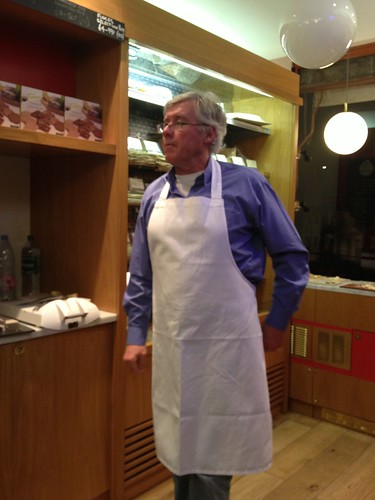
Our host for the evening was Tony, one of the owners of The Teddington Cheese. (Note of clarification for those readers who actually know where Teddington is: There are two branches of the shop, the original in Teddington, and the more recent addition in Richmond. Those for whom London geography is a hazy muddle punctuated by incorrect pronunciations of Leicester Square and the vague notion that Kew Gardens might be a nice stroll from Tower Bridge can skip that last bit.)

Untitled
Tony, holding forth on his specialist subject.

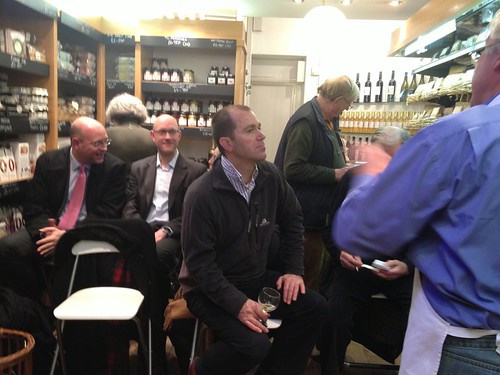
One of the reasons that it was so hard to get a spot in one of these classes is that the Richmond branch of The Teddington Cheese is decidedly on the petite side, meaning that once ten folding bar stools are set up there's just enough room to pass round a bottle of wine, but only if it's not a magnum and if you keep your elbows down.  This made for a cozy atmosphere that was most appreciated because it was a cold night, one in a long line of cold nights that have plagued the island for what seems like eternity (Yes, I know I'm whinging about the cold when most of Canada is still shovelling the sidewalk.  I have no defense.  I've become soft.  Let's move on.)  Cozier still was the fact that Tony handed around glasses of a nice white wine before we got down to cheesy business.

Untitled
The packed confines of The Teddington Cheese with Jeremy in the foreground, apparently frozen in laser-like concentration while the rest of the shop is a blur.

Tony started us off with the basics - the different kinds of milk commonly used to make cheese.  We tasted cheese made from cow's milk, ewe's milk and goat milk, and Tony gave a nod to buffalo mozzarella as well.  (Aside: I honestly did not think that buffalo mozzarella was made from actual buffalo milk because... BUFFALO MILK?  What the hell?  How would it occur to someone to milk a freakin' buffalo in the first place?  And if seized with the notion, exactly how does one go about milking a buffalo?  The mind reels.  The notion that buffalo mozzarella is made from actual buffalo product is a bit like thinking one might order a pizza topped with salami that turns out to be made from alligator meat.  In fact, I still have a sneaking suspicion that it's all an elaborate hoax, akin to the great Spaghetti Harvest BBC report of 1957.)  My ranting suspicions aside, the tasting was good, and much like you'd expect.  For each cheese Tony had a generous slice on a little platter which he chopped into small pieces and handed around to the group.  No poncey biscuits or toast to get in the way, just cheese cheese cheese.  We sniffed and tasted and Tony told us things we might notice and it was all quite nice.  The pieces were small, but we were warned that we'd regret anything bigger by the end of the night.

After talking about the different types of milk, we moved on to a study of the effects age on cheese with a vertical tasting of three different gruyeres that ended with a four year old version that was understandably powerful and excellent.  Naturally, older cheese are firmer and drier as a result of the weight of moisture lost in ageing, which I like to think of as the cheese equivalent of the Angel's Share.  No one was surprised that the older the cheese, the stronger the flavour.  What did surprise me was to learn that the maximum age a cheese can get to before it turns is about five years, and that only applies to the hard cheeses.  Softer cheese go off much quicker and that buffalo mozzarella is only good for five days.  And I was proud to learn that the oldest cheese Tony had ever tasted was a five year old Canadian cheddar, which earned favourable reviews.  I also learned a new word: affineur, which is "a person whose specialty is maturing and ripening cheeses."  Cheesemakers will often send their cheeses to an affineur for storage and ripening, and the affineur will be responsible for monitoring the cheese, turning it if necessary, and tasting it periodically in order to determine the perfect time to consume it. Clearly this profession was not on the guidance counseler's list when I was in high school because if I'd have know one could earn a living eating cheese then the theatre world would surely have lost one of its brightest technical management stars.

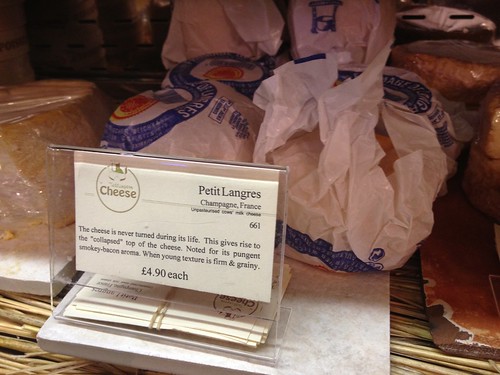
After age, we turned to a study of the effects of size on the flavour of cheese, demonstrated by tastes of a nice Petit Langres, followed immediately by its larger cousin, the (just plain) Langres.  I was surprised that the larger cheese had more flavour, expecting that whatever magic mojo happens to make cheese be cheesier would act more quickly and emphatically in a small cheese.  Nope.

Untitled
Petit Langres.  Every cheese in the shop (and there are about 140) comes with a little card telling you a few fun facts.

When we moved on to blue cheese Tony switched us to the red wine and I was starting to become grateful that I hadn't had any dinner.  Being a fan of blue cheeses in general, there were a couple in this round of tasting that I'd seek out again, including a fantastic strong Vieux Berger Roquefort and a lovely mild one called Devon Blue that won a gold medal in the 2011 British Cheese Awards.  (My invitation to that event must have got lost in the post. Damnit.)  Then it was on to the washed rind cheeses, including a lovely one called Oxford Isis that tastes like grown-up Laughing Cow cheese.  Then it was the white rinds, the most familiar of which is Brie, and by this time even I getting slightly over-cheesed.  Tony had hit his stride though, and held forth on the notion of rinds in general, and the utterly unsatisfactory use of wax to seal a cheese as opposed to a proper naturally formed rind which is normally created by washing the outside of the cheese in brine or other other things that add flavour.  The whimsically named Stinking Bishop cheese is washed in perry, a pear cider made from the Stinking Bishop pear.  And the aforementioned Oxford Isis is washed in honey mead.  As for wax?  Here's Tony's pronouncement: "Avoid it like the plague.  It does nothing for the cheese."

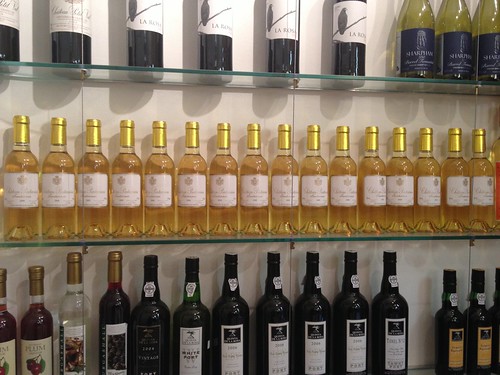
In a final attempt at mass death-by-cheese, Tony presented us with his favourite wine and cheese pairing by pouring out some ridiculously large glasses of the sweet dessert wine Sauternes and presenting it with a wicked Crozier Blue cheese which seemed counter-intuitive but demonstrated that Tony is clearly a cheese savant because it was great.  And I'm sure that had nothing to do with the fact that we were all somewhere along the continuum between tipsy and sloshed by that time.

Untitled
The Sauternes.

Alongside the wine and cheese we got tidbits of cheese trivia, such as the unsurprising fact that 80% of the cheese sold in the UK is sold through supermarkets, and 80% of that is cheddar, which is sort of sad.  Also, it turns out that Teddington cheese goes through about ten metric tonnes of cheese each Christmas, including a full ton of Stilton, that single tonne of which is equivalent to about a four foot by four foot by four foot cube of solid cheese.  Tony also tackled the thorny subject of pasteurisation.  His position is that unpasteurised cheese is a minimal risk - the acid and salt in the cheese, along with cool storage temperatures make it difficult for nasty bugs to survive.  Though interestingly, most blue cheeses are made with pasteurised milk because the cheesemakers prefer to restrict the bugs that go into those cheeses to the ones they put there themselves.

Along with the obvious (cheese, cheese and more cheese) Teddington Cheese also stocks an extensive range of chutneys which Tony was amusingly dismissive about, declaring "Chutney is an awful thing to do to a nice cheese."  Even better, one of the shop's specialties is the Cheese Wedding Cake.  This is certainly not anything to do with the graham-crust, strawberry-topped variety of cheesecake (all one word).  Oh no.  A Teddington Cheese Wedding Cake is a multi-tiered edifice constructed entirely of whole wheels of cheese.  This is a notion so beguiling that I've decided that the next time I meet a man I've got vague romantic notions about my first question will be, "If we were to get married, would you have any objections to the notion of a wedding cake made entirely of CHEESE?"  If the answer is no, he's not even going to get out of the starting gate.

Untitled
An example of the cheese wedding cake.  When you order one you get to spend a bunch of time tasting different cheese deciding exactly what you want in your cake.  And sometimes they separate the layers by adding pillars of those tiny goat's cheeses in between.  Genius.

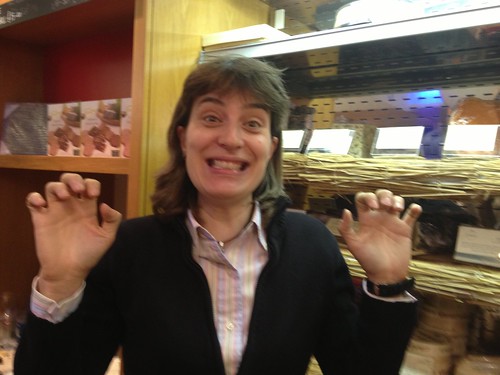
By the end of the night it really was time for home, though not before a mandatory photo op of me in the cheese shop doing my best Wallace and Gromit cheese fingers.

Untitled
Slightly out of focus and alarmingly crazed-looking. But you get the idea...

And so Jeremy and I wended our way back towards Richmond Station, with a quick pitstop at a nice pub en route to ensure there was no way I'd wake up without a slight headache on Friday morning.  And despite the fact that I sampled twenty different cheese that night I slept peacefully, thus disproving the myth of the cheese dream once and for all.  Or perhaps I'm simply immune to the effects of over-consumption of cheese, like some kind of really lame superhero.  (Then again, if I had to choose a crappy superhero power, the ability to eat epic amounts of cheese wouldn't be a bad one really.  "Oh no, little Timmy is trapped under an enormous pile of Caerphilly, who can save him?  Wait, is that enigmatic Super Cheese-o-phile?  Hallelujah, we're saved!!")

And on that note, it's clearly time to close off before things degenerate any further.  Beside that, I've got to tend to the nice bit of Oxford Isis I purchased at Brixton Market this afternoon.  Please excuse me.

Off the tourist track: Unseen Tours

Sunday, March 17, 2013

I like to think of myself as a bit of an aficionado of walking tours.  I did spend a year as a full-time traveller, and now live as a weekend tourist in one of the greatest cities in the world, so I really have trod more than my share of miles attempting to keep up with tour guides from Belfast to Beijing.  But last week I did a walk like no other, run by a company called Unseen Tours.  Their guides do not hold the coveted blue badge sported by so many professional tour guides in London.  In fact, Unseen Tour guides aren't professionals at all. That's because Unseen Tours are guided by people who have an unusual perspective on the city, because they're homeless, or recently homeless, or "vulnerably housed."

Untitled
The homemade sign marking the start point of an Unseen Tour.

I can't remember how I heard about Unseen Tours, though it was likely from one of the many emails, RSS feeds or other Random Interesting London Things (RILTs) that filter through my consciousness more or less continuously.  (Unsurprisingly, the volume of RILTs available to anyone even remotely switched on is frankly staggering.)  The tours grew out of the activities of a group called The Sock Mob, a grass roots outreach program of volunteers who take to the streets regularly to meet, talk to and befriend homeless people around London.  Their icebreaker is that they give out fresh pairs of socks, an understandably valuable commodity for people with no sock drawer of their own.  The tours are seen as a way of helping people to understand the homeless as something more than a vaguely scary or distasteful presence on the fringes of society.  As one of the founders of the Sock Mob says, the point of the tours is to give the homeless a bit more "ownership" of their lives and to "present [homeless people] in a very different light so that people can see them as having something to offer." (There's some good information about the nitty gritty of the tours here.)

Most of the £10 fee for the tours stays with the individual guides, who are coached for months by Sock Mob volunteers before being deemed ready to guide the general public. There are currently five different tours offered, at London Bridge, Shoreditch, Covent Garden, Brick Lane and Brixton.  Even though the Brixton tour was right in my back yard, I decided to head to Covent Garden. Maybe because it's easy to have a tourism-driven, romanticised "Eliza Doolittle" idea of the area, I thought that learning about it from such a different perspective would be really interesting.  And I wasn't wrong.

It was a cold day last Sunday. Not Winnipeg cold, but damp and chilly enough that I elected to wear long underwear and a toque and a lot of layers.  It was the kind of day that made it clear what a brutal thing it must be to sleep rough through a London winter.  My tour started at Temple tube station, tucked in along the Embankment at Waterloo Bridge.  I showed up a few minutes early and found my guide, Viv, who's originally from Norway, but has been a Londoner since 1975.  Maybe it was because it was a cold and rainy day, or maybe because the tube station was closed, but whatever the reason I was the only one who'd shown up for the tour that day.  Viv didn't seem bothered by this, so she took my £10 and we set out on my personal guided tour of unseen areas around Covent Garden.

We started in the small gated park right next to the station, and Viv gave me an unexpectedly scholarly rundown of the history of the name "Temple" which is apparently derives from the knights Templar, they of the crusades.  (She's something of an expert on the Crusades). These days the nearby Middle and Inner Temples are two of the four Inns of Court, which are the professional associations for barristers in England and Wales.  Then, in the kind of left turn that would soon became familiar, she pointed over to one of the wooden benches in the park and said, "I used to sleep there."  Needless to say, this is not the kind of comment I've ever had from a tour guide before.

Untitled
The Park. (Note to RobH: I would have taken a picture of Vic, but she specifically asked me not to post photos of her because of her personal situation.  She was fine about sharing details in person, but understandably didn't want them broadcast online alongside her photo.)

It was these kind of things that made the tour for me.  Viv was really open about her past, and talked about when she and her partner were part of a small community of people who slept in that park in Temple in 1999.  Apparently it's a coveted spot (not least because a charity hands out food across the street every night). There are benches to get you up off the ground, and its completely fenced in so once the gates are locked at night there's a measure of safety that's not available in more open areas.  She even told me about a set-up she had that involved borrowing crates from a nearby fruit and vegetable stall outside the tube station and setting them up like a mattress, covered in layers of newspaper, with a sleeping bag and a tarp over top.  It was, relatively speaking, a good arrangement, though also a lot of work because the crates had to be returned to the stall before the stall-holder arrived in the morning, and the other bits had to be dismantled and hidden in the park during the day so the cleaners wouldn't toss them out.  Anyone who believes the homeless are lazy might have a think about the effort involved in keeping body and soul together with no fixed address.

Viv says there are about 4,000 people who sleep rough in London every night, though that number goes up in the summer.  And I suppose its not surprising to learn that the homeless community is, well, just that: a community.  People tend to know each other, or know of each other.  Small groups like Viv's gang in the park at Temple form and stick together for a time, regulating who is and who isn't let in, based on word of mouth and personal recommendations.  When she was sleeping in that park, Viv knew each person on the other benches.

After the park, we moved off past one of the few remaining cab shelters in London.  These distinctive tiny green huts were established to provide a place for the drivers of hansom cabs (and later motorised taxis) to shelter from bad weather and get a bit of hot food and drink. They were run as a benevolent service founded by the Earl of Shaftesbury in 1875 and intended, at least in part, to keep the drivers out of the pubs while on duty.  At their height there were 61 shelters in London; 13 still survive and continue to serve food and drink.

Untitled
The cab shelter at Temple Place.  Anyone can buy food from the stall, but the small number of seats inside are still reserved for cabbies only.  Viv says you can get a cup of tea for 70 or 80p and a bacon roll for two quid.  Not bad.

As we moved along under Waterloo Bridge, we came to another important spot in the homeless geography of the area.  The areas under bridges are generally popular because they're sheltered but publicly accessible, and this spot in particular was another of Viv's former homes.  She'd had a "bash" on a platform area under Waterloo Bridge.  As she explained, a "bash" is a temporary shelter made from found materials - tarps, tents, cardboard, shipping pallets, whatever.  Having a bash is quite good, though even then you still have to be careful of theft and random violence.  Viv talked about having to haul her bedding around all day to stop it getting nicked, which again shows that life on the streets requires a lot of effort.

Waterloo Bridge Bash
You can just see that someone's got a tent set up on the platform. Apparently there even used to be a water tap, which was, as you can imagine, very helpful.

Beyond her stories of homeless life, Viv really was a source of tons of proper tour-guide-like information.  If I tried to tell it all you'd be here all day and your coffee would definitely get cold.  I got the history of Somerset House, a peek down an alley of King's College that contains an 2,000 year old Roman Bath mentioned in "David Copperfield", and an excellent anecdote about the Savoy Hotel.  But really, the most interesting bits were the little insights into the world of rough sleeping in central London, and about Viv's personal experiences.  For instance, I've had a pint or two at this pub on the Strand:

Untitled
The Coal Hole.  They do a decent ploughman's lunch.

For Viv, The Coal Hole was once a regular haunt where she met an actor who was in a show at one of the nearby theatres.  He used to sit at the tall tables outside and was friendly and chatty, often giving her a bit of money if he had some spare in his pocket.  Only later did she find out her benefactor was Richard Harris, the actor who may be best-remembered as Dumbledore in the first two Harry Potter movies.

Eventually we made our way to Covent Garden Market, the tourist hot spot.  Along the way Viv pointed out the people sleeping in doorways and explained they do that because its safer to sleep during the day so you can be awake and aware at night when it's most dangerous. The hours after the pubs close are particularly fraught and the homeless are often targets of verbal and physical abuse for drunk revellers.  It's not unheard of for people to be kicked or spat on, and there have been cases of people being doused in lighter fluid with attempts made to set them alight.  I'll say it again: it's a tough life.  There's also violence within the homeless community.  Alcoholism can be common, and wherever alcohol is abused (whether it's in a touristy Covent Garden pub or in a bash under Waterloo Bridge) hostility and violence often follow.

Covent Garden had a particularly personal landmark for Viv - the place she slept when she first became homeless.  Near the Transport Museum there are several outdoor staircases that lead directly into the basements of the museum and surrounding buildings.  I'd never noticed them before but one of them, in front of the newly-opened fancy "Balthazar" restaurant, was Viv's former haunt.  In a particularly odd moment we found ourselves at the top of the gated stairs as a young woman arrived on her way down to what's now the staff entrance to the restaurant.  Viv chirpily informed the girl that she used to sleep under these stairs, fifteen years ago.  The girl's reply was to ask - and I'm not kidding - "This place was here fifteen years ago?"  It was bizarre.  How can someone living in London and possessing of even an iota of awareness of their surroundings estimate the age of a building in Covent Garden is younger than several shirts I own?

Untitled
This is what most people think of when they think "Covent Garden".  Spin around 180 degrees from this view and you'll see this:

Untitled

Untitled
This kind of staircase used to be able to shelter 12-24 people every night, tucked out of the way, under cover, sometimes even near warm air vents.  Relative luxury.  
Now they're inaccessible - walled off or fenced or locked up.

We then took a chilly wander past the Dickens Coffee House and the Theatre Royal Drury Lane.  There's an interesting ghost there, one of the many who are said to inhabit this "most haunted" theatre in the West End.  "The Man in Grey", as he's known, is supposedly only seen on the opening nights of shows that go on to a successful run, making him perhaps the most popular poltergeist in London.

Untitled
This is the Stage Door side of the Theatre Royal Drury Lane.  Apparently these columns were salvaged from a stretch of Regent Street between Piccadilly Circus and Oxford Circus.  They were removed because they were a popular spot for prostitutes plying their trade.  Some were relocated to Drury Lane, the assumption presumably being that anywhere with such a high concentration of theatres and actors must already be beyond hope. (Unrelated aside that I have to throw in because it makes me feel cool: I've worked there!  At the theatre, of course.  NOT up against the columns.)

Untitled
We also walked past this place, which I had no idea was there.

Eventually we ended up at a spot that turns out to be a landmark for homeless Londoners. Lincoln's Inn Fields is the largest public square in London.  Wikipedia notes that it was privately owned until 1895, but Viv's version of events is different.  She told me that an old woman used to own the square, and bequeathed it to the homeless when she died.  Local solicitor's firms launched a legal appeal about the bequest that was eventually upheld on the technicality that "the homeless" as a general group (as opposed to a particular, named, homeless person) were not eligible to inherit.  "You won't find this on Google" said Viv, and indeed she's right.  A few minutes online reveal nothing of Viv's version of events, but certainly its true that there was a large homeless community at Lincoln's Inn Fields in the 1980s.  They were eventually cleared out in 1992, and fences were erected around the square and locked every night, but Lincoln's Inn Fields remains one of the only places in London where the homeless are fed every day of the year.  I leave it to you to decide whose version you want to believe.

Untitled
The gazebo now at the centre of Lincoln's Inn Fields.

The tour ended at the square.  By this time my fingers were stiff with cold and my feet were sore and I wanted nothing so much as a warm cup of coffee and a place to sit and thaw out. The Unseen Tours website suggests that patrons might want to invite their tour guides for a cup of coffee or a pint after the tour, I suppose to continue fostering personal relationships among the housed and the unhoused and to reduce the stigma associated with being homeless.  I was getting ready to ask Viv if she wanted to join me for a cuppa (she really did have a lot of interesting stuff to say, I sensed she could have gone on for another two hours) but before I could offer she said she was off to catch a bus and was gone, leaving me to make my way to the tube and then back to my warm and friendly home in Brixton.  I never asked Viv if she's still living on the street.  Despite all the personal details she shared it seemed like it would be rude to pry about her current circumstances.  So while I was safely tucked up with a cup of tea and my toes under a blanket in my room, I don't know where Viv ended up.  But I do know she opened my eyes a little bit to a world that's always been on the periphery, and I'm glad she got my ten quid.

Apropos of Nothing, return of the revenge of the son of the sequel

Sunday, March 10, 2013

A few more random thoughts for your consideration:

On the Unaccountable Presence of Corn in Odd Places:

There is something about corn here.  Or, more specifically, about corn niblets. (Or "sweetcorn" as it is known here, probably to differentiate it from its close cousin, sourcorn. Actually probably because the term corn is sometimes used to refer to any kind of grain, but really I digress.) What I was saying is there's something about sweetcorn here, and that something is that often appears in odd places. (Not odd as in on the bus, or the sock department at Marks and Spencer, or the House of Lords, but still, you know, odd.)  Some of you may be used to encountering corn in shepherd's pie, and that's common here.  But what about in your cold lunch?  Not difficult because it's basically impossible to get a tuna sandwich here without corn in it.

Corny
A tuna sandwich related sidebar: the tuna + mayo combination that we in North America call "tuna salad" is here generally called "tuna mayonnaise".  And it's chicken mayonnaise or prawn (shrimp) mayonnaise as opposed to chicken salad or prawn salad. A sandwich with "salad" in the name here is one with lettuce and sometimes other veggies added.  Which, if you think about, actually makes much more sense.  After all, what does mayonnaise have to do with salad?

And what Italian chef has ever stood at a counter staring at a partially formed pizza and thought to himself, "Aha! Obviously what this pizza needs is MORE CORN!"

Corn pizza

Every one us us has probably walked down the street at some point with a slight rumble in the stomach and thought, "Hmmm... What do I want?"

Cornier
Naturally, your first thought is probably, "Where can I get me a cup of corn niblets?"  And if that is your first thought, your're clearly some kind of freak and your next thought is probably, "Then for my main course, how about a lightly grilled stoat on a stick?  With extra cheese, please."


On the Disconcertingly Geographically Specific Nature of Air Hockey:

I like to think that I'm pretty well assimilated by now.  I've been living in London for two and a half years (!!) and I know how to read a bus map, I know it's a bumbag and definitely not a fannypack, and I can even sing "Jerusalem" without having to hum because I actually know all the words.  But still every once in a while I encounter something that makes me feel once again like a stranger in a strange land. That's what happened a few weeks ago when I went out for the evening with my friend Rob to an odd arcade / bowling alley / somethingorother on the south of the river at County Hall.  (For those of you trying to keep track of the Robs this was RobW, a relative newcomer, as distinct from RobH, frequent blog commenter and long hair fan, and Uganda Rob, now based in Nairobi.  Clear as mud.)  They had lots of video games, and old fashioned midway kind of things like those shove-penny machines and shooter games and claw machines and such. They even had coin operated bowling!  Weird, but fun.  They also had something that immediately caught my eye.

Many of you will be familiar with the game of air hockey.  A smooth table with bumpers all around and surface perforated with tiny holes through which air is forced, which makes a round flat plastic puck float on the surface while two player whack away at it unmercifully with a round paddle sort of thing.  The table surface is painted like a hockey rink with a white background and a centre line, face-off circles, blue lines, goal crease... all the things that make it look like hockey.

air hockey
Good, upstanding, god-fearin' air hockey.

I was delighted to discover an air hockey table in the basement of the arcade and happily inserted my pound coin for a quick game.  Then I did a double-take and realised, once again, that I really wasn't in Canada anymore.

Apro po of nothing
Weird, heathen GREEN air field hockey.

What the hell? Air FIELD hockey? They don't even use a PUCK in field hockey!  The whole thing must have shaken me up more than I realised because I ended up losing the game 3-2, which I blame entirely on the alien freakishness of the table. Obviously.


On the Greatest Queue Time to Event Time Ratio Ever:

One of the great things about London is that there is soooooo much going on.  Not just music and theatre and museums and such, of which there are boatloads.  There are also a ton of slightly off-beat things that crop up pretty much all the time.  I've recently subscribed to a daily email sent out by a great website called Londonist (which has the brilliant tag line: London. Londoner. Londonist.)  Every morning, by 7:00am, I get an email of a list of the cool things I could do in London that day, lots of which are free free free.

One of these emails recently noted that the art installation known as the Rain Room at the Barbican Centre was due to close soon.  I had vague memories of being told about this months ago and ignoring it completely, but since it was free, and since I still had a bit of time on my hands, I arranged with a friend to go down one morning in the last week of the installation to see what the fuss was about.  The Londonist warned that queues were getting long, so I reasoned that if we went first thing in the morning and planned to arrive about an hour before the room opened, we'd be fine.  Ha!

Of course it turned out that my estimate was laughably wrong.  London may have a ridiculous amount of cool stuff to do, but sadly it also has a ridiculous number of people trying to do it all.  By the time Ian and I arrived shortly after 10:00am the queue had already wound back on itself several times, and the Barbican had set out signs like this:

Rain Room
The queue

This caught us off guard a bit, but we quickly decided that we weren't going to wait five hours.  At least not that day.  Before we left Ian cleverly went to the front of the line and asked the people there what time they'd arrived that morning, so we could gauge when to make our second attempt.  So it was that we found ourselves settling in, second in line, at just before 8:00am the next morning, for a guaranteed three hour wait. (The gang of girls in front of us arrived at 7:00 and several people got there just after us, so I think we gauged it perfectly.)  The wait wasn't that bad.  At least we were indoors, on carpet, with ready access to toilets, free wifi and decent coffee.  And we had a deck of cards and are both skilled in the dying art of conversation, so the time passed pleasantly.

And what was it that we waited so long to see?  Well, the Rain Room is was an installation of cascading water that visitors were meant to walk through.  And before you point out the obvious madness of queuing for hours to stand in the rain when London provides ample opportunities for that on almost every day of the week, let me tell you the thing that made the Rain Room so fantastic.  The cascade was equipped with an array of sensors that turned the water off in the area in which you were standing, meaning you could walk through the deluge in a little bubble of dryness.  Yes, there were occassional drips even when the taps were turned off, and yes you had to move in a slow and deliberate way, but it was still quite a lovely experience.
Rain Room
(ARTY PHOTO ALERT!) Ian in the Rain Room.

They only let five or six people into the room at once.  It was mostly dark except for one bright spotlight, and the only sound was the water and the comments of the other visitors.  I loved looking up at the ceiling and then slowly spreading my arms out and watching the waters recede before them.  It made one feel a bit like Moses, if the Red Sea had been upside down, and if Moses and the Israelites had had to queue for three hours.

Rain Room
The ceiling, showing areas of wet and dry.

In the end we spent less than ten minutes in the Rain Room.  As cool as the experience was, there's only so much time one can spend not standing in the rain.  So we ended up with a ratio of about twenty minutes waiting time for ever one minute of Rain Room time.  Still, when we passed by the queue on our way out of the building (after towelling off the stray drips), we felt pretty smug, especially compared to anyone standing next to the "6 Hours from this point" sign.


On the Sudden Return to a Life of Toil:

And in other news: work, work, work!  My days as an unemployed layabout and full-time café dweller have definitely come to an end for the foreseeable future.  As seems to be the nature with freelance work, what started out as an occasional meeting and an infrequent hour or two with a spreadsheet has suddenly become a life filled with phone calls, lists, visits to scene shops, battles with budgets and looming deadlines on two different shows at two different theatres. All of this has been a bit of a shock to the system, but is also a relief and strangely kind of nice.  

I'd been quite worried that after a lifetime spent as a salaried employee ensconced in a building full of shops and people waiting to do my bidding (more or less) that I'd find life as a freelance production manager scary and difficult.  Certainly some things are harder, like having to go out and find people to build things instead of having them waiting in the basement, tablesaw at the ready.  It's also weird not to have a desk and a phone in an office, meaning that my café dwelling days aren't actually over, they've just morphed into something much less relaxing.  Then again, it's kind of liberating to be the master of my own schedule, and to have the freedom to, say, queue for three hours for a funky art installation before dashing off to a supplier to pick up samples, and then to the designer's studio to try and pitch him the stuff that's £8.40 a square metre instead of the stuff that £26.95.  Concatenating all the things I have to do and all the places I have to be is sometimes exhausting.  (Also: Concatenating!  That one was for both Robs W and H.)

All of this means that my blogging time has been severely curtailed.  But fear not!  I've got no intention of abandoning you any time soon.  But since my weekdays are quite full, weekend have become the best time for blogging, so you should all brace yourself for the advent of Monday morning blog posts (sorry Steve!).  

And finally, there is some quite interesting employment-related news on the horizon that I'll refrain from announcing until all the specifics are confirmed.  But I think it's going to be cool.

Scary. Big. And cool.  So stay tuned.