Ways I didn't die in Australia

Sunday, October 28, 2018

There was a time in the late 1980’s that the more mature Go Stay Work Play Live Reader may recall. It was shortly after the release of the movie “Crocodile Dundee”, when a tide of what I can only describe as Australiamania swept across North America. You couldn’t swing a didgeridoo without hitting a can of Foster’s lager or hearing some twat spout out a “G’day mate” while brandishing a boomerang. I found the whole business really boring. Now that I’ve actually been to Australia, I can confidently say that whole Australiamania business genuinely was really boring, but that Australia itself is pretty fantastic. Sure, at the time I visited I was exhausted with Jakarta in particular, Indonesia in general, and the basic concept of Asia as a whole. Plus anywhere I didn’t have to endure 32 degree temperatures and one million percent humidity was bound to be popular. And you really can’t overstate how much easier it is getting on in a place where they speak a passingly understandable dialect of English. But all that would be true in Minot, North Dakota or Sudbury, Ontario and Australia is definitely more fun than either of those places.
IMG_1320
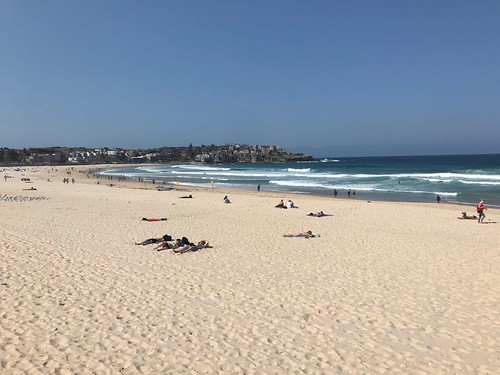
Bondi Beach. And apologies to Minot and Sudbury, but let’s be real here.

Before my Oz Adventure I had the supreme pleasure of re-reading Bill Bryson’s book about the place, “In a Sunburned Country”. It’s perfectly excellent and I recommend it highly, especially to Karen, who persists in claiming that she hates Bill Bryson’s writing, which is one of the things we have to agree to disagree on. (Other such topics include my staunch belief in the inherent interestingness of gears and industrial machinery in general, and her slight obsession with jewellery of all kinds.) One of the things Bryson goes on about at some length is the many and varied ways it’s possible to die in Australia. And I’m not talking here about the usual western civilisation killers like heart disease or diabetes or say, being hit by a bus. No, Australia has a lot more interesting ways of bumping you off than that.

It’s relatively common knowledge that the wildlife in Australia is surpassingly deadly. I had to keep reminding myself of that while I was there because it reminded me a lot of Canada so it was easy to get complacent. There’s a “we’re all Commonwealth here” feeling with an appropriate smattering of war memorials and familiar place names and pictures of the Queen, and with the more relaxed vibe I associate with Canada rather than with the mother country. Then again, because Canada is squashed up against that cultural juggernaut to the south, we ended up with baseball and "American" football and hot dogs. Whereas Australia is so ridiculously isolated that even after the colonial influence faded they carried on with cricket and rugby and even managed to evolve their own Australian Rules version of football (it’s like the Madagascar of field sport - an evolutionary one-off). Still, Australia feels familiar, especially for me who can speak fluent baseball and just about keep up when someone starts prattling about square leg and silly mid off.

The size of Australia also means it’s geographically spread out in a way that’s a lot like home. There are wide streets and long highways and a general sense that there’s no need to bunch up. Case in point: I was invited on a road trip up the east coast wherein the plan was to leave Sydney Monday morning and arrive near Byron Bay in time for dinner. It’s a distance of about 900km, and true proof that Canadians and Australians really are soulmates because when I was presented with this plan my instinctive thought was, “Yeah, that sounds about right.” In England the notion of traveling 900km in a day would be greeted with howls of derision and a detailed explanation that merely to get from Central London to Reading would take at least a day, and really one should be prepared to overnight in Slough, just in case.

But back to how Australia can kill you. Everyone is probably aware that the spiders and snakes in Australia are really not to be trifled with. Of the world’s ten most poisonous snakes, ALL are Australian. The native funnel-web spider is the world’s most toxic and a nip from the redback spider will also definitely make you late for dinner. One of my hosts in Sydney, in a typically blasé Australian way, told me that these days they tend not to give you anti-venom for some spider bites. “They’ll just see how you get on at first” she said, which was not reassuring. Then again, the typical Aussie would probably be pretty unnerved by the notion of digging a car out of a four foot snowbank in -30 degree blizzard, so I guess we all have our blind spots.

In any case, after that lovely 900k trip up the coast, including a mandatory detour for a photo op at The Big Banana, we fetched up at our home for the night and had a lovely dinner of lamb and talked about what the next day’s activities should be.
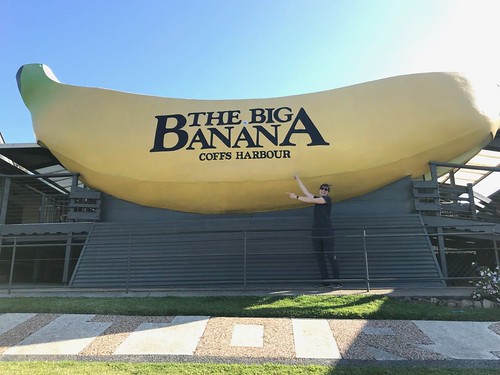
IMG_1474
More evidence that Canadians and Australians are alike. We both love a giant thing by the side of a road. Sadly, we missed the Giant Prawn.

Our hosts suggested there were some nice nature walks in the area and even handed over a small guide book that seemed to be comprised of equal parts walking directions and careful notes on things you should really avoid encountering while walking. And even though I thought I was pretty au fait with the lavishly lethal nature of the country, I was still alarmed when the first entry I saw was for the Giant Stinging Tree. A tree that can sting you? That’s just offside. Needless to say, I declined to go for a walk in the woods.

What we did instead was spend the day at Currumbin Wildlife Sanctuary, which was great. Apparently many Australians of a certain age have traumatic memories of being taken to Currumbin as a child and being subjected to the “lorikeet feeding” ordeal, which is a particular form of child torture that involves being equipped with bird feed and then covered in an alarming number of lorikeets - a type of small, colourful parrot - while screaming bloody murder and having one’s photo taken. I wisely skipped the lorikeet feeding, but I did get to pet a kangaroo and see koalas, Tasmanian devils, dingos, crocodiles AND a spiny echidna! Even the lorikeet-scarred Paula admitted that modern Currumbin was an excellent day out. Sure, it was kind of cheating to see the animals in captivity (the “koala crossing” signs we saw on the highway were clearly hoaxes) but for a kid from Canada it was pretty great.

IMG_1508
I could have paid for a photo op cuddling a koala, but I decided to spend my money on seafood and beer. I have no regrets.

After Currumbin we ended up in South Golden Beach, at another house generously provided by the previously mentioned network of Australian friends and acquaintances. And that’s when I had to remind myself again about Australian wildlife, because that night as I was getting ready to brush my teeth I dropped my toothbrush beside the sink. When I bent down to pick it up, I saw it had landed right next to an occupied spider web. At first I took no notice. Then I took a mental step back. And then I took a physical step back. And then I called Paula, because you can’t beat an Australian when it comes to identifying deadly wildlife. She came to check it out, and was generously derisive when she saw the beast, which was apparently microscopic and harmless, but my policy is you can’t be too careful in Australia. And Paula can laugh all she wants but she better not call me the next time she needs someone to dig her out of a snowdrift, that’s all I’m saying.

The next morning I got up for a run and was struck - and not for the first time - with the surpassing beauty and ubiquity of Australian beaches, because this is what was at the end of the block:
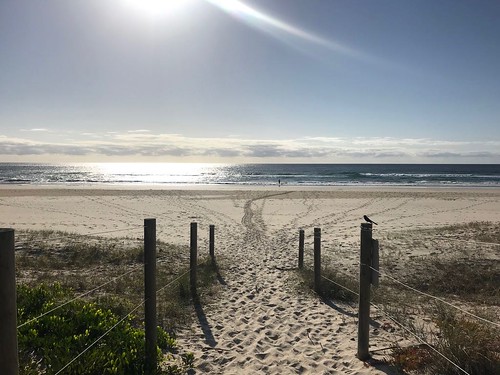
IMG_1521
South Golden Beach. One of a countless string of stunning beaches along Australia’s east coast. It’s a wonder anyone gets anything done over there.

Aside from the spider in the bathroom, the house at South Golden Beach was fantastic. However, lest we get too misty-eyed about the beach itself, remember that it’s not just things on land that can kill you in Australia. The sea is home to a lively variety of deadliness. Of course there are the sharks and the stingrays. And don’t forget the tiny-but-murderous blue-ringed octopus and the famously painful box jellyfish. Yes, the waters around Australia are full of deadly delights. But that’s not all. Even if the ocean were utterly devoid of life you’d still want to keep your wits about you when you go for a dip.
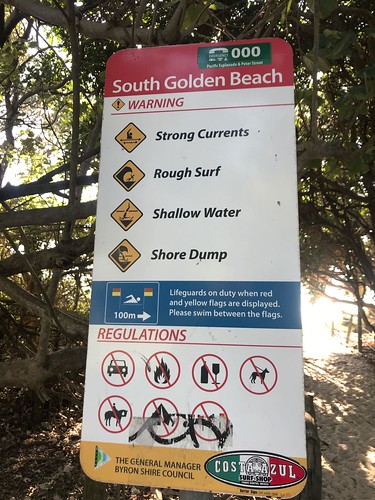
IMG_1522
I only understand about half of what this sign is saying, but the strong inference here is that even the water can kill you.

When I decided I wanted to go for a quick swim at South Golden, Paula cautioned me. “It’s pretty rippy out there” she said, meaning it looked like there could be a strong rip current. I’m still not really sure what that means, but it seems significant that they call it a RIP current and not, say, a joyful current or a mellow current or fluffy bunny current. Paula tried to explain it to me - something about how the waves were breaking creating a current that can pull you far out from shore. She told me not to go in too deep. When I pressed her about how deep was too deep - Chest? Waist? Ankles? - she sighed and said, “Why don’t I just come with you?” (Subtext: “So I can video you being pulled out towards New Zealand and give the Coast Guard rough coordinates.") Like I said: even the water can kill you. For the record, I did go for a very short swim and didn’t get sucked into an international shipping lane or fatally stung or have any appendages bitten off.

In fact, the closest I came to snuffing it was when Paula tried to kill me with red wine on our last night at South Golden Beach. Then again, that wasn’t Australia’s fault. And I didn’t actually come that close to death, I only prayed for it fervently when I woke up the next morning. Which is why it’s all the more admirable that after I’d been delivered to the airport for the short flight back to Sydney, survived the flight, schlepped my things back to the guest room, and had a short but very very very necessary nap, I managed to rouse myself in time to go out for what turned out to be a perfectly quintessential Aussie evening. My lovely hosts dragged me out to the Returned Services League Club at Paddington (not that Paddington). The RSL is the Australian equivalent of the Canadian Legion - a club nominally for current and former members of the armed services. They're all over Australia that serve food and cheap alcohol and usually have sports betting and other gambling, and maybe a dance floor. Membership is open to anyone, and entitles you to even cheaper beer and extra chances at the many many draw prizes, and profits support the aforementioned servicemen and women.

The trip that night was somewhat calculated, as we'd planned a barbecue for my last day in Australia, and Friday night at the Paddo RSL is Meat Tray Night! What better excuse for a night out than a chance to drink cheap beer, watch Australian Rules Football and try to win a meat tray for the barbie? Despite my fragile state I did manage to enjoy a couple of beers and had a very credible seafood basket. And Nick did his best to explain Aussie Rules Football to me. As far as I can tell, it involves large men running around on a pitch approximately the size of Wales in very tight shorts. There’s a ball that looks like a rugby ball and you can run with it (for a while) or kick it but you can’t throw it. You can, however, do a pseudo-volleyball-bump thing to pass it to someone else. To score you have to kick the ball between a set of four posts, which makes the whole field look a bit like a Quidditch pitch. It’s actually quite fun to watch. It's fast and rough and the action is continuous, so it’s quite like hockey in a way.

The main event though, was the meat draw! There were more that 20 different meat trays in the cooler so early winners could choose from steaks, lamb, whole chickens, roasts, sausages, chops, and various other treats. Our table spent $60 on tickets, so we were getting quite nervous as the night wore on and we were left empty-handed. And then finally, with only three trays left (including the dreaded breakfast tray which was really just sausage, bacon and a dozen eggs) at last our number came up!
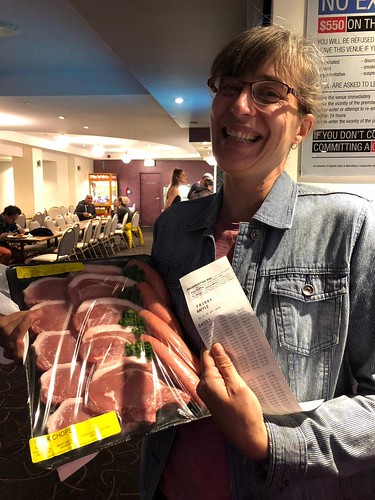
38edc2f5-5cd0-40ec-8dbf-0a4306352f0f
Behold the winner! Pork chops, pork steaks and pork sausages for lucky number 4169! Especially cherished because I’d spent the previous six months in a pork-hostile environment.

And so ended the perfect Australian evening. I had beer and deep-fried seafood at the Returned Services Club. I watched the footy. And I won a meat tray. All while hungover.

And that was my vacation in Australia. I think you'll all agree that basically, I nailed it.

Cockatoo Island

Sunday, October 14, 2018

Brace yourself for another industrial wonder from down under! Cockatoo Island was the pick of a friend in Australia who clearly understands me well. When he said “Go to Cockatoo Island” and I asked “What’s that?” He came back with, “Don’t ask, just go.” And he could not have been more spot on. I mean, who wouldn’t want to spend a whole Saturday wandering around an abandoned convict prison and shipyard?

IMG_1432
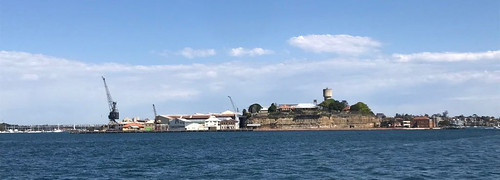
It’s also a fast and pleasant ferry ride from Circular Quay, and the day was hot and sunny. 
And check out those cranes!

Largest of the islands in Sydney Harbour, Cockatoo is a UNESCO World Heritage Site for its association with Australia’s convict history, which began in 1839 when the island was designated a penal establishment. It remained so for 30 years, with convicts first being employed in the construction of their own prisons and guardhouses (#twisttheknife). The island itself, like, it seems,  much of Sydney, is basically a big chunk of sandstone, so once they’d adequately imprisoned themselves they went on to quarry stone for other building projects in the area, including the seawall at Circular Quay.

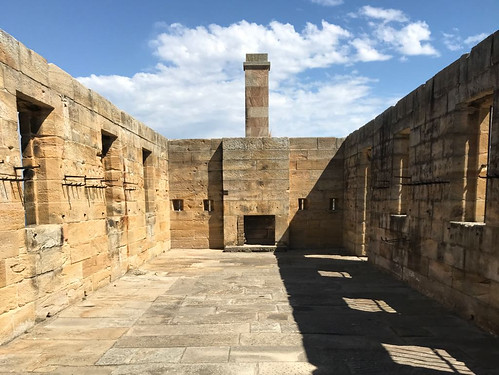
IMG_1437
This is what’s left of one of the convict-built guardhouses. It’s actually much nicer than the cell buildings, with windows to provide some ventilation in the blazing Antipodean heat.

Getting to Cockatoo was easy, and as I mentioned, the weather was gorgeous. There’s also a nice information centre right near the ferry dock where they offer reasonably priced audioguides. Astute Go Stay Work Play Live Readers will recall I love a good audioguide, so I pounced on that and headed to the convict precinct of the island, which is sort of high up in the middle. Happily, the Cockatoo audioguide was quite good (unlike others in my experience - Roman Forum, I'm looking at you) and I liked that I could move at my own pace around the island, following the directions past the island's campsite.

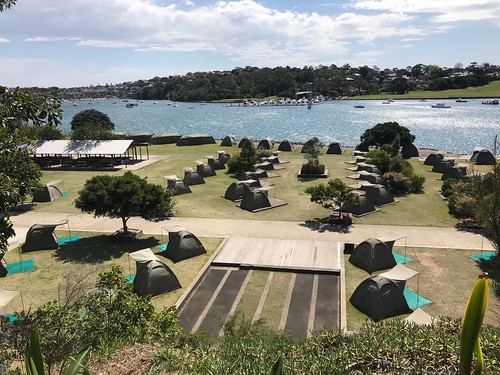
IMG_1444
Bring your own tent, or go glamping in one of the ready-made tents shown here. Or if you really want to splash out, several of the historic building on the island have been converted for short term rental. Apparently it’s really popular for New Year’s Eve, which I hasten to remind readers is in the middle of summer. Summer in January… I swear I’ll never get used to that.

Along with quarrying limestone, the convicts of Cockatoo were set to the construction of Australia’s first dry dock - the Fitzroy Dock - which was built to service the Royal Navy. Not long after the dock was finished, the convicts were moved to the mainland Darlinghurst Jail (or Gaol, if you insist) and the convict cells and related buildings were turned into a reformatory for wayward girls. Around the same time, just offshore, a large, wooden, three-masted sailing ship was anchored and became a home and school for neglected boys. The girls were split between two institutions - one a reform school for those who had broken the law, and one an industrial school intended to operate more like an orphanage. In practise, the two halves intermingled as the girls were all housed in the same dire cells the convicts had recently vacated, drinking from troughs, eating without utensils and sometimes forced to sleep on the flagstone floor as a punishment. The boys, on the other hand, were led by relatively benevolent masters who, while strict, taught them nautical skills, gardening (in a plot on the island), shoe-making and other useful skills. The intent was to reform the boys into useful citizens. The girls, on the other hand, were treated as a lost cause, trained for life as servants, locked in gloomy cells twelve hours each night, and left with little to occupy them. Charming.

There are quite a few of the old stone convict-built building left, including homes for the island governors and other staff. And while the main buildings have been tidied up you can still get a sense of how miserable they must have been, especially in the intense heat of an Australian summer. But convict prisons were not really what I went to Cockatoo Island for, so I was very pleased to head to the industrial side of the island.

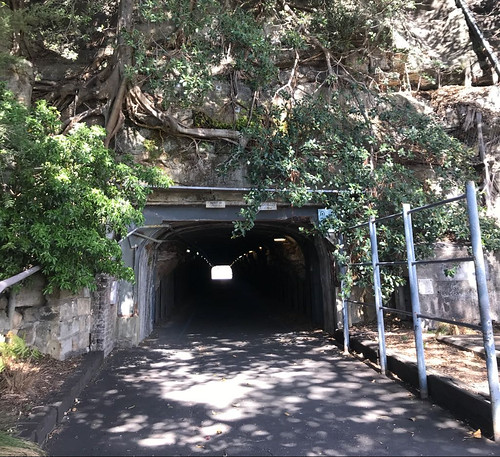
IMG_1445
Which was extra exciting because I got to there through this tunnel carved right through the island!

Even while the reforms schools were still in operation, ship repair and ship building activities  occupied the Fitzroy dock and surrounding area on the lower level of the island while the hapless girls were housed on the higher level of the island and the boys came and went from their ship, The Vernon, moored just offshore. The mix of shipyard workers with neglected boys and downtrodden girls led, inevitably, to some fraternisation, with the mistreated girls often seen as the source of the trouble. This went on until 1880 when the girls were transferred back to shore, though the boys stayed in The Vernon and then later in The Sobraon, until 1911.

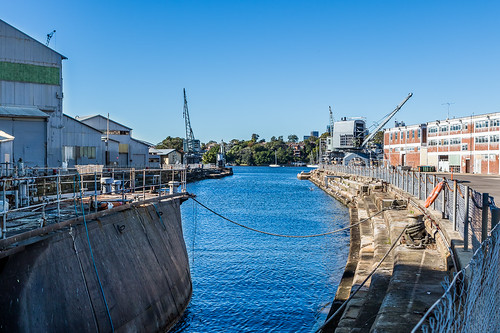
Fitzroy_Dock
Fitzroy Dock as it appears today. (Well, actually as it appears when someone else took a picture, because mine didn't turn out.)

Once the juvenile delinquents finally left, shipyard activities became the sole focus of life on Cockatoo. Sutherland Dock, a second, even larger dry dock was built, and was for a time the largest dry dock in the world. Even before World War One, the island had produced more than 150 vessels - mostly dredges and barges. By 1913 Cockatoo Island was the official dockyard of the Royal Australian Navy. World War Two saw the island become the main ship repair facility in the southwest Pacific, converting commercial vessels for wartime use and repairing Allied ships who limped to its docks after suffering sometimes debilitating damage. After the war Cockatoo was busy converting ships back to civilian use and building new and impressive vessels, like the Empress of Australia. Launched in 1964, it was the largest passenger ferry in the world at the time, travelling between Sydney and Tasmania.

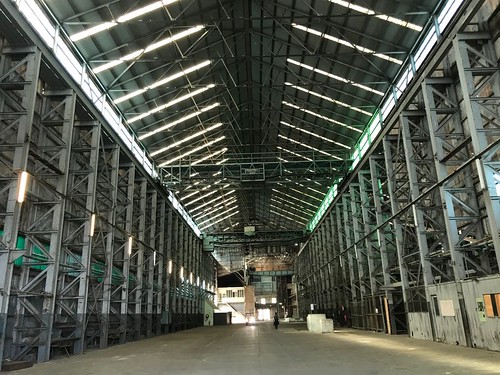
And this is where things got exciting for your humble blogger, because once I’d got through the tunnel, the audioguide turned its attention to the minutiae of ship-building and sent me through sensational, giant, abandoned cathedrals of industry.

IMG_1448
Like this enormous beauty where they did…you know... ship stuff.

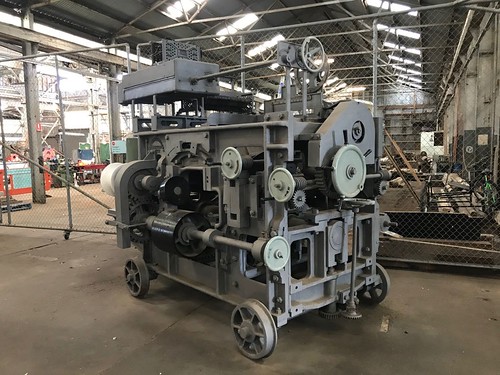
IMG_1453
And I have no idea what this machine does but I LOVE IT. It’s like a set designer said, “Make me something with lots of winding handles and cogs and unexplained bits that could chew up your fingers. And it’s gotta be on wheels. No wait! Rails! Put it on rails!"

It was great. I listened to the audioguide talk about the different stages of shipbuilding, and wandered back and forth among the mostly empty halls. There was a lot of emphasis on telling the stories of the workers, which was absorbing. One of the upper island buildings had an extensive exhibit of old photos - again, mostly about the workers. There were also audio recordings of stories from former Cockatoo Island workers - apprentices, old hands, and union organisers. For a long time Cockatoo Island was a significant force in the Australian labour movement. Immigrant workers from English shipyards brought a strong tradition of trade unionism with them and as early as World War One there were more than 21 different unions representing Cockatoo Island workers, among them "boilermakers, blacksmiths, ship painters and dockers, gas fitters and plumbers, electricians, shipwrights, storemen and packers, timber workers and the biggest group of all, ironworkers.” (From the Cockatoo Island Website.)

IMG_1456
Gratuitous picture inserted for no reason other than that this is a lovely overhead traveling crane. My blog, my rules.

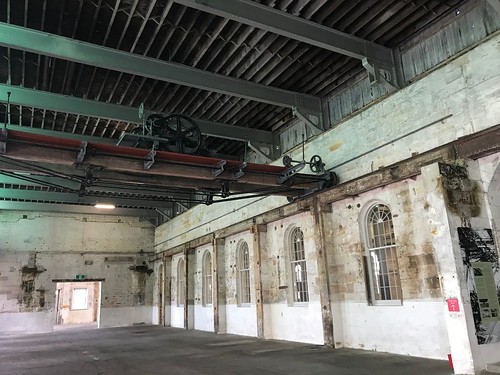
The tour also led through what was called the Mould Loft - the massive upper floor of one of the biggest buildings on site. While the plans for each ship would be created in the large drawing office on the ground level, the Mould Loft was where each piece of the ship - like the giant curved ribs and each steel plate that made up the hull - would be laid out in full scale with absolute accuracy. From that layout, wooden templates were made and sent for manufacture in the island’s workshops. This was the practice until computers arrived to assist in the 1980s.

Sadly, even as early as the mid-1960s, the logistical challenges of running a huge shipyard without rail or road access to ease the flow of materials, along with general decline in manufacturing in Australia, led to the dwindling of Cockatoo as a industrial powerhouse. For a time the shipyard survived largely on a government contract to refit the Australian navy’s submarine fleet, but in 1987 the government announced it would close the shipyard and in 1992 the site was shut, machinery sold off and many buildings demolished.

IMG_1458
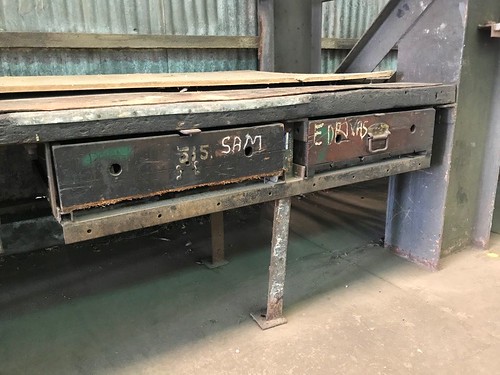
Poor Sam. Out of a job.

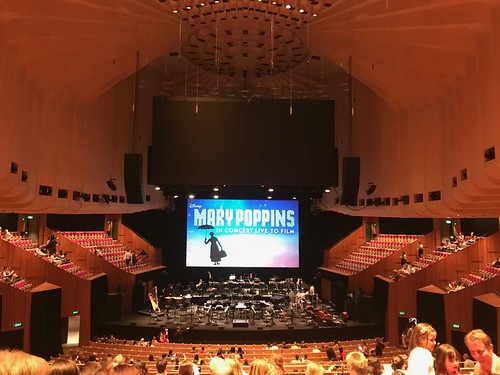
The island was neglected for about a decade until the Sydney Harbour Federation Trust started extensive renovations in 2001, eventually opening to the public in 2007. I was really captivated by Cockatoo Island - it’s presented well, and on the day I went there weren’t a lot of people around despite it being a weekend. I sense it’s not high up on the list for a lot of tourists. I suppose most people who visit Sydney want to tick off the big things like the Opera House and the Rocks and the Botanic Gardens and the ferry to Manly. (For the record - I also did all of those.) Clearly they don't have the discerning tastes of your humble blogger, or lack expert advice. Once I’d finally had my fill of Cockatoo I walked back to the dock through the other tunnel (Because of course there are two.) and caught the next ferry back to the mainland. By the time I made it to the apartment the full day of sun, wind, and giant rusty machinery had me craving a nap. But alas, there was just enough time for a short collapse followed by a shower because that evening I went out for something completely different but also excellent. I went to hear the Sydney Symphony play live to a screening of the original film of Mary Poppins (the one with Julie Andrews and Dick van Dyke and the world's worst Cockney accent). It was at the Sydney Opera House main concert hall.

IMG_1465
You could barely move for the number of 8 year old girls in attendance.  And sure, I love a good rusty bit of industrial machinery, but… Mary Poppins!!!

It was great. I love the movie anyway and seeing in that context, with the live music, was really fun. Plus I got to see the inside of the Opera House and (big bonus) I didn’t have to sit through an opera to do it! And then I had a gelato on the walk home. And when I got there I slept like the dead and took the next day off. There is, however, still more to tell about my Australian adventures, so watch this space.

On top of the bottom of the world

Sunday, September 30, 2018

There is a lot to say about Australia and I thoroughly enjoyed my time there. It turns out I’ve got a bit of a network of Aussie friends, many of whom are surprisingly willing to house me in their spare rooms or buy me dinner or chauffeur me around the country for days on end, which is both humbling and excellent. Now that I think about it, I guess I also may have a gang like that in Athens, and in New York City and probably in a few other places I can’t think of right now. This is one of the many fringe benefits of doing the kind of work I do. You end up with a widely scattered network of people you’ve been through the wars with who will almost always be happy to stand you a few drinks and give you a place to lay your head.

There's lots to say about Australia but for today we will concentrate on an iconic symbol of Sydney in particular and Australia in general, and one which Astute Go Stay Work Play Live Readers will be supremely unsurprised to learn captured my attention quite thoroughly: the Sydney Harbour Bridge!

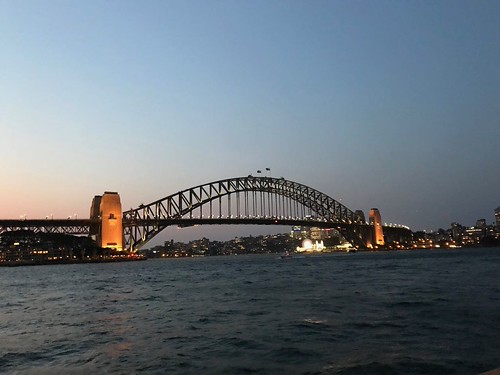
IMG_1385
Here it is in twilight, as seen from the very charming Opera Bar, just across Circular Quay at the foot of the equally iconic Sydney Opera House.

There’s now a fairly extensive back-catalogue of bridge blogs, so truly devoted fans should have a troll through the archives for fond remembrances of the Golden Gate, Tower Bridge, the Rolling Bridge, Iron Bridge and the Clifton Suspension Bridge. Ah, bridges. It’s no secret I’m fond of a bit of mechanical or sturctural engineering in general, but bridges in particular are a firm favourite. In buildings and tunnels the engineering is there but it’s mostly hidden. Bridges are where engineers get to show off. It’s like they're shouting, “Look what we can make because we know how stuff works!”

(Standby for mandatory bridge backstory, because I actually bought a book!)

European settlement of Australia started with the arrival of the First Fleet at Sydney Cove on January 26, 1788, and by the time the last convict ship docked in 1840, Sydney was a thriving community on both the north and south sides of the harbour. The more the city grew, the more inconvenient the 50km trip around the harbour, or across by ferry, became. There were many proposals to link Sydney’s two halves, including a pontoon bridge, tram tunnel and even a earthwork causeway. In 1900 the New South Wales government formally advertised for tenders for the design and construction of a bridge but that project was scrapped after a change in government, despite having attracted twelve submissions over two rounds of tenders. It wasn’t until 1922 that legislation was finally passed to enable construction.

In the interim, an Australian engineer named John Bradfield was named Chief Engineer Metropolitan Railway Construction and Sydney Harbour Bridge. Bradfield spent several years traveling the world studying underground railways and long span bridges at the request of the New South Wales government. (It's like we’re we’re soulmates, Bradfield and I, except the government of New South Wales does not pay me to travel the world blogging about tunnels and bridges. I pay for that myself. However, any and all donations are gratefully accepted.) Bradfield's initial inclinations were towards a cantilever bridge design, but during his travels, he visited the gorgeously arched Hell’s Gate Bridge in New York, and the twice-failed cantilever bridge in Quebec and at the last minute allowed submission of arched bridge designs - mostly, I suspect, because he calculated it would cost £400,000 less.

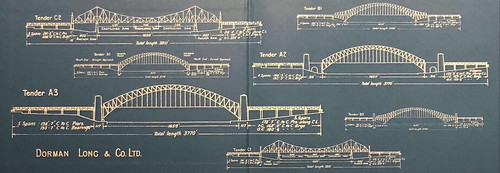
Photo on 23 Sep 2018 at 7_22_13 pm
Tender C1 and C2 are cantilever bridges. The rest are through-arch designs. So-named because the roadway goes through the arch as opposed to passing over it (like this other famous arch bridge).

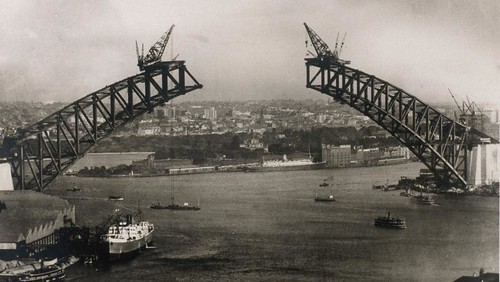
Whatever the reason, the proposal that eventually won out was the now-iconic design from Dorman Long & Co. from Middlesborough in the UK. Construction began in 1923 and the bridge was finally opened to traffic in 1932. Being an arch, the whole enormous load of the bridge itself (the arch alone weighs 39,00 tons) is supported where the bottoms of the arch rest on giant main bearings on the north and south shores. Each bearing is actually a huge hinge that allows for the expansion and contraction of the arch’s steelwork - in high temperatures the overall height can increase by as much as 180mm. Also, the arch itself was cleverly constructed with no supporting falsework underneath! Moving creeper cranes assembled the sections of the arch ahead of themselves, advancing as each was completed. The whole business was prevented from collapsing into the harbour by 128 heavy restraint cables on each side, which were anchored in tunnels in the sandstone.

Under Construction
Once each side of the arch was complete the cables were gradually loosened over the course of three and a half weeks before the two sides eventually met. And you notice how the granite pylon towers at the ends of the bridge aren’t there yet? That’s because they have no structural purpose - they’re simply to give better visual balance to the bridge. Bradfield was apparently fond of quoting John Ruskin on that score: “Life without industry is guilt, and industry without art is brutality.”

But enough of bridge history - even though I could go on for at least three more posts about the bridge and its construction and the 6,000,000 steel rivets that hold it together, and how I find it disturbing that the top chord of the arch doesn’t appear to anchor into anything very much. (Which prompted a short conversation and series of back-of-the-cocktail napkin sketches while sitting at the aforementioned Opera Bar and almost culminated in an email to one of the two different structural engineers I met on this gig, until Nick and I decided we’d pretty much figured it out.) Nope, no more about the history and engineering of the bridge - let’s get on with my up close and personal encounters with the Sydney Harbour Bridge.

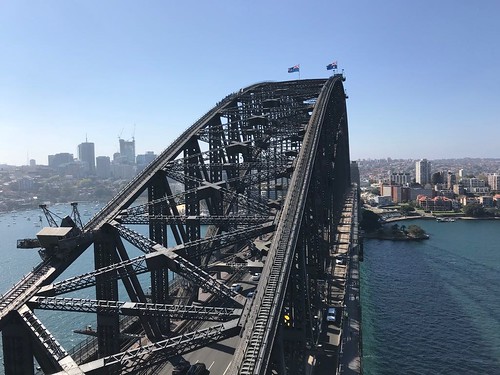
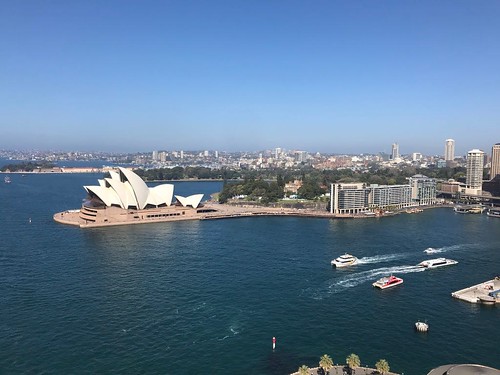
First, I got driven across the bridge, and as a pedestrian I visited the southeast pylon, which now houses a nice little museum and gives you access to the lookout platform at the top of the tower for some pretty impressive views of the harbour.

IMG_1406
Mmmm… steel trusses!

IMG_1407
Yes, the pylon lookout is a pretty good way to appreciate the harbour and the bridge.

But wait, there’s more! It’s also possible to experience the Sydney Harbour Bridge in a particular and unique way: by climbing right over the top! BridgeClimb has been operating since 1998 and allows visitors to climb up through the structure of the bridge and walk along the top of the arch, right to the highest point. This activity was recommended to me by two (very) different people, so despite the hefty price ($303 Australian for the standard three hour experience!) I decided this was a chance not to be missed.

The BridgeClimb did not disappoint. It was a three-hour experience that I prepared for with a proper Aussie breakfast of smashed avocado and poached egg on toast and a flat white (If you think Hackney is a hotbed of smashed avocado on toast, think again. They can’t even hold Sydney’s coat in that department. It’s inescapable. I’m pretty sure if I’d gone to McDonald’s I could have ordered a McAvoSmash.) Unsurprisingly, there’s a fairly extensive health and safety briefing when you first arrive. This is reassuring, since the summit of the bridge is 134m above sea level and takes you over eight active lanes of traffic and a couple of working rail lines. The potential for mayhem is, shall we say, significant.

Everyone in my group of seven was assigned a fetching grey and blue jumpsuit. The colours are designed to blend in with the bridge and be less distracting to motorists, but I predict they will not be appearing on a fashion runway near you anytime soon. We were also instructed to leave everything in pockets behind: no loose change, no mobile phones, no watches, no cameras. Sunglasses were allowed, but they were tethered to the jumpsuits. We were also assigned a waist harness safety belt with a sliding tether line, a fleece jacket in case it got cold, a handkerchief, a yours-to-keep-just-for-playing Sydney Bridge Climb baseball cap, and a radio headset to be able to hear our guide, whose name might have been Brian.

Brian (or was it Brad?) ran us through a sort of BridgeClimb simulator set of stairs, ladders and catwalks that demonstrated how the continuous safety line worked. (I suspect I was the only one in the group who found the rigging of the safety system just a bit fascinating.) Then we were off to clip in and walk along underside of the roadway and up through the southeast pylon before climbing over the arch itself. Even though the elevation gain was large, it was a comfortable climb. We walked over the actual upper chord of the arch, on catwalks laid on top of the steelwork so the incline was fairly gentle. Brian (possibly Bruce) stopped at key points and chatted to us in the way of experienced tour guides - knowledgeable, peppered with well-worn jokes, slightly world-weary, but still charming. He knew a lot about the bridge, and graciously tolerated my unusual fascination with the stainless steel brackets and anchor system for the continuous safety line that runs throughout the catwalk system.

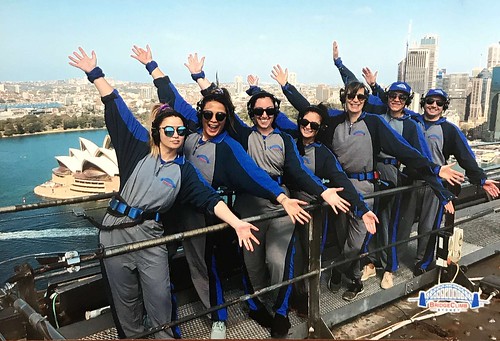
I said no cameras or phones were allowed, but Brian (Brent?) had a special (tethered) camera and we stopped at several points along the way for photo ops. Naturally, BridgeClimb were happy to take more of my money to have a couple of photos provided at the end of the experience, which is why I can show you this:

Bridge Climb Group
Everyone got this cheesy group photo.

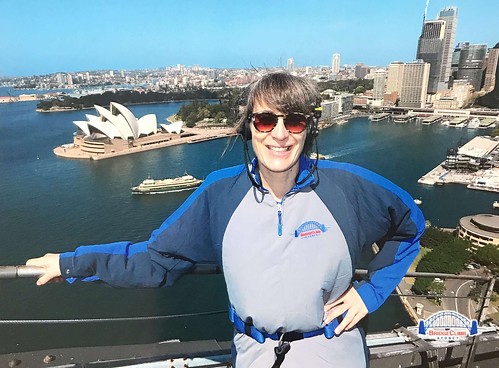
Bridge Climb Top
And here’s me near the top, with Circular Quay and the Opera House in the background. (Can I also add that this photo in the flattering grey jumpsuit makes it look like I’ve eaten at lot more than my fair share of smashed avocado but really it’s just that the jumpsuit was roomy and the wind was at my back. I promise I didn't actually come home from Indonesian looking like the Michelin Man.)

We finally made it to the very top, where there is a very very small platform that occasionally hosts special events like weddings or tiny expensive parties or those annoying segments on local television morning shows.

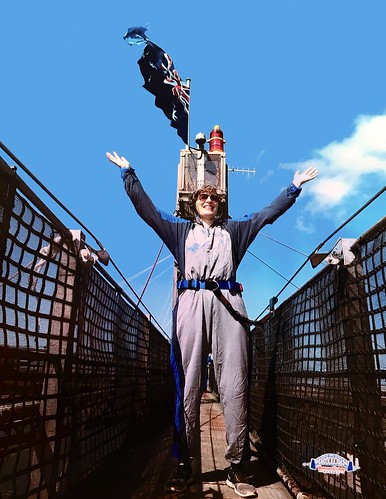
Bridge Climb Flag
One more photo at the summit before the climb down.

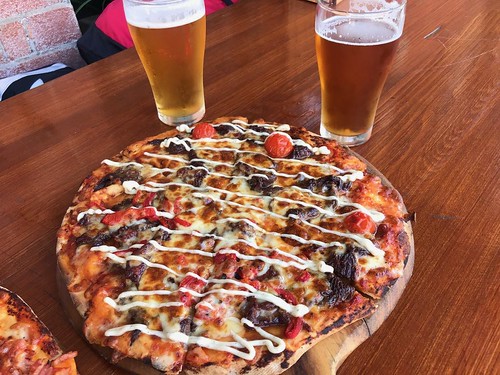
By the time it was all over three hours had elapsed, which coincided neatly with the arrival at a nearby pub of my two hosts for a well-deserved beer and lunch. The Australian Heritage Hotel is another Sydney icon, where I was able to sample the famous Coat of Arms pizza - featuring emu meat on one half and kangaroo meat on the other! This allows me to segue neatly into this fun but utterly unsupported fact I heard somewhere: Australians are the only people that eat both the animals on their coat of arms. Also, it's popularly believed that the reason the kangaroo and the emu are featured on the coat of arms is because neither animal can go backwards, which is supposed to be a metaphor for something noble, though of course if a kangaroo or an emu wants to retreat from something clearly all they need to do is turn around and run away like everything else on the planet.

IMG_1395
Good pizza. Though as with most exotic meat, it didn’t really have a distinctive flavour. I am, however, happy to say it didn’t really taste like chicken.

I was feeling pretty smug about my Australia experience by this point - climbed iconic bridge, ate iconic animals, had a nice beer - tick, tick, tick. That was to become the theme for my visit, as you’ll learn in weeks to come. So stay tuned for more kangaroos and associated odd animals, more engineering, more smashed avocado, a surfeit of ridiculously beautiful beaches, and an evening that turned out to be so quintessentially Australian it may as well have been scripted. Advance, Australia Fair!

One app to rule them all

Sunday, September 16, 2018

Hey, it’s been a while! Almost four months, I guess. I’ll admit I didn’t plan to pack in the blogging quite as early as I did on this job but sometimes life gets away from you. For those of you who need a reminder I was in Jakarta, Indonesia for six months working on the Opening and Closing Ceremonies for the Asian Games. In the end it all went pretty well. Opening especially was a triumph, despite a few hiccups backstage that were exhilarating/terrifying at the time and now make for great stories to dine out on. The next time I see you, buy me a beer and I’ll tell you about the Oman flag. Oh, and the torches… you gotta hear about the torches. (For the truly dedicated and Astute Go Stay Work Play Live Reader, here's the official ceremony video, complete with loud and incessant commentary in Bahasa.)

And now it’s all over again. Every prop has been photographed and catalogued and swathed in bubblewrap. The Parties have been had. The farewell dinners have been eaten.

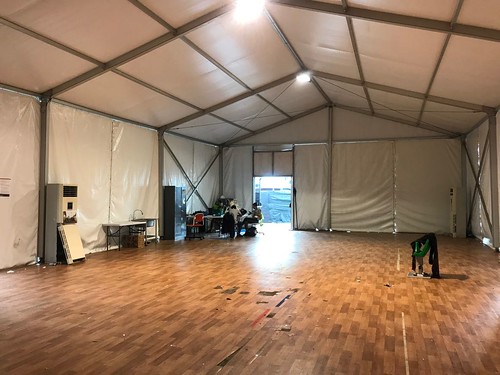
IMG_1248
The Props Tent that was once so packed with rolling carts of miscellaneous objects it was difficult to move around looked like this when I finally handed back the keys.

We’re finished a bit earlier than expected so I had a couple days to shop for souvenirs and sort through my apartment and pack before going for two weeks of vacation in Sydney, Australia! I’m actually there now, comfortably ensconced in the central Sydney guest room of a couple of welcoming and generous friends. This is super exciting and I’m enjoying it very much. Now though, with Indonesia fading in the rear view mirror, there’s one thing I’ve just got to tell you about before putting Indonesia to bed, blog-ically speaking: the magic of Go-Jek.

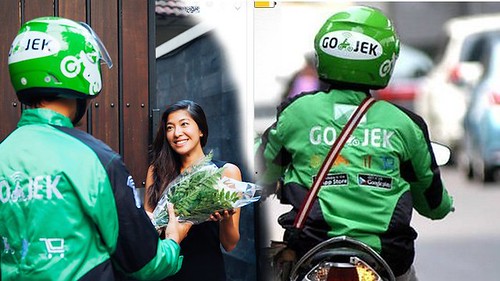
In Indonesia, “ojek” is the word for a motorcycle taxi. It’s a simple concept: you hop on behind a guy on a motorcycle and, for a small fee, he takes you where you’re going. Go-Jek is the 21st century app-based upgrade to the traditional ojek experience and it is simply brilliant. At its heart, Go-Jek is an easy way to order a motorcycle taxi without having to haggle about price or explain where you’re going. It’s the Indonesian equivalent of Uber - a simple but effective ride hailing service. It started in 2010 with 20 drivers and now has more than one million. That’s one million DRIVERS. Not one million users. One million Go-Jek drivers.

Go Jek Driver
The drivers all wear this iconic green jacket, and they all carry a spare green helmet for the passenger.

Getting around by Go-Jek is much much faster than taking a taxi in Jakarta traffic. Motorcycles can weave in and out of the lanes of jammed traffic saving a lot of time. It’s also incredibly cheap. Even a proper taxi is cheap - usually the fare from hotel to stadium was about 20,000 rupiah, roughly £1. For the same ride on a Go-Jek I think you’d pay around 8,000. 40 pence. Sure, you end up breathing in a lot more toxic exhaust fumes than if you were in a car (or probably if you were walking along the sidewalk, if there actually was a sidewalk). And of course even in a more docile environment, motorcycles are just generally dangerous, let alone riding pillion on a motorcycle in the overcrowded and somewhat haphazard nature of vehicular traffic in Jakarta.

There’s also almost always a problem with actually finding your Go-jek once they arrive to pick you up. As with Uber, the app shows you a little map with your location and the location of your driver, which should, in theory, make it simple and easy to find your guy. In reality, both positions on the map are a bit approximate, which usually results in some frustrated wandering around and very often a phone call from the driver in which he’ll speak at length in Bahasa trying to explain where he is, which is irritating and unhelpful. The few times I used a Go-Jek I often had to simply hand my phone to a local colleague, or a security guard at the hotel so that they could explain what was happening, which almost always involved the word “bule” (BOO-lay, meaning Western foreigner.) Nonetheless once you actually connect with your driver, Go-Jek is a handy way of getting around, especially for short trips.

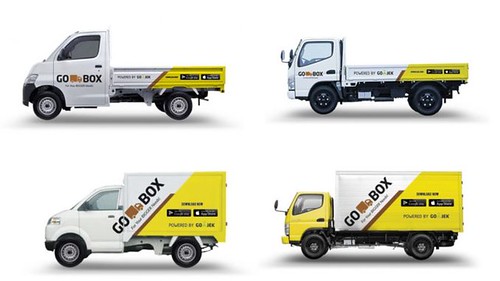
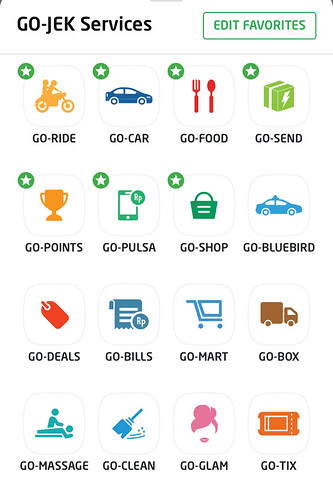
But the brilliance of Go-Jek doesn’t stop there. Oh no. You can also get a Go-Car, which is exactly what it sounds like. You can now even order a Bluebird Taxi - a car from a rival company - through the Go-Jek app. But wait, what if you don’t want to move yourself, but an object? No problem! Go-Jek has you covered. It it’s a small item, you can have it delivered by a Go-Jek driver acting as a courier using Go-Send, also through the app. And what if you need to move a couch? Or a dining room table? Or, say, three truckloads of rehearsal props? (Or is that just me?) Go-Jek has you covered. Simply order a Go-Box, in one of 4 convenient sizes.

Go-Box
In practice, you rarely see a liveried Go-Box truck. Usually they’re pretty beaten-up and generic, open topped flatbeds with high sides. But useful. Very, very useful.

But wait… there’s more! Go-Send has a natural and very useful cousin - Go-Food! Like other food-delivery apps out there, you get a choice of restaurants, order what you want on the app, and it comes. However, where Go-Jek differs is in how the orders are placed and processed. With Deliveroo, Uber Eats and other Western-based apps like that, the order gets sent directly to the restaurant. Not so with Go-Jek. Here’s what happened when, one exceptionally lazy morning, I ordered two coffees and two almond croissants from a nearby Starbucks, using Go-Food:

1. The order was placed in the app and assigned to a driver.
2. The driver physically went to the Starbucks I chose and placed the order at the counter.
3. The driver paid for the order out of his own pocket.
4. The driver waited at the Starbucks while the order was being filled.
5. When the order was filled he brought the coffee and croissants to the office.

IMG_8722
Embarrassingly, the Starbucks in question was approximately a 4 minute walk away. But, you know, it was like TWENTY FOUR FLOORS down from the office and then ALL THE WAY TO THE MALL and then TWENTY FOUR FLOORS back up. I didn't have time for that! We had a ceremony to put on!

It’s not unusual to see Go-Jek drivers in their iconic green jackets hanging around at restaurants waiting for orders. Sometimes there are a few at the same place, and some restaurants even designate a place for them to wait. And in the end, it probably would have been quicker to walk to Starbucks and back because when using Go-Food - like when trying to find your Go-Jek motorcycle - there’s almost always a series of texts or phonecalls with the driver, though in this case it’s partly because he wants to make sure you’re the real deal before he forks out his own money for your Grande Vanilla Sweet Cream Iced Latte. However, this too can be mitigated through another Go-Jek service: Go-Pay!

Go-Pay is a digital payment system that you top up (with your Indonesian bank card) and use for any Go-Jek service, meaning payment for your Go-Food order is guaranteed and the poor driver isn't taking on any risk by paying for your lunch. You can can also top up by giving cash to a Go-Jek driver who’ll credit your account. Importantly, you can also transfer Go-Pay credit to other app users so it’s become a kind of default e-wallet for a lot of people. This means that if you’re a bule without an Indonesian bank account but with local staff you can give cash to one of your local kids and they do something with their phones and then you have Go-Pay credit. (This system also works when you need mobile phone credit!) (Or you can use Go-Pay to get mobile phone credit using Go-Pulsa. Of course.)

What else can you do with the Go-Jek app? Well, you can get your grocery shopping delivered through Go-Mart, or buy other items through Go-Shop. Pay your bills through Go-Bills, get tickets for events from Go-Tix, or get medicine delivered by Go-Med. Get you car washed or maintained with Go-Auto and your home cleaned with Go-Clean.

App Choices
All in one app


Go-Glam-Manicure-Salon-Jakarta
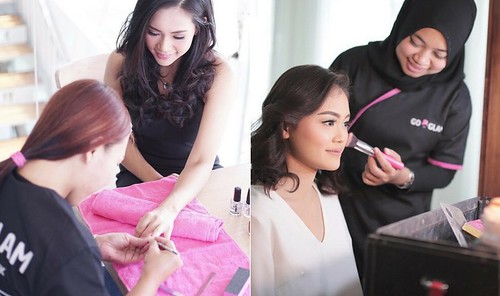
And then kick back with a relaxing Go-Massage in the comfort of your home. And have your hair and nails done at the same time by Go-Glam. I’m not kidding. Those are all real things. With Go-Glam someone shows up with a kit of tools (probably having arrived on a Go-Jek) and gives you a manicure in your own home.

As you might imagine, this whole Go-Jek universe was a remarkable discovery for me. It’s also completely infiltrated life in Jakarta. I’m truly not sure how we’d have managed those ceremonies without it. On other gigs I’ve had a full-time driver/runner with a van. No need for that in Jakarta when you can just Go-Send or Go-Box something. And I can’t count how often I called out from my desk to one of my lovely local staff and said something like, “Misha! We need another 1,000 tiny cable ties! Can you do that thing with your phone and make there be cable ties?” And then an hour or two later cable ties would appear (or tape or charcoal or fishing reels or turpentine or tubes of acrylic paint or wood chips or… whatever) and Misha would screenshot the receipts and WhatsApp it to me and I would give him pettycash to cover the cost and we’d get on with things. It’s very easy to become totally dependent on the Go-Jek universe, and it’s hard to overstate how thoroughly it seems to have become part of life.
Screen Shot 2018-09-16 at 12.22.28 pm
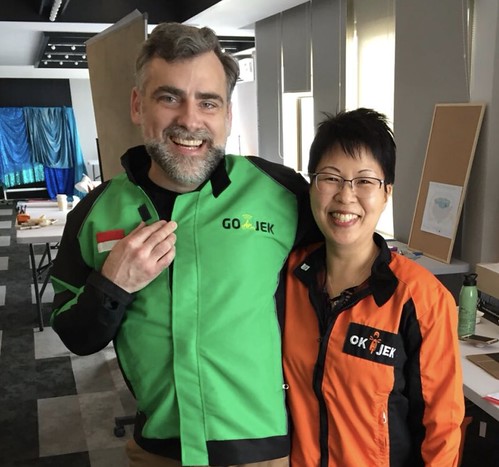
You can even buy a genuine Go-Jek driver's jacket online and have it delivered by a Go-Jek driver, which is, as the kids say, totally meta. This is Nathan modelling his Go-Jek jacket and Anne showing off her much rarer Ok-Jek jacket. (Ok-Jek is a sit-com on Indonesian TV about the lives of online motorcycle taxi drivers and staff in the fictional Ok-Jek office. You need connections to get one of those!)

As usual, there's a lot more I could tell you about life in Jakarta. Like batik -  there's so much to say about that ancient and beautiful art form - like how every Friday is Batik Friday! Just like Casual Friday in offices in the West, but in Indonesia you wear a batik shirt on Fridays. And like about how when you get served in a traditional Indonesian restaurant you get a fork and a spoon but no knife. And why, the whole time I was in Indonesia did I never find a pencil harder than 2B? And why, in a city where the temperature is normally 33 degrees and humid, did the mall next door have two stores selling down-filled winter jackets? And what is the fascination with "salted egg (yolk)" flavour? And why does everyone walk so slowly? And why are there A&Ws in Jakarta, but if you go there you can't actually get onion rings or a Teen Burger but you can get a fried egg (salted I'm sure) on top of your side of steamed rice?

Yes, there's a lot to say about Indonesia but frankly, I'm pretty much done. It was a long and difficult six months and Jakarta is a hard place to live. The climate, the traffic, the pollution and the chaotic, jumbled and haphazard streets made it a place to be endured rather than enjoyed. That city is tough and I'm ready to be home on my little boat, but not without telling you a few of the amazing things I've been up to here in Sydney, which is many of the things Jakarta is not: clean, open, ordered, temperate, walkable and beautiful.

Then again, the city may not be easy, but the people were amazing.

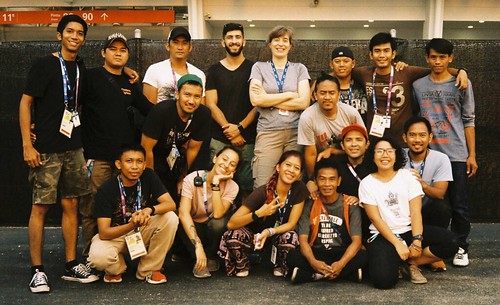
The Team
For now I'll just be grateful to these lovely people for getting us through some very long days and for smiling the whole time. Thank you Props People!

Random thoughts on Indonesia

Sunday, May 27, 2018

I’m still not really succeeding at being a tourist in Jakarta, and time’s a-wastin’. I’m clinging desperately to five-day work weeks, but that’s only going to last until rehearsals start in earnest and it’ll be time to put my head down and not look up until September. Until then I should really be taking advantage of my weekends to do Things. Colleagues are known to bring a carryon bag to the office on Friday and go straight from their desks to the airport to visit Bali or Yogyakarta or go diving or see Komodo Dragons or something. Maybe this is a sign that the novelty of this sort of work is wearing off for me - the fact that all I really want to do on a weekend is sleep in, make myself a nice breakfast, relax in air-conditioned comfort and maybe sit in a quiet coffee shop with the crossword. Still even with that agenda, there are things I can tell you about because everyday life continues and sometimes it’s different or notable or just plain weird.

On the freelance nature of traffic control:

I may have mentioned before that traffic in Jakarta is a problem. In fact, it's simply an inescapable fact of life. There are too many cars on the road, which, added to a seemingly infinite number of motorcycles that fill any gap like an angry swarm of insects, added to a somewhat approximate sense of the rules of the road mean that something as simple as turning or parking can become a real challenge.

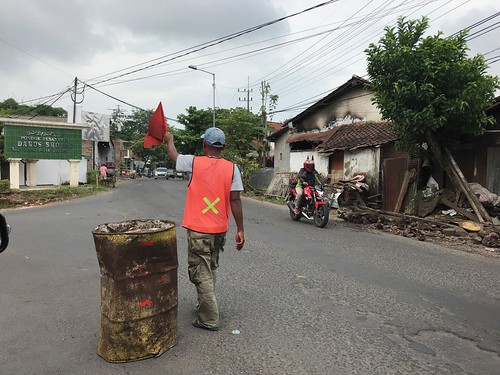
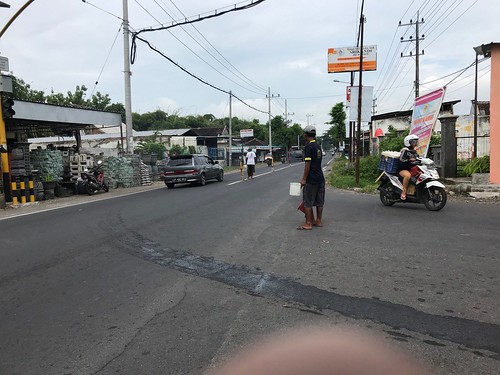
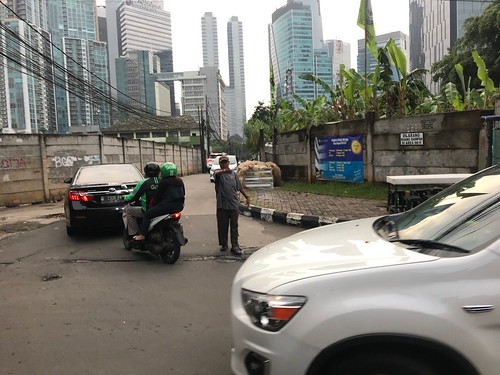
Here’s where the entrepreneurial spirit emerges in the form of the freelance traffic warden. Known locally as “Coin Police” or “Parking Masters” these are men who stand at intersections or turning points or parking spots and direct traffic. Note that I’m not talking about actual uniformed municipal police here. Those also exist in a small number of places, but the freelance guys are much more common.

Here’s how it works. Your car approaches an intersection - often this is a designated place for a u-turn, which are a very common here. Standing in the road, among the moving vehicles, will be a guy who’s basically putting this body between you and the oncoming cars to help you filter into the flow of traffic. He waves his arms and holds up a hand to try and stop or slow the cars enough that you can merge. Sometimes it works, sometimes he gets ignored. He does this for tips, usually between 2,000 and 5,000 rupiah, which is between 10 and 30 pence. So if you're inclined, you roll down the window and slip the guy a bit of cash as you roll past.

IMG_7934
This is an exceptionally well-equipped guy in Jember, complete with hi-vis vest and flag. His corner was pretty slow, making me wonder how this line of work could ever pay off, especially with the overhead of flag and vest to consider.

IMG_7937
Here’s another guy in Jember, who’s even got a bucket for collecting his money. Again, this is a very tame intersection. In Jakarta it’s a much more hectic scene.

The Coin Police also work a parking angle, where they’ll stop traffic to allow you to turn into a spot or help you exit and merge back into traffic. The parking guys also get some money for the actual "rental" of the parking spot. I assume it’s entirely unregulated and simply a case of one guy having a “patch” he works by general agreement, but who knows? Maybe there’s a central ministry that assigns dominion over parking spots on a fair rota. (Sure…)

I find the whole thing alternately charming and terrifying. But I do have a soft spot for the guys who works one particular intersection that’s on my morning 5k running route.

IMG_7617
Here’s my guy!

Recently on morning runs I’ve been packing 1,000 rupiah in coins and giving it to the guy at this intersection as I run past. I figure anything I can do to help cross smoothly and easily is worth it. However, this is highly unusual or perhaps even unprecedented. I told some local colleagues about my habit and they found it utterly hilarious that I would tip the coin police as a pedestrian. But I find it fun to think about this guy going home at the end of a shift and telling his buddies about the crazy giant foreign woman who tips him when she runs past. I’m going to make an impression anyways, so why not?

On the horrors of the food court:

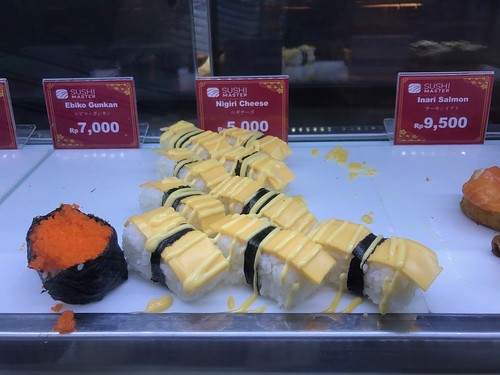
I know I talked about inappropriate cheese already but I really can’t let this particular nugget go without a special mention. The food hall in the big mall next door has a lot of odd offerings that I’ve yet to tell you about. For instance, there’s the Cheese Tea (Actual slogan: “Where cake meets cheese. Yum!”) and there’s the Pizza Cones (Actually overheard: “The macaroni was… unexpected”) and squid balls and… well I could go on and on. Recently a cheap-and-cheerful takeaway sushi place has popped up and I’ve taken advantage on a couple nights when I couldn’t be bothered to cook. It’s definitely on the low-rent end of the sushi spectrum, but even so, I was shocked and appalled to see this on offer.
IMG_8634
This is exactly what is looks like. Half a processed cheese slice on top of sushi rice, drizzled with yet more plastic cheese, this time in liquid form. For the love of all that is holy people… how can this actually be a thing? Words fail me.

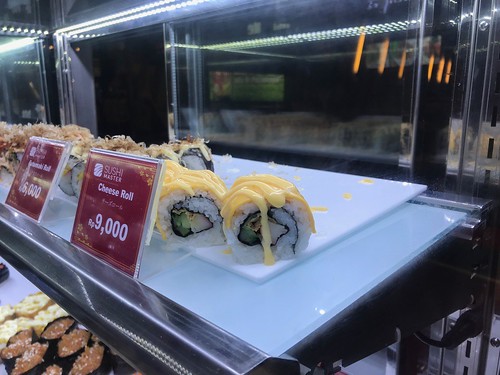
IMG_8633
And it doesn’t stop there, because you can get the same thing in a roll! Please Indonesia! Please stop! And Japan… where’s the quality control here? This is your thing. Surely you should have some kind of monitoring system in place to prevent these kind of atrocities.


On the holy month of Ramadan:

And finally, Ramadan Mubarek! Ramadan is the ninth month of the Islamic calendar and is set aside as a period of fasting and increased piety for Muslims. Observance of Ramadan is considered one of the Five Pillars of Islam and this is the first time I’ve been in a really religious Muslim country during the holy month. (Azerbaijan is a much more secular place so there was little impact on day to day life.) The chief feature of Ramadan is the fast, which is observed during daylight hours, meaning that no food or drink is consumed between sunrise and sunset (and yes that includes water, which in a country with a climate like this must be particularly challenging). Fasting is mandatory for all adult Muslims (with a few exceptions). The term sawm is used to refer to fasting but it translates more literally as “refrain” which encompasses a more general abstinence from more than just food and drink, but also smoking, sex, impure thoughts and evil deeds.

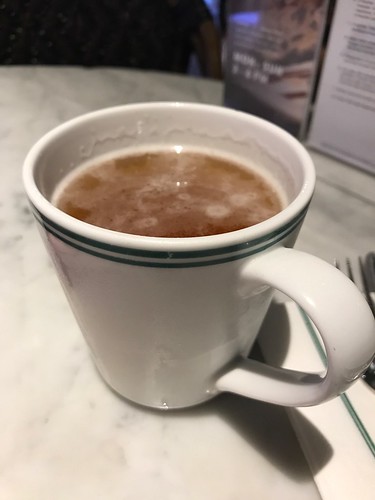
My first inkling that things would be a bit different during Ramadan was when I went for dinner and ordered a beer to accompany my meal. It was after sunset, but even so the waiter informed me that because it’s Ramadan, they serve beer in a coffee mug. Because… I don’t really know. I guess because everyone is trying to be more devout so they want to conceal the fact that alcohol is being drunk. Also, some local restaurants in the area that have outdoor patios put up curtains between the patio and the street during the day. I suppose this is to shield those fasting from seeing those who aren’t.

54825365254__45C845A3-1547-4D49-9CD3-1DD326F057B4
Mmmmm... mug o' beer!

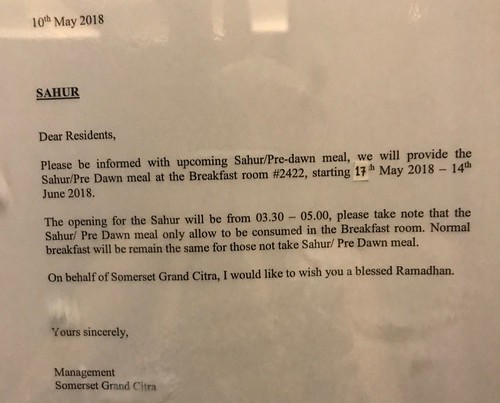
Also, a notice appeared last week at the hotel informing us that a special breakfast buffet would be available from 3:30am to 5:30am for sahur - the pre-fast morning meal.

IMG_8898
That little sticker correcting the start date is probably because the start of Ramadan is based on visual sighting of the crescent moon so can only be estimated until it actually happens.

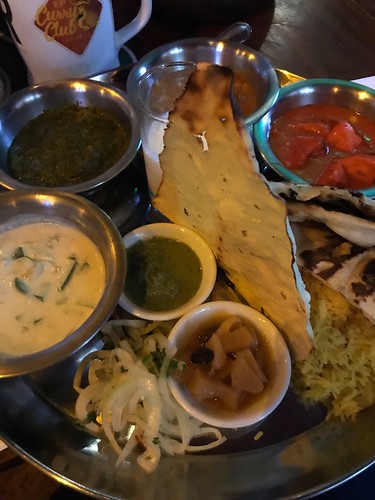
More significant though, is breaking the fast at sunset, called iftar in arabic, but known in Indonesia as buku puasa. Apparently it’s traditional to break the fast first by eating an odd number of dates. So when I and some colleagues went out to watch the royal wedding at a local ex-pat bar and had beer and curry, they brought us a little plate of dates first (because I’d ordered the special “break your fast” thali tray, also thankfully available to the non-observant).

(Aside - and at that moment I was struck once again with how odd my life is sometimes. Sitting in a quasi-Irish pub in Jakarta with American, Irish and Australian colleagues, eating a buku puasa of curry and watching an English prince marry an American actress. It reminded me of a dinner not so long ago in a Georgian restaurant in Azerbaijan when my companions were Greek and Australian and we watched a Russian news network’s coverage of Donald Trump being sworn in. I guess if they gave out points for cross-cultural-ness I’d have a pretty healthy balance.)

IMG_8878
And cheers to a good thali tray! Not quite up to the level of Adam’s Curry in Baku, but we take what we can get.

Anyway, back to Ramadan. There hasn’t been much change to the routine in the office. However many of the local staff are fasting so us infidels have been asked to eat our lunches and drink our coffee in a spare meeting room instead of stuffing our faces in front of our more devout colleagues. Ramadan lasts for a lunar month, so this will continue until mid June when there’s a big holiday - the most important of the year. Edul Fitri, also known as Lebaran in Indonesia, is the feast of fast-breaking. It’s the rough cultural analogue to Christmas in Western culture, not because of any religious equivalence, but simply because it’s the longest holiday of the year and the one where most people travel home. This means all our local staff have about a week off and much of the normal activity in the country will shut down while people celebrate with friends and family. I'll be taking advantage of this lull in activity to sneak in a week’s vacation before the real madness starts, at a location that promises to be highly blog-worthy, as long as I can find the time to write about it.

And that's all I've got for you this week. I think I've got one or two posts left in me before I abandon the blog again until the end of this job, so enjoy it while it lasts. In the mean time I'm off to the mall for a snack that definitely will not include processed cheese slices. 

On the difficulty of being a tourist in Jakarta

Sunday, May 13, 2018

I really did try. I had a recent Sunday off from work and I was determined not to just hang around at home or do another lap of the nearby mall, which is like the second home for all of us on this gig. It’s about a three minute walk away and has air conditioning, coffee shops, food markets, restaurants, movie theatres and all the other trappings of a normal western mall. But I wanted to break out and see a bit more of Jakarta. Because that’s what we do here at Go Stay Work Play Live. It’s kind of the what it says on the tin.

So I busted out the trusty Lonely Planet and looked up the top sights for Jakarta and decided on a trip to Kota. Billed by the blue bible as "the hub of Dutch colonial Indonesia", it sounded promising:
“Despite its nooks of fun and culture, to the uninitiated Jakarta can feel overwhelming and its gifts inaccessible. Kota is where they are easy to find.”
Erm. Sure. First, it took about 45 minutes in a taxi to get from the hotel to Taman Fatahillah, the central square. Because even though it was Sunday the traffic was still not easy and the distance was still not short. I’ll also admit that I made a tactical error in hanging around the hotel for the morning, because by the time I got to Kota it was early afternoon and the temperature was somewhere between scorching and surface-of-the-sun. It was about right for making a tuna melt on the cobblestones.

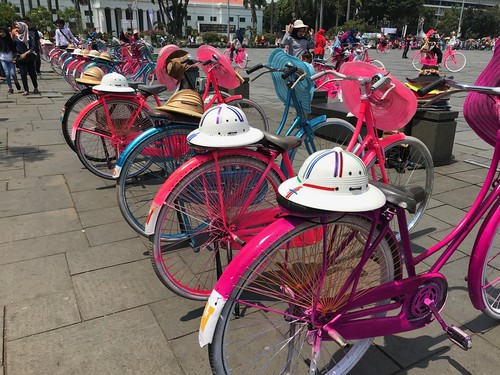
The square itself is large, and surrounded by big old crumbly colonial buildings which have definitely seen better days. Mostly the central area was empty with people huddled in the small scraps of shade around the edges. Or at least most of them were. Some people were riding neon painted bicycles aimlessly/shakily around the square.

IMG_8552
I didn’t get the story with these bikes. I guess you rent them? Plus it seems along with the use of the bike, you got to wear the floppy hat or the pith helmet, so that’s fun.

There are a few museums around the Taman Fatahillah, including the Museum Bank Indonesia which gets a reasonable nod from the LP, and the Jakarta History Museum, which was described as “a poorly presented museum of peeling plasterwork and lots of heavy, carved ebony and teak furniture from the Dutch Colonial period.” I plumped for the third option - the plucky Puppet Museum - which celebrates Indonesia’s long history of wayang or shadow puppets. It was housed in another big old colonial building dating from 1912 and somewhat kack-handedly converted into the museum. However, admission was a mere 5000 rupiah (25 pence) and it was out of the sun and even had one or two air-conditioned rooms, so I was happy to give it a chance.

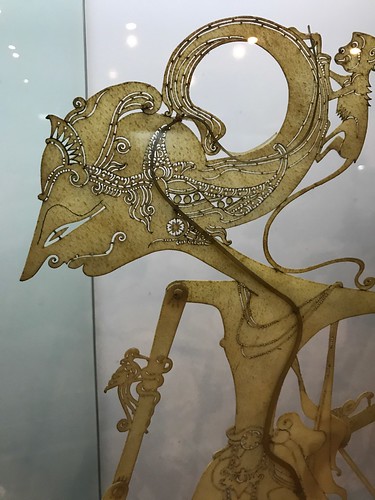
Wayang is the Indonesia word for puppet, and wayang kulit is the particularly Javanese style where the puppets are flat articulated pieces made from buffalo leather and controlled by rods. (Kulit means skin or leather.) There’s also a style called wayang golek where the puppets are three-dimensional. In 2003 Indonesia’s tradition of wayang was designated by UNESCO as one of the Masterpieces of the Oral and Intangible Heritage of Humanity, though apparently traditional shows are on the decline and it’s harder for the master puppeteers (dalang) to find young people to take up the art form.

The puppets themselves are incredibly intricate and sometimes even painted, though mostly they never appear in front of the curtain (they are shadow puppets, after all).

IMG_8550
See how intricate they are? This one isn’t painted but the cutout detail is incredible, especially considering this whole piece is only about a foot and a half high. The curving spine that curls up behind the head is always shaped like that and is made from buffalo horn.

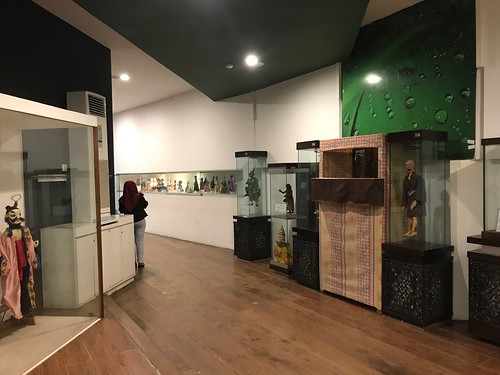
I missed the weekly 10am Sunday wayang performance, so had to just cruise the display cases and try to interpret the slightly garbled and opaque English translations that appeared intermittently. All in all it was a bit sad and faded, which turned out to be the basic theme of the day.

IMG_8547
It all just felt sort of thrown together and unloved.

After the puppet museum I poked around outside a bit but there was very little happening. There were a few small vendors selling trinkets or street food and there were a few horse-draw carts you could hire for a ride around the area. And there was the equivalent of the street near Covent Garden where all the living statues hang out. Mostly, though, it felt like the big buildings were abandoned or at least very underused, or possibly turning to compost. Eventually I ended up at Cafe Batavia, a historic restaurant that overlooks one corner of the square where I gratefully retreated for an air-conditioned break, which was the most pleasant part of the day.

IMG_8554
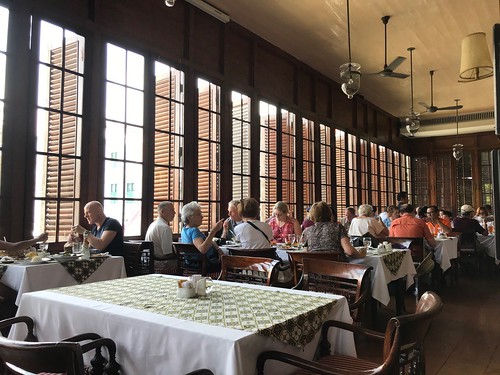
The large shuttered windows look down onto the square. Though the cafe only opened in 1993, the building started life as an administrative office of the Dutch East India Company, and they’ve definitely tapped into that colonial vibe. I had some nice steamed dumplings and a very refreshing glass of fresh watermelon juice while underpaid servants fanned me with giant banana leaves and I commented loudly about how hard it is to get good help these days. Trying to keep in the spirit of the place, you know?

After lunch I decided to try and see the other notable site of the area, Kali Besar, the canal that was once a trading hub in the VOC era. (VOC is the Dutch acronym for the Dutch East India Company). I figured it’s a canal, so I really had to check it out, right? The LP promised it was lined with once-grand homes of the wealthy and featured the last remaining Dutch drawbridge, endearingly called the Chicken Market Bridge. So even though I was sweaty and uncomfortable 1.7 seconds after leaving Cafe Batavia, I schlepped my way to the canal.

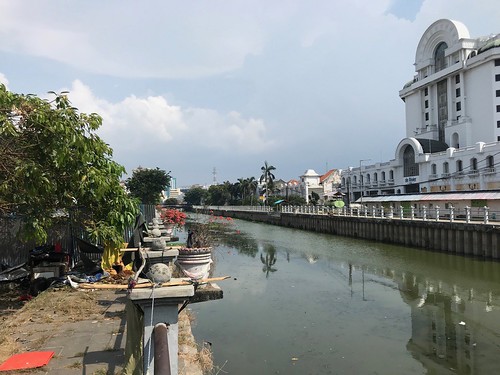
IMG_8561
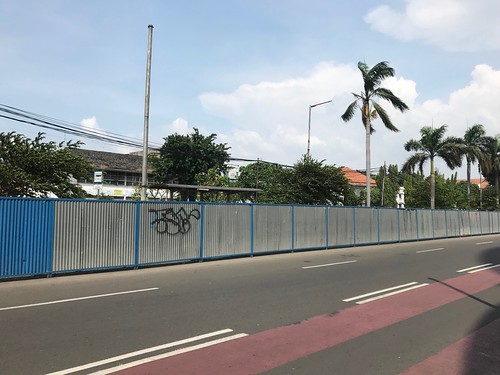
It’s gorgeous. Or at least it might be gorgeous, though it’s impossible to tell because the whole thing is shrouded in solid steel fencing. I think there is some kind of refurbishment going on, probably linked to the Asian Games.

IMG_8566
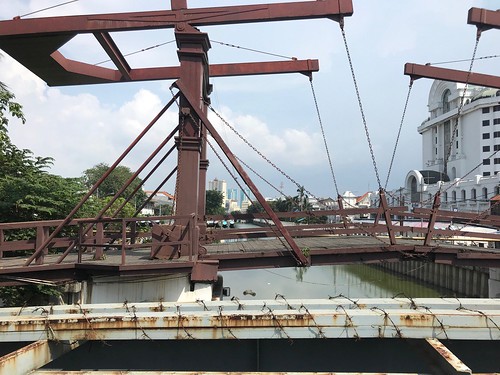
I did eventually find the Chicken Market Bridge, though it too was unaccessible. This shot was taken from a nearby traffic bridge.

IMG_8567
I did finally get access to the waterside in an area where the fencing hadn’t reached. You can see there’s great potential.

And that's really the overwhelming impression of the area - one of unrealised potential. In a place with more money the whole neighbourhood would already have been intensely redeveloped and be teeming with cafes and boutique hotels and gelato bars and places selling handmade batik and fridge magnets. And the plucky puppet theatre would be clean and brightly lit with impeccably curated displays and running shows on the half hour.

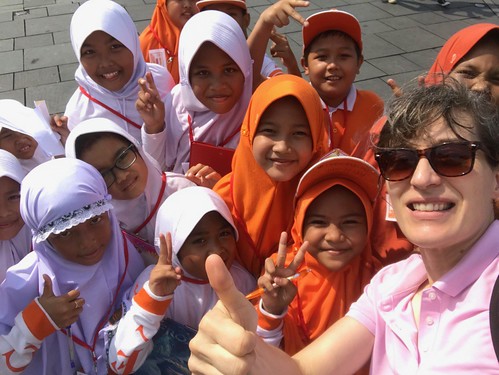
By the time I’d seen what there was to see of the canal I was utterly done. I know I go on about it but the heat and humidity here really is ridiculous and draining. So by the time I’d made it back to the square to try and find a taxi I was pretty fed up. That’s when I got stopped by an entire class of kids and their teachers who were all there to practice their English with the foreigners visiting the square. (This had actually happened early in my visit too, though those kids came as single spies and not in battalions.) So I stopped in the middle of the square in the blazing sun surrounded by a horde of 10-year-olds on a mission. And I waited while their teachers urged them forward and each one approached with their clip board and shyly asked me one of four stock questions. And then I signed each of their papers while unsuccessfully trying not to drip sweat on them and wondered how they could actually be wearing jackets while nearby a stray dog spontaneously combusted.

IMG_8571
And then I took a selfie, of course.

So even though I was drenched and deflated and kind of bummed out by the day, those kids gave me the boost I needed to find a main street and call a taxi and slump gratefully in the air conditioned back seat while the driver tried and failed to find the fastest route back to the hotel. And when I eventually did made it back I took what I think was a well-earned nap. I suppose I may need to give Kota another chance one day. Maybe when it's cloudy and I can find someone to follow me around fanning me with a giant banana leaf while simultaneously spritzing me with chilled mineral water and carrying my drink.

GRUB!: Inappropriate Cheese

Sunday, April 29, 2018

It’s about time I told you about some Indonesian grub. There has been no shortage of odd and notable food in my life since I arrived, but today I thought I’d focus on one particular thing that’s cropped in a few different places: Cheese.

Asia in general is not a hugely cheesy place. In fact, cheese is notably absent from basically all East Asian cuisine. This is partly cultural (Ha! Cheese… culture…see what I did there?) and partly because a large percentage of East Asian people are lactose intolerant, though really the two feed into each other. Whatever the case, the cheese selection in my local Ranch Market runs heavily to processed stuff, maybe because of the growing influence of Western fast food. I have managed to find two worthwhile offerings in the harder, more pungent end of the cheese spectrum, but all in all it’s not exactly a cheese party here. (Also wine is so heavily taxed that it’s basically out of the question to buy it for casual consumption. A bottle of wine that I’d expect to pay £10 for at home would be about £50 here. So a wine and cheese party? Definitely not happening.)

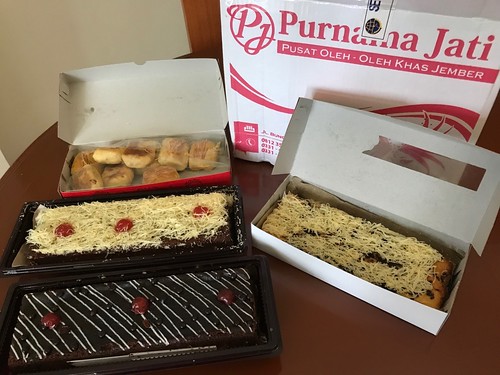
Then again, you do run into cheese in some unusual places. Back on Carefree Day in Jember our local hosts presented me and my colleagues with large boxes of packaged local cakes to bring back to Jakarta with us. This was a lovely gesture, expect that the airline forced us to check our cake boxes (???) so we ended up having to hang around at the luggage carousel even though we’d cleverly travelled with only carry-on bags. Apparently this cake could not travel safely in the cabin.

Naturally, I was curious to check out the contents of the sealed boxes once I got home to Jakarta.

IMG_7941
And here it is - what a spread!

First - DO NOT BE FOOLED. Those look like regular cakes right? And that bottom one totally looks like a tray of brownies. Which it is… sort of. All of these treats are made from tape (pronounced TAH-pay, and note that link requires translation). Tape is a fermented product, sometimes made from rice, but here we were dealing with the cassava variety. (Cassava is a starchy root vegetable called manioc or yuca in other parts of the world.) I’ll admit I was having a bit of trouble getting to the bottom of this tape business, mostly because all the websites are in Bahasa and Google Translate can only do so much.

As evidence, I submit:
"Prol Tape is known as food with nano-nano flavor, in it can contain sweet, sour and savory taste. This cassava-based food offers a variety of flavors ranging from chocolate, cheese, raisins and original. Types of food made from wheat flour, cassava tape, milk, butter and eggs it tastes almost like a cake but the flavor of tapenya is very tasty that is sweet, wry and tasty." 
So you can understand why I was confused until I found this You Tube video - which you all really need to watch right now - where the making of cassava tape is detailed in still photos and videos with English subtitles and a backing track of “I will survive”. (It is the video that proves you can find anything on YouTube). For those without the inclination or bandwidth, here are the basics: peeled cassava is partially cooked then sprinkled with a powdered form of yeast, wrapped in banana leaves, and left to ferment for about three days. The end result is a soft, sweet but a little bit sour and slightly alcoholic mushy thing. I can only assume that’s what forms a large part of the cakes from my box of cake.

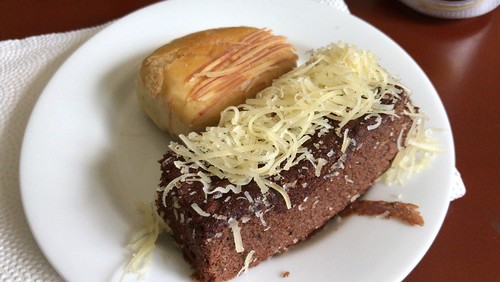
So there I was with a box full of cake made from fermented cassava. Luckily, I didn’t really understand the whole fermented cassava thing when I first tried the cake and therefore approached it with an open mind. It was a bit heavy and quite moist but otherwise, pretty nice and reasonably cake-like. The thing that really threw me off was the topping.

32F043F6-41BB-472D-B88C-F096446D79C3
See the stuff on top of the brownie that looks like grated cheese? It looks that way because it is, in fact, grated cheese.

So yeah, it wasn’t just a box of cake made from fermented cassava. I was a box of cake made from fermented cassava topped with grated cheese. There’s no getting around it, that’s just a weird combination. Also, the dry cheese is just sprinkled on top so it gets everywhere when you try to eat it. This turns out to be lucky because it means you can easily brush the grated cheddar off and be left with just the cake made from fermented cassava. Then you can go about your normal business untroubled by cheese where cheese shouldn’t be. (Like here, where you can’t even brush it off.)

IMG_8138
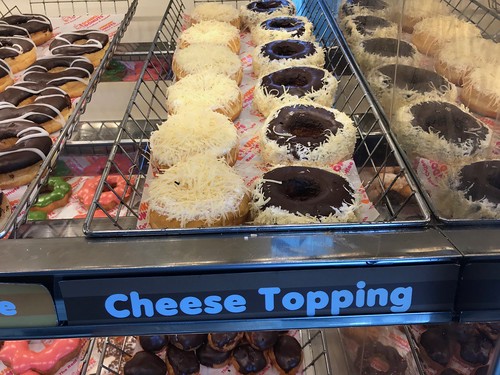
Or here, at Dunkin Donuts. (Yes, they have Dunkin Donuts here. Also Krispy Kreme and A&W, though it’s not A&W as we know it.) Honestly, Indonesia, WTF? A chocolate glazed donut rolled in grated cheese? Ok, we’re talking about a relatively mild cheddar here, but still it’s just not right. I blame the Dutch, who brought their cheese culture here as colonial overlords but clearly did not take the time to explain the finer points before they left.

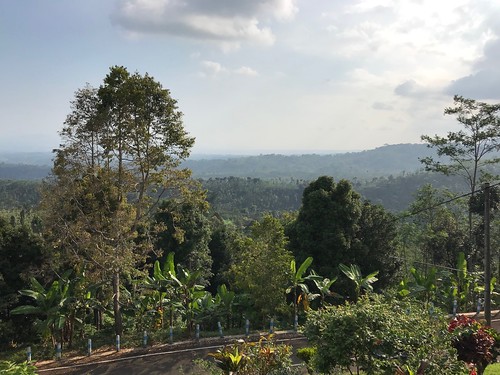
Finally, there was the delicacy we sampled on the Jember trip on our first day there. After we’d concluded the business of the day we had some time to do a bit of sightseeing and ended up driving half-way up the mountain outside of town to a faded old resort hotel. Along the way there were some nice views.

IMG_7747
And once we got there we had a good look down at where we’d come from.

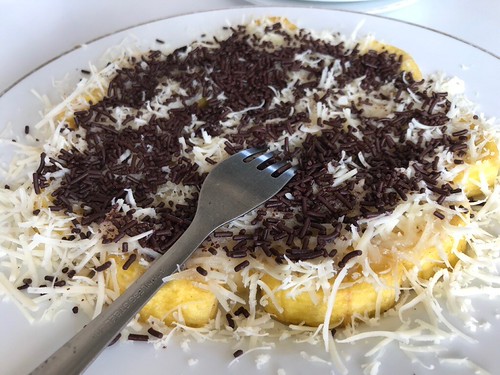
And of course we stopped to sample the local delicacy as recommended on the TripAdvisor page that directed us up the mountain. One review in particular pointed out that the “banana fritter come up beyond expectation” so of course we had to try that.

IMG_7752
Pisang keju. Literally, “banana cheese”. This has confused-Dutch-mashup written all over it - especially the chocolate sprinkles part.

Sliced bananas, lightly coated in flour and pan-fried, topped with grated cheese and chocolate sprinkles. I think there may have been sweetened condensed milk in there too. It was weirdly ok, but maybe that’s just because I was hungry. Also these bananas are a different variety that the usual Cavendish that we get at home. They were starchier and less sweet and I think that helps. Our lovely local staffer said this is a very common preparation in Indonesia, and one that she even makes at home. However, I can’t help but think it would be greatly improved by removing the cheese, and I say that as a committed caesophile. But think about it: fried bananas + condensed milk + chocolate = undeniable yumminess. Whereas: fried bananas + condensed milk + chocolate + grated cheddar cheese = Huh?

We didn’t finish the whole plate of pisang keju. Too much keju for my taste, and it was also quite filling. Since that trip I’ve seen this weird grated-cheese-on-dessert phenomenon repeated over and over again. I think my "I'll try just about any weird food" credentials are pretty unimpeachable, but I struggle with this. Cheese - at least the firm, salty cheese we're talking about here - is such a very savoury thing. If we were dealing with cream cheese or ricotta or mascarpone or similar then I'd be all over that. But I find this combination a bit like dipping your pain au chocolate in soy sauce or spreading your chocolate cupcake with a nice layer of miso paste. Yes, you could get used to it, but why bother?

In the mean time, work is still busy. I've tried to do some touristy stuff in Jakarta, but have been slightly defeated because it's a very big, very hot, very choked up city so it's hard to move around, and then mostly uncomfortable when you get where you're going. Or perhaps I just had a bad day. Stay tuned and I'll try to find something worth telling you about. And while you're waiting could someone please have a Tim Hortons Sour Cream Glazed donut in my honour? With extra gorgonzola, please.


*P.S. Am I the only one who thinks “Inappropriate Cheese” would be a great name for a band?