Two Wheels Good

Monday, January 23, 2012

I've been cycling regularly in London for a bit more than six months now.  I've had one bike stolen, landed on the pavement three times, sailed over the front fender of one exceptionally dense motorist, taken four hours of cycle safety training, learned how to repair a flat tire and survived one or two near misses.  So though six months is not a long time, I feel that I might have a thing or two to say on the subject of cycling in central London, which can sometimes feel like a bit of a battle.

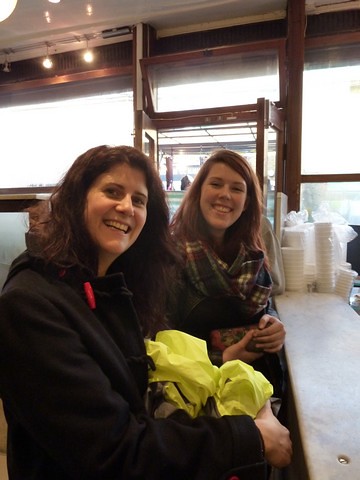
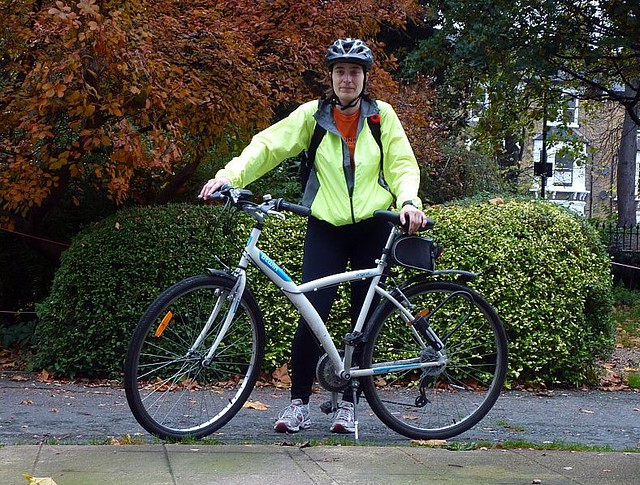
Pam and the bike
Girded for battle, with game face on and trusty, heavy, war horse of a bike.
I'm not by nature a "bicycle person".  Cycling is not a hobby for me like it is for those with gear ratios in their heads and ultra-light frames and those brightly coloured skintight shirts with the big pockets on the back.  For me, cycling is a means to and end.  It gets me to and from work while simultaneously forcing me into a bit of exercise and saving me money on transport costs (which are not inconsiderable, especially after the TFL's annual New Year's gift of general fare increases across the board.  A one week tube pass for zones one and two now costs £29.20 which is up about £4 since I arrived a year and a half ago.  Those costs add up very very quickly.)

London has made a bit of an effort to make the roads safer for cyclists.  For instance, bikes are allowed to travel in bus lanes (along with motorcycles and scooters).  This usually gets you out of the main flow of traffic, but does mean you often end up leapfrogging buses as they stop to pick up passengers and then overtake on the way to their next stop.  This also means you end up sucking up a lot of doubledecker bus fumes.  Still, I'm happier in a bus lane.  Also, many intersections have marked areas in front of the stop line where cyclists can wait for the green light ahead of the vehicle traffic.

P1080695 
A cycle stop zone, thoughtfully NOT occupied by that bus.

However, the most visible cycle-friendly things in the city are Transport For London's series of "cycle superhighways".  These are planned cycle routes that link outer suburbs of London to the centre by marking out a wide strip of pavement as a planned cycle path.  Often they run on a less trafficked streets parallel to a main road, thus getting cyclists out of the heavier flow of traffic.  Sometimes they do run along the main road, but claw back a bit of the roadway on the left as a bikes-only zone. The pavement on the routes is coloured bright blue and marked with bicycle icons and the route number.

Part of Cycle Superhighway 3, on my route to and from work.  The scheme is sponsored by Barclay's Bank, whose corporate colours are... light blue and white.  The TFL claims that the colour was decided before sponsorship was secured.  Suuuuuuure.
I'm generally in favour of the blue routes, and definitely feel more secure when I'm on the blue than when I'm on an unmarked road.  However, these cycle superhighways are not a cure-all.  There is an infamous route (CS2) that travels up to the busy Bow Roundabout, very near my office.  Two cyclists died in that intersection in the space of two weeks this fall, in part because the blue zone extends up to the roundabout and then simply stops, forcing riders to negotiate the hardest part of the route unprotected.  Thankfully, there is now talk of changing the layout and traffic light timing of that roundabout in particular, and they're said to be examining a lot of other dangerous intersections as well.  In all, sixteen cyclists were killed in London in 2011.  Then again, Wikipedia estimates there are more than 500,000 cycle journeys per day in the city, so that's 16 fatalities in more than 182 million journeys.  However, you still really need to be on your toes out there.
IMG_1318
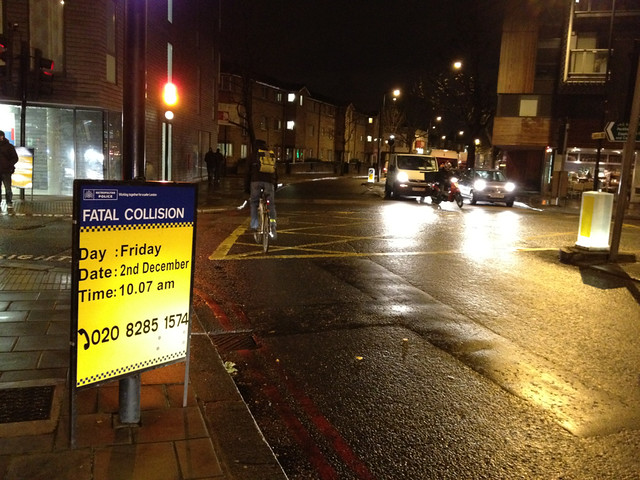
These signs get put up after, well, after fatal collisions, which usually involve either pedestrians or cyclists.  This sign was at an intersection I pass through on the way home.  It's a pretty innocuous junction, but I have to turn right there so I always dismount and cross as a pedestrian.  

Like I said, you need to be on your toes.  To that end, I decided it would be smart to take a proper cycle safety training course, and found a link to an outfit called Cycle Training UK.  They offer basic and intermediate cycle safety training, much of which is subsidised by different boroughs in London.  Luckily, my home borough of Lambeth is super keen to get people on bikes and so provide lots of funding for people who live or work in Lambeth to take these lessons.  I ended up getting two individual, one-on-one training sessions, each two hours long, for the grand sum of £8.00.  (That is not a typo.  EIGHT POUNDS. Two pounds per hour for one on one instruction.  Unbelievable.)  And, having taken that training I'm now also eligible to do a full day course on basic bike maintenance for another eight quid.  Thank you Lambeth.

The first two hour session started slowly, and was not aided by the fact that it was a chilly, windy, grey Sunday morning.  I met my instructor, Patrick, in a quiet park of Brockwell Park, very near the house.  He was a nice enough guy, and had proper clip-in pedals and everything.  He even spent the first ten minutes of the lesson adjusting my brakes, pumping up my tires and oiling my bike chain.  No extra charge for that either...  Then we did a bit of very basic stuff - changing gears and shoulder checking and emergency stops and such.  All fairly basic.

When we got on the roads, it got more interesting.  I'm sure many of you know this already, and I'd been told it by experience cycling friends, but had never really taken it to heart.  However, the truth is that the position most inexperienced cyclists gravitate to on the road is not always the safest or smartest place to be.  Trying to stay out of the way by hugging tight to the curb often puts you far enough over that impatient drivers have just enough room to squeeze past you without having to wait for a break in opposing traffic.  This means that if anything unanticipated happens, you've got nowhere to go.  It makes sense, but I know from experience it can be hard to do.  Apparently women especially have trouble being assertive enough to maintain a safe postion on the roads.  This is evidenced by a series of text messages I had with my friend Philip, who was trying to convince me about this last summer:
Phil: You should cycle in the middle, not on the left. And only let cars past when it's safe for you.
Me: How do you avoid being dragged off your bike and kicked to death by angry motorists?
Phil: Shout back at them.
Me: Yeah.  I'll shout really loud from the foetal position while I'm trying to protect my kidneys from some guy's boot...
So you could say I was resistant to the idea.  Now, I'm a convert.  I may not be in the middle of the lane, but I'm far enough out that the unexpected opening of the door of a parked car will not be the end of my trip.  And if a car wants to pass me, they can damned well wait until there's room in the opposing lane for them to swing out.  It really does work.  Thanks Patrick!  (And sorry I ever doubted you Philip.)

My route to and from work doesn't take me anywhere near the aforementioned killer roundabout at Bow, but it does go straight through another infamous roundabout at Elephant and Castle.  Luckily, my second lesson with Patrick was an intermediate level business, and he took me through a few of the tricky intersections on my route, including the Elephant.  We even stopped, locked up the bikes, and stood at the side of the road gesturing at possible approaches and discussing the merits of one lane over another before tackling things on two wheels.  And even Patrick admitted that trip through E&C from the direction of London Bridge towards Brixton is exceptionally snarly.  However, we did come to some conclusions, and had a couple of trips through on our bikes, and I'm pretty ok with Elephant and Castle now. (On a completely unrelated note: Did you know that Elephant and Castle can be anagrammed to read Aleph and Tentacles?)

So I'm all trained up now.  I've even had an unanticipated lesson in how to fix a flat tire (or "puncture" as it's known locally).  I came out of work a while back to discover my back wheel was making an odd squishy noise as I wheeled my bike towards the gate for the trip home.  It took me a ridiculous amount of time to diagnose the problem, but eventually I recognised that the tire was completely flat.  And even though I got a nifty bike repair multi-tool for Christmas, I quickly realised I had no idea how to use it.  Luckily, one of my colleagues is a former bike shop employee, so he advised me on supplies to get and spent half an hour the next day showing me how to remove the wheel, take off the tire, find the leak, locate the spot on the tire with the offending tiny sharp pokey bit in it, remove said tiny pokey bit, install a new tube and put everything back together again.  I finished with frozen fingers, blackened palms, and a ridiculously empowering sense of accomplishment.

These days I'm on the road for my commute on any day whose schedule permits it.  It's eight and a half miles each way, and every eight and a half miles takes me about an hour.  (Slightly longer on days when I have to stop at the intersection at Tower Hill to retrieve wayward bike accessories that seem to favour that particular location to make a break for freedom.  I've already had to dash into the road to retrieve both a U-lock and my front mud guard.  Then again, it does give a bit of a chance to appreciate one's surroundings while waiting for a break in traffic.)
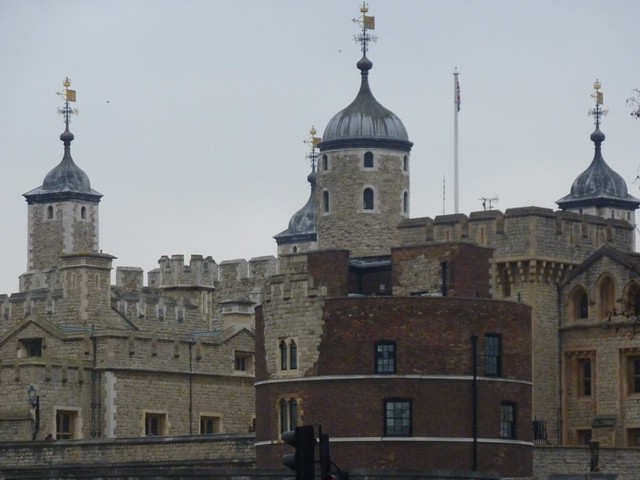
The Tower of London, as viewed from the intersection where bicycle accessories go to die.

Yet despite a few scrapes and bruises, many lungs full of soupy London air, and the occasional hair-raising encounter with a heavy goods vehicle, I'd say becoming a cyclist in London has been a good experience.  And so I'll leave you with a few shots taken along my commute, which is certainly more picturesque than the inside of a tube train.

Special lights just for the bike lanes!

Along the Lambeth Cut Canal

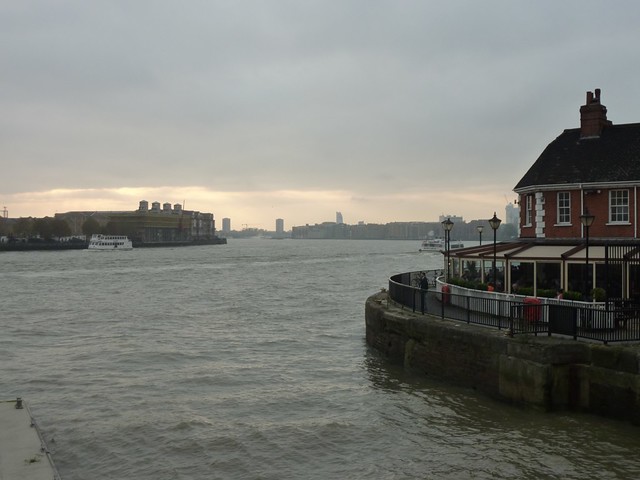
Where the canal meets the Thames. (That's a Gordon Ramsay restaurant on the right!)

*****

And in the News About Pam Department...

I've had a few requests in comments to write a bit about my job on the Olympic Ceremonies, and to that end I whipped up a nice little post that I thought was general enough not to be a problem but still give the flavour of the thing.  Just to be safe, I sent it to a higher-up at work for approval.  And that's as far as that post will go for now, because the suggestion was not to put it up.  You will all simply have to sit tight and wait until my contract expires next September, when I'll be free to dust off that post, and maybe even add some juicy bits.  Until then, please stop asking.
"London Under": a book review

Wednesday, January 11, 2012

One of the (many) pleasures of this Christmas was that I ended up with a slew of new books to read.  Some of these were gifts, and some were my own purchases, because Amazon were doing a "12 Days of Kindle" sale with many many many ebooks on sale for as little as 99p.  This meant that in addition to the dead tree books I received from others, I also managed to acquire, er... EIGHT ebooks with which to while away my time. (Though in fairness one of those was sort of a mistake - Curse you One Click Ordering Button!).

Interestingly, though it did not appear on any of my various lists, I actually received two copies of the same book: London Under, by Peter Ackroyd.  My family know me well - Ackroyd is the author of London: The Biography, an 822 page doorstop of a book that's been weighing down my nightstand for months now.  While I've had trouble getting stuck into The Biography (so far it's best viewed as a soporific), London Under proved to be a short, snappy and engaging read.  I started it on the plane on the way home, and finished it not long after.  This is partly because of its modest length, and partly because it's full of all kinds of the things I love: London, interesting trivia about London in particular, tunnels in general, and the Tube in particular.

London Under
It's even got a tunnel on the cover! What's not to love?

Water is an inescapable part of life in London, and the city's underground life is no different. Built on clay, sand and gravel, the entire city is slowly sinking, meaning that the waters that flow beneath it have to be pumped out at a rate of 15,400,000 gallons per day in an effort to keep London's feet dry.  London Under starts with a look at the hidden and forgotten wells and waterways that tax those pumps.  Wells that used to provide drinking water - some as far back as Roman times - now survive mostly as place names that are largely dissociated from their original purpose. Consider: Clerkenwell, Sadler's Wells, Shadwell, Holywell Street, Bridewell, Camberwell and Stockwell (just down the road from me!).  This is one of the joys of London - the fact that something as simple as the name of a tube station can reveal history going back hundreds (if not almost a thousand) years.  In Saskatoon a neighbourhood might be called Fairhaven simply because a real estate developer thought it had a nice ring to it.  In London Marylebone Road follows the route of the much older Marylebone Lane.  And the name "Marylebone" is derived from the name of a church: St. Mary by the bourne (a bourne is a brook).  The bourne in question in actually the hidden Tyburn river, which originates in Hampstead and follows the course of the street towards central London and the Thames. (Though of course it's more accurate to say the street follows the course of the Tyburn.)

The rivers of London have been used, abused and bridged for millennia and most have now been covered over and forgotten. There's the aforementioned Tyburn (also of the infamous Tyburn Tree) the Walbrook, Stamford Brook (another tube station), the Neckinger, the engagingly named Wandle (which still survives above ground in parts of south London) and of course the once mighty Fleet.  Most exciting of these lost rivers for me is the Effra, which rises in Norwood, south London and passes through Dulwich (I run there!) and Herne Hill (and there!) before entering Brixton where it runs under Brixton Road and near the appropriately named Effra Road.  (Effra Road! That's mere steps from my house. I walk it almost every day!) And no wonder another nearby street is called Brixton Water Lane.  Apparently the Effra used to be wide enough to support barge traffic, and King Canute once sailed its waters up to Brixton (probably to catch a movie or grab a latté).  We've also got Coldharbour Lane and Rush Common, a long skinny stretch of sadly ignored green space that runs along Brixton Road, as if it were the banks of a watercourse, perhaps covered in... rushes. It all makes so much sense.

Effra River Map
Map showing watery landmarks in da 'hood

Even more compelling though, are London Under's stories about tunnels.  You already know I'm a bit of a fan of bridges and tunnels and such, so it should be no surprise that these bits were my favourite.  The story of London's sewers alone could probably support a whole book (though such a book would likely knock London: The Biography out of the park in the Books-To-Fall-Asleep-By game).  If there were Roman sewers in London, and there probably were, they have not survived (though some Roman sewers in Rome itself lasted until 1913!).  Instead, medieval London's sewers were the open waters of the rivers we just talked about, along with the biggest of London's rivers, the Thames.  This was part of the reason that people were so keen to brick over those smaller waterways, though covered sewers and cesspits resulted in distressingly frequent methane explosions.  The earliest underground pipes to carry waste in London were built in the thirteenth century (!), but proper brick sewers didn't emerge until the seventeenth.

The hero of London's sewers, though, must surely be Joseph Bazalgate who was the Chief Engineer of the Metropolitan Board of Works in 1858, the summer of what is cringingly known as the "Great Stink".  It was at this time that the deteriorating condition of London's then 200-year old sewers, combined with the mass introduction of flush toilets in private homes led to so severe a miasmic funk from the then decidedly brown Thames that drastic measures were needed.
"The windows of the Houses or Parliament were covered with sheets soaked in chlorine, but they could not prevent the stench from what Disraeli called, 'a Stygian pool reeking with ineffable and unbearable horror.'"  (London Under)
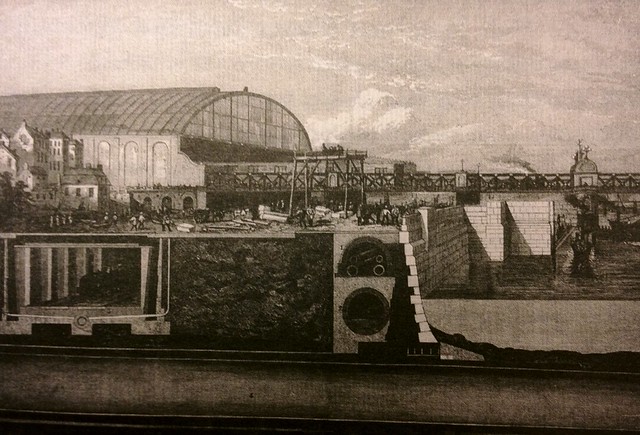
Bazalgate proposed an ambitious system of underground sewers running parallel to the Thames to intercept the, err, waste material before it reached the river and redirect it to the outskirts of the city.  There's no word of what the residents of Barking (northeast London) and Crossness (south) thought about having all of London's crap (literally) at their doorsteps, but the plan went ahead.  This not only resulted in a much sweeter smelling city, but it also in the reclamation of 22 acres of land from the river and the formation of the Thames Embankment as we know it today.  And what runs under that embankment besides big pipes full of The Great Stink?  Tube trains in tunnels!

Thames Embankment 
See? River on the right, sewers in the middle, trains on the left.  And happy Londoners strolling about on top, without the need for chlorinated sheets or gas masks.

London Under dwells for a while on water mains and gas pipes and electric cables and telephone lines.  (London was the first city in the world to locate its entire telephone system underground.) But Ackroyd really gets going when he starts talking about the Tube and the tunnels that contain it, including the tunnels under the Thames.  I've already blogged about Isambard Kingdom Brunel, and the first ever tunnel under this or any river (still in use today).  I've even already linked to that blog in the very post, so there's no need to bang on about it here anymore.

What I liked most were the chapters on the Underground itself, which was the first underground railway system in the world, opened to the public exactly 148 years ago yesterday, on January 10, 1863. (Happy Birthday Tube!).  It's so old that:
"Its first travellers wore top and frock-coats; there are early photographs of horse-drawn hansom cabs parked outside the underground stations. Oscar Wilde was a commuter on these subterranean trains... Charles Dickens and Charles Darwin could both have used the Underground... (and) Jack the Ripper could have travelled on the Underground to Whitechapel."
On that first day of service in 1863 trains ran between Paddington and Euston in a tunnel run by the Metropolitan Railway Company.  That tunnel, like Brunel's, is still in use today.  The first tube trains were driven by steam engines and looked exactly like surface trains, without the benefit of open air to dispel the smoke and fumes they generated.  Despite this drawback, the underground railway was a huge success, and many other companies sprang up to produce additional lines and compete with the Metropolitan Railway, which itself served 3,000 passengers a day.  Today's system serves 2.7 million daily - 1 billion per year.

The Tube system has evolved continuously since it opened.  New tunnels are dug and old ones abandoned, and stations change names, or lines, or are closed completely.  The London Transport Museum has an excellent  video display about the Tube Map that shows the zillions of iterations it has gone through - in a span of a few minutes you can watch the system grow and change like a living thing.  It's mesmerising. (Or is that just me again?) In London Under Ackroyd relates a simultaneously funny and chilling story about the dead South Kentish Town Station, in between Kentish Town and Camden on the Northern Line.  Apparently a passenger mistakenly alighted at South Kentish Town when the train was stopped at a red signal.  How he managed to get through the doors is not clear.  Nor is it explained why he chose to get off at a dark abandoned platform at all.  What is said is that he ended up stranded for a week, and was only rescued when a passenger on a passing train noticed the burning advertising posters he set alight as a signal.  No wonder people complain about the Northern Line.

Given their naturally spooky nature, the Tube system has its share of ghost stories too.  Underground tunnels pass right through many burial grounds and plague pits; deaths occurred in their construction, and murders and suicides have occurred on many lines.  Suicide is a constant fact of life in the Tube.  Apparently, three attempts are made per week, one if which is successful (though the term"successful" seems an odd one to use in this context). "The most popular time of day is 11:00am, and the most popular venues are King's Cross and Victoria."  Every once in a while you'll hear an announcement explaining a delayed train that says something like, "We apologise for the delay to your service, this is due to an earlier person under a train at Chancery Lane."  Erg.

All in all, London Under was a good read.  It's starts a bit slowly, but ends up giving a lot of fun, evocative facts about the London beneath our (or at least my) feet.  How could you not like a book that informs you that the Elgin Marbles were stored for safekeeping during the Blitz in empty tunnels under Aldwych?  Or that underground vaults at Bank contain the second-largest hoard of gold bullion in the world?  It's not going to change your life, but it might open your eyes a bit.

Random thoughts on home

Tuesday, January 3, 2012

It was a lovely trip home for Christmas.  I felt like I had a bit more time to relax than last year, and though there's never really enough time to see everyone as much as I'd like, it was still good.  This might be due to the fact that there was really no jet-lag at all, at least on the way over.  Last year I woke up at 3am on Christmas Eve, which was literally tiresome. This year I slept about 10 hours a night, which does remarkable things for one's whole outlook on life.  And though I had no major bloggy revelations while at home, there are a few things I did or noticed that made me stop and go "Huh."  And so onwards...

On Inside/Outside Nature Of Shoes:

This is something that always trips me up in London: shoes.  To clarify: it's not that my shoes literally cause me to trip.  It's shoes inside houses.  In Canada when you go over to someone's house - especially in the winter - you take your shoes off at the door and you spend the evening in your sock feet.  This clearly makes sense. Outside is a dirty, wet, mucky place.  Why would you wander around inside a house on its nice, clean, possibly carpeted floors wearing the shoes in which you just navigated the mean streets?  Ick.

Oddly, shoes-in-the-house is the rule in London.  Several times now I've been at house parties and taken my shoes off when I enter the house only to find that I am the only shoeless person in the building.  And keep in mind that London is a pretty comprehensively damp place a lot of the time, meaning that the odds of arriving at someone's house with wet feet are better than average. Still, the rule seems to be that shoes stay on inside the house when visiting.  Perhaps Londoners all have holes in the toes of their socks.

Whatever the reason, I was gratified to attend a pre-New Year's party in Winnipeg where everyone had their shoes off.  In fact, they took their shoes off outside the door of the apartment and left them outside.  When I saw the shoes piled up at two different doors in that condo building it gave me a little warm fuzzy feeling.

Shoes OUTSIDE
Shoes at the party - earlier in the night there were three times this many!
(The other advantage to this system is that if you like someone else's shoes more than your own you just have to make sure you leave before they do...)

On Other, Less Conventional Footwear:

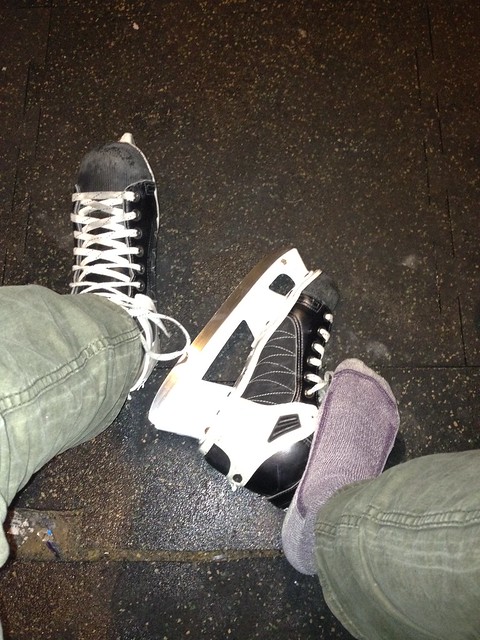
I went skating for the first time since I left Canada! On New Year's Eve!  At the Forks!  It was good fun, even though I was obviously not as solid on my skates as I was when I was playing hockey regularly.  Also my skates were a bit dull, and despite the fact that the skating was very slow and the session was very short, there were still a few muscles that made themselves known the next day on a chilly New Year's Day hash run around my old neighbourhood.  Still, it was worth it, and I did manage to acquit myself a little more skilfully than the 5- and 7-year old in the group.  Phew.

Skates 
Picture of Pam's feet.  (It's just like the good old days!)

And in the "You'd Never See That In London" Department:

Even though neither the Red or the Assiniboine Rivers are frozen over enough for skating (surely a sign of the coming apocalypse) there were still skating trails at the Forks, which were equipped with these cautionary signs where the skating trail passed over a pedestrian trail. 
(In fact, the general Manitoba/Saskatchewan area was weirdly un-snowy.  There were maybe two or three inches of snow cover over all.  What the Hell is that?  There's probably more snow in Yorkshire right now than there is in Winnipeg.  It's Upside-Down World!)

On The Difficult Nature Of Stuff:

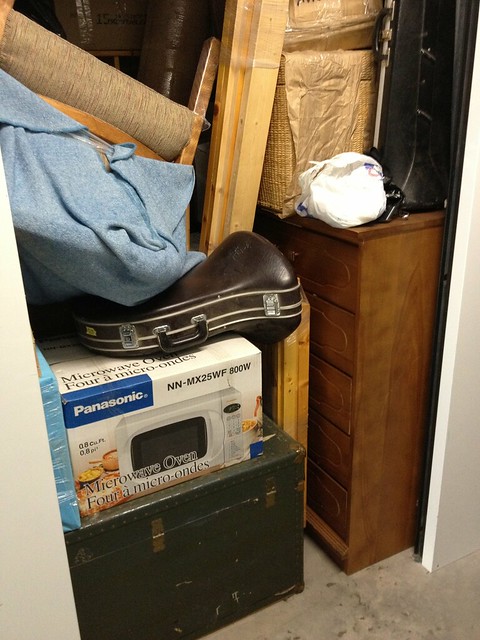
I visited my stuff.  By which I mean I went out to All Canadian Storage and threw open the rolling door on the 5' x 5' storage space that contains most of my worldly possessions. (I really went to get my skates, and pick over the much-talked-about package from Africa, but it was still a nice visit.)  It was good to see everything and remind myself that it's there, but the more time the stuff spends in Winnipeg while the owner of the stuff is in London, the easier it is to live without.  It makes me wonder why I'm hanging on to it.  And it makes me wonder a LOT about paying $65 a month to store it.  I suppose it's because I purged so much when I sold my house that I figure that what's left must really be the stuff worth keeping - the stuff I will want again some day.  Then again, does life in London really require a French Horn? Or a 40 year old 110-volt sewing machine? Or my grandmother's good china?  Probably not.  But that doesn't mean it deserves the bin.

It all comes down to whether or not I think I'll stay, and for how long, which is a question I'm not really equipped to answer.  It depends entirely on how long I can continue to get interesting work that pays the bills.  Professionally, there is nothing drawing me back to Canada, but visits like this one make me remember that I have family and good friends that will never be a proper part of my life while I'm an ocean away.  No easy answers here.

Aha!  THAT'S where I put that trombone! I've been looking for that...

On the Usurious Nature of So-Called Beer Sales at the Chili's in O'Hare Terminal Two:

I don't know why I did it.  Why did I choose to fly home through Chicago instead of Toronto?  Oh wait, I know why.  It's because I still have this lingering idea, perhaps brought on my extensive international travel, or perhaps by natural Canadian inclinations, to believe that anywhere NOT in  Canada is inherently more interesting than anywhere IN Canada.  Whatever the reason, I transited through Chicago O'Hare airport in both directions on this trip.  London to Winnipeg was the worst.  I landed at Terminal 5 and had to clear US customs (“Food products? Why no Mr. Friendly US Customs Man, I certainly don't have biscuits and cheese and chocolate and cake from Fortnum & Mason. Not me!”).  Then I had to reclaim my heavy, crippled, broken-handled suitcase and re-check it, then get the shuttle to Terminal 2, then go through security again, and THEN get to the departure gate.  Fun times.

Of course going through a third country meant I also had to get some US alternate currency to have a bit of supper while I was waiting for my (late) flight.  So I located a bank machine, figured $20 would be ample, proceeded to a handy Chili's restaurant with my new American twenty dollar bill and scanned the menu.  Oddly, there were no prices listed for the different (crappy) beers they had.  Naturally alarm bells should have rung at that point, but I must have been a bit too jet-lagged to hear them.  So I ordered a Sam Adams beer and a pulled pork sandwich  confident that $20 would cover dinner with room to spare.  (The sandwich with fries was about nine dollars, so this was not an unreasonable assumption.  Or so I thought.)

Ha!  The bill arrived and I just about choked.  $19.96 in total with all taxes, but before tip.  This means that my (mediocre, pale, American) beer cost just under 9 bucks.  NINE BUCKS FOR A CRAPPY AMERICAN BEER!  I just about called the waiter over to say something indignant like, “Mate, you are taking the piss if you think that glass of watery slop is worth five pounds fifty!”  Instead I fumed silently and picked my jaw up off the floor and pulled out my credit card. This is because I am a polite Canadian, and because I live surrounded by, and acclimatised to, a nation of people who would not raise a fuss for anything less than the severing of at least two major arteries (“Honestly Nigel, just use your school tie as a tourniquet and stop whinging.  People are starting to stare!”)

For future reference: the Chili's in O'Hare Terminal 2 is a gigantic RIP OFF when it comes to beer.  You are warned.

On the Utterly Desiccated Nature Of Winter On The Prairies:

I lived through 40 Canadian winters before I left the country, and I don't ever remember having chapped lips for two weeks straight.  Maybe I've lost my natural resistance having been away for too long, but about 1.3 seconds after arriving I started reaching for the Chapstick and ended up reapplying it about every six minutes.  How is it possible the nation is not populated entirely by a race of giant human/raisin hybrids?  It makes me think that breakdown of Canada's economy these days must be something like this:

Canadian Economy


On The Gratifyingly Dramatic Palette Of Sunrise On The Prairies:

Maybe it's just London.  Maybe there are spots in England where the sunrises and sunsets are as glorious as they are on the prairies.  But somehow I doubt it.  I've been conscious for a reasonable number of sunrises in London now, and they are almost always utterly unremarkable.  At least compared to this example from just outside Saskatoon.  Fantastic.
If anything, the colours are more muted in the photo than they were in real life.


So lovely, you have to look at TWO photos of this particular sunrise.

And that was my trip home.  It was 97% nice, 1% outrageously expensive crappy beer, and 2% Cheeseburger-of-Doom-on-New-Year's-Eve-at-The-Pancake-House-at-the-Forks. (Which was not nearly good enough to want to encounter again a few hours after it went down.  But enough said about that, because frankly my stomach is still a bit shaky three days later.)

I'm back to work tomorrow morning and I expect that within a few months work will become all-consuming so it was good to have a decent break over the holidays.  So it's nose-to-the-grindstone (if by grindstone you mean computer screen) and back to life in the big city.  Stay tuned for further exploits and, I hope, some much, much better beer.


******


P.S.  Dear Winnipeg:  Did you get the Jets back?  Really?  I never would have known.  You'd think that people would talk about that more.  And wear more Winnipeg Jets gear.  And complain more about not being able to get Jets tickets.

See what I mean?  The guy in the seat in front of me from Winnipeg to Chicago...

P.P.S.  Dear London: See? You're not the only ones who can't get tickets to major local sporting events.

GRUB!: Christmas Style

Monday, December 19, 2011

Yes you're right, there was no blog last week, and I am unrepentant.  What is my excuse? Well, last weekend I had a lovely few days in Brussels where I ran around the city with hashers, crawled pubs, drank some truly excellent Belgian beers, had a formal dinner, danced to ABBA, stayed out until 4am two nights in a row, met some fun people and topped off the beer with am generous helping of mulled wine.  I had a really excellent time, but the schedule was packed and didn't leave a lot of time for blogging, so I took a week off.  Get over it.  And now, on to your irregularly scheduled blog post:

It's a festive fiesta over here at GSWPL today!  Time to talk about some traditional English Christmas treats.  First up:

Mince Pies:

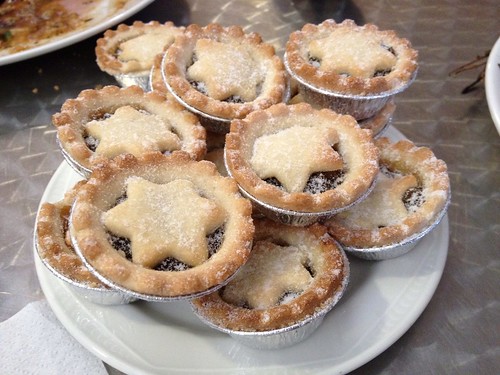
Mince pies are tiny sweet pies filled with mincemeat, a dark, thick jammy substance made by cooking suet with stuff like apples, raisins, sultanas, currants (or other dried fruit) candied peel, spices, sugar, and a generous measure of something boozy like brandy or whisky. Astute GSWPL readers will note from this list that mincemeat has no MEAT in it (Thankfully, and oddly, because over here hamburger - ground beef - is actually called MINCE.)  Still, mincemeat... no meat.  This has not always been the case, because the recipe seems to have originated as early as the 15th century when they were much more cavalier about mixing sweet spices and fruit with meat.  Over the centuries the meat faded into the background, leaving us with modern mincemeat which often now even skips the suet in favour of a vegetarian fat of some kind, resulting in a pie that looks very much like this:

Mince Pies
A tasty pile of mince pies from our work Christmas Lunch.  Yes, LUNCH.  It's normal over here to have the big Christmas meal - turkey, roast potatoes, Brussels sprouts, gravy, Christmas pudding - in the middle of the day,  possibly right after the Queen's Christmas Message.  Presumably you then lie around semi-conscious for the rest of the day pondering when you might next be able to cram something into your mouth.
In fact, mince pies are quite yummy, though possibly an acquired taste.  Luckily, it's a taste I developed as a child, having grown up in a family that embraces a whole lot of traditional English foods and customs (including steak and kidney pudding, another food which sounds like it can't decide whether it's dinner or dessert, and which is definitely a whole other post.)

Mince pies are utterly ubiquitous at this time of year.  They appear in grocery stores in boxes of 6 (for about £1! Fantastic!).  It's also impossible to enter a coffee shop without being presented with a pile of mince pies.  They are a staple at any Christmas function, and I've even seen them given away on the street for store promotions.  There is no escape, meaning that I have consumed approximately 7.3 times my bodyweight in mince pies in the last three weeks.  Luckily, they're small.  Unluckily, this makes it easy to eat nine in a row without noticing (it's the Jaffa Cake Conundrum).  Sadly, the power to resist mince pies decreases precipitously in a direct relationship with your consumption of:

Mulled Wine:

Red wine, heated through with a mixture of spices like cinnamon and clove, and often with sliced apples and oranges added.  Like mince pies, mulled wine is everywhere.  In Brussels and many other European countries it's called gluhwein.  In France it's vin chaud.  Brussels even had it for sale at outdoor gluhwein stands in the Christmas markets, which was quite lovely.  I've had it at work functions, on the street, and at house parties.  (Where it was once served with bits of chorizo sausage added for extra zip, though I am assured by other that this is a highly unusual practice.  Still, what is it about this place that makes people put meat in places where meat was not meant to go?)

Mulled wine is generally made with pretty cheap plonk, since it makes no sense to spend any more than you need to on a bottle (or box) that's going to be stewed to within an inch of its life in a pot full of cinnamon sticks and, if it's unlucky, a bit of sausage.  This means that it's not particularly high quality alcohol, hence it can be the cause of a wicked hangover.  It's very Christmassy, but should be approached with caution.

Selection Boxes:

I've heard it said that Christmas is not Christmas without a selection box.  Technically speaking, a selection box is a package containing a range of sweets from a single manufacturer.  A box of Pot of Gold chocolates would, over here, be referred to as a selection box.  And last week I got a Cadbury's selection box that had six different Cadbury's chocolate bars in it (Cadbury Flake, Dairy Milk, Fudge, Buttons, Crunchie and Caramel!).

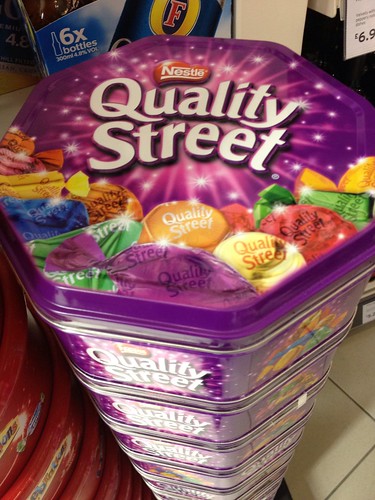
But at Christmas time it seems the two grandaddies of the selection box game are Quality Street and Cadbury's Roses.  Chocolates in these kinds of tins are generally made with pretty low quality chocolate, but are fun because they're all different shapes and wrapped in brightly coloured foil, so it's easy to develop favourites, like the Quality Street long skinny gold one, which is toffee.  Or the green triangle.  Or the famous Purple One, which used to be a whole Brazil nut covered in chocolate, but is now, for reasons unknown, a hazelnut.


Quality Street
A tower of Quality Street selection boxes, in my local Sainsbury's
Brussels Sprouts:

Pity the poor Brussels sprout!  Trotted out at Christmas every year and often boiled into oblivion, they are the nightmare of British children the nation over.  (Last year I read a tongue-in-cheek article outlining key dates in the run-up to Christmas and somewhere in mid-November appeared the helpful hint: "Grans: Last chance to put the sprouts on to boil!")

brussel-sprouts-bacon-and-chestnuts
Roasted Brussels Sprouts with bacon and chestnuts, which are very traditional accompaniments
Sprouts get a bad rap, probably because of the aforementioned overcooking, which can release a chemical compound (glucosinolate sinigrin) that makes them smell sulphurous and hence less-than-yummy.  Much better to sautee or roast them.  But everyone I've talked to says that Christmas dinner is not complete without a bowl of sprouts that get politely ignored by most people at the table.  I like them myself, though this was not always the case.  Apparently they're often served with bacon and chestnuts, which sounds excellent.

Christmas Pudding:

Christmas pudding is the truly proper end to a Christmas dinner (whether served at 1pm or 7...) and is familiar territory for me.  I've had Christmas pudding every year since, I suspect, I was in utero (except one).  And it bears repeating that in England "pudding" is a very broad term.  North Americans might fall into the trap of thinking a pudding is a smooth, gloopy, spoonable dessert advertised by Bill Cosby.  No so in England; here the term is used generally to describe any kind of dessert.

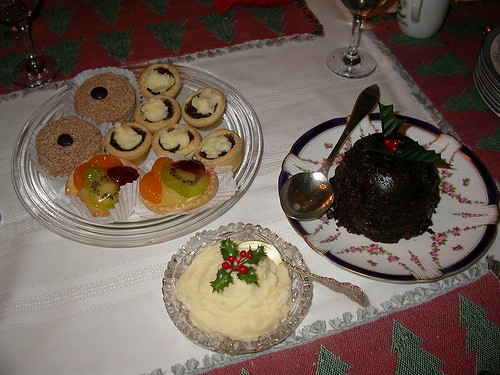
For those of you who haven't had the pleasure: a Christmas Pudding is another one of those mixtures of suet, dried fruit, sugar and booze (no meat this time!) with a touch of flour added to bind it all together into a batter.  It's traditionally cooked by pouring the whole mixture into a ceramic bowl called a pudding basin and then steaming it for hours, which results in a moist, rich, dense cakey sort of thing that resembles half a bowling ball in colour and weight when turned out onto a plate.  It's normally served by dousing it in brandy or rum and then setting it alight, and is accompanied by custard, brandy butter or - my favourite - hard sauce.

800px-ChristmasPuddingHardSauce
Christmas pudding (the bowling ball on the right), hard sauce (down centre) and a few mince pies thrown in for good measure.
(Aside on hard sauce: It's not hard, nor is it really a sauce.  Instead, hard sauce is a tooth-achingly sweet mixture of butter and sugar, possibly with a bit of vanilla or booze mixed in, which makes it quite thick - more like a spread.  My association with hard sauce goes back as far as my association with Christmas pudding.  Because a Christmas pud is very rich and dense and sort of challengingly flavoured - especially for kids - it was always a bit of a tough sell at our table.  The hard sauce, though, was a guaranteed hit.  Hence it was decreed that if you wanted hard sauce, you had to have at least a small slice of pudding to go with it.  This resulted in many years of being served a slice of pudding so thin you could read The Times through it, topped with an enormous helping of hard sauce.  Happily this tactic worked, and I'm now completely won over to the charms of Christmas Pudding.  As long as there's hard sauce.)

Christmas Crackers:

No, not crackers as in things-to-be-crumbled-into-soup.  These are crackers as in things-that-go-Crack!  Despite my Anglo-centric upbringing, this is one Christmas tradition that never made it into my personal list of Christmas Must Haves.  But over here Christmas crackers are mandatory.  A cracker is a small cardboard tube wrapped in paper so it ends up looking like a giant hard candy.   The intention is that the tube is pulled apart to reveal the contents inside.  The crack part comes because the tube is also fitted with a thin strip of cardboard impregnated with some kind of chemical banginess, so it make a sharp cracking noise when pulled apart (sort of like a cap gun).

Traditionally it takes two people to pull a cracker, with each person grabbing one end.  Similar to breaking a wishbone, the person who ends up with the larger bit after the pull is the winner, and is entitled to claim the entire contents of the cracker.  At less cutthroat tables, each person has a cracker and keeps its contents to him or herself, though the actual pulling of the cracker is still definitely a two person operation.

Crackers normally contain three things: a brightly coloured tissue paper hat, usually shaped like a crown (which must be worn); a small plastic toy of some kind (which must be crappy); and a small slip of paper containing a joke (which must be very very bad and which also must be read out to the rest of the table).

Cracker joke
A cracker and joke from the office Christmas lunch.  I told you the jokes were bad. (Other joke that appeared that day: Which side of a chicken has the most feathers? The outside!)


And there you have it - a few English Christmas traditions to chew on (ha!) over the holidays.  I'm heading back to Canada soon for two full weeks of friends, family, jetlag, food, presents, sleeping in and Christmas pudding with hard sauce.  I may blog while I'm there, and I may not... you'll just have to tune in to find out.  

The Games People Play: Rugby

Monday, December 5, 2011

It's high time I went to a rugby match, especially since I've been here for about a year and a half now and rugby really is one of The Big Three spectator sports in England, the other two being football and cricket of course.  (The "Big Three" thing is not any kind of official designation or anything.  I totally just made it up.  But it's still true.)  And most especially because one of my good friends is a HUGE rugby fan (in the sense that he has a great love for the game, not in the sense that he is physically huge and also happens to like rugby).  And most most especially because that same friend promised to take me to a rugby match oh, about a year and a half ago.  High time indeed.

Luckily, the last time I pestered Paul (the huge one) (kidding!) about his promise he was ready for it and offered a real treat.  We wouldn't be going to some piddling local match between the Little Whinging No-Necks and the Snortby-on-the-Plim Hippos.  Not us.  We were going to Twickenham, the spiritual home of English rugby and the largest rugby stadium in the world, with 82,000 seats.  (Twickenham Pronunciation Guide: It's "TWICKENum".  Certainly NOT "TwickenHAM")  Even better, the game was to be a fundraiser for the Help for Heroes charity, who raise money for wounded British servicemen.  Win-win!

Quick rugby primer: Forerunner to American/Canadian style football, the point of the game is for each 15-man team to try to advance the ball, which looks like a fat North American football, down the field to the opposing goal line.  If a player touches the ball to the ground past that line he scores a "try", which is the major scoring play and is worth 5 points.  (It also leads to an odd use of the phrase "Nice try" which doesn't actually mean, "Good effort, but not quite." It literally means... nice try.)  The ball can be run or kicked down the field, but no forward passing is allowed.  Also, there are points for kicking through the goal posts.  And there are a few odd plays like the scrum, which is sometimes used to put the ball back into play after a stoppage.  Scrums are a sort of structured pushing match involving very large men and very obscure rules.  Even Paul, who actually played the game, admits he does not understand the complex rules for scrummaging. (What a great verb!)

A short but creepy CGI video about the scrum

I probably should have mentioned that Twickenham is the home of Rugby Union, as distinct from Rugby League, a different variant of the sport.  Without going into too much tedious detail, it seems the major differences between Union and League are that League uses 13 players per side, and have tweaked the rules so that there are fewer chances to contest possession of the ball after a tackle.  Where Union players continue to hammer away after a tackle, League players stop.  League uses a system of six downs before possession switches automatically, similar to North American football.  There are no downs in Union; possession only switches when it is earned.  Union is generally the game that's played internationally.

As with everything in England, rugby exhibits some pretty iron-clad class characteristics.  Culturally, it's  considered an upper class sport, as befits its birth at Rugby School, one of the oldest public (posh) primary schools in England.  The oft-quoted maxim is this:
Football is a sport for gentlemen, played by thugs.  Rugby is a sport for thugs, played by gentlemen.
Rugby Union is certainly upper-class, and most popular in the more affluent south of the country.  Rugby League is more popular in the North and with working class fans.

But enough of the rules and the cultural baggage and the schism between Union and League - what about the game?  My foray to the heart of English rugby started with a traditional pint at the Cabbage Patch Pub, so named because Twickenham stadium itself is built on a former cabbage patch, which was purchased by the Rugby Football Union in 1907 for the sum of £5,550 12 shillings and sixpence.


After a warm-up pint at the Cabbage Patch we walked to the stadium, which is really big! Along the route the streets were lined with vendors selling burgers and mini donuts and cornish pasties.  We were early, so we hung around a bit, and had another pint, and I had a quite respectable chicken pie and mash, and we chatted and commented on how cold it was, and how we were both woefully underdressed (I think that by the time I was finishing that second pint the beer was colder than when it had been poured...).  And then it was into the stadium:

I told you it was big
It wasn't until I was in that stadium that it really became clear to me how popular rugby is.  Coming from North America, where rugby is a fringe sort at best, it was a bit like walking into an 80,000 seat badminton arena.  No disrespect to the rest of the planet, much of which likes the game very much (especially Australia and New Zealand and South Africa and, oddly, France).  And no disrespect to the game either, which is fast and rough and exciting and in that respect is very much like hockey and hence is A Good Thing. (Also, no disrespect to badminton.  Well, maybe a little...)

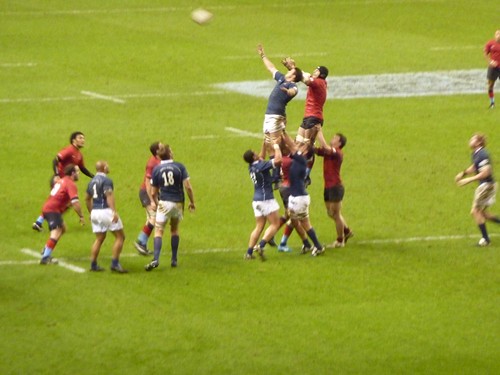
When I say the sport is rough I'm not kidding.  The players wear almost no padding, and the tackles can be vicious.  Also there are very few substitutions - many players are on the field for the whole game, which has two running-time 40 minute halves.  (One of the ways you can be sent off is in a "blood substitution", which means you're out to receive medical attention.  So like I said... rough.)  However, it can also be quite elegant.  When the ball moves down field in a choreographed series of running backward passes it's impressive.  As is the "lineout", a means of throwing the ball back into play from the sidelines.  Some time ago a bright spark got the idea that if a player were lifted up on cue he'd be able to receive the sideline pass well over the heads of the opposing players, so now whenever there's a lineout the players on both teams do this impressive lifting move to try and gain possession.

It's practically ballet!  Sweaty, dirty ballet performed by men who weigh 250 pounds and can probably tear phonebooks in half. 
The game was billed as the "Help For Heroes Northern Hemisphere XV against a star studded Southern Hemisphere team", and featured former professionals, players from the armed forces, and selected young "academy" players. I don't know any better, but Paul said there were a few legends in the lineup.  Naturally we were cheering for the North, who ended up being soundly smacked by the South by a score of about 17 to something-more-than 17...  But the North had a few nice tries and the South had a few more, and we cheered for those too, because rugby fans are a remarkably civilised lot.  In fact, rugby fans are known for being even-tempered and appreciative and, unlike football (soccer) fans, never have to be separated from opposing fans in the stadium, or escorted to waiting buses - for their own safety - when at away games in "hostile" territory, or hauled away in police cars or ambulances (or caskets) after altercations.  There is simply no such thing as a "rugby hooligan", which is a lovely thing.

And so even though the North lost, a good time was had by all.  Paul and I left the stadium chatting happily and trying to get blood moving back into our frozen limbs.  And even though 30,000 people were headed to the train station the walk was orderly and the wait for the train was surprisingly short and the trip home was quick.  So it was a nice afternoon - I finally got to see a game live, and Paul gets to stop having me pester him about the rugby, and the Help for Heroes people made some good money.  Win-win-win!

Me and Paul at Twickenham (See?  He's not huge at all!  I, on the other hand, apparently have a touch of jaundice...)


P.S.  Paul is doing a big bike ride next summer as a fundraiser for Help for Heroes.  Send him money for it!  Even if you're not a fan of this or any war, it's still a good cause.  Also, I suggest you make your donation contingent on him wearing his famous pink lycra cycling shorts.  Win-win...

Apropos of Nothing, son of the sequel

Monday, November 28, 2011

More short, random observations of life on this side.

On the oddly bi-polar nature of driver's licences:
First of all, they're not called driver's licenses, they're called "drivING licences". I guess it's not the person that's licensed, it's the act.  I recently traded my Canadian driver's license for a UK one, which was relatively painless and not even that expensive.  The annoying thing is that driving licenses in the UK require you to take your test in a manual transmission vehicle if you want to be licensed to drive a manual transmission car.  Of course there's no way to prove that I took my driving test (27 years ago...ohmygod) in a manual transmission car because no one in Canada gives a damn about that and hence no records of that are kept (oh, also I didn't take my test in a manual, but that's not the point.)  The point is that I wasn't able to get a manual transmission license.  This, despite the fact that every vehicle I've ever owned and registered was a manual.  I suppose the fact that I owned them is no guarantee that I drove them.  So now I have to arrange to take a test to upgrade my license, because about 90% of vehicles in the UK are manuals, which is all kind of boring.  That's the first bi-polar thing about driving licence - the manual/automatic differentiation.

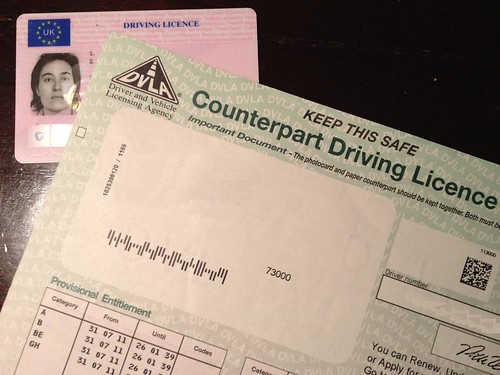
The other thing is the physical licence itself. It comes in two parts, like the old Saskatchewan licences.  There's the plastic photo card part that most people carry around, which is familiar. Then there's the "paper counterpart" which is a full A4 sized sheet and is a legal part of the licence itself. Theoretically you're supposed to carry both halves at all times, which almost no one does, partly because it's a pain and partly because it's just a flimsy piece of paper that will decompose in a wallet in no time flat.

Driving License 
It says: "Important Document - The photocard and paper counterpart should be kept together. Both must be produced when required."  And that's my photocard in the corner, the pink thing with the EU symbol and the unflattering photo.  Then again it's not nearly as unflattering as the ID photo on my new Olympic Park pass which makes me look 70 years old, three-quarters dead and supremely uninterested in everything. People gasp and make involuntary vowel sounds when they see it.  Then their eyes start bleeding...

On the similarly dual nature of laundry detergent:
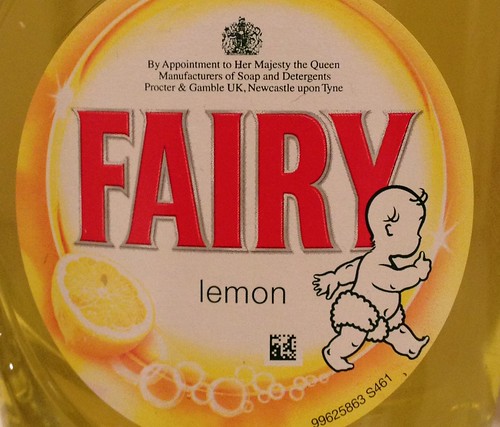
Again, we've got a linguistic clarification to make here.  It's not actually called laundry detergent here, it's called "washing powder".  Also, dishwashing soap is called "washing up liquid" because doing the dishes is referred to as "doing the washing up". "Washing up" is apparently a phrase that refers exclusively to the dishes.  So it's "washing up liquid", unless it's "fairy liquid".  Not because it comes from fairies, but because the best-known brand of washing up liquid is Fairy.

Fairy liquid
Lemon Fairy Liquid, though it's most common form is Mild Green Fairy Liquid.
But back to the washing up powder, and something that baffled me for a long time after I arrived before I finally got off my butt and asked about it.  All washing powder over here is clearly divided and appropriately labeled as belonging to one of two camps: Biological and Non-Biological, usually abbreviated to Bio and Non-bio.

Bio vs. non bio
See what I mean? Clearly labelled.

And what's the difference?  According to our friends at Wikpedia (and let's just pause for a moment and consider that there are actually people out there who care enough about this subject to write a short but reasonably informative article about it) (Oh, and let's also have a short moment of reflection to admit that I am also in the process of writing about it.) (And don't forget you are reading it, so don't get snooty)... but back to Wikipedia, which says that biological detergent contains "enzymes harvested from micro-organisms such as bacteria adapted to live in hot springs... whose purpose is to break down protein, starches and fat in dirt and stains on clothing... for example food stains, sweat and mud."  Apparently those enzymes increase the cleaning power of the detergent, especially in cold water, which is odd if they're harvested from hot springs.  (And exactly how does one harvest micro-organisms from hot springs? With extremely tiny nets?)  I can't believe there are enough hot springs in the world to produce enough of these enzymes to fill the shelves at every Tesco, Sainsbury's , Lidl, Waitrose and Asda in the UK.  (Especially not the Asda at Putney Vale, which I think is large enough to be visible from the International Space Station.)  

No matter, the bio stuff supposedly works about 10-15% better. However the bio stuff is also harsher, probably because those enzymes must have to be pretty tough characters to survive in steamy, mineral-laden hot springs. Hence the existence of non-bio washing powder for babies, people with allergies and anyone who is generally just a whinging wimp. Nonetheless, the wholesale and absolute division of the entire laundry detergent world into two discrete types was disconcerting - a bit like walking into the grocery store to find the entire dairy section had separate areas for left-handed and right-handed yogurt.

On the most excellent nature of Christmas lights on Oxford and Regent Streets:
Oxford and Regent Streets are the hub of retail consumerism in London, centred at the intersection (or junction) of the two main roads, called Oxford Circus. There is handy tube station at Oxford Circus which I have NEVER exited without being completely disoriented.  This is because unless you were to conduct an exhaustively mapped, years-long, three-dimensional study of the various exits from Oxford Circus Station, I think it's completely impossible to know upon exiting which direction you need to walk to get to the Apple Store. I generally stumble up out of the tube and try to locate All Souls Church, which I firmly believed to be in an easterly direction along Oxford Street, and then orient myself from there.  Naturally it turns out that All Souls is actually north up Regent Street.  And surprisingly it also turns out that Regent Street and not Oxford Street is the one that curves south and east into Piccadilly Circus. Huh.  This goes a long way to explaining why I've always found Oxford Circus a tad confusing.

Navigational challenges aside, Oxford Circus is a shopper's paradise.  The area is home to big department stores like Selfridges, Debenham's, and the beloved Marks and Spencer (which really deserves a post all its own), and to the flagship stores for a lot of major retailers like Apple, Uniqlo, and the famous Hamley's toys store.  And because Christmas is high season for shopping, the Oxford/Regent Street businesses really do up the place with festive lights, which is really fun.

This, for example, is a Boots Drug Store (Chemist):

Boots Christmas Lights
Nice work Boots, but not quite as classy as:

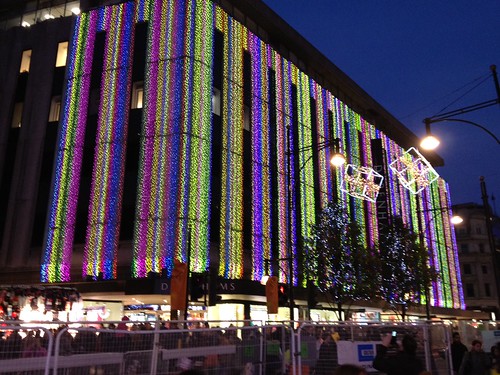
Debenham's Christmas Lights
Debenham's, which I would say is roughly equivalent to The Bay.  But bigger, of course.  And highly skilled with the Christmas lights.

Lights like this are generally called "fairy lights".  So if it's Christmas time you could theoretically make a batch of fairy cakes and then wash up the bowl with fairy liquid all under the gentle glow of fairy lights.  How lovely.  Especially the cakes.  And not so much the washing up.

Brixton Station Steel Drum Band:
Lastly, a little taste of one of the things that makes living in Brixton fun and cool.  There is an Iceland store just next to Brixton Station (Iceland is another of the grocery chains,this one with a particular focus. And I'll admit now that it took me an embarrassingly long amount of time to understand that focus.  This after I'd had numerous trips to Iceland wherein I'd wander up and down the aisles thinking to myself, "Damn, they have a LOT of frozen food in this place. Weird."  Yep.  Iceland sells... frozen food.  Not one of my shining moments.)  Anyway, the front of the Iceland is a popular spot - usually for guys selling sticks of incense which is smelly and annoying and which I strongly suspect is a thinly-disguised front for drug sales.  The Bible-thumpers tend to hang out a little farther down the street around the same place as the Communists, but when the stars align the steel drummers come out, which is my favourite:


How fun is that?  All they need is some fairy lights and we'd have it all.

GRUB!: Pie and Mash

Monday, November 21, 2011

It’s been too long since we indulged in any local delicacies and this weekend I had the perfect opportunity to seek out a classic.  This is because I’m now working in the Far East (of London) which has historically been a very working class area, and one of the time-honoured foods of  London’s working class is pie and mash.

First I should clarify that over here pie is always assumed to be meat pie unless otherwise stated.  Fruit pies exist but are much less common; in the UK the default setting for pie is meat.  And mash is mashed potatoes of course.  So pie and mash is meat pie – usually minced beef (hamburger) – with mashed potatoes.  There’s a third critical element to traditional pie and mash, but I’ll get to that in a minute.

So there I was at work in deepest darkest East London on an odd split-shift Saturday morning facing a long break before I’d next be needed. Clearly there was no choice but to dragoon a couple of coworkers - one of whom cleverly knew the way - and head to a traditional local pie and mash shop.

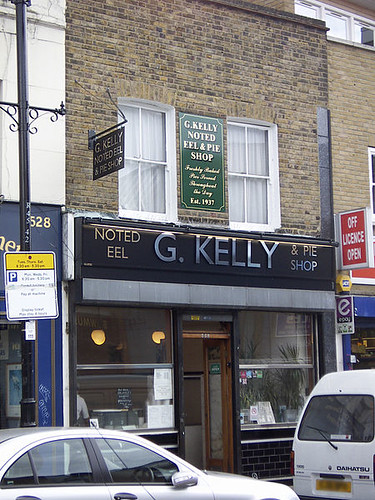
G Kelly Pie and Mash Shop
G.Kelly Noted Eel and Pie Shop, Est. 1937
Ok, I suspect you're wondering about the "Eel" part of that sign, and there's really no way to talk about pie and mash properly without talking about eels (of course). This is partly because they're both proper working class foods. Eels were cheap, nutritious and readily available - coming right from the Thames itself. Hence they, like pie and mash, became a staple for London's poor.  There are two common cooking methods for eel. The first is to boil them in water and vinegar and then allow the mixture to cool.  Because eels are, as Wikipedia charmingly says, "a naturally gelatinous fish", a sort of jelly forms when the cooking liquid cools resulting in a batch of the delicacy known as jellied eels.  (Aside: Yes, I realize that the day is coming when the blog topics become thin on the ground and I'll have to take up the "Steve's Weird Food" Challenge once again and at least try some jellied eel, but let's hope that day is a long long way off, because a big ole plate of jellied eel is a terrifying thing to behold.) Thankfully eels are also served warm with the broth they're cooked in.  That broth is the "critical third element" I mentioned earlier.  Fortified with lashings of chopped parsley which turn it an odd green colour, eel broth becomes something called "liquor", the traditional accompaniment to a proper meal of pie and mash.  Pie and mash and liquor - that's what I was after.

And so my hardy companions and I headed off to G. Kelly's, which is situated on a particularly old thoroughfare, as you can see by this picture of the street sign:

P1080888
I told you it was old.  Apparently it's the oldest known trade route in Britain (taken by Boudicea on her way to burn the Romans out of London).  
A properly traditional pie and mash shop is decorated with white tiles on the walls and has white marble tables and counter top, and I am happy to report that G. Kelly's had both, along with a woman behind the counter who referred to everyone as "lovely" - and that's a noun here, not an adjective, as in "That'll be three pound sixty, lovely."  When pressed for time "lovely" gets abbreviated to "luv" but either way, it's great.  

P1080895
Emma and Jo at the white marble counter of G. Kelly's.
The menu at G. Kelly's is extensive. You can have pie and mash, or double pie and mash, or double pie and double mash.  Pie comes in beef mince, chicken and - surprisingly - vegetarian mince.  Liquor is optional, but very traditional.  You can even have just a bowl of mash and liquor if you're not in the mood for pie, but why would you possibly go to a pie shop if you weren't in the mood for pie?  We, of course, were very much in the mood for pie and all three of us had a single beef mince pie with mash and liquor and a mug of hot tea.

P1080896
My plate of pie, mash and liquor.  Note the mash is scraped off the serving spoon along the edge of the plate.  Apparently even this is traditional.
I can't say that Kelly's pie and mash was like a party in my mouth. The mash was lovely, but the liquor was oddly bland and the pie was average: pastry a bit tough, filling a bit meager.  Then again you really can't complain when a lunch of real food made by real people, including a nice cup of tea, comes to £3.60.  Pie and mash is still cheaper and more nutritious than a Big Mac and fries.  And after our pie we had... more pie!  G.Kelly's stretches to some lovely little fruit pies in cherry and apple, along with rhubarb or apple crumble. They even had mince tarts, which taste like Christmas!  All in all it was a resoundingly successful and quintessentially East London little outing. G. Kelly's was as proper a pie and mash shop as you could hope for (except possibly for the inclusion of the vegetarian option) and came complete with local punters in flat caps eating pie and mash while filling out betting slips.

Roman Road even has a reasonable street market on Saturdays, so we had a wander through that as well. The market runs quite heavily to cheap clothing that looks like it "fell" off the back of a Top Shop truck, along with a few fruit and veg stalls and the usual jumble of other merchandise with suspicious origins, but it was diverting and festive.

P1080889
Third floor... ladies wear... lingerie...
And because I was lucky enough to be with friends I got them to take a picture of me, standing in the churchyard of Bow Church, a lovely little spot tragically located in the middle of a traffic island.

Me and Bow Church
Me at Bow Church. (In my super hi-vis cycling jacket.  I got it on Amazon, which boasted that it was waterproof AND breathable, which turned out to be a complete fabrication.  Waterproof, yes, but that jacket is about as breathable as mustard gas.  It's like wrapping yourself in clingfilm (that's saran wrap for the folks at home).  Still, I wear it whenever I cycle because being sweaty is better than being dead.)  
And that's the story for this week.  Now please excuse me while I go finish the ironing and the next episode of "Master Chef" where, sadly, they never do pie and mash.