Showing posts with label Russia. Show all posts

It's not rational...

Sunday, May 25, 2014

It feels like a hundred yeas ago, and it's hard to believe that I've only been back in the UK full time for about a month.  I’m busily at work on a new show, and my diet actually includes fruits and vegetables at most meals, and I’m running or cycling every day and everything kind of feels… normal.  It’s delicious.  On the other hand, there are a few anecdotes I just have to tell you about Russia, so here goes:

On the fickle nature of hotel laundry:

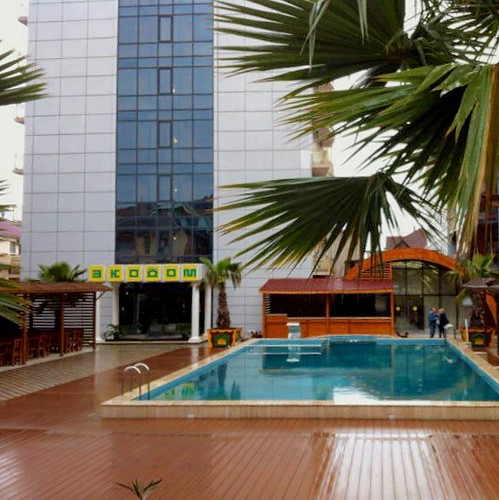
I've said it before, but that gig was HARD.  The hours were long, we were way behind schedule, and, as I mentioned before, the living conditions were not ideal.  There was one good thing about our hotel though - they did laundry, and they did it cheaply.  The fantastic posh hotel in Moscow also did laundry, but given that it cost about £6 to get a pair of running shorts washed I didn't use that service often.  At the good old Ekodom Hotel in Adler, getting a normal load of laundry washed, dried and folded cost about 70 roubles (£1.25). This was a godsend. Except, of course, there was a catch.  In Russia it seems there's ALWAYS a catch, though this one applied only to women.  I noticed it after I got my first batch of laundry back.
Ekodom Hotel
The Ekodom...

Everything seemed normal, but for one small oddity.  All of my underpants had been separated from the rest of the laundry, secured in their own plastic bag (knotted shut) and tucked in with the rest of the load.  I thought this was a bit odd, but at that stage I’d been in Russia long enough that this quirk was barely enough to register on the Russian Weird-o-Meter, so I took them out of the bag, shoved them in the closet, and got on with life.

Later that week I pulled out a pair of underwear and noticed that it wasn't clean.  “Odd," I thought.  "That one must not have made it into the laundry bag."  The next week I sent another bag of laundry in, including underwear.  Again, it came back with all underwear neatly sequestered, and this time I confirmed that NONE of it had, in fact, been laundered.  I marched down to the front desk with my bag of dirty underwear and asked them to please send it back because when I sent my clothes in to be cleaned I naively assumed that the people I was paying for the service would actually clean ALL of them.

The next night I stopped back to pick up my clean underwear.  And it's worth noting here that this was probably at about one o'clock in the morning, after a fourteen-ish hour day, so my nerves were slightly raw.  And then... then the truth came out.  Once again my underwear was not clean, but now there was an explanation (or what passes for an explanation in Russia). They simply didn't do women's underpants.  At all.  No exceptions.  Men's underwear was no problem.  Other women's undergarments were ok too.  But women's underpants?  No way.

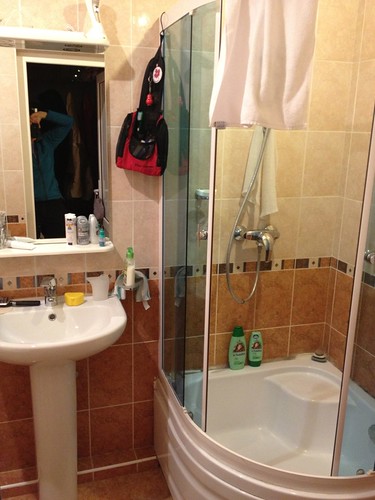
As I stood at the front desk, mouth gaping, trying to think of something to say, a female colleague who was also staying at the hotel said something to the effect of, "Oh yeah. The No Underwear Thing.  Didn't anyone tell you?"  Well, no.  No they didn't.  And what kind of a ridiculous freaking rule is that?  I trudged back up to my little orange shoebox of a room clutching my plastic bag full of dirty underwear and sat on the edge of my bed and tried hard not to cry.  "Typical," I thought.  "I'm working on the biggest show on earth, under huge time pressure in bizarre circumstances, and the thing that almost pushes me over the edge is the fact that they won't wash my knickers."  And then I snapped myself out of it, probably with the help of a drink.  And the next morning I filled the bathroom sink with hot water and dish soap and I hand-washed my underwear and hung it to dry in the shower.  And I did that every three days for the next ten weeks.
IMG_4571
The bathroom sink and shower in question

I can't remember whether we were talking about this exact little quirk of life, or some other equally odd happening, but I was having a conversation with a colleague about this sort of thing and he said one of his suppliers had coined a term for when he was confronted by the sheer bloody-minded, unbelievable frustration of it all.  "It's not rational," he'd say.  "It's Russian-al".

Truer words were never spoken.


On overcoming obstacles:

I've already mentioned the problems we had with food on the Olympic Park site. (But I didn’t mention this… one day in the canteen one of the dinner options included LIVER FRITTERS. Seriously?  How is that even a thing?)  And I mentioned my successful method for smuggling in food stuffs to help me survive.  It also happens that I had a reasonable stash of that most Canadian soul food imaginable - Kraft Dinner.  At some point along the way I realised that there were microwave instructions on the KD box, which was a revelation.  While I didn't have a microwave in the hotel room (they were forbidden, of course) we did have them in the office.  So I decided that I'd risk trying to smuggle in a box of Kraft Dinner.  I had enough boxes that if I lost one it wouldn’t be an unmitigated tragedy, and the idea that I might be able to stop for a few minutes and have a bowl of KD in the middle of the maelstrom was a powerful draw.  So I opened up the box and poured the macaroni into a ziploc bag (also imported from Canada) and shoved it into the toe of one of my big fuzzy socks.  The envelope of cheese powder went into the other sock, and both got twisted and turned inside out so that it looked like I was simply carrying two pairs of big fuzzy socks through the security checkpoint.  Perfectly normal, or at least normal-ish.
IMG_4632
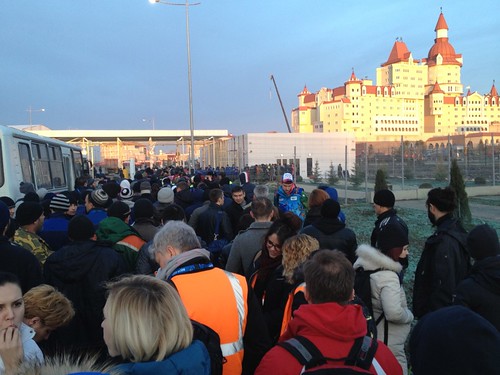
One of a number of exceptionally long queues to get through security.  We're heading for the small square white building.  The wacky castle is... well, we just called it Wacky Castle.  It seemed to be associated with an amusement park right outside the Olympics Park gates.

No matter, I got in.  (As I've mentioned before, the Big Fuzzy Sock Method was one hundred percent successful.  The only time I had food confiscated was when I forgot I had a Snickers bar in my jacket pocket, which really doesn’t count.)  Later that day, after a really tough afternoon, I finally found time to sit down and contemplate how to assemble my contraband KD.  I had a fairly large plastic tupperware sort of bowl (but a Russian one, so the lid didn’t actually stay on).  And we had water coolers that dispensed really hot water, so I was able to fill the bowl with the right amount of water and then pour in the macaroni in preparation for the microwave.

Of course this was the point of not return.  Once the macaroni hits the water there’s no going back.  No chance that I could change my mind and postpone.  It was now or never for that Kraft Dinner.  So I turned around to put my plastic bowl of happiness in the microwave. Except… the microwave was GONE.  Both machines that had been sitting on the table next to my desk for weeks had vanished.  I stood there, stricken.  A colleague noticed my expression and asked what was wrong.  (Or perhaps I just might have attracted some attention by exclaiming, rather more loudly than might have been appropriate, “Are you fucking KIDDING ME????”)  Whatever it was, I soon found out that the Russian catering department had decided to start feeding the cast hot meals and to that end had commandeered every microwave in the building and taken them to the rehearsal site to heat up food.  Of course.

So let's review:  I’d managed to get this Kraft Dinner all the way from Canada.  I’d smuggled it in my socks to get it on site.  I had the time, the bowl, the hot water… and yet still Russia had managed to thwart this tiny bit of homey happiness.  Once again, just like with UnderwearGate, I almost cried.  It really is the little things that kill you sometimes.

But wait!  This story has a happy ending.  It turned out that one lone microwave had survived the cull.  So I carried my precious bowl across the compound to the canteen, where I found the skankiest microwave I’ve ever encountered.  And I put that bowl in and watched it boil over.  And I cleaned up the boiled over sticky pasta water with a thousand paper napkins. And it boiled over again.  And I cleaned it up again.  And then I carried the burning hot bowl back to my desk and mixed in the cheese stuff and a bit of milk and mayonnaise (because I didn’t have butter) and damn, it was GOOD.

And actually, that’s kind of what it was like a lot of the time.  You’d expend a massive, ridiculous, disproportionate amount of effort to make something happen.  And then just when you thought it was sorted out, six other things would get in the way.  And you’d just have to put your head down and keep plugging, and eventually something pretty ok happened.
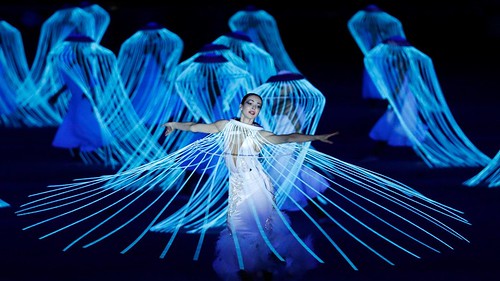
winter-olympics-opening-ceremony-photos.jpg
Like this.  These light-up spinning head-dress things were props, and despite numerous ridiculous obstacles, they ended up looking really cool.

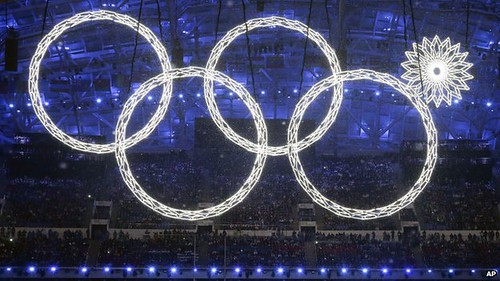
Thoughts on Russia

Sunday, April 27, 2014

First things first.  This was NOT my fault.  Not even my department.  Nothing to do with me.

_72839813_72839807
And the rumour that the guy responsible showed up dead in his hotel room the next day? Complete rubbish.

Moving right along... Hi!  I know it's been a while, but I did warn you.  Here's a bit of catch-up: I finished work in Russia on March 21, spent a quick weekend in Moscow with the lovely Moscow hashers, had a short stopover in a London to do laundry and re-pack, and then was off for a week of vacation in New York City, followed by two weeks of visiting with family in Canada.  I finally got back to London and unpacked my suitcase for what I hope will be a long long time just a week ago.  So the job ended about a month ago, and yet it seems like a hundred years.   For those of you who haven't been paying attention, I was living in Russia and working on the Opening and Closing Ceremonies for the Sochi 2014 Winter Olympics and Paralympics.  All of it feels impossibly, deliciously distant in a way that I wouldn't have believed when I was in the middle of it.  I arrived in Moscow at the beginning of August 2013 and I left at the end of March.  Eight months, including a punishing stretch of more than five months without a trip out of the country.

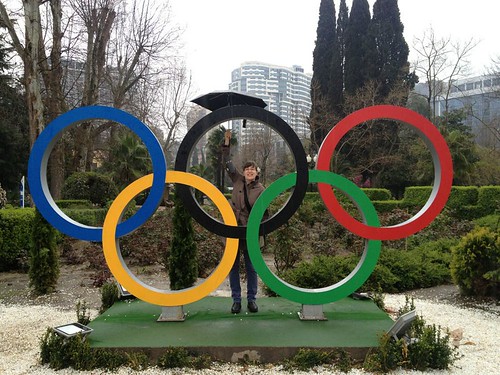
Me and the Rings
Me posing with some rings in Sochi.  I'm smiling because this was taken on the day before I left!

I'm struggling to know where to start.  Astute Go Stay Work Play Live readers will remember that I worked on the ceremonies for London 2012.  So this wasn't my first ceremony, and in many ways it was quite similar to London.  I suppose any ceremony is going to have the same elements.  Unrealistic schedules that shift continuously, gruelling hours, a determination to push the bounds of the possible, a scale that boggles the mind.  That kind of thing.  Maybe what I need to do is focus on what was different...

Different thing #1:

This will be stating the blindingly obvious, but did I mention I was in RUSSIA?  With the London ceremonies, even when it was crazy, I was still going home every night.  That was a huge comfort.  I slept in a familiar bed.  I cooked and ate normal food.  And on the rare occasions when had a day off, I had friends to visit and a normal life that I could dip back into, even if only briefly.

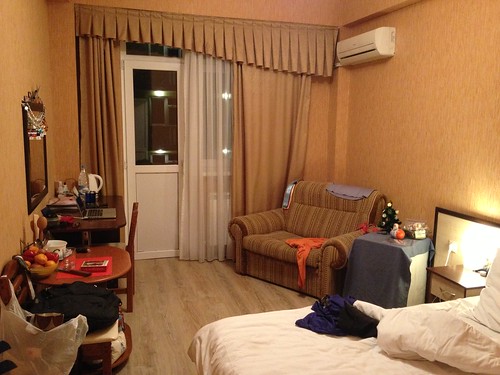
In Russia I lived for the whole time in various hotels ranging from gorgeously well-serviced (Moscow) to eminently pleasant (Krasnodar) to three star orange-wallpapered, saggy-furnitured shoebox (Sochi).

photo
The orange shoebox.  It was quite a come-down from Krasnodar and Moscow, though I did eventually make my peace with it.  Not that I had a choice.

Also, in London there were people in my life who had nothing to to with ceremonies.  I saw them occasionally when I dragged myself in from a long night and they were up finishing the end of a bottle of wine and I was reminded that normal life continued for some people.  In Russia I got on the staff bus in the morning with the same people I'd work alongside all day. We ate lunch together.  We ate supper together.  We moaned and complained together.  We waited for the bus home together.  And then when we got home to the same hotel, the only people to have a drink and unwind with were the same people you'd just spent the whole day with.  Luckily, there were many excellent people and I formed some really great friendships. But still, it was relentless and unnatural.

Different thing #2:

Once again in the blindingly obvious category, most people in Russia speak Russian. There was a large contingent of international English speaking consultants (me included... we were all there in what was technically called an advisory role...), and an equally large number of local Russian people, some of whom were bilingual and some who were not.  The Props Team in particular seemed quite integrated.  Our international and local Russian staff worked alongside each other every day, which happened less in departments that had mostly international staff and contractors.  And of course outside the office on the street, it was all Russian all the time.

"Wait a minute," you astute GSWPL readers might say. "Didn't you take a few month of intensive one-on-one Russian language lessons before you went?  I'm sure I remember a whining blog post about that…" Of course you're right.  I was one of a handful of international staff who had made an effort to take formal lessons (I think there were four of us) and it definitely made a difference.  By the end of my eight months I could make myself understood most of the time with out uni-lingual Russian crew, though I was largely limited to bread-and-butter stuff like, "After rehearsal we need all props in Tent B." Or "This is very very important."  Or frequently "I'm tied, hungry and cold." Not bad, eh?  Unfortunately, as is the case with my French, I speak Russian much better than I understand it.  So while I can phrase a comprehensible question, parsing the answer was often beyond me.  Nonetheless, it made a difference.

For instance, the Transport department had English and Russian staff, but it was the Russians who really held the reins.  So whenever I needed a truck for one of the endless back-and-forth moves of props from the stadium to the rehearsal venues and back (honestly, it was like we were doing laps with them) I had to speak to Transport.  Eventually the English Transport Manager just said, "Look, you just need to go across the hall and talk to Albina, because that's all I'm going to do anyway.  She doesn't speak English, but someone will translate for you." So across the hall I went and started to make my request in English, but when I understood some of the related Russian conversation and responded in Russian... well!  The transformation was miraculous.  Suddenly it was all, "You speak Russian! Sit down! Where did you learn Russian? What do you need again?"  I felt a bit like a dog walking on its hind legs, but on the other hand I never had trouble getting a truck again.  So there you go.  Like anywhere, if you make a little honest effort, people respond.

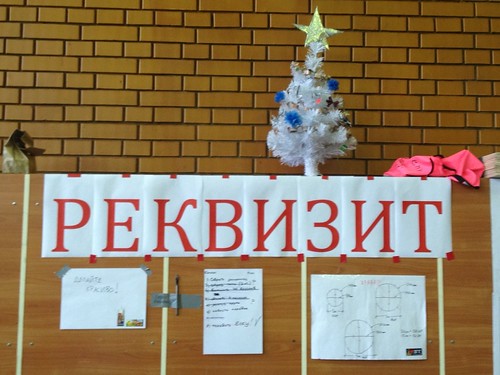
Props
A very important word!  РЕКВИЗИТ means PROPS, of course. (And the bushy white thing with a star on top is a ёлка.)

Different thing #3:

Food.  Or, to be more accurate, Lack of food.  In Moscow it was no problem.  There was the lavish breakfast buffet at the hotel and there were normal (-ish) grocery stores stocked with (mostly) familiar things.  In Sochi… not so much.  We lived in a little town called Adler, part way between the city of Sochi and the Olympic Park.  Adler is a funny town.  Its main reason for existence is to service Russian summer holidaymakers with its proliferation of bars and souvenir shops and its unfriendly rocky beach.  Being there in the off-season meant that it had a lonely and forgotten vibe

Beach
The beach, on New Year's Day.

Anyways, the supermarkets were not great in Adler.  And of course you might notice from the picture of my hotel room that I did not have a kitchen.  I anticipated this fact before arriving and actually bought a portable toaster oven sort of thing that I schlepped from London to Moscow to Krasnodar and finally to Sochi.  And what did I find out when I got there?  The hotel had banned all such devices.  Of course.

photo (1)
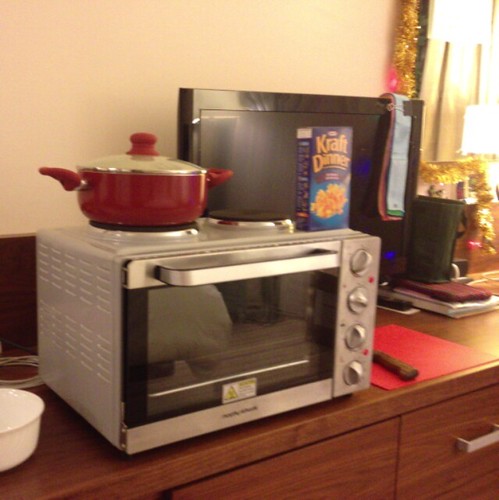
Here’s the device in action briefly in Krasnodar, cooking up a pot of Kraft Dinner on one of the two top elements.  It was a great appliance.

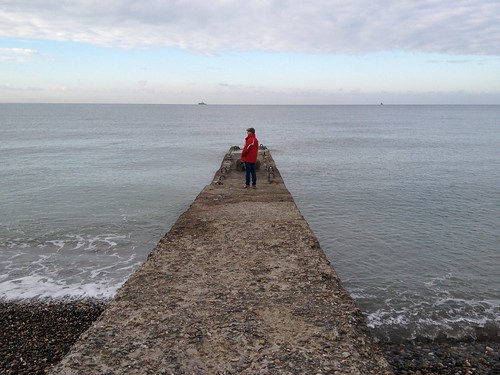
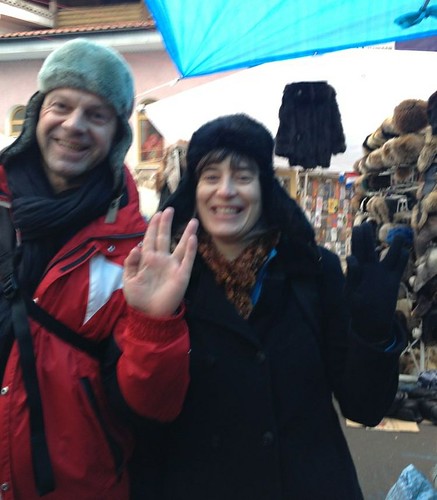
We never got a really clear reason WHY this was the case.  Sometimes they cited fire regulations.  Sometimes they claimed there wasn’t enough power.  Sometimes they said that you could use a device if it had an automatic shut-off timer, like a kettle or a toaster.  My next-door neighbour and partner-in-crime Gerald (pictured above, posing on the pier on New Year's Day) cleverly bought a multi-cooker that was like a quick crockpot sort of thing.  It seemed to tick all the boxes and we enjoyed one really nice meal out of it before it, too, was banned.

Add to this less-than-ideal hotel situation a total prohibition on bringing food or drink into the Olympic Park.  Total.  Every day we had to line up at the security gates for an airport-style x-ray and pat-down.  Every day people had food confiscated.  Some people even had packs of gum or breath mints taken away.  And sometimes this was after we’d stood in line for 45 minutes just to get to the point where they’d take your stuff.  It was really dehumanising. Most people developed systems for smuggling in small amounts of food (mine involved balling things up in a particularly thick pair of sock.  "What?  Food?  Nope.  No food here Mr. Russian Policeman.  Just some warm socks for later.  Yep.  Nothin' to see here...")  Even though I was one hundred percent successful in my smuggling efforts, it generally wasn’t enough to keep body and soul together which meant that at least once a day you’d have to take your chances on the staff canteen.

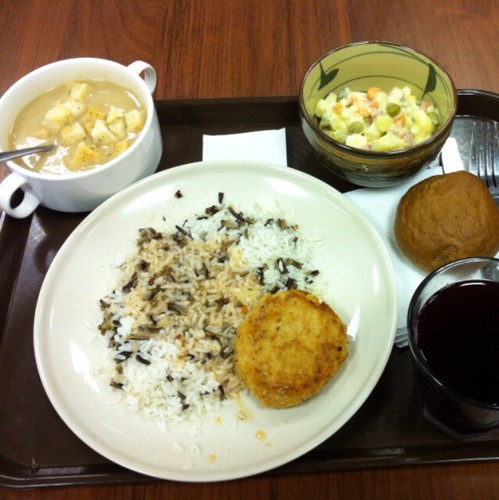
The canteen was... Overcrowded.  Overpriced.  Overcooked.   Just really disheartening.  The fixed price was 300 roubles (About £6 or $9).  For that you got a salad course, usually a choice of something heavy on the mayonnaise and potato, or a plate of scary sliced luncheon meat, or a bowl in which beets featured prominently.  Then soup (though only at lunch), which was usually thin and highly average.  Borsht.  Solyanka.  Creamed vegetable.  Meh.  The main course was usually the worst.  A few kinds of potato or rice, or sometimes a boiled vegetable. Plus a choice of some kind of dodgy meat product, often a sort of processed cutlet, or maybe fish, or maybe chicken.  It was all just maddening and nasty a lot of the time.

foto 3
Clockwise, from top left: cream-of-something soup, pototo-mayonnaisey salad, bread roll, glass of compote (a juice-like beverage) and a plate of rice with random sauce accompanied by processed meat cutlet of some kind.  Typical.  You wouldn't go hungry, but then again, you might just end up with scurvy.

In fairness, they did improve things after a few near-riots caused by crushingly long line-ups and inflexible opening hours.  Eventually you could get fresh fruit and yogurt and take-away pizza and real coffee.  But they never relaxed the food ban and it was always an issue.

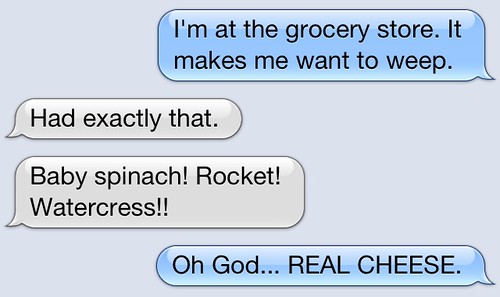
I could probably go on and on about the food but maybe that’s enough for now.  Just looking at those photos makes profoundly grateful that I can walk around the corner to a large grocery store where I can buy fresh spears of asparagus and sweet potatoes and spinach and, well, this exchange of texts with Gerald on my first day back kind of sums it up:

photo (2)
I don't know why, but Russian cheese is kinda awful.

So yeah, I think that's enough for now.  Enough to start giving you an idea of life in the Ceremonies Salt Mine that was Sochi 2014.  And enough to get me back on the blogging train. I might just skip ahead and tell you about my trip to New York next, or I might tell you some more random tales of Russia, but either way I'll try to do it soon.

It's good to be back.

From Moscow with Love, Part Two

Sunday, December 22, 2013

I've scraped up a few minutes to get this post together, but I think we all need to get comfortable with the idea that my blogging days are pretty much over until this gig is done.  I might get a chance to compose a few words over Christmas, but I'm not making any promises. (Especially now that Santa is scheduled to bring some very very very overdue props on Christmas Day, which will require immediate assembly and re-fit, thus effectively killing the three days off we were scheduled to have for the holiday.  Ho Ho Ho.)  For now though, let's look back on a rainy Saturday in Moscow, which seems like a lifetime ago.

When last we left our intrepid heroes (me and Gerald), we'd just strolled out of the Cathedral of Christ the Saviour and onto the pedestrian bridge across the Moscow river.  Our next stop was perhaps Moscow's most infamous landmark, a colossus of steel, bronze and copper unveiled in 1997.


The Peter the Great Statue was commissioned to mark 300 years of the Russian navy, and has been controversial from the beginning.  Certainly it's, err... large.  At 98 metres high it's the eighth tallest statue in the world, positively dwarfing the Statue of Liberty (a mere 46m, not including the pedestal) but falling well short of assorted Buddhas and emperors scattered about the Far East.  And I don't think anyone could challenge the assertion that the design lacks a certain... refinement.  It frankly bristles with spars and flags and assorted naval accoutrements, and Peter is weirdly outsized, making him look like he's riding a toy boat.  In 2008 it made a Top Ten list of the ugliest statues in the world.


Mostly, though, I think Muscovites hate the statue because Moscow is a very odd place to put a statue commemorating Peter the Great.  After all, Peter did move the capital of Russia away from Moscow (which he hated) to St. Petersburg, a city he named after himself.  So you can understand why Muscovites might be touchy about having a 300 foot tall black, spiky thing commemorating him in the middle of their city.  There's also a rumour that the statue was originally designed to commemorate the 500th anniversary of Christopher Columbus's first voyage, but was repurposed with a Russian theme when no American buyer could be found.  The designer - Zurab Tsereteli - denies this claim.  And, in an interesting tie-in to Part One of this blog post from a hundred years ago, Zurab Tsereteli was also one of the designers of the Cathedral of Christ the Saviour.  Apparently he was a great buddy of Yury Luzhkov, the Mayor of Moscow at the time.   After Luzhkov left office, the new city government offered to relocate the statue to St. Petersburg, but the good folks up north politely declined the offer.

Moving right along (and after a brief moment being trapped on the island that is home to the Peter the Great Statue) Gerald and I continued our rainy walk along the south bank of the Moscow River.  Our next stop was one we stumbled onto by accident, but turned out to be quite excellent.  Fallen Monument Park is an appropriately bizarre and unexpected little corner of Moscow situated in the green space surrounding the huge Tretyakov Gallery.  According to Wikipedia: "In October 1991, when the Soviet Union collapsed, smaller socialist realism statues of Soviet leaders and unidentifiable workers and peasants were removed from their pedestals, hauled to the park and left in their fallen form."


As you can see, they've now been reinstated.

Alongside the obligatory statues of Russian leaders, including lots and lots of Lenins and Stalins and a smattering of Kruschevs and even a Brezhnev or two, there were also some Pushkins and many other unidentifiable folks.  It was a marvellous place for a photo op, and since I was with a buddy I got a great shot of me, my fuzzy hat, and Lenin.  (Just for you, Rob H.)


And how could you not take a picture of this?

The statue park was a lovely unexpected find, and even though it was wet and cold, we had a great time wandering in the mud and posing.  It's definitely a spot worth seeking out the next time you've got an hour to kill in central Moscow.

Then a little further along, in front of the main gallery building, Gerald was compelled to take a photo of this:


We like to call this one "Does this hammer make my ass look big?"  
(Answer: No, no, a thousand times, no.  
And, Mr. Soviet Hammer Guy, are you free for drinks later?)

As the sunlight started to fade, we finally made our way into Gorky Park, our ultimate destination.  I'd been through the park on a couple of runs earlier in the summer, and was supremely impressed with the renovations they've done since I first visited Moscow only a few years ago.  Astute Go See Run Eat Drink readers will remember that Gorky Park was a sort of run down and seedy amusement park back then, populated by Whack-a-Mole games, the obligatory garden-sized train set, and one sorry camel.  I'm happy to say that the park has turned around completely.  In the summer there are big areas of lush grass covered with giant beanbag chairs.  And there are restaurants and concerts and bright lights and all manner of friendly diversions.  But in the winter? Ah, in the winter, it's even better.

I should have realised that the Russians would do winter well, as evidenced by the marvellous construction that popped up in Gorky Park sometime after the temperatures starting falling. The area that used to house the big beanbags is now covered in the largest outdoor skating rink I've ever seen.


This was just one section.  And I think that forest of coloured poles in the middle must have been some kind of light sculpture, though we didn't see it light up.

The whole ice area is surrounded by raised wooden walkways that let onlookers stroll around watching the action on the ice below.  It was fantastic.  Little did we know that the most fantastic part was yet to come.


LIGHTS!  UNDER THE ICE! Chasing, colours LED lights installed UNDER THE FREAKIN' ICE!  As a Canadian I tend to think we've got a bit of a monopoly of the celebration of winter, but Russia, I take my toque off to you.  That ice rink at Gorky Park was a revelation.


And just when I thought it couldn't get cooler, I realised that the ice extended for approximately 8 zillion miles, and ALL OF IT had those lights.  Seriously, seriously cool.
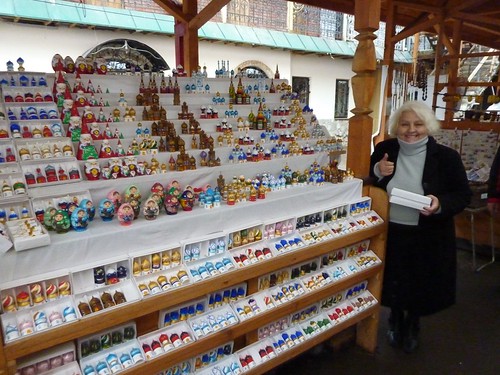
So Gerald and I strolled through Gorky Park, which was genuinely magical, especially after dark.  And we made plans to come back and skate, which never came to fruition, and we eventually made our way across a funny pedestrian bridge and back to the Metro, having walked about 10km in the cold and having had an unplanned but fantastic day in Moscow.

That Saturday already feels like a hundred years ago.  I've been in Krasnodar for 3 weeks now and will make the move to Sochi in just 8 days.  Krasnodar has been lovely.  There are shops and restaurants and cafés a short walk from the hotel, and we've finally got into a bit of a routine with rehearsals.  Of course this means that it's almost time to pack up and move to the next part.  That's always the way with these gigs.  You start a new phase and you scramble and rush to figure everything out and just when you start to get a handle on it, everything changes again and you're back to scrambling and rushing.  But first it'll be Christmas in Krasnodar, and a tiny bit of a break, and maybe even a turkey dinner and a bit of mulled wine and a few gingerbread cookies.

From Russia with love... or something

Sunday, November 24, 2013

The clock is ticking here in Moscow.  I'm scheduled to leave for Krasnodar on Thursday morning, and it seems quite possible I won't be back in Moscow again.  This is utterly bizarre to me.  How can it be over so soon?  How is it that I've done NOTHING?  I'm filled with regret about what I haven't seen and what I haven't done here in the city.  I think perhaps my expectations were unrealistic.  In that past I've always visited foreign cities as a full time tourist, free to determine my own schedule and pick from the menu of amazing things to do more or less at my leisure.  This kind of life really isn't that at all.  I'm here to do a job, and I'm doing it 5 or 6 long days per week.  In the small amount of time left, it's often been hard to muster the energy to go out and explore.  That's why I was so pleased to spend a full day out on the town last Saturday, with my new co-worker and buddy Gerald, who only arrived a few weeks ago.

Once again, the weather was grey, cold and rainy.  In fact, I genuinely cannot remember the last time we've had more than a hour or two of sunshine.  Certainly there hasn't been a drop of sun on a weekend since about August.  It's frankly a bit dispiriting.  Nonetheless, with a friend to share the experience with, it was much less annoying.  We started out at Izmailovsky Market, where I was able to show Gerald around like an old pro.  I picked up a few bits and pieces, including some nice linen tea towels with the days of the week on them (in Russian, of course!), and some little Christmas tchotchkes.  And because the weather was so cold, and we still had a lot of walking ahead, we both splashed out on big silly fuzzy hats, which made life way more comfortable.

Hats
The hat seller man clearly is not exactly Annie Leibovitz, so please forgive the fact that this photo is only slightly less fuzzy than the hats.  And yes, we're doing the Vulcan "live long and prosper" thing.  It's a long story...

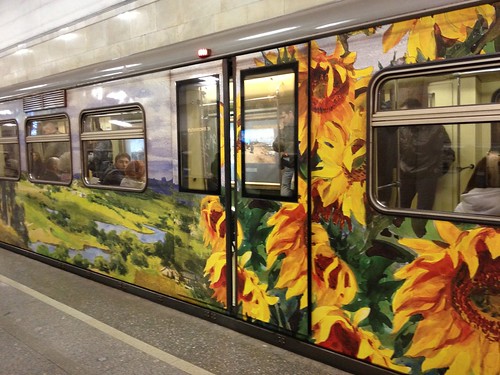
After the market, we headed back into the centre of town to do a long walk past a few of the big sights.  At the Metro we got an unexpected treat.  I've already told you that the Moscow Metro really is a work of art.  In this case, that was true in a very literal sense because the train that pulled into Partazanskaya Station to take us back to town was the Watercolour Train, an art gallery on wheels.

Untitled
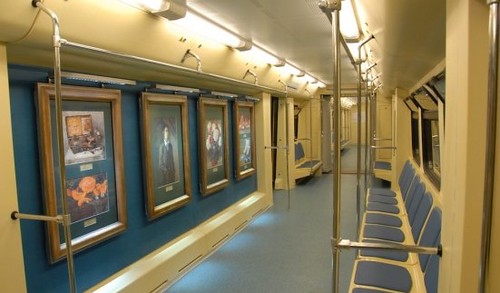
And it's not just the outside of the train that's pretty... oh no.  The outside is just the beginning.

851d582bb69966c2a7349254f2564e99
The cars are actually decked out like an art gallery!  Honestly, the Metro system might be the coolest thing about Moscow by a long chalk... 
(This is not my photo, but it illustrates things MUCH better.)

The lovely art train eventually dropped us off at Arbatskaya,  where we stopped to warm up with a cup of cofffee and then walked to the first stop on the agenda, Christ the Saviour Cathedral, on the banks of the Moscow River.  At just over 100m high, it's the tallest Orthodox Christian church in the world.

Untitled
A nice shot from the opposite bank of the river.  
Imagine how lovely that would be if the sun ever came out!

Judging by appearances, you could be forgiven for thinking that the cathedral has been there for hundreds of years.  And in a sense, that's sort of true.  The original was first conceived in 1812, in thanks for Napoleon's retreat from Moscow.  But as these things generally go, it was not actually complete until 1860.  Those of you who know anything about Russian history may be able to guess what happened next... in 1931, under orders from Stalin, the cathedral was demolished.  Stalin planned to use the site to build a grand monument to Socialism called the Palace of the Soviets.  The Cathedral was dynamited on Dec 5, 1931, after having much of its interior opulence stripped and sold or repurposed.  Apparently some of the marble benches made it into nearby metro stations.

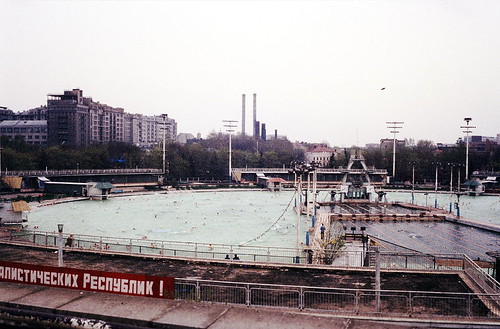
As is often the way with these big building projects, the grand Palace of the Soviets was delayed due to lack of funds (and flooding from the nearby river).  Eventually - and this is the best part - Kruschev turned the foundations of the Palace (all that was ever built) into the world's largest outdoor swimming pool.  (Honestly, you could just not make this stuff up.)
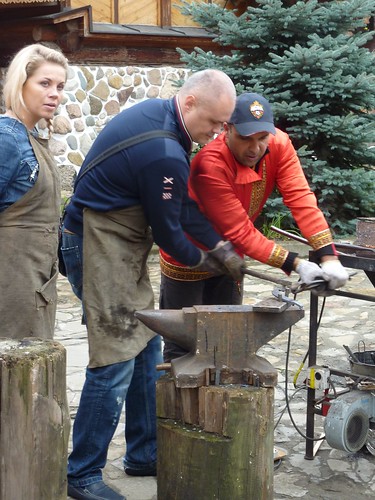
1024px-Schwimmbad_Moskwa
See?  How crazy is that?

It wasn't until 1990 that they finally got around to trying to rebuild the demolished cathedral and it wasn't completed and consecrated until August of 2000.  I find that very surprising, because it honestly looks like it should always have been there.  Also, cathedral building is just not the kind of thing you expect people to be doing in 1997.  Listening to "Candle in the Wind" and watching "Buffy the Vampire Slayer"?  Yes.  Building a gigantic Russian Orthodox Cathedral out of a swimming pool? Not so much.

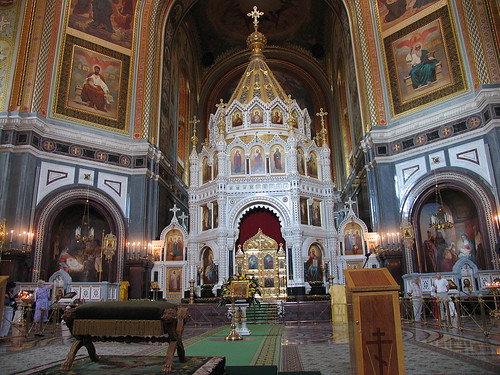
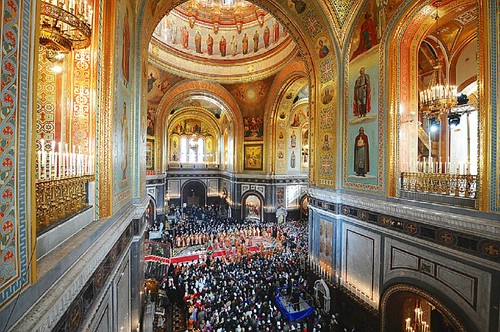
Christ the Saviour is, of course, a working church, so we observed the correct proprieties and put the cameras away.  Also, men must uncover their heads and women keep theirs covered, so Gerald removed his fuzzy hat, and I kept mine on, and we had a quiet walk around.   The pics below are from Google, and you can see how opulent and stunning it is.

1024px-Cathedral_of_Christ_the_Saviour_in_Moscow_04

We were there on a Saturday and the place was full of ordinary Muscovites, there to worship. In fact, it was these same ordinary Muscovites who helped pay for the magnificent building.  More than one million of them donated to the construction fund.

Orthodox churches are laid out very differently to non-Orthodox ones. (Is that the right term? Non-Orthodox?  It sounds weird.  Then again "Un-Orthodox" is worse...) Mostly, there seem to be individual shrines or icons or relics placed around the interior, and people were lining up to kneel before them or light candles.  I always feel like a bit of an intruder in these places, but there were so many people it was easy to blend in.

christ-the-saviour-cathedral
Apparently the cathedral is quite an accurate replica of the one that was demolished, which is nice.  Before I'd seen the place, when all I knew about it was that it was built in the 1990s, I was afraid it was going to be some kind of modernist nightmare, which, as you can see, is not even remotely the case.  Phew.

After we left the church Gerald and I continued our walk, though by that time is was actually spitting rain and the temperature was dropping even further and the sun was starting to set. Our path took us past a few other remarkable Moscow sights, but I think I'll save those for another time.  With my days in Moscow winding down, it'll be good to have a little something saved up to tell you about the next time I manage to scrape up a few hours of blogging time. No promises about when that will be, but we live in hope.

The Bolshoi

Sunday, November 10, 2013

Finding the time and energy to blog is becoming more and more difficult, as you may have suspected considering the dearth of new posts since I got back from vacation.  Luckily for you, I did manage to squeeze in a very very Russian activity a few weeks ago: I went to the Bolshoi Ballet!  I'm not sure how it was managed, but word went around the office before my vacation that tickets were being arranged and I put my name on the list.  They were not cheap (7,000 roubles), but it seemed ridiculous to be living in Moscow with the means and the opportunity to see the Bolshoi Ballet and to pass it up in favour of another night on the couch with the latest episode of Masterchef.  Weeks later that I realised I'd managed to double-book myself.  The Ballet was on the same night as a huge and legendary Halloween party I'd been invited to by some Moscow Hash House Harriers.  I was semi-gutted, but having committed to a £140 ticket, there was no turning back.  Also, it meant I didn't have to scramble around trying to cobble together a Halloween costume, which was a definite bonus. Then, after a few conversations with local ex-pats, I realised what a big deal it is to get tickets to the Bolshoi.  In fact, anyone I mentioned it to immediately replied with, "You went to the BOLSHOI?  HOW DID YOU GET TICKETS? I've been trying for (six months... four years... since Stalin was in power... blah blah blah)"  Here's the answer: I don't know how I got tickets.  Someone at work arranged it.  I think one of the Russian people in the office has a high-up connection at the Ballet.  When I sais this, people inevitably nod sagely, and understand.

Months ago when we were first starting, our lovely Russian team member Anna was trying to explain the relationship of a particular potential supplier or workshop or something to one of the producers.  She was clearly struggling to find the right English word because she finally said, "He is, umm, he is… do you have this word in English, umm… trusty-face?"  This was met with either blank stares or giggles, I can't remember which, but regardless it was mostly clear what she meant.  Apparently there is a word in Russian that translates literally as "trusty-face" and sort of means "someone I've worked with/ trust/ can call on for a favour" etc.  It's actually a very useful (and very Russian) concept, and one that has passed into the vernacular in the Props Department.  We've also expended it into the very useful acronym: MRTS.  For instance, months ago we were trying to figure out how to get a prototype made, struggling with identifying a workshop, and figuring out how to get the expenditure approved (impossible).  Then one day we were in a meeting and looked across the room to see the very prototype we'd been trying to get, sitting there on a table.  Where did it come from? The MRTS. Someone picked up the phone, called a trusty-face of theirs, and boom, one prototype.  It's the Magical Russian Trusty-face System.  To be fair, I think it's the same everywhere.  It's just the Russian version of the old adage.  In Russia, just like everywhere else, it's not WHAT you know…

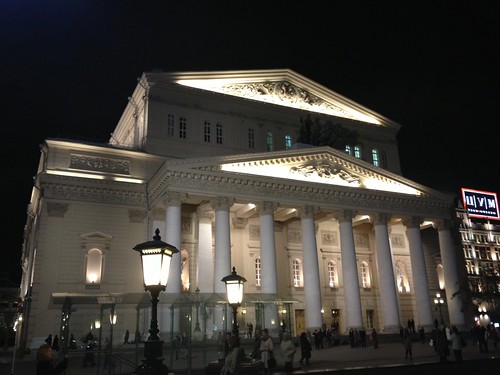
So that's where the ballet tickets came from: the MRTS.  And back to the Bolshoi.  The Bolshoi Ballet (which translates literally as "Big" or "Grand" Ballet) is one of the world's oldest and most prestigious classical ballet companies.  It was founded in 1776, though only rose to international fame in the early 20th century, during the Soviet era.  The ballet tours the world, but its home is the similarly-famous Bolshoi Theatre, opened in 1825.  The theatre itself is stunning, and recently re-opened after a six year renovation and restoration.  Seeing the Bolshoi Ballet anywhere is a treat, but seeing them in the Bolshoi Theatre is a big deal.
Untitled
The exterior of the Bolshoi Theatre.  Not bad.  If you were to turn 180 degrees, you'd be facing towards Red Square.

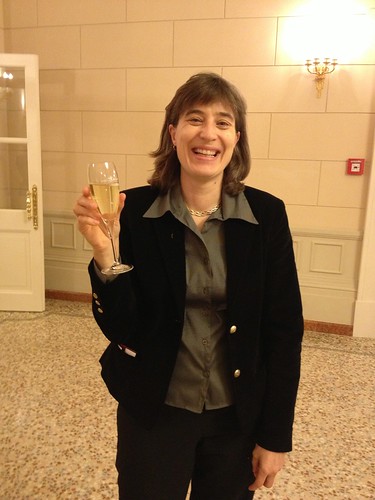
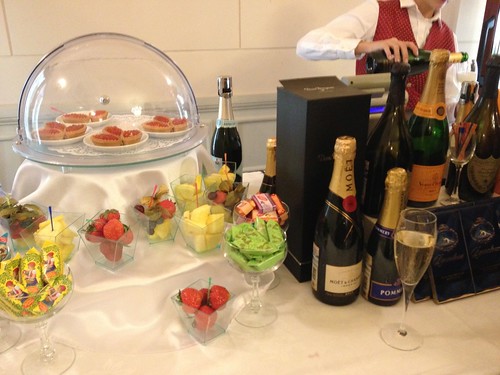
Luckily, I packed my dress-up clothes, so I was able to look more or less like I belonged when we set out from the hotel in a fleet of taxis.  We arrived just in time for a drink before the curtain, so we stopped in one of the side rooms for a glass of champagne, which seemed the only sane thing to do. That is, until I discovered that a glass of champagne (I think it was Moët) cost a staggering 1,350 roubles.  For these keeping score at home that is £27.  Or about $42.  That is not a typo.  They were also selling candies and strawberries and little open-shelled tarts filled with red caviar.  I shudder to think what they were worth.

Untitled
Me, with about $36 worth of champagne left.

Untitled
And the rest of the delights on offer.  Right next to this display was a RosBank desk offering short-term loans with quite reasonable interest rates.

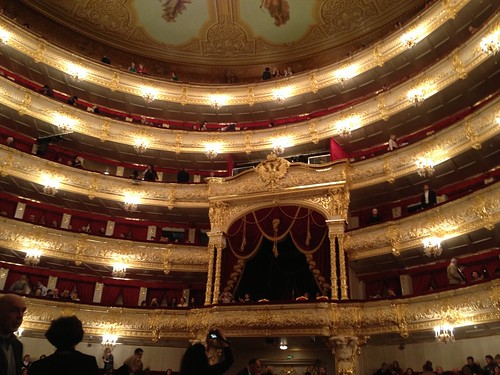
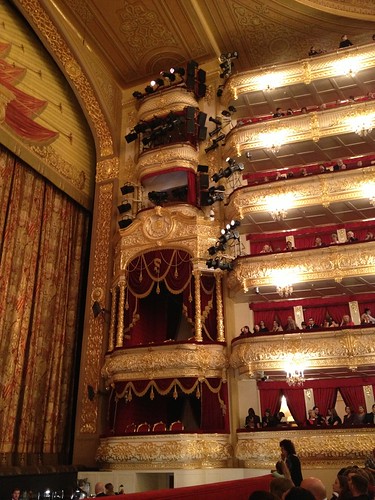
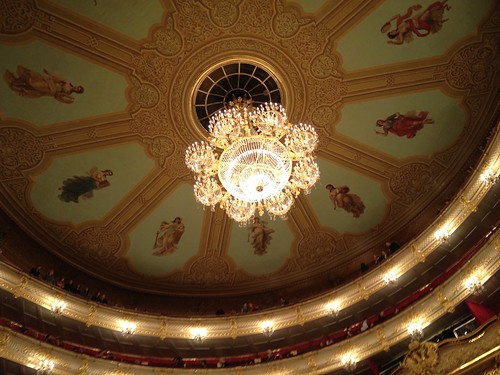
Irritatingly, the bell sounded almost immediately after these pictures were taken, meaning that I had to chug my liquid gold down in two slurps and head off to find my seat.  Luckily, once I actually entered the theatre, any irritation vanished because the auditorium itself is frankly stunning.

Untitled

Untitled

Untitled
These photos don't really do it justice, taken as they were with a shaky iPhone camera.  
But you get the idea.

But wait, it gets better!  My seat was in the SECOND ROW.  Not up in the back of the ninth balcony.  Not in the standing-room-only seats that came with oxygen tanks and safety harnesses.  The second row.  It was a-mazing.

Equally lovely was the fact that the ballet was accompanied by a full orchestra, in a very spacious pit, which included not one but TWO harps and five double basses, along with the usual classical assortment.  Excellent.

Untitled
The orchestra, warming up before the performance

"But wait!" I hear you cry.  "What about the actual BALLET?  You know, the reason for you being there?"  Here I have to confess that I am not actually a massive fan of ballet, or indeed of any form of dance.  However, I was lucky in that the performance we saw was one of Gisele, which has a strong storyline and a bit of a pantomime flavour to it, meaning that after I'd been clued up by the more ballet-savvy in the group, I generally enjoyed it.  There was still, you know, an awful lot of dancing, but on the whole, it was great.

Speaking of the ballet-savvy, I was surprised to hear from them during the interval that the woman who started the performance in the lead role of Gisele (the young peasant girl with a heart condition) (no, really) was not the same dancer who finished the act.  Apparently there must have been some big ballet disaster because the first dancer exited after a solo and was never seen again.   Also, the ballet experts were a bit sniffy about a few of the other soloists, who I have to admit did look shaky in some of the more challenging lifts and spins.   Then again this didn't really bother me, probably because I spent most of the first act looking at the thighs of the male soloists, which appeared to exhibit entire muscle groups I didn't realise existed. (Artëm Ovcharenko, you rock.)

As far as the production values were concerned, I have to allow that they were less impressive than I was expecting.  In fairness, the repertoire of the Bolshoi is staggering, so keeping all of the bits and pieces for all the different shows in good nick must be daunting. And I think that the sets and props for these kind of productions get passed around the world more or less endlessly, appearing for a year or two at the Bolshoi, then being rented to another company in Japan or Paris or San Antonio or Canmore until they pretty much turn to dust.  I noticed a few dodgey props, including one notably rubbery sword.  And I haughtily decided that the cut backdrops really needed a bit of steaming or stretching to take out some of the wrinkles, but all in all that was a mere footnote.  (Though I do have to reserve particular scorn for the very tacky chasing LEDs lighting effects built into the second act graveyard set, which blinked on an off like a cheap department store display while attempting to portray the foreboding arrival of the Wilis - the beautiful but deadly spirits of women jilted by their lovers.  Really? Blinky blue lights?)

Cheesy lighting effects aside, it was a thoroughly enjoyable evening.  Despite the comically never-ending curtain calls, and the crush of people at the mandatory coat check after the performance (the Russian definitely have a very loose grasp of the queueing concept), and the outrageously priced champers, and the rubbery sword and the Wal-Mart LEDs, there's still a undeniable level of elegance, sophistication, talent and fabulous old world grandeur that made the whole evening simply fantastic.  And in the end it was all over in time for me to hop on the metro and make it over the the Halloween Party while there was still witch's brew in the punch bowl.  All in all, a most satisfying evening.

More random observations

Sunday, September 29, 2013

What can I say?  It's still grey and chilly, and we're nearing the end of what purports to be the coldest and wettest September in Moscow since the 19th century.  And my head cold is lingering with quiet insistence, in the sort of way that make me think it's taken up semi-permanent residence and is now rearranging the furniture in my sinuses, browsing through take-out menus thinking about whether to have pizza again, and moaning that the TV reception sucks this far up in the nasal cavity and it might miss the new episode of "Downton Abbey."  In short: meh.  Nonetheless, I have a few observations I've made which I now share with you.

On the mutability of Russian Names

We've got an contact list at work which is, naturally, populated mostly with Russian names.  I had to look someone up a while ago and discovered something that any Russian will find as normal and obvious as 2+2=4, but which seriously blew my mind.  I was looking up the correct (Roman alphabet) spelling for the name Ogurtsova (Огурцова).  And there, right next to Ogurtsova was listed an Ogurtsov.  "Hmmm…" I thought.  "That's interesting.  We've got two people with almost the same last name."  And then I realised that Ogurtsova was paired with a female first name and Ogurtsov was paired with a male one.  The plot thickens…  I trolled through the whole list and discovered that any last name that ended in A was listed alongside a female first name, and (almost) any last named that ended in a consonant was listed with a male first name.  (The only exceptions were for last named that were obviously not Russian, like the Tanya Adams or something like that.)

I quizzed my local go-to person on all things Russian - my co-worker Anna - and she confirmed what I'd begun to suspect.  Last names in Russia are not fixed and immutable.  They change according to the gender of the person they belong to.  So your family name might be Semonov, and you'd call your son Dmitri Semonov, but if you have a daughter her name would be Tatiana Semonova.  I'm not sure why, but I find this disturbing.  It just feels wrong to think that a last name could be mucked about with so easily.  It was the same when I found out that Russian proper names are changed according to the case they're in in a sentence.   For instance, the city I'm in is Moscow, in Cyrillic:  Москва.  But what about this sign?

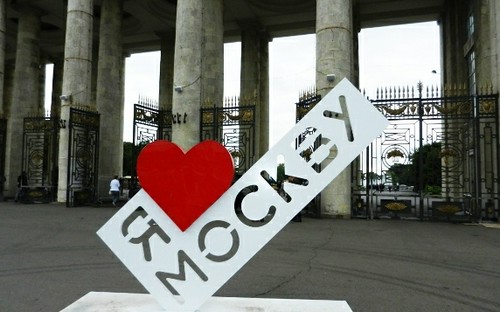
I heart Moscow
(This picture is included for illustrative purposes only.  I'm not at all sure at this stage whether I heart Moscow or not.)

You can probably all tell that this sign says "I *heart* Moscow", but why does Moscow have a Y at the end instead of and A?  Why is it Москву instead of Москва?  Well in this sentence, Moscow is the direct object of the sentence, so is declined in the accusative case, meaning that the last A is dropped and replaced with Y.  Simple.  (Note: Not really.)

And this doesn't just apply to places.  It also applies to people's names, and that's what I find unaccountably disturbing.  Getting back to young Dmitri Semonov… if we were to talk about Semonov's cat, his name would be declined in the genitive case and become Semonova, which makes him sound like his sister, except that his sister's name in genitive becomes Semonovы. (And now I'm mixing Roman and Cyrillic letters, which is just wrong, but I'm trying to illustrate a point.  Michael - if you're reading this: Sorry!).  And it's not just last names, it's all names.  Anna becomes Annы or Annе or Anny or Annой

My point is this - in English names are a fixed thing.  His name is Johnson.  This is Johnson's book.  We were talking about Johnson.  I went to the concert with Johnson.   Not so in Russian.   Linguistically, I suppose this makes the meaning of a sentence clearer.  And when you're looking someone up on a phone list, you can tell with certainty whether it'll be a soprano or a baritone on the other end of the line.  But I still can't help but find it unsettling.


On the Odd Habits of Russian Cashiers Regarding Paper Receipts:

This one is really weird.  There's a little ritual that occurs almost every time you buy something that produces a paper receipt.  I notice it most at the grocery store.  Just like at a store in the west, the products get scanned, the total is rung up and I dig out my roubles.

(Aside: Now I even remember to bring all the small change from the dish on my bedside table, which is normally mostly useless because roubles are one of those tiny currencies like Vietnamese Dong (Actually not nearly as bad as Dong.).  The smallest note - 50 roubles, is worth about £1, or about $1.50.  Coins come in 10руб (20p), 5 руб (10p), 2руб (4p), and 1руб (tuppence).  The now-mostly-defunct subdivision of a rouble is called a kopek, with 100 kopeks in a rouble.  50 kopek coins are common and sometimes you find 10 kopek coins, which are worth about 1/5th of an English penny.  Anyways, for some reason the clerks at the grocery store get really sniffy if I don't have small change, so now I take everything I've got and painstakingly count it out every week, thus thwarting their chance to look down their noses at me, at least about that one tiny thing.)

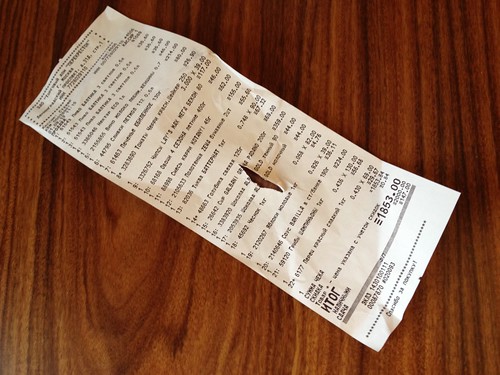
But back to the weird thing about receipts.  After I've presented my roubles and kopeks and the machine has spit out the long paper receipt, just before the cashier hands it over she will always put a tear in the paper.  Sometimes it's a big tear that goes halfway through the paper at the top of the receipt, or sometimes it's a small hole made by folding it over and making a tearing the middle.

Untitled
Here's one that's been torn in the middle.

This happens EVERY TIME.  It also happens in other shops, mostly smaller ones, but with enough regularity that it's obviously A Thing.

So what is The Thing?  Here's the best I can come up with, based on a bit of googling.  It seems that tearing the receipt somehow marks the transaction as "complete" and may go back to the Soviet Era when shopping was conducted differently.
Supposedly, this practice goes back to the Soviet days, when most stores had the merchandise behind counters and glass cases. To make a purchase, you would ask an employee to get the merchandise for you and prepare a sales receipt, which you take to a second employee/cashier. After you paid, you would take the receipt back to the first employee to pick up your stuff. Then that employee would tear the receipt, to finalize the transaction, and prevent customers from trying to come back and get a second item later for free.  (Thanks to Carpe Diem for this explanation.)
Another blogger even went far enough to uncover a Russian statute (Law Number 904 dated 1998) still on the books that apparently states:  "Receipts are considered closed with the simultaneous release of goods (rendering of services) and the use of a stamp or tearing [the receipt] in a specified location."

So there you have it. The grocery clerks are simply conforming to Law 904.  Which makes me wonder whether Law 905 is something like "Each transaction shall be further verified by the clerk or attendant looking sideways at the purchaser to indicate general disdain or disinterest."


On the Life Underground:

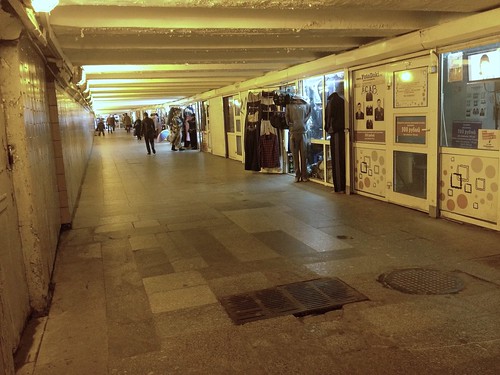
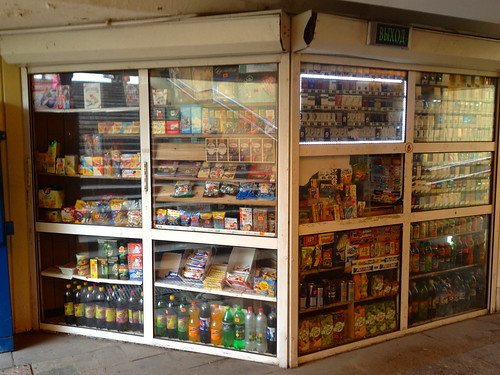
Moscow is a big city in many ways.  In particular, and I know I've mentioned this before, they are inordinately fond of very wide streets.  This would pose a problem for pedestrians, if weren't for the existence of another particularly common Muscovite phenomenon - the perehod.  (Переход.  Pronounced with that throat-clearing "H" heard in Loch.  "Pair-u-HODE")  A perehod is simply a pedestrian underpass that allows one to cross safely beneath a busy street.  But it doesn't stop there.  It's true that some perehods are quite plain (even, dare I say it, pedestrian!  Ha!).  But many, especially in busier areas or near metro stations, are lined with tiny shops selling just about anything.

Untitled
Here's a shot of the perehod leading to Dinamo metro, in my 'hood.

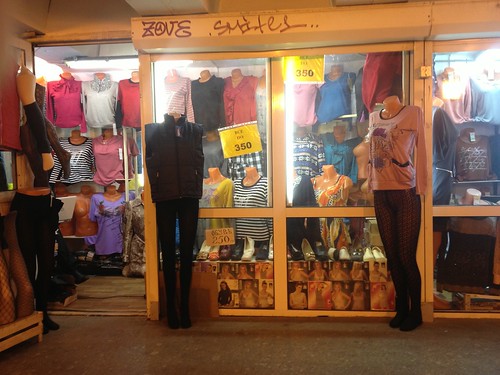
As you can see, it's not exactly Selfridges.  Ceilings are low, lighting is generally not great, and the shops are incredibly tiny.  In most cases I'd estimate that the square footage of an average kiosk in a perehod could be as little as 4' x 8-10', or maybe a bit bigger.  Certainly you'd never have the room to lay down sideways in most.

Untitled
A shop in my Dinamo perehod.  

Untitled
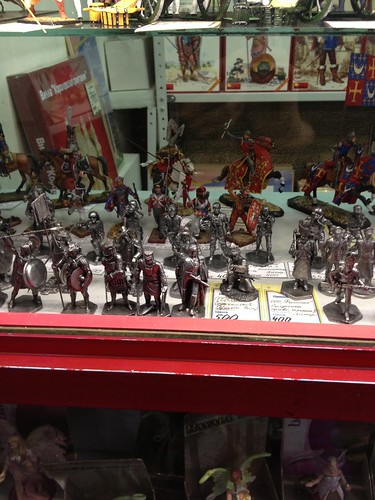
And I don't know about you, but the first thing on my mind on the way to the Lubyanka metro is not "Where can I pick up some nice painted miniature soldiers?"

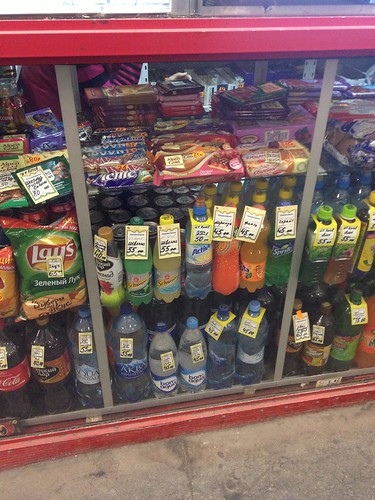
Most shops in perehods are far too tiny to admit patrons so usually the shopkeeper sits inside, with all his or her wares crammed into the windows on display.  Business gets transacted through a tiny hatch, which makes buying in a perehod somewhat intimidating for someone with limited language skills.  It means you really need to be able to describe what you want, because pointing can be tricky when the seller has no real line of sight to what you're pointing at.

IMG_4074
See what I mean?

Untitled

And what can one buy in a perehod?  Almost anything is the quick answer.  I took photos and notes at Dinamo and at another large perehod at Lubyanka metro, and here's the list I came up with: women's clothing and undergarments, purses and accessories, magazines and newspapers, jewellery, kids' clothes, umbrellas, ID photos, drinks and junk food, cigarettes, keys and locks, stationery and greeting cards, lottery tickets, mobile phone accessories, linen and bedding, watches, football souvenirs, fresh baked goods, real estate, pantyhose, batteries, electronics and flowers.  They're like a whole little subculture (literally sub-, in fact.)


And that's all for this week.  Next Saturday I'm off for a quick vacation in Canada and an even quicker stop in London to renew my visa.  And though I've only been here for a short time, I'm really looking forward to the break.  Let's all just hope that my sinuses smarten up sometime before I get on the trans-Atlantic flight.  Please?

Izmailovsky Market

Sunday, September 22, 2013

I'm writing this on Saturday and it's cold and wet (again) and I've got a bit of a head cold that's added a vague cotton-wool effect to the last few days, so I'm taking the day to relax. I'll hole up in my gilded cage and watch Moscow roll past from the rain-spotted window of the 16th floor lounge, while I think about attempting a large pot of stovetop Boeuf Bourguignon later this afternoon.  Perhaps after a bit of a nap.  Luckily, I was very industrious last weekend and so I have something to tell you about today.

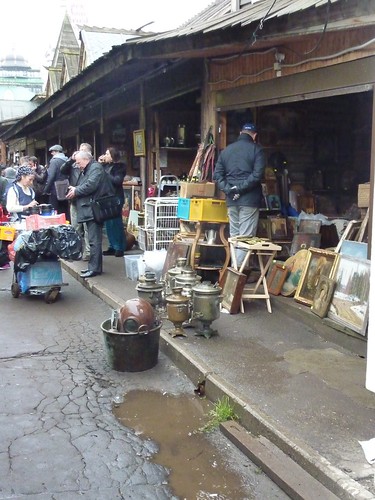
Last week was also cold and wet, but I had more energy and a purpose and less cotton wool in my sinuses, so I made the trek out to Izmailovsky Market.  Izmailovsky is a huge outdoor souvenir and flea market that's open all week, year round, but is definitely most popular on weekends.  The market is, like many things in Moscow, a bit large for comfort.  (Like the streets, for instance.  I suppose if they didn't need them 16 lanes wide they wouldn't build them that way, but that reasoning doesn't make it any easier to cross when you feel like you should stop for lunch half way through.)  Similarly, the market just keeps going and going, and being the thorough and dedicated blogger I am, I explored almost all of it.  I was also doing some very early Christmas shopping, so it was a good excuse to get into a lot of the nooks and crannies.

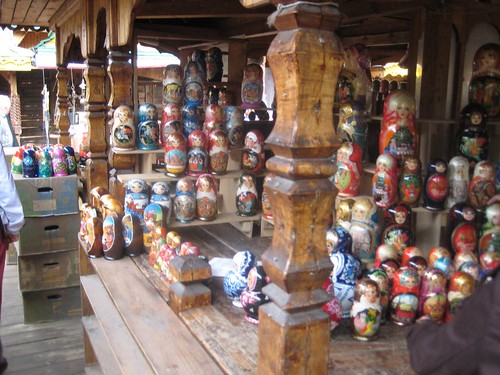
By far the most common item at the souvenir market seemed to be the traditional Russian stacking dolls called matryoshka. (Sort of pronounced ma-TROOSH-kuh.  Not to be confused with mashrutka - pronounced ma-SHROOT-kuh - which are privately run minibuses that operate alongside the larger public buses, but are cheaper and generally have terrible safety records.  Though come to think of it, it would be fun to have a matryushka set made up in the shape of mashrutka.  Ha!  A mashrutka matryoshka!  That would be excellent!  Ok, I'm finished with my little Russian spoonerism… back to the matryoshka.)  You know the ones I'm talking about:

IMG_3056
This is actually a picture I took the first time I visited the market… in 2009.
More on that later.

Tradition states that there should be an uneven number of dolls in a set.  Five is the most popular number, though I saw sets at the market that may have been ten or more.  And while the traditional matryoshka are painted with a female figure dressed in a colourful peasant dress, it's popular nowadays to paint them in all kinds of different themes.  Russian leaders are a common subject, and you often see sets that start with Lenin and work their way in through Stalin, Khrushchev, and Gorbachev, ending with a tiny little Vladimir Putin, which I find hilarious.  And the souvenir sellers definitely pander to the tourist market because you can get matryoshka for basically any NFL team you want, and Premier League football, and NHL hockey.  I even saw matryoshka of Star Wars, the Simpsons and Spongebob Squarepants.  I strongly suspect that it's not actually legal to leave Russia without purchasing matryioshka, so I stocked up to avoid any possible trouble.

Soviet-era memorabilia is also popular - stuff like reproduction propaganda posters and fridge magnets and postcards and such.  And there's a whole section of military stuff too.  Like if I'd wanted to pick up a handful of empty shell casings I'd have had no trouble at all.  The vendors tended to be reasonably friendly and open to a bit of haggling, though I'm terrible at that kind of thing and generally prefer to pay more than to press the point even a tiny bit. Still, even I got "a deal" on a few things.  And I was hugely impressed with the language skills of a lot of the stall holders.  I was shuffling through some posters or books or something and trading a few words of English with a seller, and then he turned to negotiate with another patron and switched seamlessly into Spanish, and spoke Russian with his boss.  Other sellers were the same.  I suppose it just makes sense, but I still find it impressive.  I recall this from my travels a few years ago, running into service people in the poorest places where a waiter or hotel clerk would hop around through English, French, German, Italian, Spanish, whatever. It's humbling, I tell you.  Especially when I have trouble just remembering my tiny Russian vocabulary.

(Language-related aside:  I am trying to use what Russian I have, but often when I do I'm stymied by my tiny vocabulary and I feel very inadequate.  Sometimes when this happens to cheer myself up I'll construct the sentence in my head in French, which is much much easier, just to prove to myself that I'm not as thick as I feel at the moment.)

Untitled
A lovely, helpful vendor who actually didn't speak much English, but was infinitely patient with my halting Russian

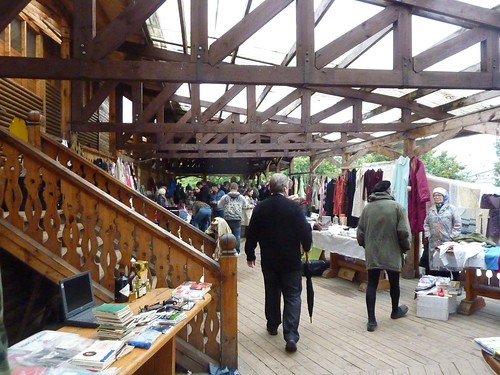
Back in the market, I was pleased to discover the more interesting upper level, which is built up on a huge wooden platform accessed by semi-hidden stairs from the more touristy lower level.  Making large structures like this out of wood seems to be pretty common here, and it gave the whole place a really cozy feel.

Untitled
Here's a shot of the upper level

That higher level is where the real flea market part is - lots and lots of smaller stalls that seemed like the world's biggest Garage Sale (for UK readers: Car Boot Sale, or kind of like the tatty northern end of Portobello Road).  Some people were quite organised, in proper divided booths.  Other smaller traders just had their wares spread out on a sheet on the floor.  And there was a whole section I skipped that was all framed artwork - paintings and such.

Untitled
Spot the cartoon copper diving helmet!

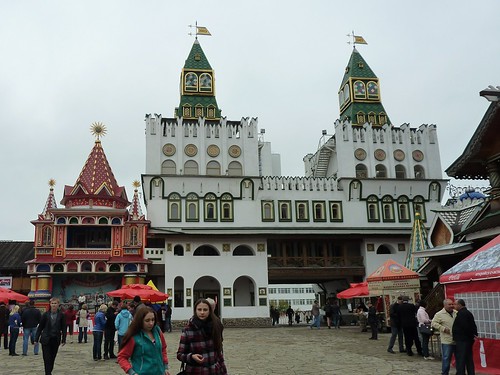
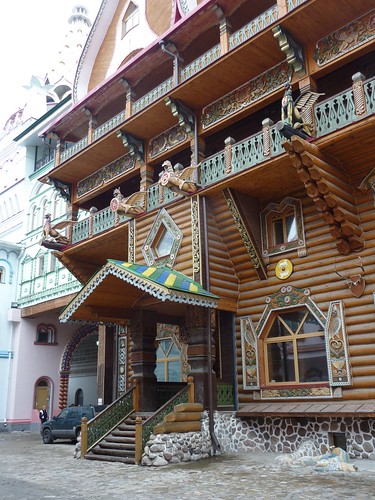
I made one or two small purchases in the flea market, but the best part about the upper level was that it also led to a whole different attraction - the Izmailovo Kremlin.  Those of you who haven't read my my other blog may not remember that "kremlin" is actually a somewhat generic word for castle or fortress.  So while we refer to The Kremlin and mean the-big-walled-fortress-in-the-middle-of-Moscow-next-to-Red-Square, in fact there are kremlins all over Russia.  So asking someone who's visited Russia, "Did you see the kremlin?" is a but like asking someone who's visited England, "Did you see the castle?".   Izmailovo Kremlin is a bit weird.  I definitely don't recall this kremlin from my visit in 2009, but it turns out there is an excellent reason for that.  A quick consultation with the Lonely Planet Moscow reveals that the whole Izmailovo Kremlin complex is completely fake and has only been there for a few years. This goes a long way to explaining why the whole place feels sort of like Medieval Russia Disneyland.

Untitled
It's all much too new, clean, and brightly coloured to be anything but fake.

Then again I was quite charmed by it all, probably because I wasn't expecting it and it made a nice change from the endless miles of people hawking tea towels with Lenin's face on them and kalishnikovs and such.  The Izmailovo Kremlin is a series of connected buildings arranged around a big central courtyard that you enter through a whitewashed tower.  Inside are shops and restaurants, and an outdoor stage, more small market stalls, and a water feature and bridge and pony rides and people dressed up like Cossacks and, well, all kinds of odd and quirky things.

Untitled
Like the blacksmithing demonstration.

Untitled
And the Vodka Museum

Untitled
And the giant wooden… er hotel? Conference Centre?  I dunno.

Untitled
And the metal tree provided for loving couples to attach padlocks to, and then throw away the key.

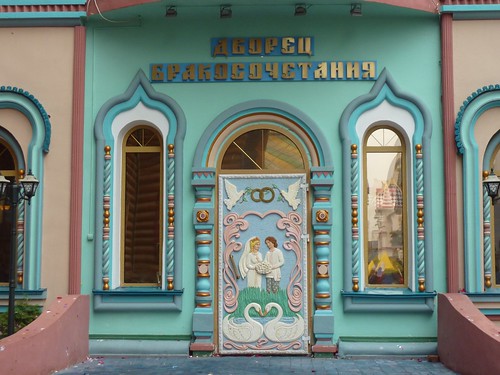
Untitled
And though the translation escapes me a bit, I'm pretty sure this is a wedding chapel.
This assumption is also based on the fact that the place was positively heaving with newlyweds and wedding parties.

I really enjoyed soaking up the crazy atmosphere in the Izmailovo Kremlin, and bought a few more trinkets, and a nice cup of very sweet hot spiced mead with honey, and paid 20 roubles to use the toilet.  I even poked my head into the Vodka Museum, though I didn't bother to pay the entry fee for the whole deal, I just nosed around in the gift shop.  By that time I was getting tired, and my wallet was almost empty, and my shopping list was taken care of, so I started to wander back to the metro.  It was only then that I realised the market is right next to the hotel I stayed at when I visited on an Intrepid tour in 2009.  I'm not sure how I managed to NOT notice this on the way in considering that I think the hotel is the biggest one in Europe.  It was a bit weird looking at it all again from this new perspective.  I distinctly recall visiting the souvenir market with my roommate from the tour group when we had a few hours to spare.  That was back when I was in No-Souveniers mode, so I contented myself with getting a tiny keychain matryoshka which is still with me today.  And I remember going for a run in the park across the road from the metro station, and I remember the little shop where I bought beer and potato chips on my first night in Russia.  What an odd thing... to be living in Moscow in the first place, and then to end up stumbling into a wistful moment of deja-vu.

And now it's time to fire up the stove and get a big pot of something warm and filling on to simmer.  And there's also the small matter of that nap...

GRUB! Pelmeni

Sunday, September 15, 2013

I have not been bowled over by Russian cuisine yet, but maybe that's because I haven't eaten much typically Russian food yet.  And, given their fondness for dill and propensity to add sour cream to almost anything, I suppose it was inevitable that eventually I'd find something that appealed to me.  Such was the case when I picked up a bag of frozen pelmeni in the grocery store.  (Pronunciation note: it's pell-men-ee)

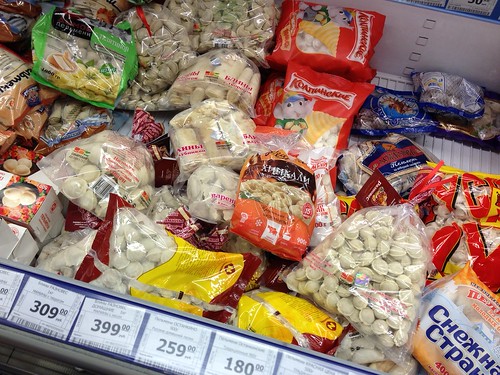
Pelmeni in the freezer
The pelmeni and other assorted random frozen things.

Pelmeni fall into that vast family of food that arises in almost every culture - the small package of something flavourful wrapped in thin dough.  It's Russia's contribution to the the wonton/ gyoza/ ravioli/ perogy/ kreplach category (a sub-category of boiled/steamed dumpling that falls into the larger clan that includes samosas, empanadas, and even stretching to Cornish pasties, calzone, sausage rolls, Jamaican patties, Pizza Pops and… well I could go on and on.)  Pelmeni are usually round and the ones I got were about an inch across, though apparently they're often larger - up to about two inches.  They're stuffed with ground meat, in my case a combination of beef and pork, but sometimes mushrooms or even fish.  And the dough casing is supposed to be quite thin, making for a pleasing ratio of dough to filling.

Pelmeni
The frozen pelmeni, ready for the pot.

Apparently pelmeni are well-suited to freezing, and often associated with Siberia, where they were preserved by the simple expedient of leaving them outside (probably for about 15 seconds). I just thought they looked at lot like tortellini, and I was planning to do something pasta-ish with them.  When I got them back to my room I thought I should look up what one is really supposed to do, which, as I suspected, does not normally involve pesto.  It turns out the usual method is to boil them in broth to make soup, which sounded a bit dull.  I elected to ignore that and treated them like tortellini, and they were FANTASTIC.  You know how toretllini and ravioli can often have a sort of indeterminate mushy filling that's kind of hard to place?  Pelemni have none of that.  A pelmeni might look like tortellini on the outside, but inside they're denser and chewier and the meat is coarser and more flavourful.  In short, they are scrummy and I devoured a bowl of pesto pelmeni in short order, with little regard for the monumental culture clash I'd just created.

Later in the week I tried something a bit more traditional.  They weather has turned autumnal and I was looking for something quick to make after work, and also looking for any excuse to eat more pelmeni, so it seemed a great time for soup.  Here's an odd thing: you can't get canned soup here.  You know the aisle in the supermarket that's lined with cans of Campbell's Chunky and generic chicken noodle and scotch broth and cream of tomato and all? That doesn't exist here.  At first I wondered if I was just shopping in a particularly crap place, so I consulted with the one Russian native on our team at work.  Anna is my go-to person for all questions of Russian culture, language and cuisine so the fact that she was puzzled by the very notion of soup in a can confirmed that this deficiency is, in fact, normal. This doesn't mean you can't get soup in a grocery store, it just means you're limited to envelopes of dehydrated soup only.  There's a reasonable selection of dehydrated stuff, but it's all in that Lipton-Cup-a-Soup sort of style, meaning that you only every get little cubes of unidentifiable vegetables paired with those skinny short noodles that added together make it look like you're eating a bowl of punctuation marks.  In fancier stores you can also get fresh soup in plastic pots, but the familiar can of condensed soup is absent.

So back to my mid-week supper.  The soup came from an envelope, which meant it was a very simple thing to throw the dry soup, frozen pelmeni and some extra frozen vegetables into a pot of water and cook up a reasonable supper in very short order.  Here again, the pelmeni shone as an excellent addition, and really made the soup into a meal.  It was also yummy and filling the next day for lunch.  Two points for pelmeni.

Anna was pleased and impressed that I'd embraced this little bit of Russian food culture so heartily, and told me that if I liked pelmeni, I had to try varenyky. Ha!  I grew up in Saskatchewan, which has almost as many Ukrainians as Ukraine, so the notion that a varenyky (or perogy) might be something unknown and exotic is a little bit like suggesting that I might enjoy watching a game of the fast-paced winter sport known here as Хоккей.

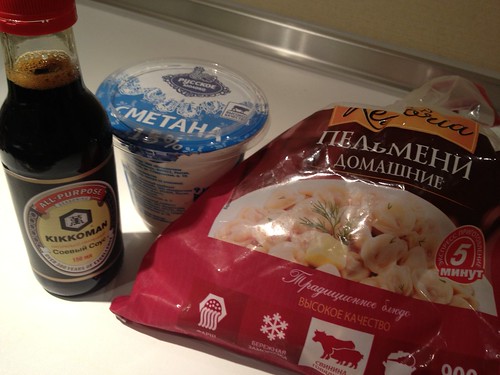
In any case, Anna told me her favourite way to have pelmeni, which agreed with several accounts I'd read online, so it seemed clear that this was a method that needed trying out. Basically, the boiled pelmeni are drained and then fried in a pan, and served with Russian sour cream, called cmetana (with a soft c, "smetana") and, oddly, a dash of soy sauce. Apparently this is often done with leftover pelmeni that were cooked in broth the previous day (though the notion that there might be "leftover" pelmeni is difficult to believe.)  One person online even commented that despite the fact that he greatly preferred the fried option, his Russian-born wife insisted that the first batch must be eaten in broth instead of skipping directly to the fried version.  Luckily, I have no such compunctions, as must already be evident, given the culture-blind pesto-pelmeni combo described above.  Off I went to the grocery store to pick up some cmetana and soy sauce.

Pelmeni

Cmetana seems to be a pretty big deal.  Where sour cream takes up one section of one shelf in the average North American dairy case, the cmetana section in my local shop is roughly 10 times that size.  And it's not exactly like North American sour cream either.  I got the slightly-less-fat version and can report that it's not so tangy as sour cream, and is thinner and smoother.  More like creme fraiche.  The milder taste is quite nice, and I also enjoyed it on some fresh figs I had for dessert, along with a drizzle of warm honey.  (And can I just say that 6 fresh figs cost about £1.50 which is bloody brilliant.  And honey is a whole other world here.  I really need to blog about honey…).  But back to the fried pelmeni.

Pelmeni
Here it is, in the pan.

I have a touch of my Mom's propensity to muck around with recipes, so I added some onions and sliced mushrooms to the pan (reasoning that fried perogies without fried onions are a crime against God and Man and pelmeni probably fall into the same category).  I cooked the pelmeni in a pot of salted water, drained them, and tossed them in the pan for a generous amount of time until they got golden brown and delicious.  Then, a generous dollop of cmetana and a splash of soy sauce.

Pelmeni
And here's the result

Unsurprisingly, it was excellent.  What's not to like? Chewy, sausagey dumplings, FRIED, with onions and mushrooms and SOUR CREAM, and a bit of salty seasoning?  I ask you, what could be better? (This, and the figgy dessert described above just go to bolster my long-standing conviction that there is no food that is NOT improved by the addition of sour cream.) I hoovered through the bowl in record time and had to hold myself back from a second helping.  I did manage to restrain myself, meaning I had a few leftovers for lunch the next day, which was exactly what I needed after a long and chilly afternoon of Christmas shopping at Izmailovsky Market.  Which is definitely a story for another week.

Happy Birthday Moscow

Sunday, September 8, 2013

I actually did proper bloggy things this weekend!  In fact, it was a bit of a two-for-one deal. A colleague at work recommended the Contemporary History Museum a few weeks ago, and it seemed like the perfect destination given that the weather this week has been positively sodden, meaning that a big indoor museum sounded like just the ticket. Also, the museum recommendation came with the report that the place was home to a truly excellent telephone, so how could I not go? (Yes, telephone.  Look, three different people waxed rhapsodic about this phone, so it seemed like the kind of thing that should be seen.)

However, by the time I got out of the hotel on Saturday morning and then escaped the mobile phone shop where I tried (unsuccessfully, of course) to top up the data plan on my iPad, the weather had turned quite pleasant.  When I emerged from Tverskaya Metro to head for the museum I was greeted by dry skies, which made me less inclined to dive into a dusty museum.  Also it was clear that something interesting was afoot, because the sidewalks were all barricaded off from the street.  Of course!  Saturday was Moscow City Day, the annual celebration of Moscow's birthday.  This year the city turns a spritely 866, and in celebration they'd obviously blocked off the street for a parade.  This conclusion was bolstered by the proliferation of marching bands milling around on the street obviously waiting to get started.

Untitled
Tverskaya Street desserted... eerie!

I asked around (in Russian, even) and determined that the parade was going to start in only half an hour so it seemed downright silly to miss it, especially given that the sidewalks were almost deserted so a prime parade-watching spot could be had easily.  I waited around until things got underway, which they did almost exactly on time (a bit of a surprise).  The parade seemed to be an international showcase of marching bands, as evidenced by the display of flags at the front.  In fact it turned out to be nothing but marching bands, so I'm guessing maybe it was some kind of competition, but really I have no idea.  This is one of the sometimes fun, sometimes annoying things about venturing out into a foreign city.  Stuff happens around you and you often have only the vaguest notion of what's going on. It's best just to go with it.

The Russians started things off, naturally.  Then I watched the Finns go by, and then the Austrians.  But the the highlight was undoubtedly the arrival of the UK contingent, resplendent in kilts and audible from a mile away.  The bagpipes had arrived!

Untitled
Kilts! Bagpipes! Moscow clearly needs more of this.

Annoyingly, it seemed that the organisers had a rather imprecise grasp of the concept of a "parade" because the bands kept stopping for long periods, which really killed the mood.  And then there was the Chinese delegation, which was inexplicably made up of a group of men with absolutely no musical instruments at all who simply marched along carrying big sticks.  What?

Untitled
The Chinese.  Noticeably lacking in bagpipes.

Nonetheless, the pipers got my blood going and I was feeling like if it was a competition then the Brits had things in the bag.  That is, until I came upon the troops from the United Arab Emirates who not only had bagpipes, but also trombones and saxophones and all manner of drums including something that looked sort of like marching bongos.  It was deliciously weird. I mean first of all, UAE? They're not exactly known for their marching band culture are they? And then the instrumentation... Fantastic.

Untitled
The UAE marching band.

When I finally tore myself away from the mesmerising combination of bagpipes and bongos and made it to the museum, I was a bit choked up to be charged for two tickets so that I could take photos. Apparently the camera needs its own ticket. (And why was I charged 250 roubles for each ticket when my colleagues had paid about 150 per person?  Honestly, the things I do for this blog...) Then again, there was the promise of the fantastic phone ahead, so I carried on.

The museum is housed in a huge pinkish building on one of Moscow's main roads. Formerly the home of an aristocratic Russian family, then the headquarters of the English Club, the building is quite lovely by itself.  The exhibits trace Russian history from about the start of the 20th century through to Perestroika.  All of the commentary on the exhibits is in Russian, but most rooms offered a short page of English to describe the contents of the room, so I wasn't completely lost.

Untitled
The English Club library room.  Not bad.

I found the beginning a bit dry, but as the subject matter turned to the Revolution, WWII and beyond, things got more interesting.  Interesting enough that I made the mistake of leaning slightly too far into a replica display of an office for the Supreme Worker's Industrial Fabrication Collective (or something like that) and tripped a motion sensor that sounded a very very loud alarm.  Oddly, none of the many security guards in the place paid the slightest notice, and later on when I had moved further into the museum I heard the same alarm sound again, so obviously they just ignore it now.  (Marginally related aside: The office and the hotel both have metal detectors at the doors and every time anyone goes through, they buzz.  Every time.  And I've never seen anyone pay the slightest notice.)

Untitled
The office display.

But back to the museum.  Naturally there was a generous helping of great propagandist stuff, and I took a lot of photos so that I could get my 250 руб worth. (All photos, including ones of the parade, are over at Flickr in a set called "Moscow City Day", including bagpiping video!)

Untitled
For instance, there's this great replica of the famous statue of "Worker and Kolkhoz Woman".

Untitled
And what's the point of being a brutal dictator if you can't have your face on a three foot high ceramic vase?

Untitled
Or a nice Avant Garde commemorative plate.  And now that I look a bit closer at that, err, banner... tea towel... tapestry... whatever it is... see the bottom left corner? I'll be you dollars to blini that hole used to have Stalin's face in it.

Untitled
There was a good room about the Space Race.

Untitled
And I think this was my favourite exhibit.

By the time I got all the way through Perestroika I was getting a bit peckish and thinking it was time to head for the nearest café.  That's when I rounded the corner expecting to find more displays or, ideally, the stairs back down to street level.  Instead I was confronted with a darkened hallway and a plastic folding chair unceremoniously blocking the way.  The handwritten sign on the chair said, "Sorry, there is no exit". Of course.

Luckily, I didn't mind having to make my way backwards thorough history to find the way out because on my first pass through I'd managed to completely miss the World's Coolest Phone. It was smaller than I was expecting, but still quite excellent.

Untitled
The promised phone.  The receiver is a hammer and the cradle is a sickle!

On my way out I also cruised through a display of Soviet propaganda posters and a truly bizarre exhibition of photographs.  It was called "Good and Evil", and was sponsored by TV channel.  As near as I could tell it was all photos of celebrities made up to look like characters from fairy tales or stories, each with elaborate makeup, costumes and backdrops.

photo.JPG
Olga Drozdova as, well, I'm guessing she's Pinocchio, right?  There were also two different photos of two different guys playing Gollum, and a vampire, and a Baba Yaga and a group that looked like the Adams Family and, well, you sort of get the idea. Or more likely you don't, so welcome to my world.

This is the kind of thing I was referring to earlier.  Stuff happens around you and you often have only the vaguest notion of what's going on.  Maybe if I'd been able to read all the accompanying signage it would have made some kind of sense.  Coming as it did after the Unites Arab Emirates Bagpipe and Bongo Corps, the space-going pooch and the chrome-plated jingoistic telecom equipment, it was a bridge too far for me.  I made a hasty retreat (after stopping in the gift shop for a bit of early Christmas shopping) and then decamped to the nearest café for a very large coffee and a bit of what passes for normality these days.

And so passes another week in Moscow.  I miss the bagpipes already.