Fourteen Days

Sunday, April 12, 2020

As I implied in my last blog, there’s more to say about my walking weekend in Dorset. But just like everyone else on the planet my life is upside down these days, so I'm publishing this earlier than my self-imposed loosely-followed bi-weekly schedule. For me, upside-down life manifested itself in a last-minute dash back to Canada to lock down closer to family, which meant I had to self-isolate for fourteen days after I arrived. Luckily, I was able to book a very comfortable AirBnB with a helpful and accommodating host where I hunkered down. (I hasten to add that said host was also fully informed of my potentially virulent status as a foreign traveller, and the possibility that I would be slathering every surface in the house with the plague.) And because there aren't enough lockdown diaries these days, here's mine. Just be thankful this is my outlet, as opposed to me contributing to the apparently infinitely-expanding body of YouTube videos of people re-writing songs from Broadway musicals with Covid-19-inspired lyrics and then performing them with family members and home made props. You're welcome.

IMG_3025
Monday

Arrived late in the evening on Sunday, so I’m calling Monday Day 1, as reflected in the thoughtfully-provided inspirational message from my AirBbB hosts. Spent most of the morning unpacking and getting set up. This place is remarkably well-equipped though I can’t figure out why there are two teapots but no kettle. There seems to be everything else, including the retro felt letter-board, a salad spinner, a stick blender and baking parchment paper. I boil water in a pot on the stove to make coffee. Text with Karen about the set-up and remark that it’s no different than showing up for a long-term gig somewhere new, “Except for the End of Days, of course”. Family have stocked the place up before my arrival, including a three litre box of what turns out to be dangerously tasty red wine, and 15 cans of beer. Do they think I’m planning a house party over here? Run 10k on the river trails and enjoy a long hot shower. This is definitely an upgrade from #boatlife.

IMG_3043
Tuesday

Woke up at 4am. Luckily I have coffee and, unlike life in the UK, I have proper cream to put in it. Also, I found the kettle! It was disguised - a blue ceramic teapot with white polka dots that has a built-in heating element. All set now. I’m also kind of working remotely on a future Dubai project and they’re all 10 hours ahead of me so being awake at this hour is actually productive. Go for a run later in the day and Karen helps remind me what to wear for winter running. I remark that I should have brought my old running tights, which are warmer. At least I’ll know for the next global pandemic.

IMG_3060
Wednesday

Last week seems a lifetime ago. I was still in London. I was still unsure if I’d be travelling. I was still stocking up the boat for possible isolation at the marina, stopping frequently at the small local shop where (unlike the big supermarkets) they actually had pasta and tinned tomatoes and, remarkably, toilet paper. Now Prince Charles has the virus, Patrick Stewart is reading a Shakespearian sonnet every day on Twitter and I’m doing remote tech support to get my Dad’s household set up on Skype. I revive “Russian Word of the Day” with my buddy in Azerbaijan, where they’re locked down so tight they’re not even allowing travel between cities. The word is нуждаться, the verb “to be in need of". It’s reflexive, so I take the time to learn the rules for conjugating reflexive verbs in Russian. Because why not? Get a drop of a few more groceries from local friends, including an all-important additional supply of coffee. They stand on the sidewalk and I stand on the front porch. I also Skype with a designer in Shanghai about the Dubai project, even though it’s blindingly obvious that it will have to be postponed; the organisers just haven’t got around to admitting it yet. Tonight would have been the opening night of the show I was working on in London before the Zombie Apocalypse arrived.

IMG_3073
Thursday

A buddy in Dubai proposes a rousing round of online Exploding Kittens, which turns out to be great. I download the app and spend several hours with her and colleagues in London and Baku. It’s the highlight of the day. Run 8k, and I’ve started doing YouTube Yoga with Adriene. As ever, I struggle with Downward Dog. How on earth is this considered a “rest pose”? My shoulders scream and my hamstrings tell me in no uncertain terms: “We can EITHER be tight enough to run 8k at the drop of a hat OR we can stretch enough for Downward Dog. Not both. Your choice.” Evening is spent on the couch with “Avengers: Infinity War”. I’ve been diligently working my way through the entire Marvel Movie canon over the last year or so, in preparation for watching “Endgame”. Infinity War is number 20 out of 23. The end is nigh. Please keep your spoilers to yourself.

IMG_3081
Friday

I’m particularly proud of today’s letter-board message. I think it should be a trending hashtag: #stayINalive. I have no interest in doing anything to make that happen but Astute Go Stay Work Play Live Readers could run with it. Otherwise, a strong start to the day. I do loads of niggly life admin computer stuff like updating software and business accounting and downloading bank statements and such. I’ve also got lots of time for the cryptic crossword these days and Karen gives me some advice on Downward Dog that helps. Boris Johnson has the virus. People home in London are clapping for the NHS.

IMG_3089
Saturday

A routine has formed. Get up, have breakfast, and read the Guardian cover to cover. Morning of ditzy busy work on the computer, then coffee break and crossword. Yoga with Adriene. Lunch and YouTube videos of tiny houses. Run late in the afternoon then shower and have a small glass of wine and a tightly controlled volume of snacks while reading a book, until it’s time to make supper. Supper. Videos. Bed. Rinse and repeat. Added activity today: I learn how to do lattice multiplication. Because, like conjugating reflexive Russian verbs, why not? Also, it’s cool and when we have to rebuild society those of us with a broad range of transferable skills will be in high demand. At the end of my run I go past mom’s place a block away and pick up a jar of real maple syrup that’s left for me on the front porch because tomorrow is...

IMG_3099
Sunday

Pancake Day! Normally I’m not a big lover of pancakes - more of a French Toast kind of gal. But the AirBnB included a partial box of pancake mix, and my mid-week grocery delivery included a small bag of frozen saskatoon berries. I’ve been very careful so far to keep food intake in check, but today I’m not bothering. Pancakes for breakfast. Generous treats, including a stropwafel, with morning coffee. Gooey grilled cheese sandwich for lunch. And for supper, the piece de resistance - steak and baked potato. My sister shares her Disney+ log in so I get to watch “The Mandalorian”. Baby Yoda! I also have a long WhatsApp voice call with Uganda Rob, who’s now living and isolating in Pretoria with his wife and kids. He’s done some research and says that Saskatchewan has far more ventilators per head than London, so that’s something. Run 6k. New York is a mess.

IMG_3112
Monday

Half done this isolation thing. I email a few more friends to check in. Winnipeg. London. Vancouver. I also add a few more time zones to my iPhone’s World Clock, which is now displaying Calgary, Saskatoon, Winnipeg, Toronto, New York, Santiago, London, Gothenburg, Athens, Pretoria, Dubai, Baku, Chiang Mai, Jakarta, Beijing, Tokyo and Sydney. There are friends, family or colleagues in each of those places. Finally, finally, I get word that my Dubai gig is postponed, though it’s not official yet and we don’t know the length of the postponement. I immediately stop working on the few things I was doing and concentrate on more important stuff like joining in a virtual Hash get together with my old peeps from the Abu Dhabi Hash House Harriers. It’s a blast, though it’s 8pm in Abu Dhabi but only 10am in Saskatoon so I refrain from cracking a beer open. That’s a slippery slope I’m still clinging to the top of. Elves from the outside world deliver fresh home made cookies and two bags of Doritos.

IMG_3120
Tuesday

It’s practically April but there was heavy snow overnight, continuing into the morning. This is one of the things I really don’t miss about no longer living in Canada. Spend much of the day trying to set myself up with a Canadian SIM card for my phone, which I normally accomplish by walking into a store. Now I’m doing everything in chat windows and on Skype. Bell Mobility’s chat guy is so utterly useless that I end up swearing at the screen but eventually manage to set up an eSIM for local calls with another company, while maintaining my UK SIM in the same phone. Pleased that Apple has finally got on the dual-SIM bandwagon, however late. I donate some money to Yoga Adriene and download her 30 Days of Yoga videos. (Downward Dog, I WILL conquer you!) Despite the snow I manage a run outside and reward myself with sushi delivered to the airlock (A.K.A. front porch). Manitoba suspends Kindergarten to Grade 12 school indefinitely.

IMG_3129
Wednesday

When I wake up the temperature outside is -19º C, -28 with windchill. WTF? Is this an April Fool’s joke? I used to do four hour marathon training runs in these kind of conditions, but I’m no longer mentally or wardrobically equipped for that. Rely on 40 minutes with Adriene and a bruising couple of circuits of indoor interval training rather than facing a run outside. Spend a few hours going back through the photos stored on my computer and purging to free up disk space, another of the things that’s on my “Ditzy Stuff to Take Care of List”. This means a lot of time remembering my big trip day by day, including places and people and things that I’d forgotten, which is quite nice. I have Facetime supper with my sister’s family in Calgary. It's odd but also not. In London, the NHS is converting the ExCel exhibition Centre into a 4,000 bed hospital.

IMG_3139
Thursday

Get a resupply of coffee but it’s whole beans and I have no grinder. But no matter because it’s Quiz Night in Abu Dhabi! Spurred on by the success of Monday night’s virtual gathering, the Abu Dhabi gang have organised a virtual pub quiz, and I’ve signed up. My team spans 13 time zones - Saskatoon, Abu Dhabi and Chaing Mai. I open the Zoom link and also maintain a separate WhatsApp chat group with my team while we try to navigate a culturally UK-heavy set of questions with a team consisting of one Canadian, one Indian and one American. How many questions can there be about rugby and The Wombles?? Despite our disadvantages, we’re near the top going into the final round (music) when we flame out and have to settle for fourth place. Chiang Mai pleads sleep deprivation because it’s 1am there. Flimsy excuse. It’s still freaking cold outside so I do another round of nasty circuit training. Finished “The Mandalorian” so I start watching “Tiger King”, like everyone else on the planet. I’ve lost track of how many times a day my Apple Watch says, “Time to Stand!"

IMG_3153
Friday

Still. Here. I get another humanitarian aid package which includes a coffee grinder and an unexpected bonus supper of frozen chicken fingers and oven potato wedges, complete with tiny jars of ketchup, chili sauce and vinegar. Do a bit more ditzy life admin work and fetch some warmer running gear from a dead drop at my mom’s. My crosswording stills have sharpened considerably in the last week, and I even managed to finish one completely, though usually the day ends with one or two unsolvable clues left hanging. I pass these on to the crossword coach currently isolated in France. Even though it’s still cold, it’s very sunny so I head out for what turns out to be a great 8k run, getting some much-needed vitamin D and earning my potato wedges and a beer for supper. The Tiger King is running for President, proof that even before the apocalypse the world was not exactly running smoothly.

IMG_3159
Saturday

Finally get around to starting a blog called “Fourteen Days”. It’s snowing heavily, but I go for a run anyway. There’s a sense on invincibility you get after a run in really foul conditions which is exhilarating. Piran sends me a photo of himself relaxing in a hammock on his sunny balcony, wearing shorts. I send him a photo of the snow-covered street outside and I think he’s genuinely surprised that it’s still so emphatically winter here. Come to think of it, I’m also surprised at that. I finally cook up the box of Kraft Dinner that was part of my original supply drop - a momentous occasion, worthy of the letter-board. And I’ve started doodling a tiny cartoon robot every day, which is pleasingly diverting.

IMG_3171
Sunday

Last full day in this particular brand of captivity. The tiny cartoon robots are becoming more and more diverting, and I start to dream up a game revolving around them, leading to more tiny cartoons and taking up a lot of mental energy, which is excellent. Plus once we descend to “Lord of the Flies” level chaos we who can capably use hand tools, provide amusements like cartoon robot games, and also conjugate reflexive Russian verbs will surely rule over you all. I run another 7k and order in pizza for my last supper while the UK rolls out the biggest gun it’s got in times of crisis - a message from the Queen. They must have Her Majesty and Prince Philip suspended in individual sealed bubbles up there at Windsor Castle. Boris Johnson is taken to hospital.

IMG_3173
Monday

Free at last, free at last. Did a full fourteen days, plus the evening before and the morning and I wasn't felled by the virus, so I don’t think anyone can argue I didn’t do this isolation thing properly. My dad comes to pick me up and even though it's April 6, it's snowing heavily. Because it's April in Saskatchewan and winter is not giving up without a fight.

And that was my 14 days. No profound conclusions here, because none of this is concluded yet. I’m just bobbing along in a continuing state of limbo along with everyone else. Next time we’ll resume our regularly scheduled post from the Dorset coast with more hills, more wind, an inevitable drenching, and at least one Very Excellent Thing.

The Dorset Coast, Day One:

Sunday, April 5, 2020

Public Service Announcement: We here at Go Stay Work Play Live World Headquarters (A.K.A. GSWPLWHQ) continue striving to bring you top quality content in these trying times. Thank you for choosing us in between Zoom Pub Quizzes, takeaways, and episodes of "Tiger King".


**********

There was a time when I did quite a few touristy group activities. My days back at Go See Run Eat Drink were a whirlwind of package tours and guided walks. And more recently I’ve enjoyed several AirBNB Experiences. But group activities come at a cost. There’s the financial cost of course, but there’s also a psychological one. Being part of a group means you are relieved of much of the bother of organising an activity but it also means you are relieved of the ability to make your own decisions about that activity. Still, sometimes it’s nice to just go along with the group, and it’s never a bad idea to have options when more individualised plans are tricky or impossible. At least that’s what Piran and I figured when contemplating The Outdooraholics two day walking trip on the Dorset Coast. Mostly it was that they were planning to get to an out-of-the-way but promising village that’s been on my list, and partly it was about trying something new. And I suppose there was also a generous measure of “why not?”

Whatever the ratio of rationales, that’s how I ended up in a rental car on a Friday afternoon with Piran at the wheel, en route to a youth hostel in the coastal village of West Lulworth. I assumed my youth hosteling days were long over, and I’ve thoroughly enjoyed my decade long transition from 20-bunk dorm to 5-star hotel. But it was only going to be two nights. And then we were offered guest rooms at the lovely home of a couple of Piran’s friends who lived very nearby, so then it was only one night, and that seemed very doable.

IMG_2710
Yeah yeah, blah blah blah. What’s the number for room service?

The trip sounded good on paper - Jurassic Coast, special village, wacky rock formations, chalk cliffs - what more could you want? Of course walking in the UK in March is a crapshoot because there’s always the chance of miserable weather (though actually that’s a risk at any time of year) but then again what’s the point of a countryside ramble if you don’t end up scaling a rocky peak in the teeth of a force nine gale so you can squat on your haunches at the top eating a soggy sandwich?

We passed a very pleasant Friday evening with our hosts in the local pub and then repaired to our private beds in our private rooms Friday night. We arrived at the hostel on Saturday morning just in time for a quick second breakfast, a rapid round of sandwich making, and the group briefing.

IMG_2794
The common room / dining room / briefing room of the hostel. Overwhelmingly adequate in every respect.

With the briefing complete, including the warning that there were three large hills in our future, we struck off from the hostel in a group of about 30 towards Durdle Door, which is not magical portal from Harry Potter but one of those wacky rock formations I mentioned. It was a sort of warm-up walk before the main part of the hike, and the pace and terrain were gentle.

IMG_2721
Me posing at Durdle Door, which is that arched rock formation in the background. 
It’s famous, I promise.

After Durdle Door there was a quick toilet stop near Lulworth Cove (also famous, because it’s very round) and then we started out on the main part of the hike. The hike leader Milena - a slightly scary Bulgarian Woman - issued stern instructions that we needed to pick up the pace because we were falling behind schedule. “Now, we must hike!” And here I refer you back to my previous remarks about being relieved of the ability to make decisions about schedule. So hike we did, starting almost right away with a hill that the other hike leader - Lee - called "The Beast". Fun times.

IMG_2741
A downward slope on the other side of The Beast.

IMG_2731
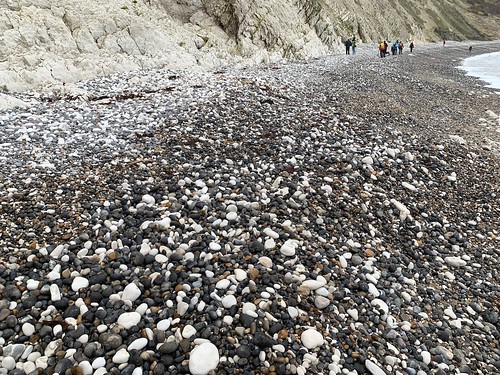
We also walked a little ways around Lulworth Cove before the ascent, and the beach was pleasingly replete with roundy rocks in three colours - white, black and rusty red.

The main reason I wanted to do this particular walk was because it promised to include a visit to the abandoned village of Tyneham. Tyneham was inhabited by 225 people when, in 1943, the government ordered all the residents to leave so that it could expand the nearby tank firing range in preparation for D-Day. With just a month’s notice, all the villagers were required pack up and vacate, though they were promised they could return when the war was won. Poignantly, one resident left a note pinned to the door of the village church.
 “Please treat the church and houses with care. We have given up our homes where many of us have lived for generations, to help win the war to keep men free. We will return one day and thank you for treating the village kindly.”
Despite the government’s promise, the looming Cold War led the government to acquire the village by compulsory purchase and it remains part of the military range that dominates the area. The village's families were never allowed to return.

IMG_2735
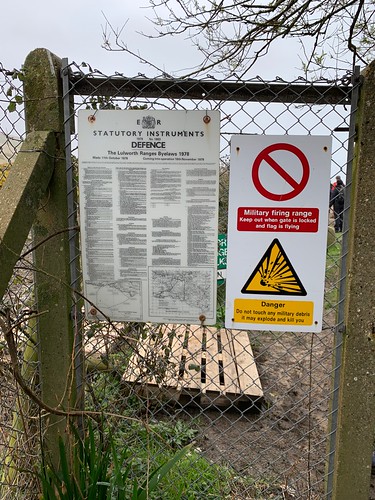
The range is still in use and access is understandably restricted when they’re lobbing live shells around. Happily, that’s one of the things that people who organise group excursions tend to verify in advance.

2020-03-07 12.31.12 (1)x

One hopes this particular tank is a target and not on active duty.

Even though we'd made it as far as the firing range, it would still be a long way and a few more big hills before we reached the village. And because the walk was along the south coast, it was a trifle exposed and the wind coming off the water was occasionally irksome, there being nothing between us and France to break its stride. Normally when I go out rambling I like to make sure there’s a convivial pub on the way which one could expect to stumble into around lunchtime for a fortifying pint and a hot meal. Indeed my favoured source for walking routes (the Saturday Walkers Club), that I have mentioned before, make a point of routing past pubs at approximately the midway point of a walk. Sadly that’s not how the Outdooraholics roll, which, again, is one of the perils of a group experience.

2020-03-07 12.45.22 (1)
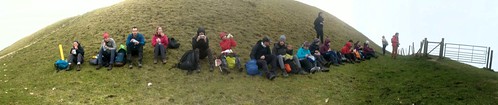
Instead we huddled against a small hill trying to shelter from the wind and sharing out Tesco flapjacks. I’ve been trying to find a lovely half-remembered quote from Bill Bryson about the English and their love of blustery tea breaks on the side of a hill, so I might just have to nip off quickly to re-read “Notes from a Small Island” and get back to you. Until then you should all go read this because it’s fantastic.

IMG_2749
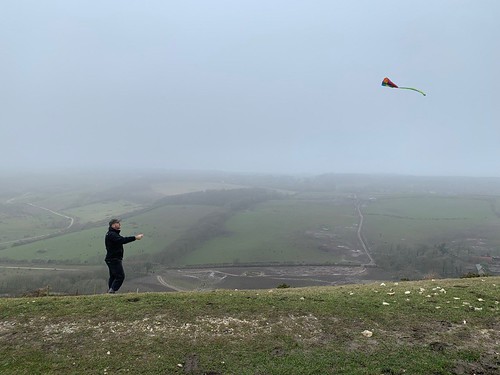
And to demonstrate he’s generally more prepared and hardier than I am, Piran braved the unsheltered side for a bit of lunchtime recreation, also ably demonstrating the wind speed.

Finally, after a few more hills and few of our number dropping out due to exhaustion or chilblains or altitude sickness or something like that, we at last made it to Tyneham Village. Other than the remains of the stone buildings that are the heart of the village, there was a barn that’s been fixed up, a long section of fresh drystone wall, and several larger buildings further afield. It was a place I could have spent a very happy hour or more. For the Outdooraholics it was a place for a quick toilet stop and what felt like a five minute pause. And that’s when the whole group activity thing really fell apart for me and I had a bit of a melt-down. Having emerged from the church building to see the rest of the group disappearing up the road while I was just getting started, I was at a bit of a loss and determined not to shortchange myself so dramatically. One of the hike leaders, Lee, even came all the way back to chivvy us along, but luckily Piran was able to convince him that we’d be able to make our own way back to the hostel without guidance, well-equipped as we were with Ordnance Survey maps and common sense. Mollified, Lee trotted off to catch up with the group and we were free to explore.

IMG_2762
This lovely little building was a seed store, propped up on specially shaped mushroom-like legs to prevent rodents from getting at the seeds.

IMG_2764
And this gent was literally building a dry stone wall! The Tyneham site is used as a testing ground for the Dry Stone Walling Association. I’d have loved to have had the time and gumption to talk with this guy. (Also, I love the mere existence of the Dry Stone Walling Association.)

The heart of the village was Post Office Row - a string of attached stone and brick buildings that, unsurprisingly, once included the Post Office. (Also, I really should have issued a formal Comic Sans Warning ahead of that last link, because the website it leads to has made a very odd typographical choice, especially given the subject matter.)

IMG_2765
The public used to be able to wander around in houses of Post Office Row, but they’ve now been deemed too dangerous.

IMG_2783
It is still possible to go into the church, which is filled with displays and remembrances from people who lived in the village. I didn’t have a lot of time there, but I recall they ran heavily to tales of the congregation's joy upon the installation of a heating stove in the church and heart-warming stories of small boys earning tuppence to pump the pedals on the pipe organ.

IMG_2776
The schoolhouse is probably the most interesting and well-presented building in the village, set up as it may have been before the residents left.

IMG_2773
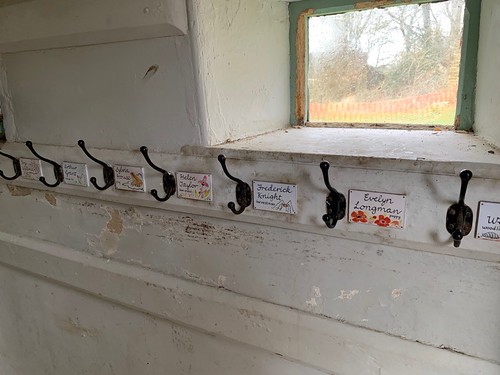
Young Fredrick Knight (third hook from the right) was apparently an ancestor of an employee of half of the couple who lived in the house where we spent our very agreeable Friday night.

Even though we knew the way back and had successfully extricated ourselves from the group, I still felt like we should be hurrying on to try to catch up, though there was no practical reason for this urge. Nonetheless, we headed off up the road about half an hour behind the crowd to revisit some of the favourite ascents from the walk there. I’d been expecting that the path back would follow a different, more inland route, because it didn’t make sense to retrace our steps when there might be new things to see, fewer dispiriting hills, and less Gallic blusteriness to endure. Sadly, the area covered by the military firing range is extensive enough that we’d have had to detour for many miles for that, so it was back to the high chalk cliffs and what seemed like and endless slog in a very steady gale. Cleverly, a few others of the group actually managed to blag a ride from Tyneham back to the hostel from a complete stranger in the visitor’s car park. Well played, ladies. I'd take my hat off to you if it hadn't been blown to Poole and beyond.

2020-03-07 15.20.16 (2)
I think the slope of my shoulders and the colour of the sky in this photo are two good indications of my mood by this point.

We did eventually catch up with the straggling end of the group a few minutes before we reached the hostel. The day's walk had been about 20km, and the wind had been that unrelenting energy-sapping type that meant by the time we reached the hostel I was simultaneously chilled and sweaty and also quite muddy and comprehensively knackered. Naturally, the hot water system in the hostel was incapable of coping with the arrival of 30 people all in need of a shower so I think I just laid on my upper bunk in a bit of a daze for a while. The tour did include cream tea with (shop-bought) scones though, and it was nice to tuck into those and have a hot cuppa later. And eventually there was an easy amble to a pub in Lulworth Village for a swift half, and then there was finally enough hot water for a shower and then there was supper and an evening pouring over the OS map making plans for the next day. Sunday had a few high highs and few low lows, but your coffee is probably either cold or gone by now, and I’m over my self-imposed 2,000 word limit, so let’s save those tales for another blog.

IMG_2792
Many muddy boots on Saturday evening

The Chelsea Pensioners

Sunday, March 22, 2020

Public Service Announcement: We here at Go Stay Work Play Live World Headquarters (A.K.A. GSWPLWHQ) understand these are trying times and our absolute priority is to ensure the health and safety of Astute Go Stay Work Play Live Readers. To that end we are committed to continuing to deliver hastily-researched blog posts about whatever might have been happening before the End of Days arrived, or whatever happens after, or whatever random bullshit happens to cross our minds. We're certain that ten minutes of distraction delivered on our usual intermittent and unpredictable schedule will help while away the hours while you contemplate what's next on Netflix and which of your loved ones will be the first on the BBQ when the ramen noodles run out. And now, on with the blog.


**********

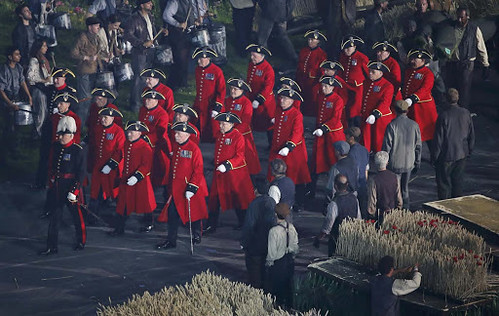
There are few things more certain to stir a positive and patriotic response in the average Brit than the sight of a scarlet-clad Chelsea Pensioner. They are an unassailable icon.

OC Chelsea Pensioners
A group of Chelsea Pensioners parading in the Opening Ceremony of the 
London 2012 Olympics. Remember that?

For overseas or under-informed Astute Go Stay Work Play Live Readers, the Chelsea Pensioners are residents of the Royal Hospital Chelsea, a retirement and nursing home for former members of the British Army located in Chelsea, London. The Royal Hospital was established in 1682 by Charles II as a home for army veterans. Until that time no official provisions were made to support old or injured soldiers and Charles was said to have remarked, "Those who have served the king, the king shall then serve them". Quite right. (And don't bother questioning the source of that quote because I heard it from the lips of King Charles himself. Sort of. See below.)

Designed by Sir Christopher Wren, the hospital buildings are part of an impressive 66 acre Thames-side estate surrounded by high walls and iron gates. When it was built most people would have arrived by river, so what we think of now as the front - facing Royal Hospital Road - is really the back. The site is probably best remembered as the location of the famous Chelsea Flower Show but it’s not generally known that the grounds are normally open to the public during the day (including a post office and café) and tours of the grander buildings are also available. Recently the Royal Hospital also started offering evening “candlelit tours” as another way of showing off the place. Having seen these tours advertised, I quickly snapped up some tickets and planned a visit with the always-willing Piran and the visiting Canadian Don for a peek into the life of the famous pensioners.

(Hastily inserted note from GSWPLWHQ: Obviously there are no tours or public access during the Zombie Apocalypse, but I wrote this post back when you could still move around on the street and even go to the pub. Ah, the good old days, last Wednesday. To be known by history as "The Infectious Old Days".)

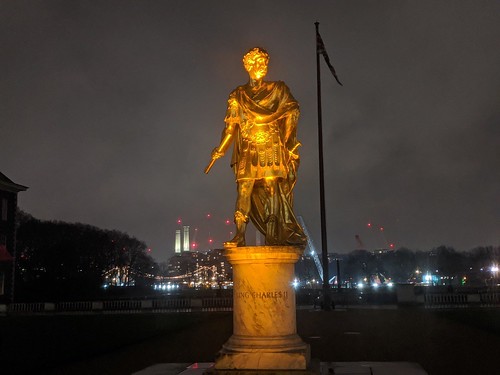
2020-03-04 19.25.31
Statue of Charles II in the style of a Roman general, in the central courtyard. Designed by the famous (and excellently named) sculptor and wood carver Grinling Gibbons.

Part of what’s interesting about the Royal Hospital buildings are that they’re still being used today for the very same purpose for which they were constructed more than 300 years ago, barring a few renovations along the way. The first residents were admitted in 1692 and are still technically known as in-pensioners to distinguish them from out-pensioners who received financial assistance but didn’t live on site. The hospital is currently home to about 300 men and women. (Of course men have been eligible for residency since the hospital’s founding; the first women arrived in 2009). To be eligible to join the ranks of the Chelsea Pensioners an applicant must be a former soldier or non-commissioned officer of the British Army who served for at least twelve years, be at least 65 years old, and be in receipt of an Army or disablement pension. They also have to be healthy enough to live independently in the famous “long wards” (more on them later) and be free of financial obligations to support a spouse or other family. If accepted they surrender their army pension (which is used to fund their stay) though they do retain their state pension. Residents are also assured of later life care in a separate infirmary on site.

Our tour was on a rainy Wednesday evening and it was clear from the start that the Candlelit Tours are new, and they’re still working out the kinks. The Royal Hospital’s grounds are extensive, so finding the entrance gate was a bit of a schlep (did I mention it was raining?). Being directed to a different gate a long-ish walk away was disheartening. And then being sent back to the gate where we’d started was, well, let’s just say there may have been some strong language employed by your humble blogger. When  we finally found the right spot we were greeted by a Chelsea Pensioner named Peter, wearing his scarlet coat and carrying a handheld lantern equipped with a rather dim LED candle. I suppose that’s the “candlelit” part. (Note to RHC: I can help you with that. Internally lit handheld props are genuinely one of my core competencies. Call me.)

IMG_2672
Peter and his lantern and his smart scarlet coat. He’s wearing a less formal hat here called a shako (“shake-oh”) instead of the traditional tricorne. The pensioners normally wear a more casual dark blue uniform and shako around the hospital and local neighbourhood for day-to-day activities, reserving the scarlet and tricorne for trips further afield and special occasions.

Peter was lovely and informative, leading us through the grounds and into the state apartments for our first stop where we were greeted by... *heavy sigh*… an actor portraying King Charles II. I’ve said it before, but I truly hate this trend of presenting costumed live action characters from the past to spice up a tour. I suppose it’s nice for the actors who get the role - good steady work - but I just find it cringe-y. Usually these sort of encounters are relatively short but King Charles had a lot to tell us that night, including a large measure of Civil War and Restoration history, and it seemed to go on forever.

2020-03-04 19.13.24
“King Charles II”. With all due respect Your Majesty, please move it along a bit.

Eventually we were released to make our way to the chapel, which sits opposite the Great Hall in the centre of the complex. It being dinner time we didn’t get to see inside the Great Hall, where the residents take all their meals, but which I imagine its pretty much the same as the Great Hall from Hogwarts but with more Ovaltine and false teeth. En route to the Chapel we passed the Birkenhead Memorial, a little-known tribute to the men of H.M.S. Birkenhead, which broke up off the coast of South Africa in 1852. You’ve probably never heard of the Birkenhead, but you know its legacy. After the ship foundered on the rocks, “there were not enough serviceable lifeboats for all the passengers, and the soldiers famously stood firm on board, thereby allowing the women and children to board the boats safely and escape the sinking… The soldiers' chivalry gave rise to the unofficial 'women and children first' protocol when abandoning ship…” (Wikipedia. Obvs.) This practise is also known as the "Birkenhead drill”, and came to describe courage in face of hopeless circumstances.

IMG_2676
Approaching the Great Hall (on the left) and the Chapel (on the right)

The Chapel is undeniably impressive, designed by Sir Christopher Wren and featuring a vaulted roof and a very accomplished mural that was apparently painted freehand inside the concave surface of the quarter dome at the end of the room. Demoralisingly, the chapel portion of the tour was conducted by a living representation of Christopher Wren himself, who was even more loquacious than King Charles and somewhat frenetic, with the added indignity that he stumbled over his lines a bit and passed on some very dodgy information about the engineering properties of the arched roof that had me screaming silently. Nonetheless the room is lovely and eventually Christopher Wren stopped talking.

IMG_2681
The Chapel. Perhaps better viewed in daylight when the large windows could show off the woodwork better. (Woodwork that was carved by the aforementioned Grinling Gibbons!)

Things picked up when we left the chapel and moved on to the area where they’ve preserved two of the original rooms where the pensioners would have lived when the building was new. Called berths, each man was assigned a 6’ x 6’ space with walls reaching only partway up, arranged in rows on a long corridor in the main hospital building. Called the long wards, each man’s berth held just a small single bed, table, and chair, with a shutter opening onto the communal corridor. Even the famous red coats had to be hung on pegs outside the door. Eventually the berths were expanded to 9’ x 9’ but much of the space on the long wards has always been devoted to the corridor outside the berths, equipped with comfortable chairs, tables and tea-making facilities. The small size of the berths and the congenially appointed corridors means that the residents are encouraged to move around and socialise more.

2020-03-04 19.57.04
Carl, another pensioner, with Peter, in one of the small “heritage berths" on display in the museum area of the Hospital. Carl is wearing the everyday “blues” uniform.

The berths are the heart of the Royal Hospital and the life of the pensioners, but until recently their spartan nature meant that 36 elderly residents shared one communal bathroom at the end of each corridor. Because of this, the long wards underwent an extensive renovation, completed in 2016, that provided pensioners with enlarged bedrooms including generous windows, en suite facilities, and a separate small study. The architects cleverly maintained the wide social corridor and left the walls to the outer study lower to maintain the connection to the shared space.

social-corridor-reinstated-to-full-width-west-wing
The long wards after the renovation, with Wren's original oak panelling carefully preserved. Note the scarlets still hanging outside the doors. Old habits, I guess. The total number of berths on existing long wards was reduced in the renovation, but more were created in a separate building.

We didn’t actually tour the wards of course (that photo is from the interwebs) but at the end of the evening we were invited to the residents’ private lounge for a glass of wine and a natter with Peter and Carl, and that was genuinely the best part of the visit. Talking with real Chelsea Pensioners we got a true sense of what their life is like. “Happy as a pig in muck” was the quote I wrote down, and I can understand why. The place is comfortable, the meals are apparently so lavish that it’s hard to maintain a fighting man’s physique, and they get Sky Sports for £10 a month.

IMG_2686
Nice library, big tv, comfy couches. What more could you want on a rainy evening?

As I mentioned, the Chelsea Pensioners are universally revered, and Peter and Carl confirmed that when they’re at the pub in their scarlet coats they never have to buy their own drinks. This can, however, lead to abuses of the system. Being a Chelsea Pensioner is not a life appointment for some. For instance, we learned of one who’d been chucked out for charging tourists £5 each for selfies with him, though I’m sure that’s a very rare situation. For the most part the Chelsea Pensioners play by the rules and enjoy their lives. They also pursue their own hobbies and are very active in the wider community. Every week there’s a bulletin of events requesting their attendance and each resident is expected to volunteer for an appropriate number of appearances. And being ex-military, they’re also used to being volunteered when circumstances require it. Though there’s certainly never any difficulty filling the seven seats they’re given for every home fixture of the Chelsea Football Club, with whom the Pensioners have a longstanding association. Chelsea Pensioners are also seen at Twickenham and Wimbeldon and make appearances at Parliament and Downing Street. It’s a far cry from the 17th century, when they were required to patrol the King’s Road with pikes as a public service.

Once we’d had a glass of wine, dried out, warmed up, and quizzed Peter and Carl about their lives, all that was left was to forget to take our own selfies with them and head back out into the rain. Tragically, it was bizarrely difficult to find a pub that was still serving food by the time we left, so we had to content ourselves with a warm seat by the fire at The Antelope where we attempted to keep body and soul together sharing out a single scotch egg I had in my bag, supplemented with six bags of Mini Cheddars and several pints. We probably should have just brought Carl and Peter with us. I bet nobody tells a Chelsea Pensioner that the kitchen is closed!

Birmingham Day Three: The Coffin Works

Sunday, March 8, 2020

Birmingham truly just kept on giving. After the Back to Backs and the Cadbury Factory and the Balti there were still a couple of sights to squeeze in before hopping the train back to London. Birmingham has no shortage of industrial history and now has many small museums dedicated to the various trades that once thrived in the city. For instance very near my AirBnb was the Pen Museum where I got to cut and stamp my own pen nib and learned that there was a time when “three-quarters of everything written in the world was written with a Birmingham pen.” Impressive indeed.

IMG_2247
Bins of pen nibs in the Pen Museum

The Pen Museum probably deserves greater mention, being a lovely, small, volunteer-run sort of outfit that falls into the Plucky Off Beat category and deserves love and support. However, the quirkiness award in Birmingham must surely go to the Coffin Works Museum, the preserved premises of Newman Brothers. From 1894 to 1999, Newman Brothers specialised in the manufacture of brass fittings for coffins - the handles, breastplates, crucifixes, and other ornaments known collectively as coffin furniture. (Similarly, here in the UK the hinges and handles and other bits for doors are called “door furniture” as opposed to “door hardware” in North America. I use the term frequently at work but still find that hard to get used to and often find myself picturing happy families of doors pouring over catalogues of door couches and door ottomans and door dining room tables and such.) Newman Brothers was (and in some ways still is) renowned as one of the finest coffin furniture makers in the world, having supplied the funerals of Winston Churchill, Joseph Chamberlain and many members of the Royal Family, including George V, George VI, the Queen Mother, Princess Margaret, and Diana, Princess of Wales.

Astute Go Stay Work Play Live readers will perhaps have noted that I said the company ceased trading in 1999, whereas the Queen Mum downed her last G&T in March of 2002. Such is the reputation of Newman Brothers coffin furniture that the inventory still in existence (and there is a lot of it) is kept in storage for the right clients. It’s entirely likely that sets of Newman Brothers coffin furniture are currently put aside for still-breathing members of the royal family, ensuring there’s no chance a British Royal coffin will be forced to employ grubby foreign hardware.

IMG_2201
The Coffin Works location on Fleet Street.

The Newman brothers Alfred and Edwin (and one sincerely hopes Alfred’s middle name started with an E) started trading in 1882 as a foundry for brass goods of all kinds at a site in the Eastside area of Birmingham. By 1894 they moved to the location where I found them, at Fleet Street in the Jewellery Quarter very near the canal. At that time they started trading specifically in coffin furniture and also branched out into soft goods - shrouds, robes and coffin liners. Remarkably, the business remained in Newman-run hands until 1952. There followed a period when the business was run by a small group of shareholders, but the most notable part of the company’s management history may be when it was taken over by Joyce Green in 1989. Miss Green started at Newman Brothers as an office secretary in 1949, worked her way up in the company, and finally became the sole owner in 1989. She remained in charge until the vagaries of the global coffin furniture industry finally forced them to close the doors in 1999. By that time Miss Greene not only owned the company outright but also the freehold. (For non-UK readers I really don’t have the energy to get into the whole leasehold/freehold thing. You’ll have to figure it out for yourself. And when you do, please explain it to me.)

However, Miss Green’s involvement with Newman Brothers did not end when the company dissolved. She campaigned to have the building and contents preserved as a museum and by 2000 the factory was given Grade II* listed status. Funding dramas delayed works but major resotration work eventually took place between 2013 and 2014 and the museum opened to the public in October of 2014. The only access to the factory is by pre-booked guided tours, so I was careful to book ahead and presented myself smartly at the appointed hour in the Coffin Works gift shop, where I was presented with an old fashioned timecard and instructed to punch in on the original factory time clock.

IMG_2204
One of the other participants punching in.

The tour was led by a very enthusiastic volunteer who started us out in the courtyard of the building. Newman Brothers coffin furniture was made by two different methods - casting and stamping - which are exactly what they sound like. Casting involved creating the moulds, pouring the cast pieces, tumbling them to remove the sharp egdes, and then polishing them. And here I have to admit that it’s been more than a month since I was in Birmingham and I’ve got an intriguing note from the day that says, “Blacking shop. Green hair” that I don’t really remember anything about. I think it was something to do with the chemicals involved in one of the various nasty industrial processes turning the hair of the workers green. Yes. Let’s go with that. (I’ve also got a note that says "Coffin makers were garage lenders” which must be some kind of autocorrect situation.)

One thing I was careful to remember was about the barrelling shop. (Though not why it’s called the barrelling shop. Let’s say it was because that’s where they tumbled cast pieces in barrels to knock off the flashing). What I did write down properly was a note about how the spinning barrels in the barrelling shop - and the other large power tools in adjacent workshops - were driven by belts looped around a single central axle in the ceiling, which was powered by a gas engine (disappointingly not steam driven). This sort of belt drive system was once very common, allowing a single engine to power machines throughout a whole factory, even over multiple levels. At the beginning of a break or the end of shift rather than powering down the whole system, each tool operator was able to knock the belt for his machine off the drive pulley and onto a slave pulley to take the tool out of service, which is the origin of the phrase “knocking off”. And you’re welcome.

Handles for coffins were usually cast, but the lighter pieces like nameplates and decorative breastplates were stamped from thinner metal. To do that the original design had to be drawn onto a solid block of metal - in mirror image - and then chiselled and sanded by hand into the desired pattern, a process that could take weeks or even months for skilled workers.

IMG_2213
Some of these stamps are a foot across, so you can see why it would take a while.

Once the design was finished it still needed a mating piece called a “force” for the stamping action to work. The force was cast inside the concave stamp and then with the stamp set carefully under the hammer and the force mounted onto the hammer above, a thin piece of metal could be pressed between the two, creating the finished design. The biggest hammer in the restored stamping room at Newman Brothers was a mighty 30 tons, though it’s no longer operational. The current workshop has a single hammer they still operate for demonstration purposes, which of course requires a lot of prep time, health and safety gear, and imprecations to stand well clear. When the factory was in operation , hammers would strike every two seconds.

IMG_2209
They also ran benchtop presses like this one for small pieces. Called a fly press, they were often operated by women because they’re usually shorter and hence less likely to get whacked in the head by the action of the rotating arm and counterweight swinging around at the top of the machine. (I suspect given the size of the iron ball at the end of the arm that this was a mistake you’d only make once. Though I’d like to think that if they took you out of Newman Brothers in a box, at least it would be one with very handsome handles.)

Workers at Newman Brothers were paid on a piecework basis with no pension or holiday pay, and they worked six and a half days a week. However, Newman Brothers was a surprisingly enlightened employer in some ways and many of their workers were extremely loyal. Miss Green was not the only employee with an exceeding fondness for the company. Long-time employees could expect a generous lunch party on their retirement, usually held on the premises in the large first floor Assembly Room. Instead of a gold watch, the honouree was encouraged to choose their own retirement gift meaning that many were able to upgrade their living conditions with a new fridge, cooker or carpet. A surprisingly sensible approach, I think. And of course each retiring employee was given their own personal gown and set of coffin handles for future use.

IMG_2240
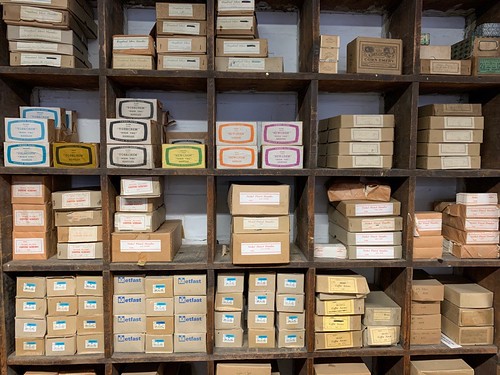
The Assembly Room, where most of the stock was kept.

IMG_2222
These boxes have been left stacked as they were when the company closed. 
Each one is still full.

There was also a tea trolley for elevenses, and they played the radio for workers in the shops, an uncommon practise at the time. They even had big Christmas parties on site and a 100th birthday celebration for a particularly loved employee - Miss Dolly. Dolly Dunsby started at Newman Brothers in 1915 at just 14 years old and stayed until her retirement in 1975. Such was the loyalty of Newman Brothers employees that even after the company closed shop in 1999, some of the machine operators would still visit the factory every Friday to oil the machinery and take care of the place.

IMG_2237
We also got a look at the second floor sewing room, where they made gowns, shrouds and coffin liners. This part of the operation was shut down during the war years so that the cloth could be diverted to the war effort. It didn’t start up again until the end of rationing.
IMG_2236
The tea station in the sewing room, complete with a list of how each machinist took her tea.

Though the sewing room branch of the business was never profitable, Newman Brothers maintained it in order to provide a complete service to funeral homes, thus ensuring that the local funeral directors wouldn’t end up taking their trade elsewhere. They were also leaders in other crafty sales techniques. For instance, they were some of the first to create catalogues of their wares with removable pages so they could be updated easily and quickly. And they didn’t print the prices on the catalogue pages - a practice I hate, while still acknowledging its practicality.

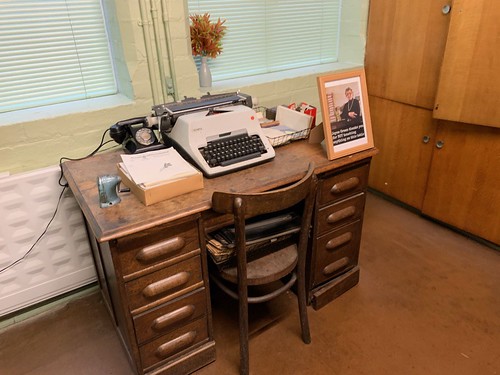
The museum website talks some about the restoration of the building and says they elected to recreate the factory in the 1960’s style largely because the company never updated its furniture and fittings beyond that era. This was in evidence in the company office, where Miss Green’s desk is preserved and a Gestetner copier sits idle on a nearby table.

IMG_2227
Miss Green's desk.

A computer may never have darkened the door of Newman Brothers, but they apparently had the first telephone answering machine in Birmingham. This makes sense, as the funeral business is one that happens at any hour. It was common for funeral directors to call up overnight ordering coffin furniture and for the staff at Newman Brothers to package it in the morning and dispatch it on the city bus that stopped outside the office on Fleet Street.

The tour of the Coffin Works was really excellent, partly because the topic is interesting and the building is well presented, but largely because our guide was so enthusiastic. He’d been part of the team involved in the original purchase of the building from Joyce Green and had stories about visiting the factory to meet with her about the project, most of which seemed to involve the generously stocked drinks cabinet in the office. The tour was schedule to last 90 minutes but stretched well over two hours simply because our guide was so effusive. On contemplating a tour of a factory that dealt so intimately with death you’d expect it would be a somber and morbid experience, but the Coffin Works was bright and happy and full of people who were glad to be there, myself included. So despite the cold and rainy weather outside, I left Newman Brothers with a spring in my step and generally contented with life, though most especially grateful that I've got a good umbrella.